Lifecycle email marketing has developed from a useful strategy to the foundation of successful online retail businesses. It offers the correct message to the right person at the right time in their customer journey, in contrast to typical email blasts that treat every subscriber the same.
With the right strategy, ecommerce companies that use comprehensive lifecycle emails report average first-year revenue growth of 45–60%; other high-performing brands report even more dramatic returns. These aren’t numbers pulled out of thin air. We actually have case studies with results that directly prove the efficiency of this strategy. One of them is our report on collaborating with Lulalu.
In this article, we’ll explore every step of creating, refining, and expanding a lifecycle email marketing plan on a particular example that helped to deliver measurable results for our client. This will give you a better understanding of how professional marketers implement lifecycle marketing methods in practice.
What Is Lifecycle Email Marketing?
In general, lifecycle email marketing is a customer-focused strategy that modifies campaigns according to each customer’s stage of interaction with your company. Lifecycle marketing employs automation, timing, and personalization to deliver highly relevant material rather than sending generic, one-size-fits-all blasts.
By offering meaningful experiences that promote client happiness and loyalty, the objective is to create enduring relationships. You can boost client lifetime value, foster trust, and convert customers into brand ambassadors by tailoring your marketing to each stage of the customer experience.
The sequence of events that your consumers go through, from learning about your brand for the first time to making a purchase and all points in between, is known as the customer lifecycle.
The customer lifecycle’s phases are commonly referred to as:
- Acquisition
- Consideration
- Conversion
- Retention
- Re-engagement
Why Lifecycle Email Marketing Matters for Long-Term Customer Engagement
Every client is unique, and their emails ought to reflect this. Messages feel more relevant, personable, and helpful when they take into account what people are doing and what they need next. This is the reason lifecycle email marketing works so well. It’s about presenting something that genuinely aids at the appropriate time.
And the outcomes are self-evident. Some reports claim that the average open rate, click rate, and conversion rate of automated emails are 42.1%, 5.4%, and 1.9%, respectively, far greater than those of non-automated campaigns. In actuality, one-third of those who click on an automated message go on to buy anything.
What is the takeaway? It won’t make a difference to send more emails. Better ones that are linked to behavior and lifecycle stage will be sent.
How to Implement Lifecycle Email Marketing Strategy: Lulalu Case Study
Now that we have explored the importance of this approach for fostering long-term engagement, let’s see what steps qualified marketers take to implement it. We’ll analyse it based on our case of working on the email marketing strategy for Lulalu, a women’s lingerie brand that targets ladies with bust sizes below normal.
Flowium was contacted by Lulalu in order to improve their email marketing campaigns.
They wanted to make sure they were optimizing their email marketing potential, improving their email capture approach, and boosting their income from email campaigns.
Flowium started by putting in place a custom lifecycle flow strategy after realizing there was room for significant improvement. This was followed by a variety of sophisticated flows that targeted particular client behaviors on their website.
Stage 1. Acquisition
Goal: Converting Visitors into Subscribers
The first stage focused on turning new website visitors into engaged subscribers. Key systems we implemented:
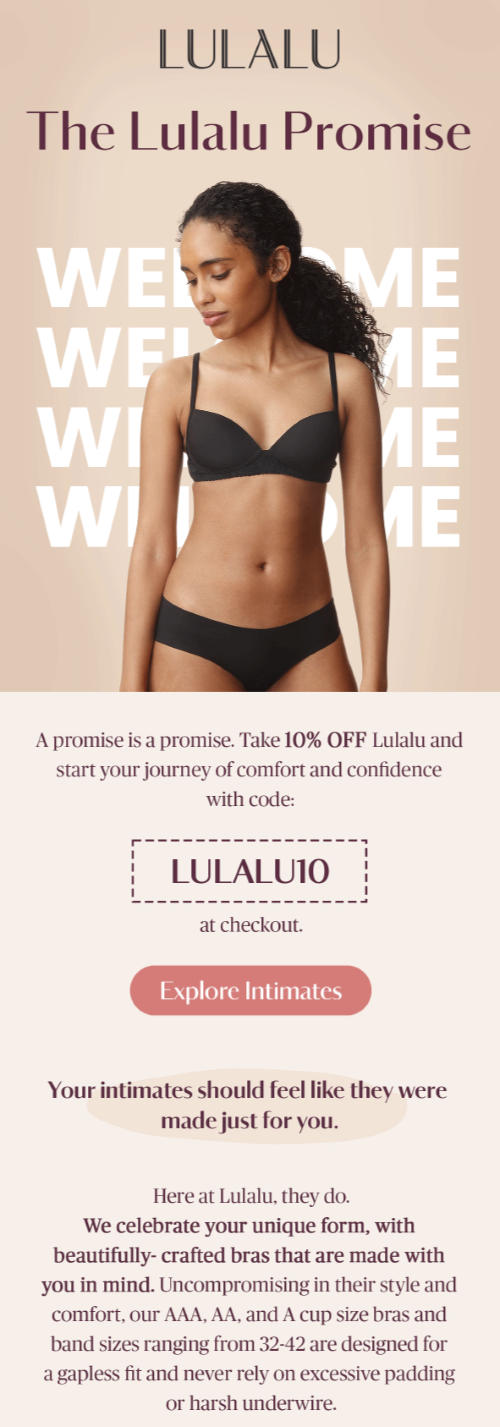
- Welcome flow
- Product-specific exit-intent flows
- Bra fitting quiz capture
The automated bra fitting quiz played a major role in improving acquisition quality. Customers completed the quiz to determine their ideal bra size and style, and their personalized results were delivered via email.
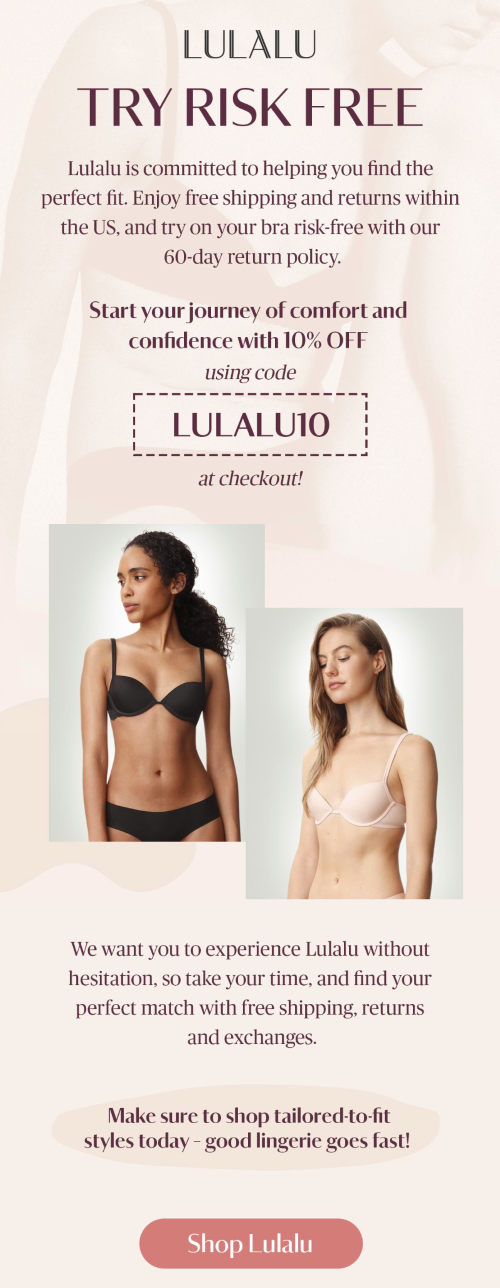

This approach achieved multiple goals:
- Increased email signups
- Delivered personalized product recommendations
- Reduced purchase hesitation
- Improved the accuracy of product selection
Result: By capturing customers earlier in their journey, Lulalu was able to begin nurturing relationships before the first purchase.
Stage 2. Consideration
Goal: Nurturing Interested Shoppers
At the consideration stage, the goal was to convert engaged visitors into buyers.
We implemented behavioral automations based on on-site activity and browsing behavior:
- Browse abandonment flows
- Product-specific follow-ups
- Segmentation based on browsing patterns
These emails reminded customers about products they had already shown interest in and delivered highly relevant recommendations.
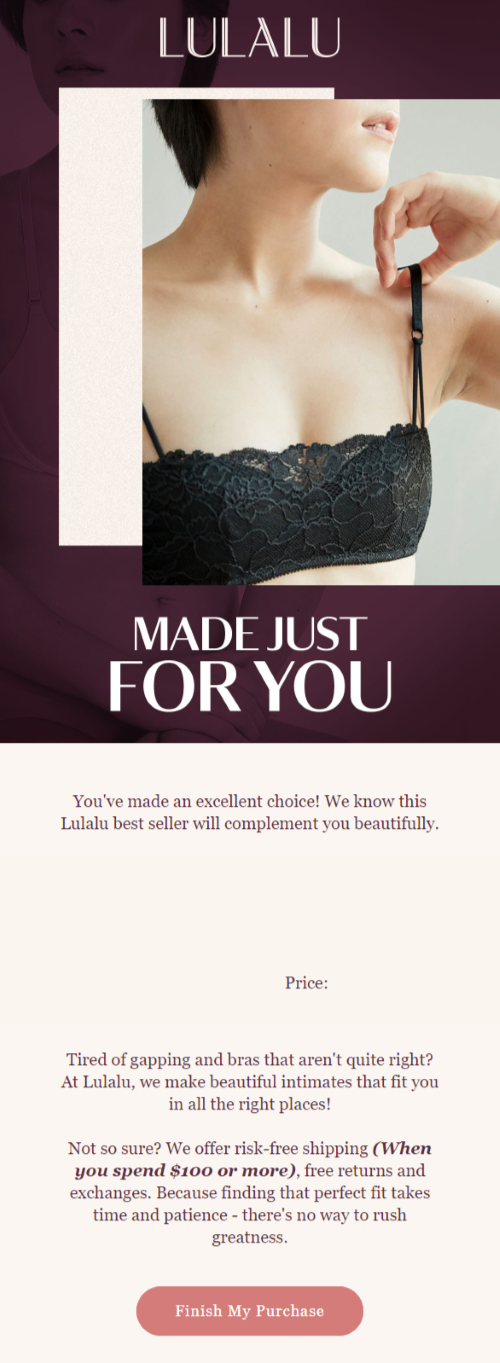
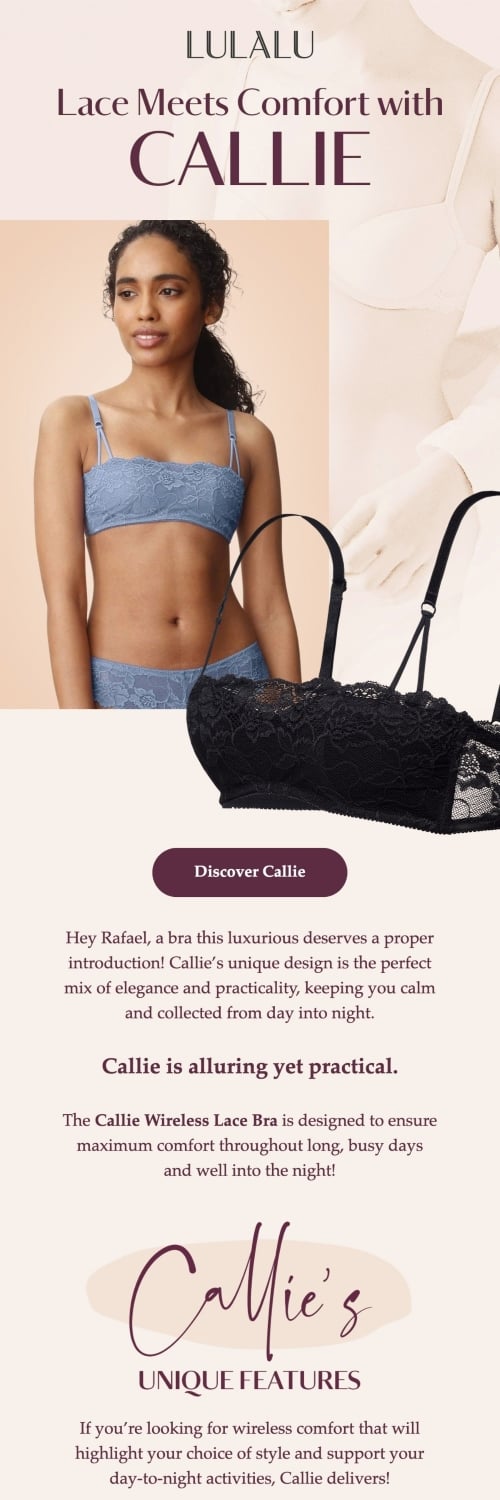
Results: Personalized messaging during this stage ensured that shoppers received the right product at the right moment in their decision process.
Stage 3. Conversion
Goal: Turning Interest into Purchases
To capture high-intent shoppers, we implemented several purchase-focused automations:
- Abandoned cart (add-to-cart) flows
- Product-specific exit intent flows
- Personalized product recommendations
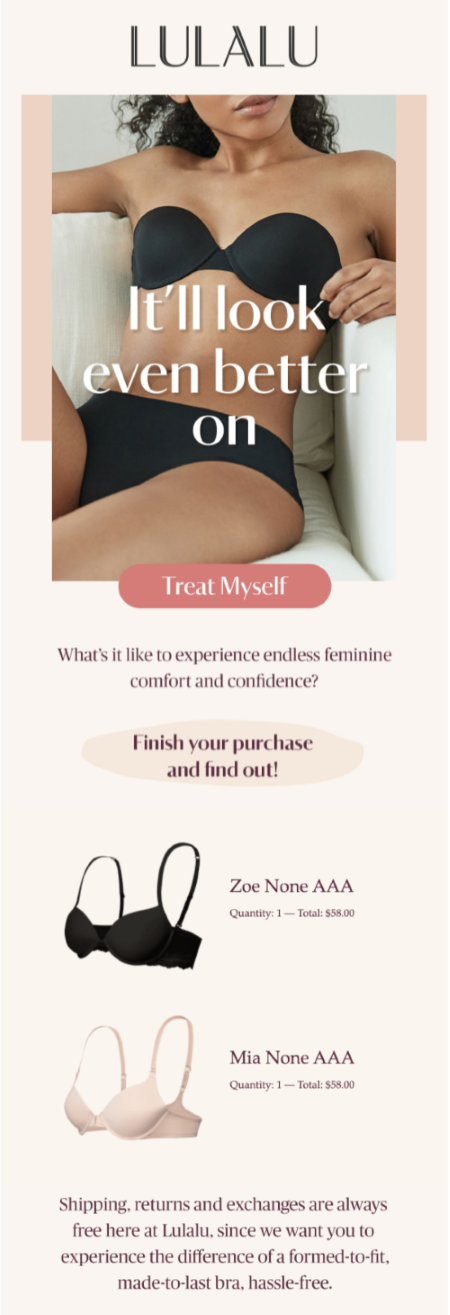
These automations targeted customers who had already shown strong buying intent but had not yet completed their purchase.
Results: By addressing common purchase barriers—such as sizing uncertainty and product comparisons—these flows significantly improved conversion rates.
Stage 4. Retention
Goal: Increasing Repeat Purchases
Once customers completed their first purchase, the focus shifted to maximizing lifetime value. Key retention systems included:
- Post-purchase flows
- Upsell and bounce-back automations
- Repeat buyer sequences
These flows introduced customers to complementary products and encouraged future purchases. Additionally, we launched loyalty and referral programs that aligned with Lulu’s community-driven brand identity.
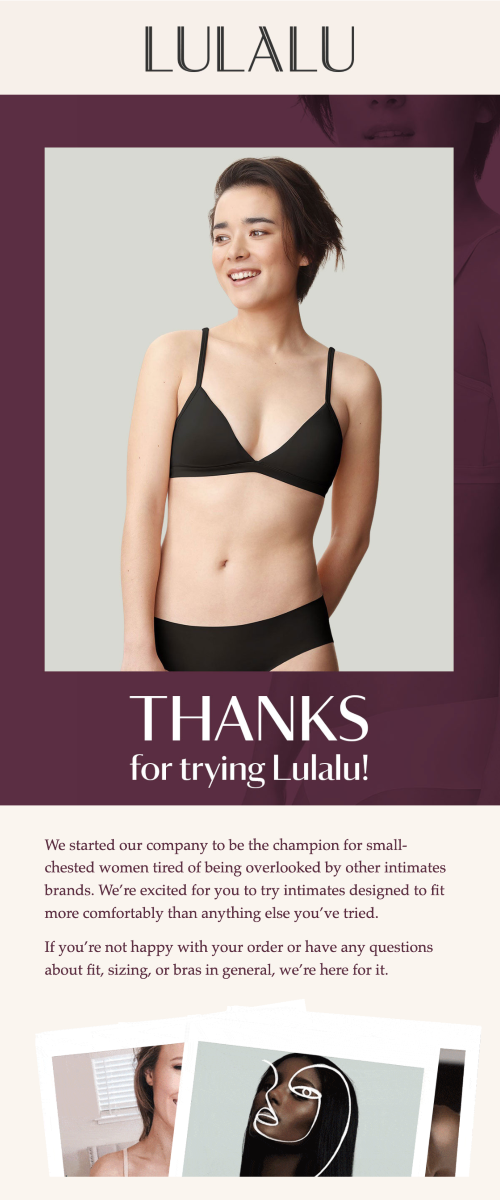
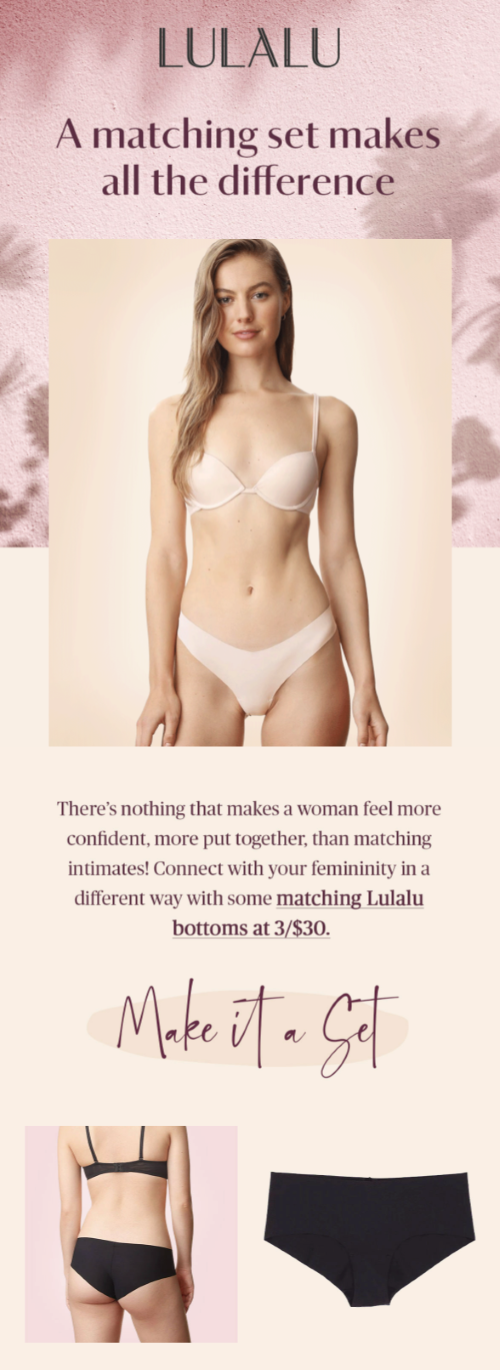
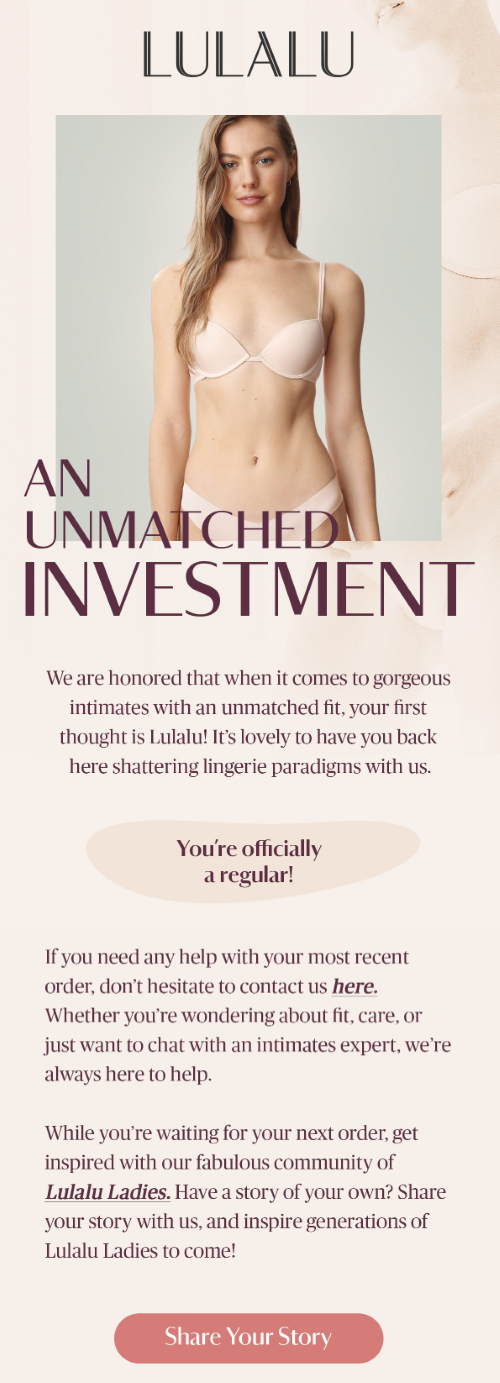
Results: Since the brand already had an engaged audience, referral incentives and loyalty rewards naturally encouraged repeat purchases and brand advocacy.
Stage 5. Re-Engagement
Goal: Bringing Customers Back
Customer inactivity is inevitable, but effective lifecycle marketing ensures these subscribers aren’t permanently lost.
We implemented several re-engagement strategies:
- Win-back campaigns
- Back-in-stock notifications
- Sunset flows
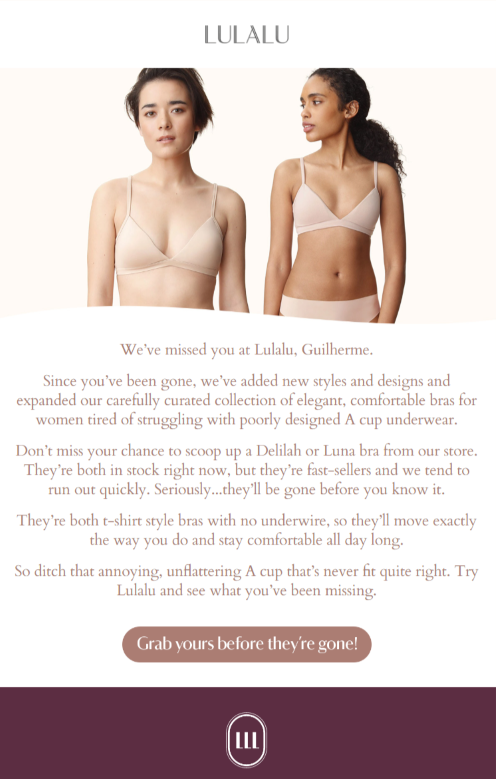
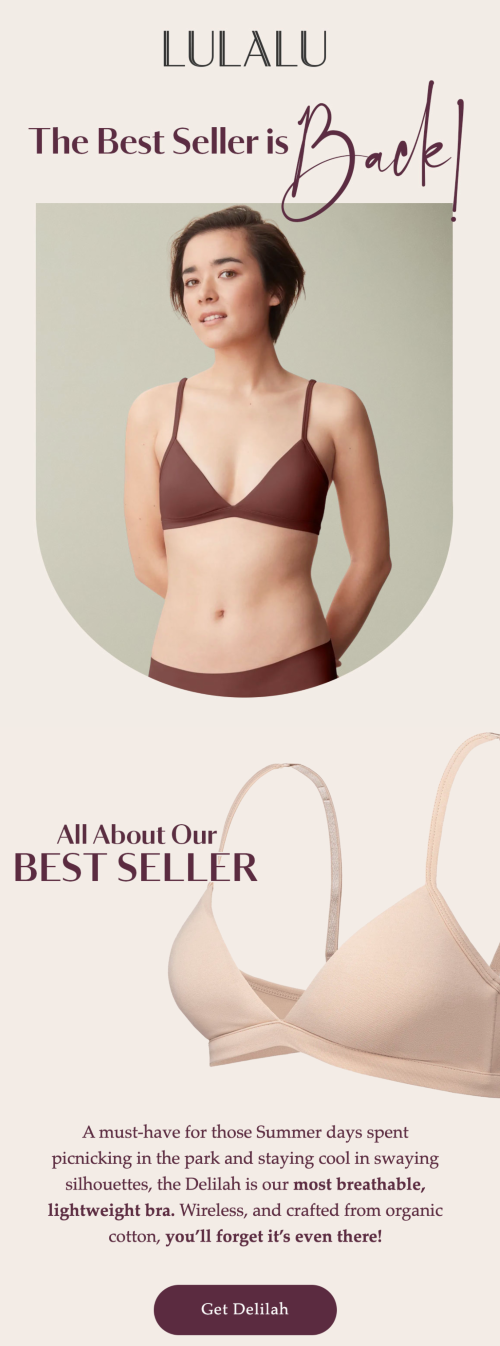
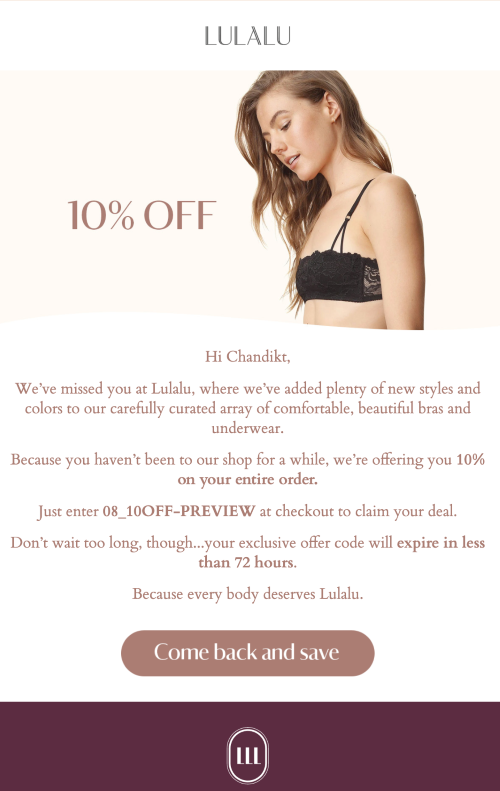
Results: Win-back campaigns reactivated dormant customers with targeted offers and product recommendations, while back-in-stock alerts captured renewed demand for popular products. These flows helped recover revenue that would otherwise have been lost.
How to Measure Lifecycle Email Campaign Results
Measuring lifecycle email performance requires more than tracking open rates. The most effective evaluation looks at how email contributes to revenue, engagement, retention, and audience growth across the customer journey. Here are the key metrics used to evaluate the lifecycle email strategy implemented for Lulalu.
Revenue Per Recipient
One of the most important lifecycle metrics is revenue per recipient, which measures how effectively each email subscriber generates revenue.
This metric reflects improvements in:
- targeting
- segmentation
- personalization
- lifecycle automation.
For Lulalu, optimizing lifecycle flows resulted in:
- 46% increase in revenue per recipient within the first four months.
This shows that improving the email ecosystem can significantly increase revenue without increasing advertising spend or traffic.
Campaign Engagement Metrics
Campaign engagement helps measure how well newsletters and promotional emails resonate with subscribers.
Key indicators include:
- click-through rate
- open rate
- engagement growth over time
Results from the lifecycle strategy for our client included:
- 62% increase in campaign click rate
- Open rate growth from 27.8% to 45.5% over 18 months
Higher engagement suggests stronger audience relevance and better segmentation.
Automation Performance
Lifecycle email systems rely heavily on automated flows triggered by customer behavior.
Important metrics include:
- flow open rate
- flow click rate
- number of recipients entering flows
After implementing a structured flow system, Lulu saw:
- 63% increase in flow click rate
- Open rate improvement from 30.6% to 42.7%
- Significant increase in flow recipients
This growth reflects improved behavioral targeting across stages such as browse abandonment, post-purchase, and win-back sequences.
Email-Attributed Revenue
One of the clearest indicators of lifecycle success is the amount of revenue attributed to email marketing platforms such as Klaviyo.
For Lulalu:
- Email-attributed revenue grew from $46,000 at the beginning of the engagement
- To $519,000 within 18 months
This demonstrates how a well-structured lifecycle strategy can transform email from a supporting marketing channel into a major revenue driver.
Subscriber Growth and List Health
Lifecycle strategies should also support sustainable audience growth and retention.
Metrics to monitor include:
- total subscriber count
- list growth rate
- subscriber engagement levels
During the implementation period:
The email list of our client grew from 9,000 to 15,500 subscribers within one year.
A growing list combined with higher engagement signals that acquisition strategies, such as quizzes and sign-up incentives, are attracting high-quality subscribers.
Benefits of Customer Lifecycle Email Marketing
From the results of our collaboration with the brand, we can outline numerous benefits of putting lifecycle-focused marketing into action. Compared to traditional efforts, companies that use lifecycle marketing usually achieve better retention and engagement outcomes. Among the main advantages are:
- Retention Growth
It increases user retention by sending timely reminders and helpful information. By addressing drop-off points before they become more serious, these emails help users stay engaged with your product experience and lower the risk of churn.
- Increased Engagement
Sending messages to your audience without any prior planning might rapidly result in email fatigue. Effectively crafting your email journeys is a terrific countermeasure that helps sustain engagement over time. You can simply avoid overwhelming your contacts while maintaining their focus on your offerings by using value-driven content and well-timed touchpoints.
- Accelerates Onboarding
Assists new users in getting off to a fast start so they can obtain value before falling off. An effective onboarding process guarantees that users comprehend how to use your product and creates momentum early on.
- Increases Conversions
Increases email conversion rates by using behavioral triggers to remind consumers when their intent is at its peak. These emails are more likely to convert since they arrive at the precise moment when a recipient is prepared to act, as opposed to sending out generic communications.
- Develops Loyalty
Through tailored content, relationships are gradually strengthened. Beyond merely transactions, lifecycle emails can help users feel recognized, supported, and appreciated by providing pertinent advice or commemorating a milestone.
- Facilitating Transition
You may expedite your recipients’ move to the next phase of their customer lifecycle funnel by having all activities, touchpoints, and challenges clearly visible.
- Decreased Cycles of Sales
Guiding customers through their customer journey makes it easier for them to make judgments about what to buy. Reduced sales cycles result from their smooth and uninterrupted progression through the stages.
- Boosts LTV (Lifetime Value)
Upsells, renewals, and reactivation messaging keep users interested over time. Long after the first conversion, lifecycle emails contribute to the growth of client lifetime value.
Lifecycle Email Marketing Best Practices We Used
It takes more than just solid copy to create a successful lifecycle strategy. Iteration, segmentation, and architecture are all involved.
- Establishing Stage-Specific Objectives
From acquisition to winback, establish quantifiable results for each stage. Whether it’s feature adoption, reactivation, or onboarding completion, understand what success looks like and craft your emails to support those objectives.
Determining a person’s stage at any given moment is the foundation of lifecycle email marketing. You should divide up your audience according to their behaviors, especially when it comes to lifecycle email marketing. Purchase history, website interactions, email engagement, and product usage are a few examples of this. The easiest way to position a person in the stages of their lifecycle is to look for patterns in these areas.
- Automation
Emails shouldn’t be sent when you have time to do so, but rather when a user acts (or doesn’t). To make sure your emails feel pertinent and responsive, use real-time triggers like sign-ups, feature usage, or drop-offs.
- Keeping the User’s Intent in Mind
If a user has abandoned their cart, explicitly address their reluctance. Give them a heartfelt celebration if they’ve accomplished a milestone. What the consumer is doing and what they need next should be reflected in your material.
- Testing Frequently
Performance can be affected by anything from send timings to topic lines. Test frequently and consider engagement, conversions, and lifecycle impact in addition to open rates.
- Keeping Channel Consistency
Make sure your messaging is consistent across SMS, email, push, and in-app. The experience seems unified rather than disjointed when users receive the same tone and guidance across channels.
- Monitoring and Measuring Success
To determine how well you are guiding people through the customer lifecycle, make sure you are monitoring your metrics at each stage of the process. Utilize these insights to hone your tactics and enhance your plan as a whole.
Conclusion
At first, developing a lifecycle marketing strategy could seem overwhelming, but keep in mind that the goal is progress rather than perfection. Start small by charting your client journey and determining the crucial phases where email automation can have the most influence.
Continue to optimize after that. The more you understand, the more adeptly you may modify your strategy to optimize client growth and retention.
Brands that cultivate connections, inspire trust, and foster enduring loyalty will own the future of ecommerce, not those that solely concentrate on acquisition.
Create your lifecycle marketing funnel now if you’re prepared to maximize the benefits of client lifecycle email marketing and spur business expansion. To turn your retention plan into a long-term ROI generator, contact us now to partner with professionals like Flowium.
FAQ
- What distinguishes promotional emails from lifecycle emails?
Lifecycle emails are generated by user actions and are automated. Usually sent in large quantities, promotional emails concentrate on temporary deals.
- How many emails should I send during the lifecycle?
No universal number exists. At least one email should be sent at each key stage of the lifecycle, and further communications should be triggered by user activity.
- Is it possible to utilize the same email content on many channels?
Core content can be repurposed, but each channel has its own limitations. Modify tone, length, and formatting as necessary.