According to popular belief, the main goal of email marketing is generating leads, but it’s also an effective practice to retain clients and re-engage inactive subscribers. When it comes to the latter, you can get in touch with the clients who stopped engaging with your brand by sending them strategic winback emails. The main goal here is getting them to become repeat clients. Of course, to execute this strategy properly and capitalize on the campaign, you need to know the best practices used by professional email marketers and experienced businesses. To help you with the task at hand, we prepared a comprehensive guide on how to create successful winback campaigns and the best examples for your inspiration.
Why Send Winback Emails
“Winback emails” are a series of messages designed to rekindle a customer’s interest. This sequence of messages is sent to customers who have lost contact and haven’t bought anything from you in a long time.
So, the primary purpose of customer winback emails is to persuade customers to return and resume using the service.
Naturally, there are several reasons why businesses opt for this type of re-engagement campaign. Here, you can see the common advantages of connecting with inactive subscribers through winback emails.
- According to Klaviyo, after receiving this type of email, about 45% of subscribers will open subsequent messages from your company.
- Research by MoEngage shows that winback email marketing can increase the likelihood of selling to current clients by 60–70%.
- Statistics by Revinate show that significant consumer re-engagement has resulted from winback initiatives that have attained open rates of up to 57% and click-through rates of 11%.
- Rejoiner states that since it’s frequently less expensive to re-engage lapsed customers than to find new ones, winback tactics can greatly improve customer retention.
Top Winback Email Examples and Strategies
To generate interest and re-engage clients, a lot of companies employ innovative email marketing strategies, such as gamification in emails, countdowns, personalized product suggestions, and appealing incentives. To give you a more accurate vision of how businesses use these tactics, let’s take a closer look at some customer winback email examples that brands choose due to their effectiveness and performance.
Friendly Reminder
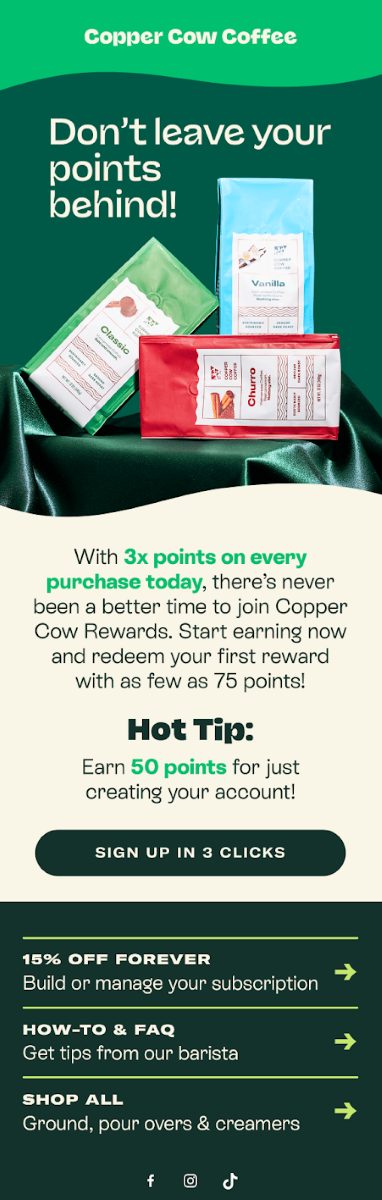
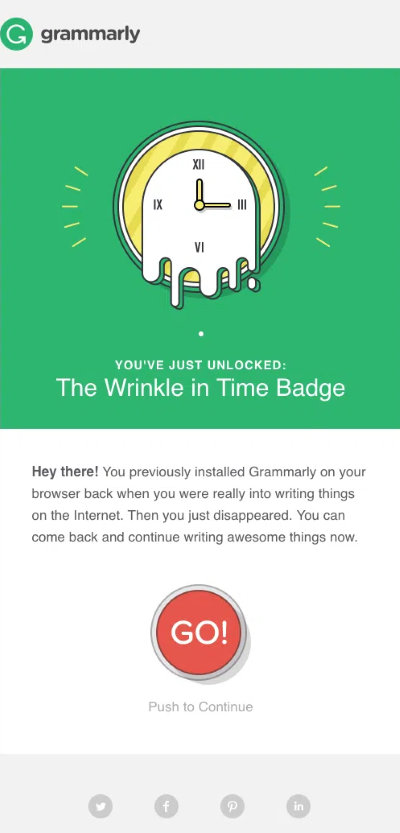
This winback email should be the first one in your sequence. It is a kind way to reconnect with inactive subscribers by reminding them about your offers and products. It usually contains news about the firm or product recommendations.
Winback Email Example: In the emails below, you can see how companies utilize this strategy to refresh their clients’ memory about themselves. You can simply remind them about their previous interactions with your brand, e.g. purchases, subscriptions, earned bonus points, etc.
Emotional “We Miss You” Email
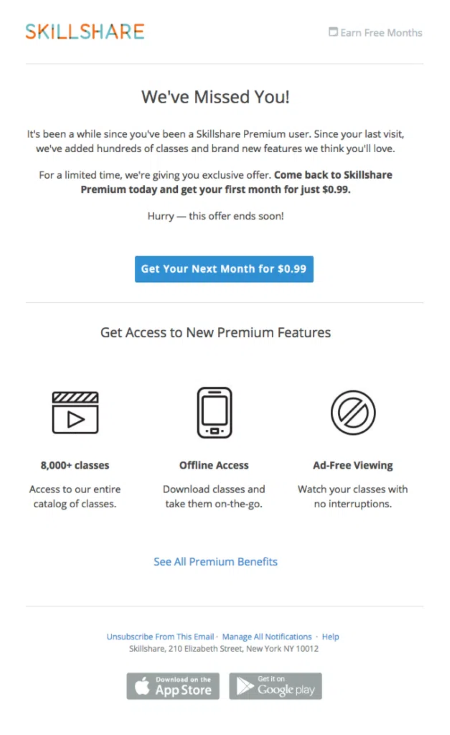
Adding emotional messages is a sure way to go about your winback campaign, especially if a client had spent some time with your brand but suddenly stopped engaging. A “miss-you” note is standard, but you can be even more creative in your email design and copy. Don’t be afraid of using emotional tone and visuals to revive the connection between your company and customers.
Winback Campaign Example: The most important thing about this email is personalization since it creates a feeling of sincerity. Generic messages won’t help you to restore the connection. Be sure to present personalized offers or mention real interactions with this client based on their history of purchases and activities. We also recommend addressing them by their name to reinforce your emotional message.
Winback Email for Feedback
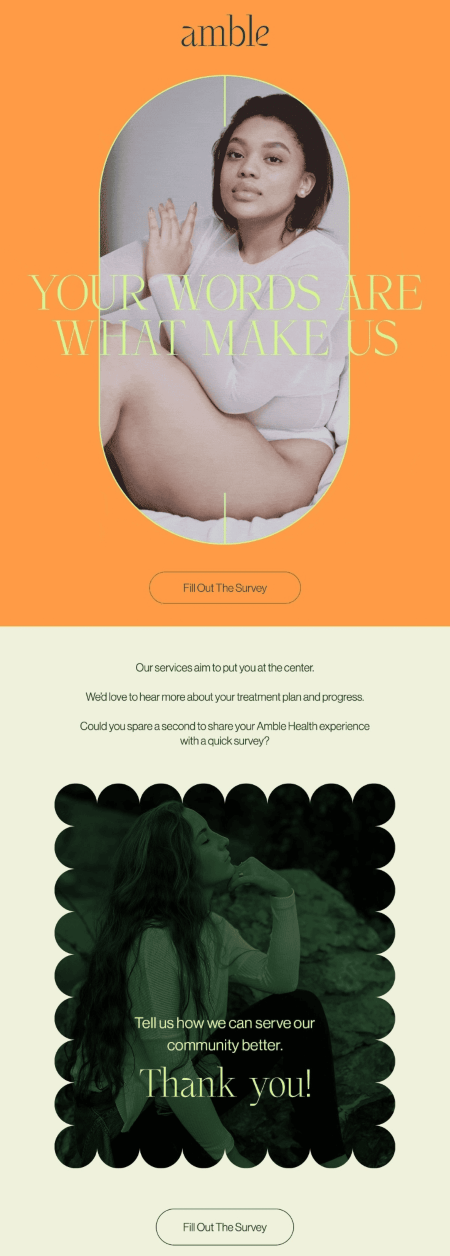
A feedback request email solicits opinions, assessments, or insights about a product, service, or experience. This type of winback email usually aims to gather valuable information to improve services, boost customer satisfaction, and strengthen relationships with others.
Winback Email Strategy: The receivers of this email are specifically asked why they aren’t responding. To pose this question correctly and appeal to answer, you can use a survey, a system of grades, or simply a simple text message asking for comments. You can also offer incentives or discounts to encourage recipients to share their thoughts. For more efficiency, this campaign can be sent automatically by setting up email marketing automation.
Winback Campaign With Incentives
Provide discounts, freebies, and other incentives to entice clients to choose you over competitors, especially those who engage with your emails. Here are some effective strategies to keep your clients coming back:
- Discounts;
- Presents;
- Free shipping;
- Additional reward points;
- Free consultation.
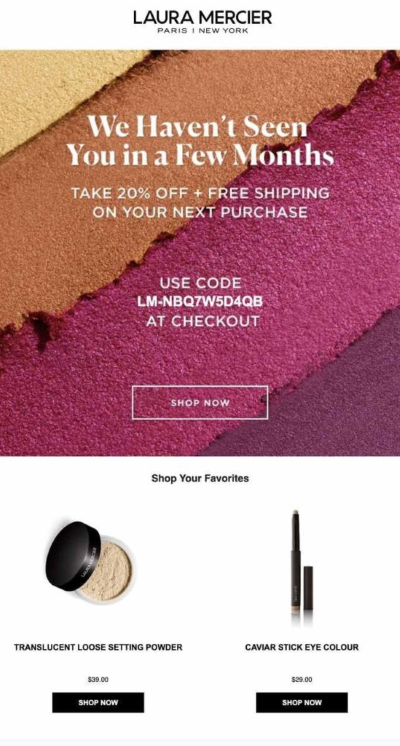
Special Deal Winback Email Example: Entice your clients to come back to you and buy more by proposing enticing deals and benefits. Offering a discount and free shipping, as you can see in the example below, is a good way of appealing to receivers and reevaluating their relationships with the brand.
Product Suggestion Emails for Cross- and Up-Selling
Product recommendations are the primary content of this kind of winback email. It aims to dispel the notion that there are either too many items to look through or that the recipient isn’t interested in any of them. By providing personalized product suggestions, you can boost sales instantly and enhance customer retention as it makes purchasing more pleasurable and rewarding.
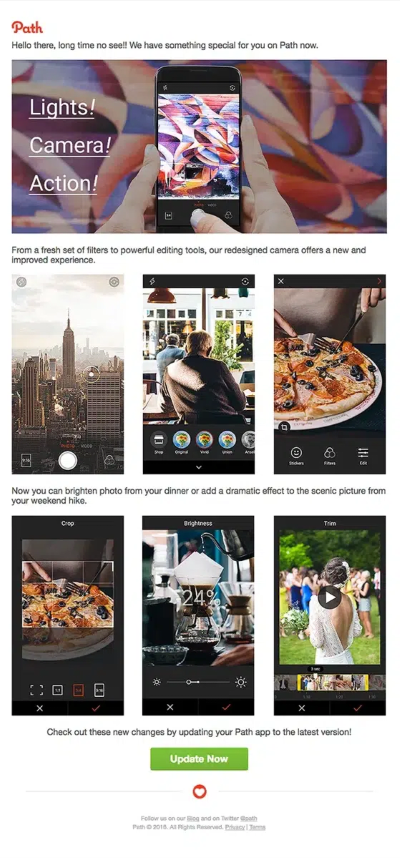
Winback Campaign Idea: Create automated email campaigns that aim to persuade customers who have already bought from you once to make a second purchase. These marketing campaigns offer special discounts or promotions on related products to get back customer purchase momentum. In the example below, you can see how a photo service brand tries to get client’s interest in its tools and filters and suggests clients to try them out.
Refresher Winback Email
This kind of winback email campaign serves to remind recipients of your brand and its unique selling points. It seeks to assist them in recalling the initial reason they joined your email list.
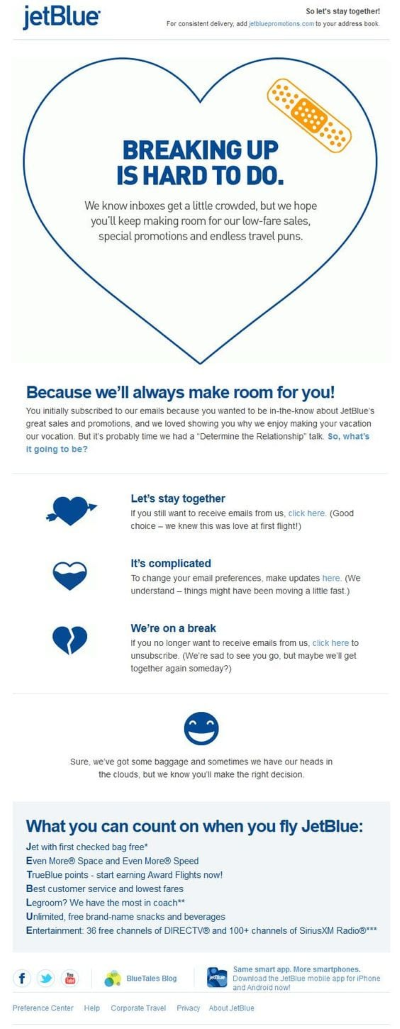
Refresher Winback Email Example: To rekindle the audience’s enthusiasm, you can highlight new goods, exclusive deals, or tailored suggestions. This kind of email improves retention and preserves client relationships by enticing lapsed customers to come back. Remind them about the values you share and the advantages they’ll get from staying with your brand. The example we found closely follows this strategy by using friendly and sympathetic language to evoke emotions while listing all the benefits of cooperation to appeal to the rational side.
“Last Chance” Winback Campaign
Before designating inactive clients as dormant or unsubscribed, a “Last Chance” winback campaign is an attempt to re-engage them. It encourages quick action by using exclusivity and urgency, such as a time-sensitive discount or offer.
Example of Winback Email: This campaign can help turn hesitant clients into active ones by effectively generating a sensation of FOMO (fear of missing out). Highlight in the email that this is the final chance to benefit from the brand’s offer. Make sure to inform readers that if they do nothing, they will be automatically unsubscribed.
Social Proof Email
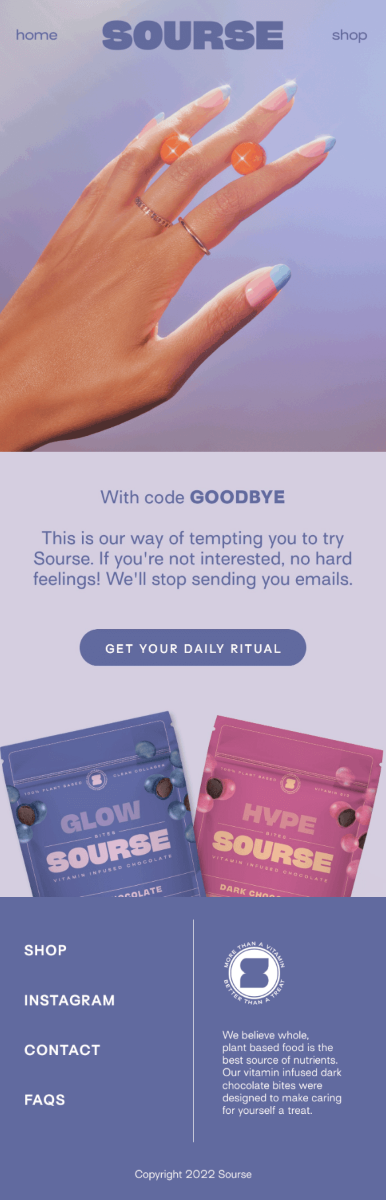
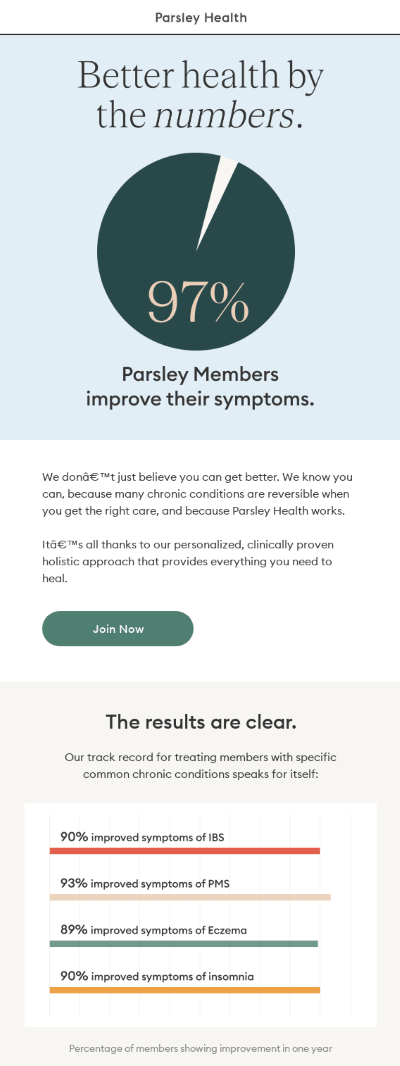
To re-engage dormant users, a social proof winback email uses client endorsements or success stories. This message usually includes reviews and other social proofs. It seeks to increase consumer confidence in your company and goods.
Winback Email Example: Showcasing satisfied customers’ experiences fosters trust and serves to remind recipients of the worth of the product. Show important metrics like the number of your satisfied clients, statistics, achievements, etc. to add authenticity. In the example, you can see the masterful use of this tactic as the company Pasley Health presents the results of its services. “Join Now” is an example of a clear call to action that motivates customers to turn to the company for help.
Unsubscribe Message
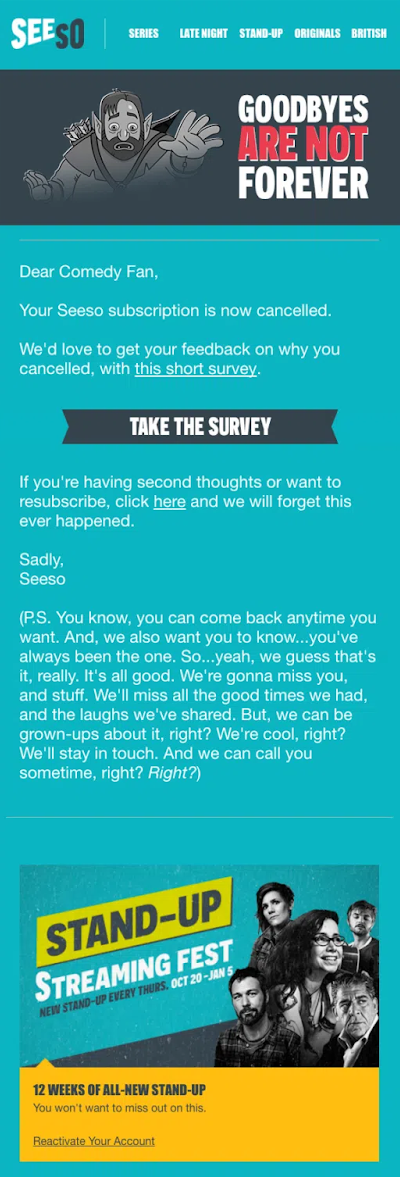
Before suppressing an inactive subscriber, send a final re-permission email asking whether they still want to receive marketing messages. We recommend sending this kind of email. It informs them that although they are no longer on the list, you would still be delighted if they came back.
Unsubscribe Winback Email Strategy: Provide a link for them to bookmark your website or follow your business on social media so they can keep informed without being added to your email list. Giving users the option to easily re-subscribe in case they change their minds is also one of the top strategies for winback campaigns.

How to Create Complex Winback Campaign
A successful customer reactivation campaign is much more comprehensive and isn’t limited to email newsletters alone. In this guide, we focus on email as the primary engagement strategy; however, to maximize the effectiveness of customer reactivation, we recommend running these campaigns across more than one channel. To create a comprehensive and highly effective winback campaign, follow these steps:
Steps for Email Winback Campaign
Optimize subject lines
Make sure the email’s value is clear from the subject line. Create subject lines that are understandable, succinct, and straightforward.
Try using a variety of voice tones
While maintaining the aesthetic of your business, experiment with both formal and informal tones to engage your audience.
Run A/B tests
To see what works best, experiment with different offers, content formats, and subject lines for the best engagement.
Use one call to action
While having multiple CTAs is not prohibited, we recommend opting just for one. Defining a single desired action, such as clicking a link or using an offer ensures that you don’t overburden readers. To cut down on confusion, keep your emails to a single call to action (CTA), like “Shop Now” or “Reactivate Your Account.”
Analyze outcomes and optimize
Use conversions, click-through rates, and open rates to determine what works, adjust your approach accordingly, and make future campaigns better.
Winback Segmentation
Segment your customer base
Your customers should be divided into at least 3-4 groups based on the last purchase date, average order value, and product category. Depending on the characteristics of each group, every group should have its own winback scenario, since a customer who hasn’t been active for 60 days and one who has been inactive for 180 days require significantly different messages.
This targeted approach will improve the effectiveness of customer reactivation considerably more than a generic message. To increase the accuracy of your targeting, we recommend using the best practices of RFM segmentation.
Reactivation Personalized Offers
Personalize your winback messages
Personalizing winback requests is very important, as the chances of a return increase when customers feel a sense of exclusivity and a connection with the brand. Be sure to include customers’ names in the text.
Personalize retention offers
Implement dynamic content in your emails so that an enticing retention offer is automatically generated based on the customer’s most recent order. Offer options could include a discount on their favorite category, free shipping, or loyalty points. Personalize discounts, as generic ones will only cause customers to expect them.
Email + SMS Winback
Make your campaign omnichannel
Brands with advanced marketing strategies use more than one channel besides email. Your targeted campaigns should cover each channel simultaneously, building a sequence rather than a single message. An omnichannel approach yields a 25-40% higher return rate compared to email-only campaigns.
For example, when combining email and SMS, the sequence should look something like this:
send an email → no response after 3 days → send an SMS with a single clear call to action → no response → paid retargeting.
It’s important that the text isn’t duplicated across channels, since each has its own distinct mechanics, and duplicating text will yield minimal results.
Utilization of Customer Purchase History
Send winbacks based on purchase history
You don’t need to spend your budget on a customer who made a small purchase a year ago. Filter out these customers separately or test a completely different approach on them. If you’re using the RFM model for segmentation, focus on customers with a Frequency of 2+; these customers tend to return more often and pay off faster.
What are the KPIs of Successful Winback Email Campaigns?
Click-Through Rate (CTR):
- For effective re-engagement, aim for a click-through rate (CTR) of 2 to 5% or more.
- According to industry standards, a successful winback email should have a CTR of 2.6% or above.
- When compared to non-segmented campaigns, segmented campaigns can boost CTR by as much as 100%.
- Up to 14% more CTR can be achieved with urgent offers.
- Depending on your sector, aim for an open rate between 15 and 25%.
- Compared to text-only messages, emails with images usually have an open rate improvement of 20–30%.
- There is a 26% boost in open rates with personalized subject lines.
- A/B testing can greatly boost CTR and raise open rates by 49%.
- Depending on the business, a successful campaign should aim for a conversion rate of 1% to 3%.
- Conversion rates can increase by up to 42% when emails contain a single, targeted call to action.
When to Send Winback Emails: Timing is Everything
Sending winback emails, especially to people who have stopped interacting with you, may vary depending on the product category, but generally should be done once every three months of inactivity.
Some companies provide pricey products that turn off customers, but if your sales cycle is efficient you have a better chance of getting them to return or carry on doing business with you. These companies with shorter sales cycles should take immediate action following the anticipated window for purchases. Since they haven’t completely disengaged, dormant subscribers who haven’t clicked or opened emails in months are excellent targets. It might not work well if you wait too long.
Sending at the right time is halfway to success. Send a winback email too early, and the customer won’t engage because they’ve recently purchased from you; send it too late, and they’ve already forgotten about you or, worse yet, found an alternative. As email marketing experts drawing on our own experience, we’ve compiled the most relevant triggers for sending winback emails:
- 60-90 days without a purchase. This trigger is exactly what we mentioned; it is the most popular and fundamental one. This is the simplest way to remind a customer who used to buy regularly that you’re still here.
- Lack of response to recent campaigns. It is common for a customer to stop opening emails, not click on push notifications, and ignore text messages. A certain number of campaigns that a customer has ignored often indicates that the person has already left the communication, without even unsubscribing. Three to five ignored campaigns are often a clear sign.
- Predicted churn. Modern CRM and ML models can calculate the probability of customer churn based on even the slightest behavioral patterns. A decrease in visit frequency, a drop in AOV, and a lower number of page views are already red flags that these systems detect. With automation set up, the system automatically flags the customer as “at risk” and launches a customer re-engagement campaign in advance.
- Unsubscribing or switching to a cheaper plan. If a customer has switched from a paid plan to a free one or canceled their subscription, this isn’t just a signal, but a cry. Customer retention efforts here must be immediate and accompanied by an enticing offer.
- App uninstallation. For mobile products, this is one of the most critical triggers. If uninstallation data is available, the push notification channel is closed, but email and SMS are still active to send a recovery message.
- A drop in activity in the loyalty program. The customer has stopped earning or redeeming points, even though they used to do so regularly. This is often noticeable long before purchases stop.
- Seasonal drop-off. If a customer used to make purchases, for example, every summer or before every holiday, but hasn’t this time, this is an important signal to launch a personalized winback scenario at the right time.
Customer Winback Email Best Practices from Flowium
Set Up Winback Email Flow
Setting up a winback automation of any type, whether it’s a sunset flow or any other re-engagement sequence, is an efficient strategy to streamline marketing. Here’s a simple example of such a sequence to give you a basic understanding of how businesses do it.
- Email #1: Overview + Savings
In this email, you remind them of their purchase from you. After telling them you miss them, you give them a legitimate discount to get them to buy from you again. The discount could range from 10% to 20%.
Even if the discount is optional, remember to include urgency in your email if you choose to include it. Give clients a discount that is good for 48 hours. They will feel a sense of urgency, which will speed up their choice to buy.
- Email #2: The Final Opportunity
If your consumer hasn’t made a purchase yet, you remind them of the discount that will expire in a follow-up email sent during the urgency period.
- Email #3: Higher Discounts
You raise the discount if they haven’t made a purchase yet. At this stage, your consumer may have already chosen to purchase from you, in which case an additional discount will benefit both of you. We refer to this as the discount ladder. You provide a discount on your goods; if that proves ineffective, you raise the discount. All of them will be temporary promotions.
- Email #4: Final Opportunity to Receive the Larger Discount
This is the final email in the winback series in which you notify them of their final opportunity to receive further savings. Although you can be creative with this flow and include as many campaigns as you like, you don’t want to send too many to your clients.
Inform Clients of Improvements
Inform clients of any recent enhancements you have made. Admit what went wrong in the past and demonstrate that you have something worthwhile to offer them if you know why they departed and have updates on the same.
Acknowledge your previous relationship and remind them of the reasons they initially chose you.


Make Your Winback Email More Individual
Send your winback email to clients you’ve had a long-standing relationship with some emotion. You can employ a more familiar emotional tone with these clients.
Ask to Optimize Preferences
Inquire whether subscribers would like to stay on your list. In this manner, you maintain the highest possible click-through rate. Your list will be cleaner if you remove subscribers who do not wish to receive your emails.
Employ a Professional
Winback initiatives are a common strategy used by many businesses nowadays but not all businesses can set up this campaign properly without outside help. Contact email marketing experts like Flowium who have a ton of knowledge and know exactly how to frame a winback email if you need assistance creating the ideal one.
Klaviyo Winback Flows
Most email marketing platforms allow you to set up automated winback campaigns. We’ll use Klaviyo flows as an example, as we’re their Master Elite Partners and can explain the winback email setup in detail. The standard winback workflow is as follows:
Set up a trigger (e.g., 60 days without a purchase) → then Email 1 with a reminder → then branch the workflow depending on whether the customer opened the email or not → Klaviyo also works with SMS, meaning that if a customer doesn’t open the email, you can set up an automatic SMS message with a brief offer → and finally, you can send Email 2 as a “last chance to return”.
This is an example of a classic automated winback workflow. You can find many examples in the platform’s help center, and here’s one that includes more customized branches:
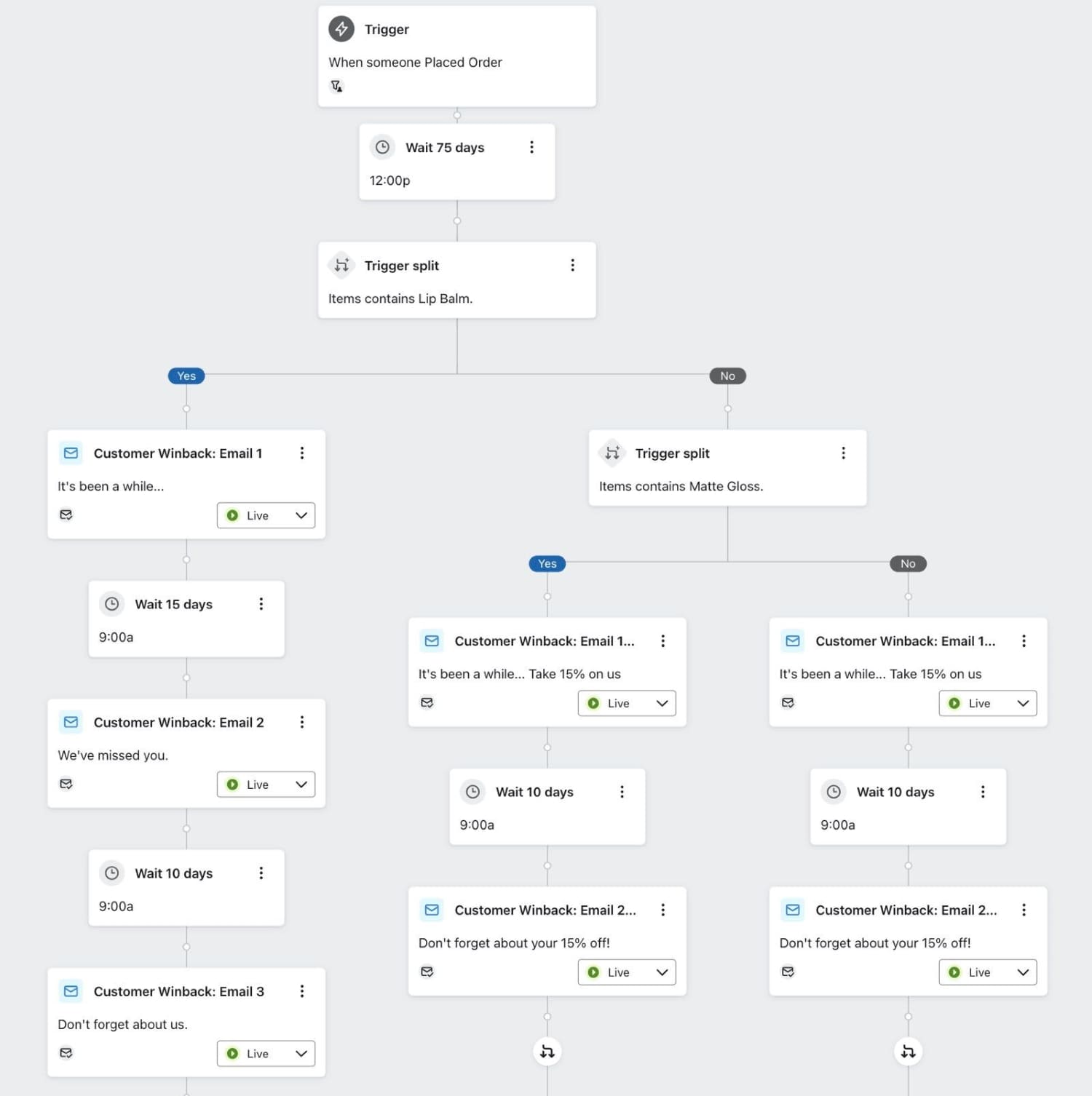
In addition to the classic setup, Klaviyo offers additional features that significantly improve campaign setup and reporting; here are the top 3:
Exit trigger
The “Placed Order” metric automatically removes a customer from a specific flow immediately after a purchase, without sending any unnecessary emails.
Conditional Split
This feature allows you to split based on the total amount of previous orders, meaning VIP customers receive a more attractive offer than one-time buyers.
Flow Analytics
Klaviyo is known for its reporting capabilities. This feature tracks conversions at every step so you can immediately see where a flow is failing and needs an offer adjustment.
More Winback Campaign Examples
Let’s see more customer winback campaign examples and analyze what tactics they use to re-engage clients successfully. Here’s a compilation of inspiring campaigns from famous brands.
Zoom
Subject Line: Are you ghosting us? Reactivate today
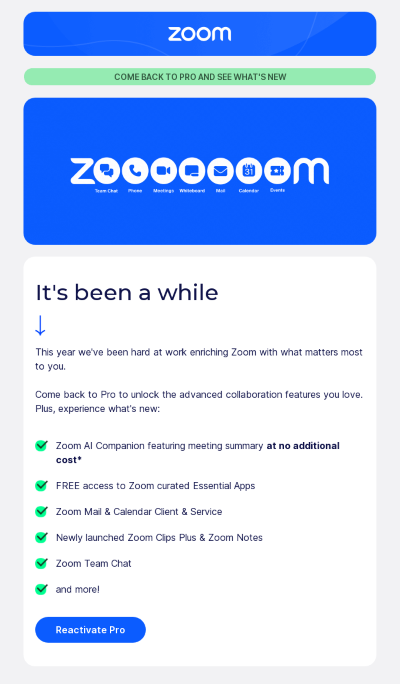
Zoom is a famous video conferencing software that uses chat, video, and audio capabilities to provide virtual meetings, webinars, and teamwork. In this example of a winback campaign, the company uses the opportunity to not only remind about its services but also present new capabilities to the public.
By using this tactic, they increase the chances of reactivating clients with exclusive features that might be more interesting and relevant for them. The email design is meant to be in line with the software style and branding with accents on important offer positions. A clear CTA offering to reactivate a Pro account directly represents the purpose of this winback campaign.
RIND Snacks
Subject Line: Still into us?
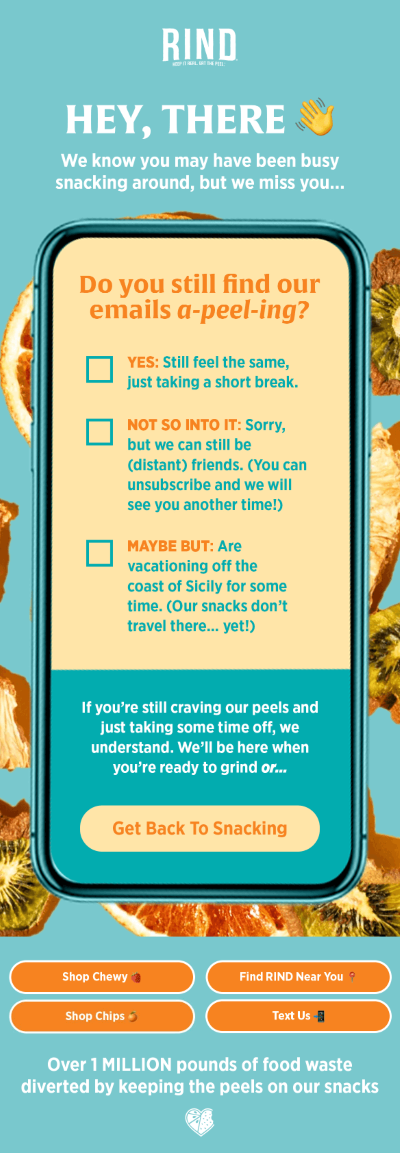
A food company called RIND Snacks sells dried fruit snacks that are prepared with the entire fruit, including the peel, to optimize nutrition, reduce food waste, and give a nutritious, high-fiber snack choice. Their vibrant winback email design perfectly aligns with the brand’s philosophy and styling.
The initial message is simple – saying “I miss you”, but the brand also does something more strategic. The main purpose of this campaign is to evaluate the level of interest with a small survey, which also counts as engagement if clients participate. This way you can both get the needed feedback, get clients to answer your mail, and follow through with the instructions. Additionally, showing how valuable their opinion is for you can help to patch your relationships.
Harvest
Subject Line: Check out what’s new in Harvest
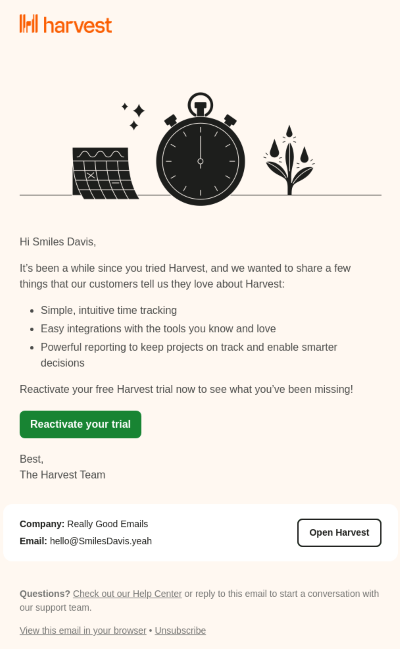
Harvest is a time-tracking and invoicing program made to make it easier for companies and independent contractors to manage their time, monitor the status of projects, and simplify billing. You can see all these advantages listed in the example of a winback email from the software company. The design is rather minimalistic with the main emphasis on a CTA which leads readers to trial reactivation. As you can see, this type of campaign doesn’t need to be always flashy to be effective, even plain colors will do if you know how to place accents.
Cuisinart
Subject Line: Pssst…we have a question for you.
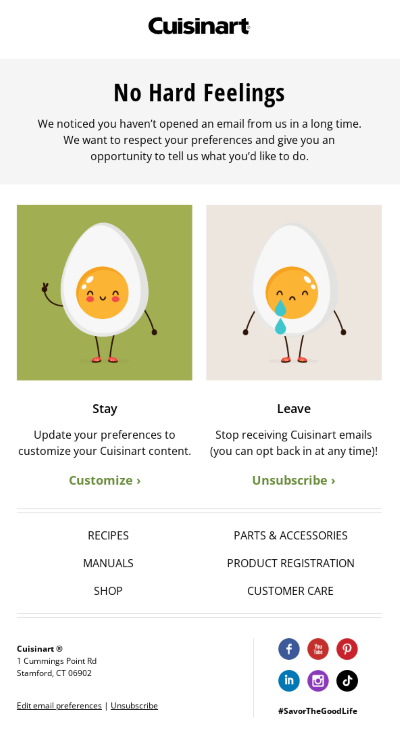
Cuisinart is a well-known brand of kitchen appliances and cookware that produces high-quality items that make baking and cooking easier. The winback campaign example by this brand combines an emotion-evoking approach with smart email marketing strategies.
Asking clients to update their preferences is a good strategy that works well for retention. In this case, the brand even reinforces the impression by adding friendly-looking images to encourage people to opt for the customization option. The other variant “Leave” is represented by a crying egg image, which perfectly represents sadness of separation while going in line with the Cuisinart’s line of work.
Final Thoughts
Winback emails are crucial for boosting open and click-through rates and attracting clients to your business or product by providing them with special advantages.
Winback email campaigns are an excellent method of reminding customers about your brand and ensuring that customers return. Many well-known firms employ this tried-and-true technique as part of their marketing plan. You can turn your one-time customers into repeat customers, and so on.
You’re on the right road if you’re considering implementing a winback email campaign for your brand to winback clients who have lapsed or are about to do so. It takes a lot of effort to get past this concept, but with professional assistance from our email marketing team you can do it easily. Contact us now to start winning over the hearts of your customers again.