Even though most businesses focus all their attention on acquiring new customers, there’s a highly overlooked element of customer acquisition that has a lot more value than attracting new clients: customer retention. Meaning repeat customers who come back to buy from you.
Gearing your marketing strategies towards creating repeat customers who continue doing business with you is one of the best ways to increase your revenue. In this article, we’ll explore why recurring customers are crucial to your business, what healthy rates of repeat customers look like, the latest business statistics, and most importantly, the strategies you can use to attract more of them.
What Is a Repeat Customer?
The repeat customer meaning signifies someone who has purchased from you before and keeps coming back to your store to buy from you again and again. That is, a loyal client who can make stable purchases for years or become the closest fan of the brand.
Returning customers are the foundation of any e-Commerce business. They’re essential to any business because they’re more likely than first-time customers to make repeat purchases and spend more money with you. They’re also your most loyal customers and brand advocates who recommend your products or services to their friends and relatives or share their positive reviews of your brand on social media.
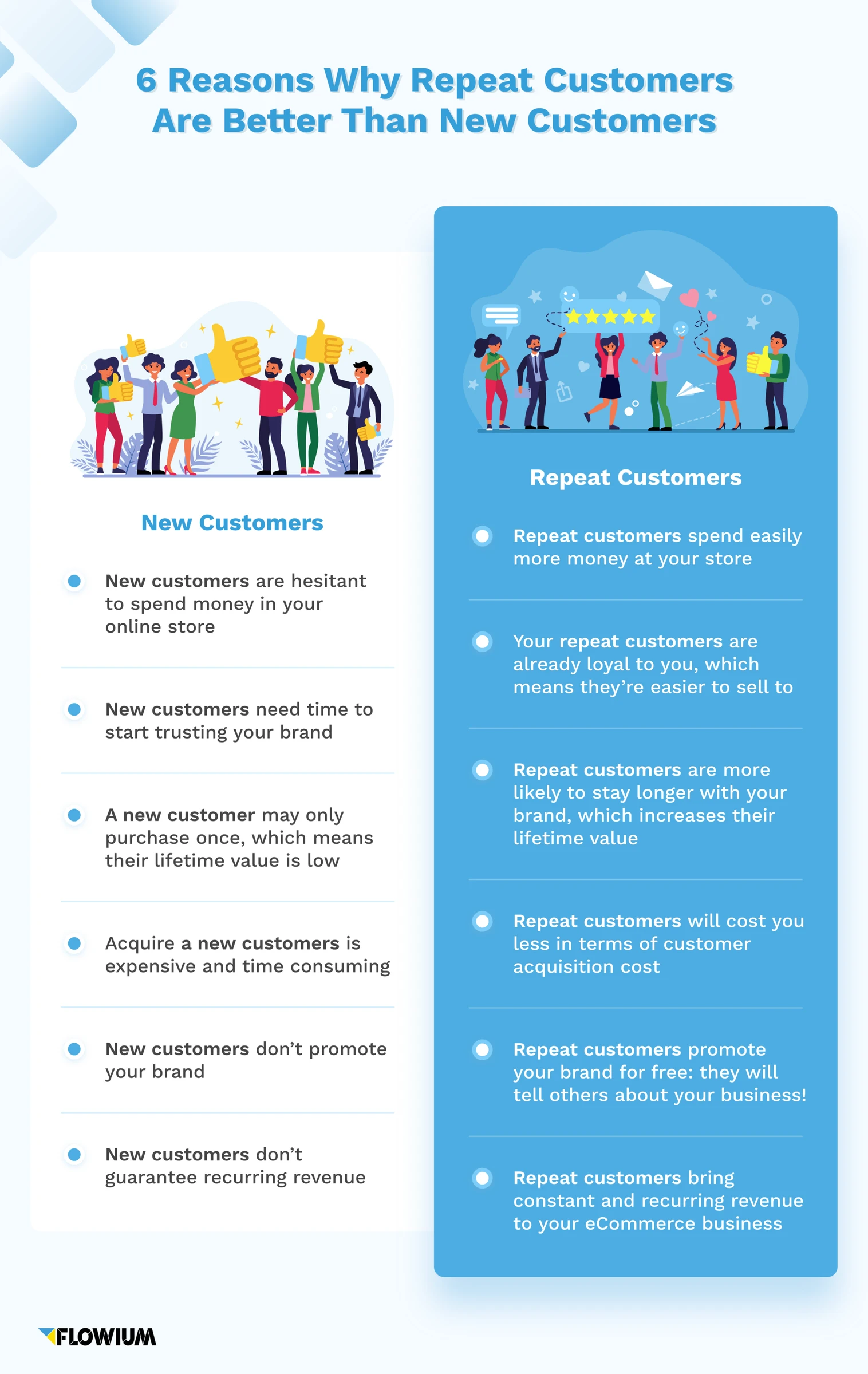
6 Reasons Why Repeat Customers are Better Than New Customers
The importance of repeat customers to your eCommerce business can’t be overstated! That’s because recurring customers generate recurring revenue, and recurring revenue is important to your bottom line.
According to numerous studies, loyal customers, or simply those who make at least one repeat purchase, generate between 44% and 48% of a brands’ revenue. Here are the 6 other reasons why repeat customers are much more valuable than new ones.
Repeat Customers Spend More
Repeat customers spend more money at your store. Statistics say that the average repeat customer spends 33% more per order than a new customer on their first visit to your site. That means the longer someone shops with you, the more likely they are to spend more money on every purchase over time. This is because each purchase builds trust and familiarity with your brand, which leads to more purchases later on down the line.
Repeat Customers are Loyal
Did you know that 81% of customers make buying decisions based on how much they trust a brand? Your repeat customers are already loyal to you, which means they’re easier to sell to. They already know they can trust you and count on you to deliver what they want. So, they come back because they feel confident buying from you and want more of what you have to offer.
Repeat Customers Have a Higher Lifetime Value
A new customer who’s just trying out your store or website may not be sure about making future purchases there. This means they may not stick around as long as someone who’s already had a positive experience buying something from you in the past.
Repeat customers are more likely to stay longer with your brand, which increases their lifetime value.
Repeat Customers Cost You Less
One of the biggest challenges of any eCommerce business is optimizing its customer acquisition cost (CAC), and repeat customers will cost you less in terms of it than new customers.
In fact, acquiring a new customer can cost up to five times more than retaining an existing customer. With repeat customers, you’ve already done the hard work of getting them to know about your product or service and getting them to buy from you once.
💡 Repeat purchases require less time and money spent on promotion and advertising, which means more profits for your business over time.
Repeat Customers Promote Your Brand
Repeat customers will tell others about your business because they want them to get the same great experience they did when they bought from you.
This gives you free advertising and word-of-mouth marketing at its best!
This is especially true if you have an active social media presence. Social media has the ability to reach thousands of people at once, making it ideal for spreading word-of-mouth recommendations.
💡 Good reviews have the power to influence people’s buying decisions positively. In fact, 93% of consumers are more likely to buy if the brand has positive online reviews.
Repeat Customers Bring Recurring Revenue
Repeat customers bring constant and recurring revenue to your eCommerce business. If you have products or services that sell well, you can count on a steady stream of income every month or year because you know that your loyal customers will keep coming back for more of your products or services.
This means that no matter how bad things get in terms of economic downturns or other external factors affecting the business climate, these loyal customers are likely to keep coming back.
How to Get Repeat Customers
By now, you already know why repeat customers are the clear priority in the “repeat customers vs. new customers” debate. However, this doesn’t mean that getting repeat customers doesn’t require some marketing efforts from your side.
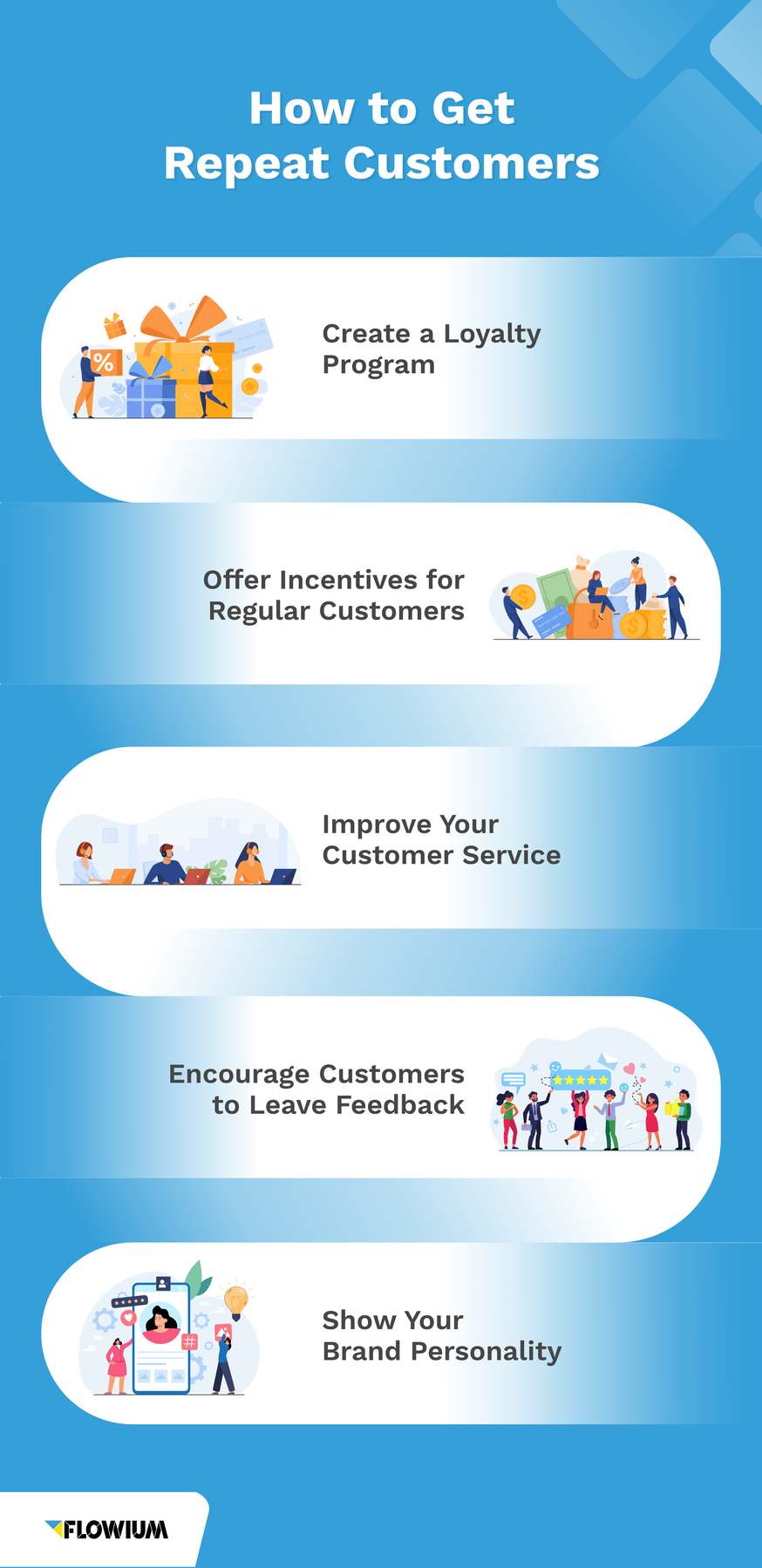
On the contrary, if someone buys from you once or even twice, they may not come back again if they don’t feel like they got value for their money or if they had a bad experience with your product or service. So, how do you convert new customers into repeat customers and make sure they stay loyal to your brand? Let’s go over a few strategies you can implement to get more repeat customers.
Create a Loyalty Program
Customers love loyalty programs! 68% of consumers value shopping with a brand more when they can participate in a loyalty program and get personalized discounts. A loyalty program can be something as simple as having a rewards card. This is a great way to incentivize repeat purchases and encourage customer loyalty.
If your business sells a variety of products, it’s easy to set up a rewards program that will appeal to everyone who shops at your store.
For example, if you own a pet store, you could offer points toward free products for every dollar spent on food or toys.
You could also give away free gifts for customers who reach certain point levels.
Offer Incentives for Regular Customers
Customers who come back to shop with you over and over again are usually the most loyal ones. Giving away discounts, gifts, or free shipping can be an excellent incentive for them to keep coming back and a token of appreciation for their loyalty.
For example, you can offer them a discount whenever they enter the store or shop online. You can also give them additional discounts on their birthdays or anniversaries, or send them a discount coupon for future use after they make an order above a certain amount.
Offering such incentives will make your customers feel very special and encourage them to keep coming back.
Improve Your Customer Service
Did you know that 66% of consumers in the US cite good customer service as one of the main reasons they stay loyal to a brand?
No matter what type of business you’re running, one thing is for sure: your customers will always appreciate a good customer service experience. If they don’t have one, they won’t be happy with your business and probably won’t come back for more.
Good customer service isn’t just a matter of having someone who can answer questions about your products. It’s also about making sure that you’re doing everything you can to meet and exceed your customers’ expectations. That means responding quickly when they call or email, offering solutions to any problems, and following up after purchases are made to ensure everything went smoothly.
Encourage Customers to Leave Feedback
If you want people to come back for more, you need to know what they’re thinking. Feedback is a great way to get insight into what your customers want and need from you.
You can even do this by emailing them with a short survey or asking them questions via social media or on your website. As retention marketing experts, we assure you that omnichannel marketing remains the most powerful strategy for 2026.
Give your customers the opportunity to share their feedback and act on it to improve your service. You don’t have to agree with every complaint, but it’s important that your response acknowledges the customer’s concerns.
💡 If customers feel like they’re being heard and respected — even if they don’t always get what they want — they’re more likely to come back for more.
Show Your Brand Personality
Brand personality is the most important part of your brand, and it can help you get repeat customers. How? By showing your brand’s personality to customers, they will feel like they know you and understand the why behind your business.
When you show your brand’s personality, it makes you more relatable to customers, which in turn makes them want to come back again.
💡 A great way to show your brand personality is through social media. You can share fun behind-the-scenes photos and videos on Instagram, Facebook, or TikTok. This will help build trust with your clients because they’ll be able to peek behind the scenes and get closer to your brand.
How to Measure Repeat Customers
Measuring repeat customers is important for any business. It shows how well your company is engaging with customers, and it can help determine how successful your marketing strategies are. There are several ways to measure repeat customers, including:
- Customer Retention Rate (CRR): This metric measures the percentage of customers who come back after their first purchase. A high customer retention rate means the company has done a good job of satisfying its customers.
- Customer Lifetime Value (CLV): This is the average amount of money each customer spends over their lifetime with the company. The CLV gives insight into how much profit you can expect from each customer over time.
- Repeat Customer Rate: This is the percentage of people who purchase from you more than once. It helps measure how well you build customer loyalty and retain customers over time.
What is the Repeat Customer Rate (RCR)?
The Repeat Customer Rate (RCR) is a fundamental retention metric in eCommerce. It is designed to reflect the percentage of customers who have made more than one purchase within a specified time period. By tracking the changes in this metric for your business and comparing it to industry benchmarks, you can gain insights into the quality of the customer experience, product satisfaction, and other factors.
How to Calculate Repeat Customer Rate
When calculating your returning customer rate, it’s important to remember that not all customers will buy from you again within a short period of time — some may buy months or even years later.
You should look at a longer period of time when calculating your customer return rate to get an accurate picture of how loyal your customers are over time. That said, here’s a simple formula to calculate your repeat customer rate:
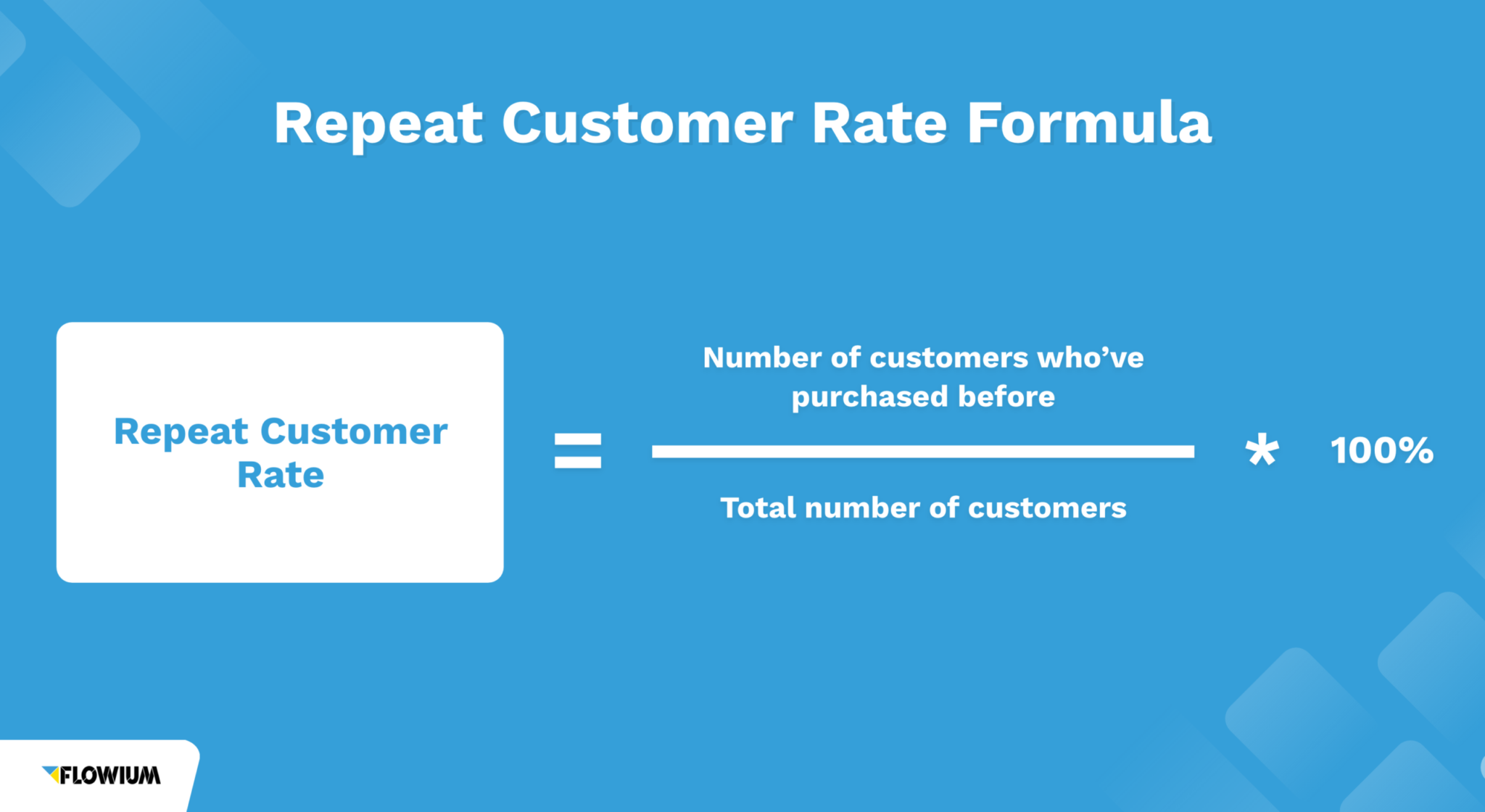
In other words, to calculate your repeat customer rate, you have to divide the number of returning customers (those who have purchased something from you more than once) by the number of total customers, and then multiply it by 100 to get a percentage.
Repeat Customer Rate = Number of customers who’ve purchased before/Total number of customers * 100%
For example, suppose you had 1,000 unique buyers who made a purchase from your online store last week. Of those 1,000, 50 were customers who’ve already purchased something from you in the past. In this case, your calculation will look like this:
Repeat Customer Rate = 50/1000*100% = 5%
So, in this case, your repeat customer rate would be 5%.
What’s a Good Repeat Customer Rate?
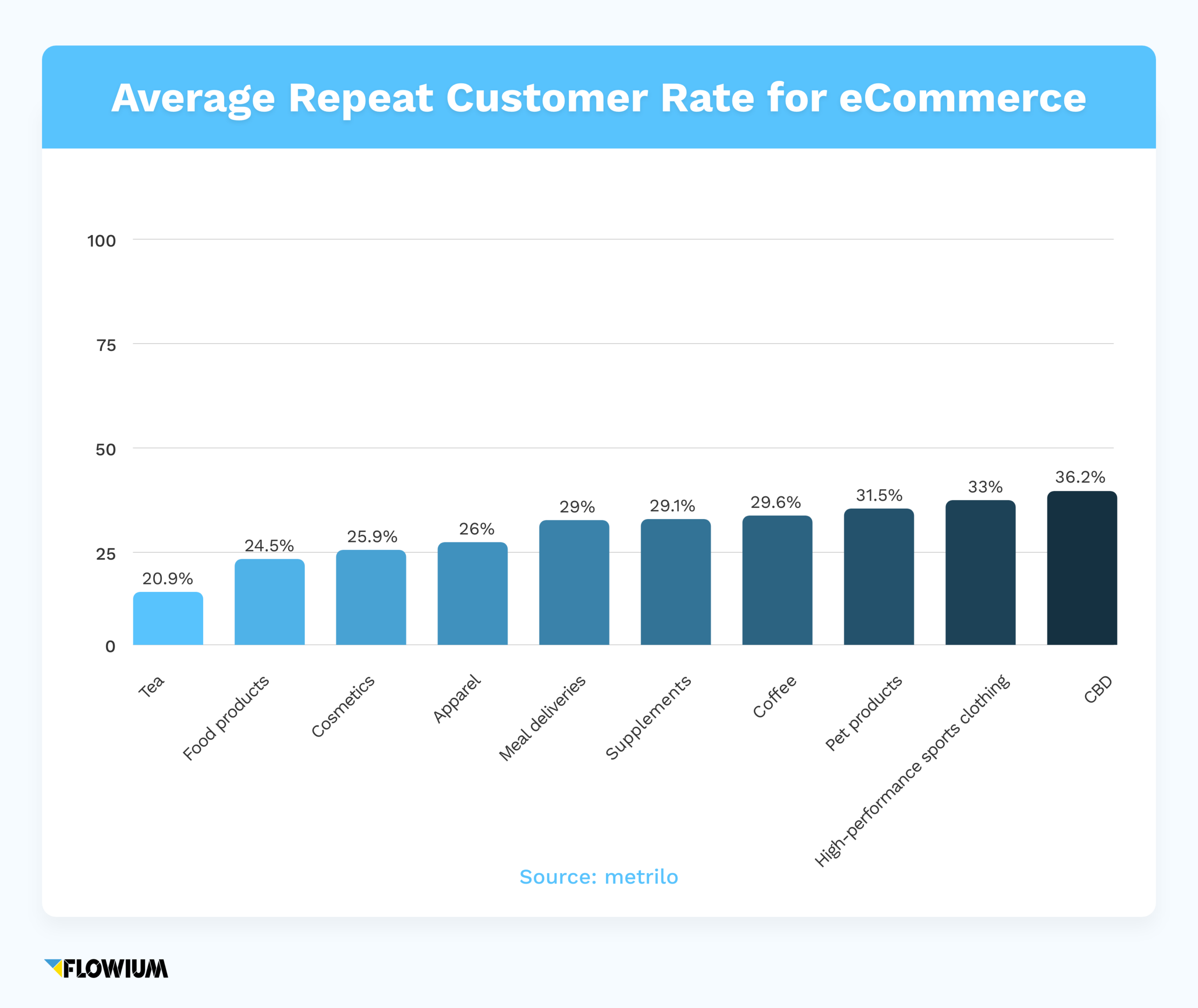
To determine whether a given percentage of repeat customers is optimal or low by comparing it to the average, you need to take into account the specifics of the product category. The average benchmark for most eCommerce brands in 2026 ranges from 25% to 30%. However, a proper analysis of business performance should be based strictly on a comparison with relevant industry metrics.
RCR Benchmarks by eCommerce Industries in 2026
It is a well-known fact that products with a naturally short consumption cycle demonstrate the highest rates of repeat purchases. In contrast, high-priced, long-lasting goods have objectively low transaction frequency rates, which are fully offset by a high average order value (AOV).
| Industry | Average RCR (12 months) | Category Specifics |
|---|---|---|
| Food and Fast Delivery | 65.2% | Regular weekly consumption, getting used to the interface. |
| Subscription Services (Subscription Boxes) | 40.0% – 55.0% | Automatic recurring payments, predictability. |
| Pet Supplies | 30.0% – 40.0%+ | Consistency in pets’ diets, auto-delivery. |
| Dietary Supplements and Wellness | 29.0% – 45.0% | Consistent use of treatment regimens, auto-renewal. |
| Beauty and Skincare | 25.9% – 40.0% | Daily beauty routines, high brand loyalty. |
| Clothing and Footwear | 25.0% – 32.0% | Seasonal wardrobe updates, sensitivity to sales. |
| Home Goods and Decor | 18.0% – 25.0% | Gradual home improvement, long replacement cycle. |
| Electronics and Gadgets | 12.0% – 18.0% | Long product lifecycle, upselling of accessories. |
| Luxury Goods and Jewelry | 9.9% | Extensive deliberation before purchase, high average order value. |
State of Your Business Based on the Average Repeat Customer Rate
To conduct a quick audit of your repeat customer effectiveness, here are three degrees of comparison with average RCR metrics:
- Metric below 20% (Risk Zone): If your business does not exclusively sell high-priced or long-lasting goods, but the metric is below 20%, you may be in the risk zone. Under these conditions, any increase in advertising costs on Meta or Google platforms will instantly erode your profit margins. You must immediately stop scaling up your advertising budgets and refocus on optimizing the post-purchase customer journey.
- Metric between 20% and 30% (Average Level): The eCommerce store is operating within market norms. Retention is stable, but there is significant room to increase profitability by implementing automated retargeting and demand regeneration strategies.
- Rate above 30% (Excellent result): The brand demonstrates a high level of customer loyalty. The main focus for optimization at this stage is increasing the average order value (AOV) among repeat customers and promoting referral programs to attract new leads at no cost.
To cement the idea that repeat customers are crucial for your business success, here are some relevant 2026 repeat customer statistics that you should be aware of.
- The economic advantage of retention over acquisition: The cost of acquiring a new customer is 5–25 times higher than the cost of retaining an existing one.
- Revenue share from loyal customers: The existing customer base is the main source of profit, as it accounts for 65% of the company’s total revenue.
- Share of repeat customers in the customer base: Repeat customers make up only 21% of the total customer base, yet they generate 44% of total revenue and account for 46% of the total number of orders.
- Growth in average order value over time: Customer loyalty increases over the years, so by the 31st–36th month of the relationship, customers spend 67% more than they did at the beginning.
- Probability of repeat orders (trends): The likelihood of a repeat purchase rises sharply with each new order: it stands at 27% after the first purchase, reaches 49–54% after the second, and rises to 62–67% after the third.
- Impact of Customer Service Quality: High-quality support is crucial for business, as 95% of customers consider the level of service a key factor when choosing a brand.
- Sensitivity to Negative Experiences: Today’s consumers are very demanding, which is why 73% of shoppers are willing to completely stop using a brand’s services after just one mistake or negative experience.
Comparative Analysis: Repeat Customer Rate vs. Repeat Purchase Rate
In the professional field of customer retention, the terms Repeat Customer Rate and Repeat Purchase Rate are often confused and used interchangeably. This is not a major mistake, but understanding the precise difference will help with analytics. To configure them accurately, it is important to understand the technical differences between them, as they address different analytical and managerial tasks.
The main difference is that:
- RCR is always tied to a specific customer profile within a defined cohort of buyers.
- In contrast, RPR is a more flexible metric focused on transactional behavior, which can be calculated using several methods depending on the marketing objective.
| Repeat Customer Rate (RCR) | Repeat Purchase Rate (RPR) | |
|---|---|---|
| Analytical Focus | Behavioral stability of the customer cohort. | Transaction frequency and speed of repeat purchases. |
| Formula specifics | Based exclusively on unique customer profiles. | It can be calculated by orders, customers, or time windows. |
| Time frame | Long-term (usually 12 months). | Short and medium-term (30, 60, 90 days) |
Understanding both metrics is critical to avoiding analytical errors. For example, two online stores may have an identical annual RCR of 25%, but the first has a second-purchase window of 30 days, while the second has one of 180 days. Thanks to faster capital turnover and a higher repeat purchase rate (RPR), the first brand will generate significantly higher lifetime value (LTV) and have much more sustainable unit economics.
How to Thank Repeat Customers
When you have repeat customers, it’s important to show appreciation and thank them for their business.
💡 Repeat customers are an excellent indicator of the quality of your business and products, as well as your customer service. If a customer returns to purchase again from your business, it shows they were happy with their previous experience.
It’s important to thank repeat customers for their loyalty. Here are some tips on how to do this effectively:
Send Them a Thank-You Email
There are many ways to show appreciation for your repeat customers. The simplest and most common way is to send them a thank-you email.
It doesn’t have to be a fancy email campaign. A simple email with a thank you message and a token of appreciation, such as a discount code or a gift, will be enough to make your customer feel appreciated.ated.
Send Them a Thank-You Note
As an eCommerce business, you can get really creative with your thank-you notes! One way is to slip them in the packages so that when your client receives their order, they’re greeted by a personalized, and ideally handwritten, thank-you note.
There’s just something about snail mail that makes it so much more personal than email or text messages.
So, when your repeat customers purchase from you, send them a note thanking them for their business. That extra effort from your side will make them feel incredibly special, which will likely lead them back into your shop again and again.
Final Thoughts
Businesses often focus on acquiring new customers. However, acquiring them is 5-25 times more expensive, while more than 60% of profits come from repeat customers. To achieve a healthy repeat customer rate, brands need to focus on marketing automation, implementing multi-tiered loyalty programs, and providing impeccable customer service. Investing in retaining the existing customer base generates recurring revenue and protects the business from rising advertising rates on Google and Meta.
The best solution for maximizing the effectiveness of repeat customer acquisition is to turn to professional retention marketing agencies. Flowium is exactly that solution. Contact us today, and let’s work together to build the best strategies for repeat customers.
Frequently Asked Questions
What’s repeat customer’s meaning?
Repeat customers are those who have purchased from you more than once. They’re loyal customers who keep coming back to buy from you again and build a long-term relationship with your business.
Why is it important to have repeat customers?
While there are many benefits of repeat customers, the biggest one is that having a good repeat customer rate can help you significantly increase your profit margins each month. In addition, repeat customers also bring recurring revenue, so you can be sure that you’ll always have someone buying from you.
How can the repeat customer rate be improved?
There are many ways to improve your repeat customer rate, such as creating loyalty programs for regular customers, offering incentives in the form of discounts, coupons, or gifts after each purchase, or providing excellent customer service that exceeds expectations.