On their path to scaling up, brands often encounter their limits and don’t know how to overcome them. Revenue seems unpredictable, customer acquisition costs are rising, and metrics don’t provide insight into what’s working.
The eCommerce marketing maturity model can solve these kinds of problems. It’s a roadmap for your business, divided into levels. It will help you determine where you stand in the industry and create a practical action plan for growing your marketing operations.
In this article by retention marketing experts, we’ll explore the main maturity levels, provide you with a handy 5-minute test to determine your level, and offer a unique roadmap for DTC eСommerce brands. Read on and take your business to the next level today.
What is the eCommerce Marketing Maturity Model?
The eCommerce marketing maturity model is a system that allows you to assess the level of development of your marketing strategy and identify the most effective path to the next level.
In other words, it’s a roadmap for your marketing that shows you where you currently stand and what tasks you need to complete to move even higher.
Marketing maturity is measured not by the number of tools or channels, but by how effectively they interact with one another to generate predictable revenue that grows exponentially. First and foremost, the eCommerce marketing maturity model is a way to transition from unpredictable revenue to a systematic one. More on its importance below.
The Growing Importance of eCommerce Marketing Maturity
According to the latest statistics from SimplicityDX for 2026, total customer acquisition costs have risen by 222% over the past ten years. For most mid-market brands, growth based solely on customer acquisition is structurally unsustainable.
The solution lies in developing retention strategies, which can be achieved through a marketing maturity model. Email and SMS are the most effective countermeasures against inefficient customer acquisition growth. Confirming this, Omnisend’s 2026 data shows that eCommerce brands earn an average of $45 in profit for every dollar spent on email, which is the highest ROI among all digital channels. However, since this is an average figure, these returns are distributed unevenly. The largest returns go to brands with higher levels of marketing maturity.
eCommerce Marketing Maturity Map
The maturity of eCommerce marketing can be determined by a variety of factors. Most importantly, it is not determined solely by revenue, but primarily by the actual condition of the company. It is entirely possible for a brand with $30 million in revenue to be stuck at Level 1, while a brand with $7 million in revenue is at Level 3.
Before we move on to a detailed analysis of the three main maturity levels, we’d like to present a brief overview of them, highlighting their key characteristics based on retention. This overview will give you a general idea of marketing maturity and an approximate understanding of which level you’re currently at.
| Level | Growth Focus | Customer Data | Automation | Channel Coordination | Retention | Primary KPI |
|---|---|---|---|---|---|---|
| Level 1 | Acquisition only | Not structured | Absent | Single | No strategy | ROAS, CPA |
| Level 2 early | Mostly acquisition | Basic tracking | Flows launching | Multi, separate | Reactive tactics | Opens, sessions |
| Level 2 solid | Mixed, unplanned | Collected, siloed | Flows running | Connected, basic | Tactical, patchy | Attributed revenue |
| Level 2-3 transition | Retention emerging | Used partially | Branching, optimizing | Coordinated, lagging | Channel specific | LTV recognized |
| Level 3 | Retention-led | Predictive, unified | Behavioral, scaled | Unified system | Strategic, proactive | LTV:CAC, RPR |
Most brands in the $5 million to $50 million range often start out at Level 2. If growth has been steady, certain customer retention measures are already in place, attribution is possible, but there is no unified strategy, and LTV is not a determining factor in decision-making.
The 3 Levels of the eCommerce Marketing Maturity Model
The maturity levels of eCommerce marketing can vary from model to model. Some propose 5 levels, some 4, depending on the targeted marketing approaches. For example, our partners at Klaviyo have examined the eCommerce email marketing maturity model. We, however, will explore this from a distinct perspective. We researched our competitors’ maturity models and, combining them with our expertise in retention marketing, created a more general model with three well-defined levels. Here is a description of each:
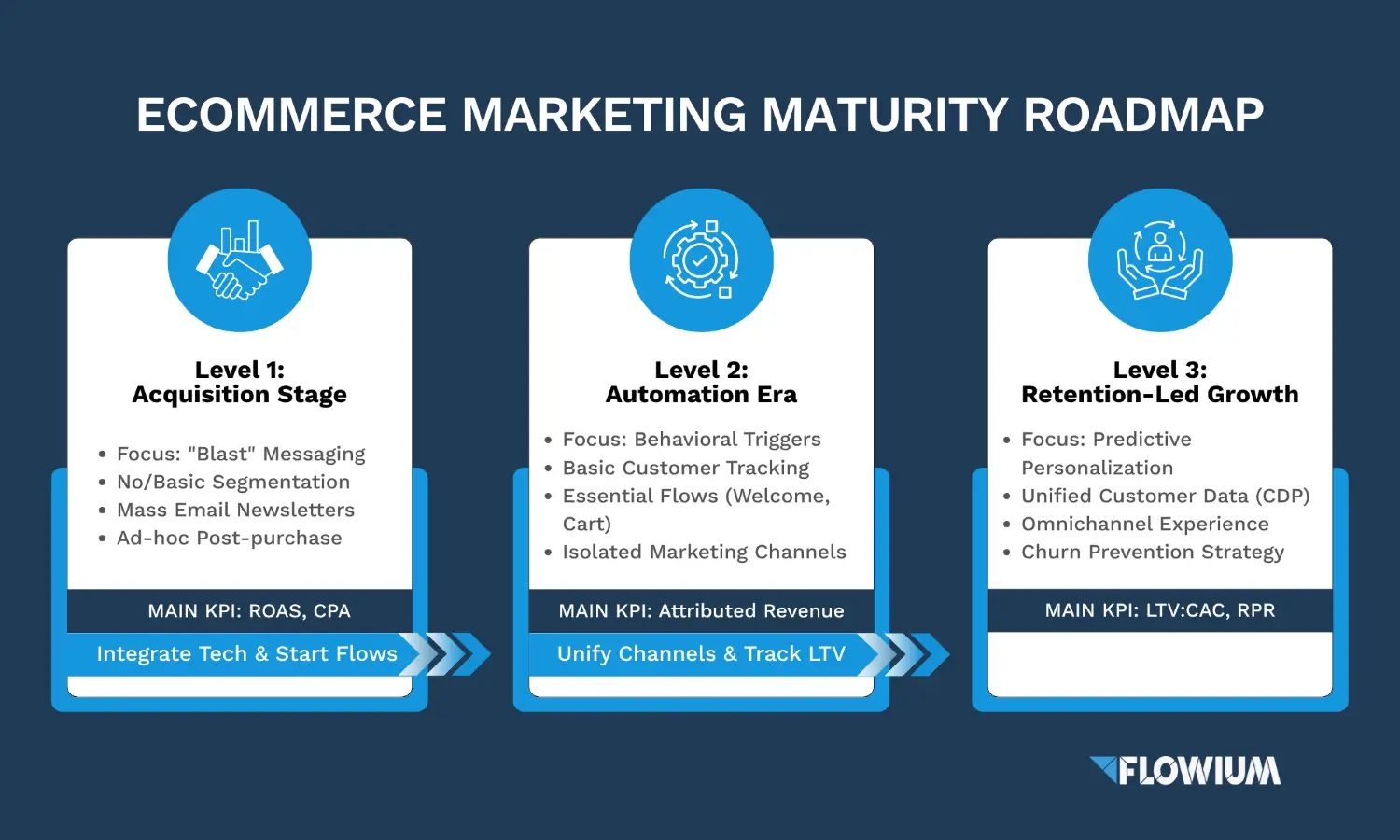
Brand Maturity Level 1: The Acquisition Stage
Brands at maturity level 1 are entirely focused on a growth model driven by acquiring new customers. Other characteristics include:
- The budget is spent on paid advertising and collaborations with influencers.
- Analytics are established through session tracking and conversion rate monitoring, but are not typically used to guide decision-making.
- There is no tracking of customer lifetime value (LTV). The same applies to the repeat purchase rate. The business usually knows its ROAS, but not the LTV:CAC ratio.
- Marketing messages are sent massively. Email newsletters are sent once a week or every two weeks and focus on sales, new collections, and seasonal promotions. Segmentation is mostly absent, and all these newsletters are sent to the entire mailing list. Nevertheless, there is often a welcome email. It is typically sent when a new customer registers and has not been significantly updated since its creation.
- The post-purchase experience is minimal and limited to transactional messages such as confirmation emails and shipping notifications. Customer relationships are short-sighted and end after the first order. Loyalty happens by chance rather than by plan.
Opportunities for growth at this stage are present and obvious; they’re just usually ignored for now or aren’t yet seen as a significant priority. As a result, growth is measured by traffic and the number of new customers, rather than by LTV or the repeat purchase rate.
Brand Maturity Level 2: The Automation Era
At Level 2, decision-making becomes more reasoned thanks to data-driven insights. The focus on acquisition channels is much more substantial; they are tracked and compared. Other characteristics include:
- Brand spending is directed not only toward the top of the sales funnel but also toward strategies following a customer’s first purchase. It focuses on product page quality, checkout conversion, and the post-purchase experience.
- A significant step and change that is a defining characteristic of the second level is the shift in focus from a calendar-based approach to an event-based one. Manual planning is replaced by behavioral triggers. As a result, welcome email series, abandoned cart recovery campaigns, and return offers for former customers are introduced. The tools initially run automatically in the background without the need for daily manual data entry.
- However, there are still limitations in terms of depth at this level. These are typically characterized by overly generic and unvaried retention programs that do not adapt based on a customer’s value or behavioral history. For example, this means that a customer who has placed numerous orders and spent a significant amount will receive the same return-to-purchase messages as an average one-time buyer.
- At Level 2, channels still operate in isolation; email and SMS have their own schedules, and the loyalty program runs separately. Multiple customer acquisition channels are tracked using attribution, providing some ability to compare effectiveness at the channel level.
A brief description of Level 2 eCommerce marketing maturity is that the brand is focused on customer retention, but does not yet have a strategy for it. In other words, it has a set of tactics rather than a single strategy with a key performance indicator.
Brand Maturity Level 3: Retention-Led Growth
For businesses at Level 3 of marketing maturity, the business model has already undergone significant changes. The main change is that growth no longer depends primarily on acquiring new customers but shifts toward maximizing the value of existing ones. Other characteristics include:
- The allocation of the marketing budget is determined by analyzing cohorts based on LTV, rather than campaign ROAS.
- Every decision is largely based on customer data. LTV by acquisition cohort is regularly analyzed and determines budget allocation across channels.
- Predicting customer needs is effectively achieved through behavioral signals to prevent a loss of interest. Among these behavioral signals are viewing patterns, purchase frequency, product preferences, and declining activity. Customer churn is identified at an early stage and addressed proactively, rather than reacted after the loss.
- At maturity level 3, channels are already fully integrated with one another. Email, SMS, loyalty programs, and direct mail exchange customer data. As a result, communication is consistent rather than being repeated every time from scratch for the customer; timelines are coordinated, and mailings are not duplicated.
According to Smile.io’s 2025 dataset, the top 5% of eCommerce customers generate 35% of total revenue. Level 3 brands value these customers the most, know everything about them, and often build their entire growth strategy around retaining and acquiring them. Unlike Levels 1 and 2, there are different tiers of customer value here, each receiving significantly different treatment.
eCommerce Marketing Maturity Quiz
If you have read all the details about the levels and their characteristics but still haven’t determined what maturity level your marketing is at, we’ve created a quick quiz for you. Answer each of the 6 questions accurately and check the table to see which level of the model your eCommerce marketing is at.
- Do you know the ratio of profit from new customers to repeat customers, and does this figure influence how you allocate your marketing budget?
- Can you identify which customer acquisition channels deliver the highest 90-day LTV, rather than just the lowest CPA?
- Do you have automated programs that respond to customer behavior after their first purchase?
- Is your customer retention strategy segmented by customer value?
- Do you track your repeat purchase rate and LTV:CAC ratio weekly as core KPIs?
- Can you predict which customers are at risk of churn before they actually stop buying?
Level 1: If you answered “yes” only to questions 1 and 2. Your business prioritizes attracting new customers over retaining existing ones.
Level 2: If you answered “yes” to questions 1, 2, and 3. You have retention programs in place, but they are not strategy-driven.
Level 3: Answering “yes” to all 6 questions. Congratulations, your growth is now largely focused on aligning channels and predicting customer behavior.
Our test is basic, since there are countless features and strategies that define these levels. To conduct an accurate marketing maturity assessment and identify all gaps in your strategies, we offer a marketing maturity audit by Flowium’s retention marketing experts. In a brief conversation, we’ll identify which customer segments and channels aren’t performing at their best and how to address them. Get the full picture now!
How to Advance Through the Levels
Finally, we’ve reached the concluding section. From our overview, you’ve already learned what the eCommerce marketing maturity model is, why it’s valuable today, what the levels are and their characteristics, and where you currently stand. Now that we’ve identified your position on the path to success, we’ll determine how to advance from the level you’re stuck at and move up to the next one. Here are our strategies for advancing through the levels:
Level 1 to Level 2: Build the Foundation
At this stage, effectiveness comes first, and perfection second. If your customer retention programs being implemented this quarter are imperfect but effective, they’re still better than the perfect ones you’re only planning and have been refining for a long time.
Your next priority actions to raise the level:
- Increase the focus on repeat purchase rates and LTV in your standard reporting.
- Set up attribution so that it shows which acquisition channels bring in the most valuable customers.
- Integrate your marketing platform with your online store to synchronize customer behavior events in real time.
- Set up basic post-purchase automation workflows, such as welcome messages, abandoned cart reminders, post-purchase follow-ups, and more.
- Define what a retained customer means for your brand, that is, what purchase frequency indicates retention, and start tracking it.\э
- Set up revenue attribution by channel and program type to see which customer retention efforts are actually delivering results.
Level 2 to Level 3: Build the Strategy
At these advanced levels, the goal is no longer to add more programs, but to unify the existing ones. At Level 2, you need to combine all the tactics you use across different channels into a single, unified strategy.
Your next priority actions to raise the level:
- Conduct a cohort analysis by LTV across acquisition channels to determine which sources bring in the best customers, and then redirect your budget specifically to those.
- Create customer value tiers and develop unique, differentiated programs for each one.
- Connect your customer retention channels so that email, SMS, loyalty programs, and direct mail share customer data and exclusion logic.
- Shift from after-the-fact customer recovery to predictive churn prevention by identifying at-risk customers based on behavioral signals.
- Replace campaign-level performance analysis with cohort-level analysis.
- Make repeat purchase frequency and LTV:CAC your key performance indicators.
Final Thoughts
Based on our review, you can learn that the eCommerce marketing maturity model is a system that serves as a roadmap, allowing you to determine the current level of advancement of your marketing efforts and how to raise that level.
We focused specifically on retention and determined three main levels. In short, the difference between the first level and the others lies in the focus on acquiring new customers in the early stages versus a more comprehensive retention strategy in the later stages.
You can raise your maturity in marketing by following our tips above. However, if you need a more personalized approach to increase revenue from your channels, you can contact Flowium. We’re an agency with years of experience and a portfolio of successful case studies. Feel free to contact us and take advantage of opportunities to boost your revenue right now.