Turning customers into fans of your brand is the final and most important phase of the customer journey. A loyalty program is one of the best ways to increase the number of your brand’s fans. Moreover, customer retention is one of the most important goals for a business, and an eCommerce loyalty program is the best tool for this.
A loyalty program (also known as a rewards program) is one of the best ways to keep customers in your business and increase their lifetime value. How do you choose one for your business? In this post, we’ll talk about that and provide you with some of the best options and detailed information about them.
What is an Ecommerce Loyalty Program?
A loyalty program for eCommerce is a system designed to enhance and deepen the customer experience by creating an engaging community around your brand. Rewards programs are mostly distinguished by the schemes they use. Such schemes can be: level-ups, earning points, earning achievements, etc.
Some programs may combine different schemes. The main idea is to gamify the customer experience in a clear, entertaining, and rewarding way to increase engagement and repeat purchases.
Insight! According to the service Queue it, more than 90% of companies around the world currently have a loyalty program. This marketing approach has become so popular and profitable that 9 out of 10 companies now feature it.
When is an eCommerce Loyalty Program Worth It?
Implementing a loyalty program will bring many bonuses to any eCommerce business, but that doesn’t mean everyone should implement it. Below, we will present the conditions under which loyalty will save the day and bring the most benefits.
1. Your store has a stable number of purchases, starting at 20 per month.
2. Customers in your industry are sensitive to changes in prices or offers.
3. There are many competitors in your market who are doing everything to outshine you, significantly increasing the competition.
Benefits Provided by eCommerce Loyalty Programs
Before choosing the most suitable rewards program, you need to know why it is worth it. Increasing the customer’s lifetime value is, of course, the most important thing and the primary goal of an effective program. Here’s a quick fact about why it’s important:
Quick Fact: Loyal (returning) customers tend to spend, on average, 67% more than new customers, as proven by Harvard’s review.
If increasing the number of repeat customer purchases is not the most important thing for you, we provide you with all the benefits that can be obtained by cooperating with the best eCommerce loyalty programs.
- Increase customer retention rates.
According to Harvard Business School, members of loyalty programs generate 12-18% more incremental revenue growth per year than non-members, meaning retained customers don’t just stay, but actively grow your revenue over time.
- Raising your overall sales amount.
The longer your customers stay with you, the more purchases they make, maybe not big ones, but still. Loyalty members show 40% higher AOV than regular customers. Emotional connection and rewards drive larger purchases, with tiered programs showing even stronger results. For seasonal peaks like Black Friday or holiday campaigns, this lift in average basket size is where loyalty programs pay for themselves most visibly.
- Profiling of customers.
With customized online rewards programs, you can collect more complete and varied customer data for any purpose of your marketing. 73% of customers want personalized loyalty program rewards, and companies that execute personalization well can generate up to 40% more revenue. This is where loyalty and retention marketing truly overlap.
- Enhance the customer journey.
Digital loyalty programs with gamification features increase engagement by 47%, loyalty by 22%, and brand awareness by 15%.
- Increase brand recognition and awareness.
73% of loyalty program members are more likely to recommend a brand, expanding customer advocacy and boosting overall retention. Having received good rewards, your customers will begin to recommend your business to their friends, not to mention that some reward programs offer bonuses for bringing customers’ friends to buy.
Types of eCommerce Loyalty Programs
Different types of loyalty programs have been created to meet the different needs of eCommerce enterprises, and below we will name the main ones and describe them.
Tiered Programs
The essence of tiering is that to reach a higher level, a customer must make more purchases. However, his reward will be not only in achieving a certain goal, but also in the exclusives provided by certain levels, and the higher the level, the more loyalty the customer shows and the more exclusives he receives, which as a result increases his lifetime value.
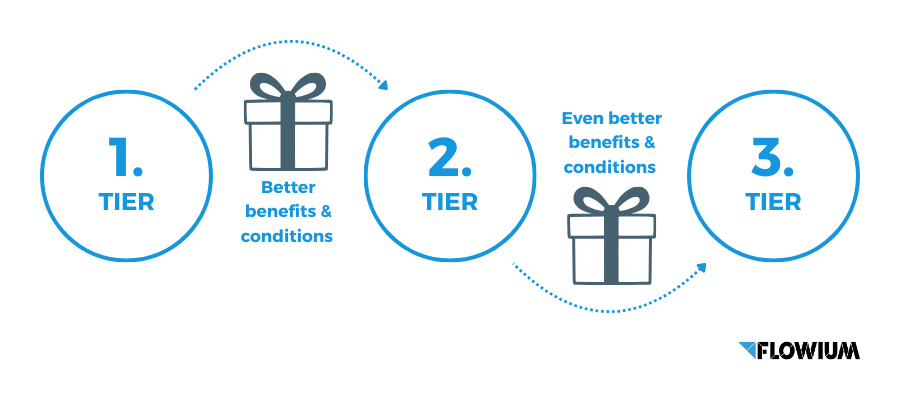
Suitable for: A tiered program is best suited for companies with a low frequency of purchases, as it will give customers an incentive to buy to reach a higher level.
Points-based Programs
By accumulating points mainly by purchasing branded goods, a customer can receive pleasant bonuses such as discounts, gifts, or exclusive products. This will encourage customers to buy the products they need from you. This type is the simplest eCommerce loyalty rewards program as a way to extend the customer’s lifetime value.
Suitable for: Such a program is suitable for increasing the value of purchases rather than the frequency. This happens due to the system’s feature where the larger the amount of goods, the more points you can get, which will be a significant incentive for your subscribers.
Value-based Programs
Value-based loyalty programs are focused on building deeper connections with your customers by rewarding actions that align with your brand values, such as social responsibility, sustainability, or participation in the community.
Suitable for: A value program is suitable for reducing the extra spend on customer acquisition. Creating such an emotional connection with customers reduces their outflow, which in turn allows you to avoid spending on external companies aimed at increasing engagement.
Subscription Programs
Subscription programs are becoming more and more popular by the day due to the spread of services provided for the purchase of subscriptions. The reward of these programs is in the form of bonuses provided for the purchase of subscriptions. In other words, if a client buys a subscription to certain products, they receive certain bonuses for this, as opposed to a one-time purchase.
Suitable for: A loyalty subscription program is best suited for eCommerce businesses with a high purchase frequency rate, and as benefits will bring recurring revenue and reduced customer churn.
Paid Programs
Another example of a loyalty program is a paid program. Their essence lies in the fact that customers receive bonuses and special opportunities for purchasing a certain membership. This type reminds us a bit of a subscription program. This method allows you to get even closer to loyal customers and provide more opportunities for other customers.
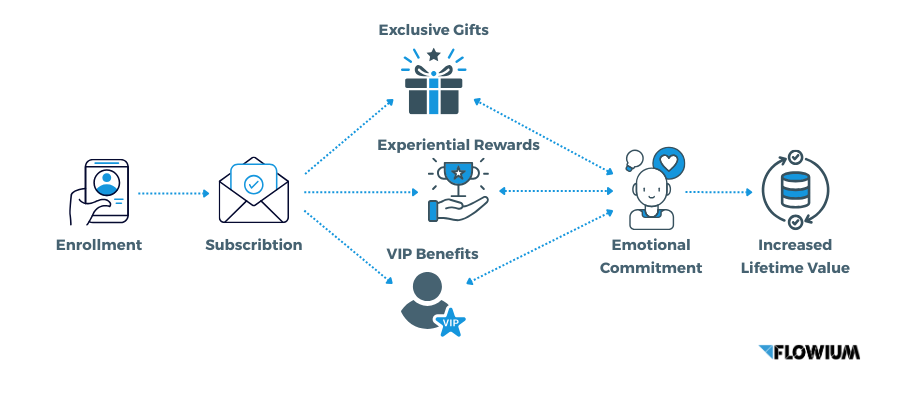
Suitable for: It is most often used by companies that want to create more exclusivity in sales. It will also help to create a separate segment of customers who are more loyal, or in other words, more qualitative.
Referral Programs
Referral loyalty programs promote word-of-mouth marketing. The strategy involves motivating existing customers to invite their friends, family members, or colleagues to shop at your store. Usually, both the referrer and the referred person receive a special offer or a simple discount. The person invited receives a discount on their first purchase, while the referrer receives a reward only after the person they invited makes their first purchase. This turns loyal customers into something of a brand ambassador.
Suitable for: A referral program is best suited for eCommerce businesses seeking to reduce CAC and reach a new audience through word-of-mouth marketing. It is particularly effective for brands with high levels of customer satisfaction and products that people naturally recommend even without a referral program.
Coalition Programs
The name of this program speaks for itself; its essence is to create a coalition of several brands to create a joint mutually beneficial reward program. This means that the client will receive bonuses from more than one company, which will encourage them to visit the company that additionally participates in the program.
Suitable for: Among other benefits, this program will bring new customers to the company. It is suitable for companies that want to increase their customer base. It works like a mutual exchange of customers between companies.
Hybrid Programs
What could be better than a loyalty program? That’s right, two combined loyalty programs. By combining them, you can take the best of each and get twice as many benefits. As an example, in addition to offering points for purchases, you can also give points for reaching levels or purchasing subscriptions.
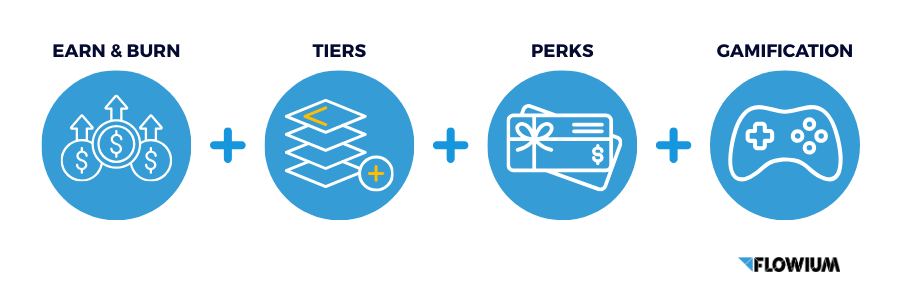
Suitable for: This program can be suitable for any business, depending on which programs you combine. However, managing multiple programs at the same time is much more difficult and requires a careful approach. You’ll need to be careful to avoid making the rules for rewards too complicated, so you don’t discourage or confuse customers.
Now that you know about these types of programs, you can choose the one that suits your target audience, industry, and goals to create the best experience for your customers.
7 Platforms for the Best eCommerce Loyalty Programs
Platforms that allow you to create your own unique loyalty program differ in terms of the business sizes they focus on, pricing, integrations, features, and much more. We’ve compiled a list of the 7 leading platforms for you, covering a range of price points and business scales. In addition, we’ve expertly evaluated their integration with Klaviyo, which is essential for retention marketing.
The first thing you need to check is whether the loyalty app integrates with your eCommerce platform. If it doesn’t, you can immediately eliminate this tool. You shouldn’t do a custom integration, which is expensive, takes more time, and may not work correctly.
Here’s a list of the most popular loyalty program platforms for brands that sell directly to consumers. If you need help choosing the right software for your business, schedule a free consultation and our team will gladly advise you on the best software for you.
| Loyalty Lion | Yotpo | Smile.io | Stamped | Antavo | Rivo | Bubblehouse | |
|---|---|---|---|---|---|---|---|
| Best for | Mid market | Mid / Enterprise | SMB → Mid | SMB → Mid | Enterprise | SMB | Mid / Niche |
| Starting price | $199/mo | $199/mo | $49/mo | $59/mo | Custom | Free | Custom |
| Key eCommerce platforms | Shopify | Shopify, BigCommerce, WooCommerce, Magento | Shopify, BigCommerce | Shopify, BigCommerce, WooCommerce, Wix | Shopify, Magento, Salesforce | Shopify | Shopify, Magento, Salesforce |
| Integrations | 50+ | 70+ | 20+ | 50+ | 40+ | 20+ | 40+ |
| Built-in review app | ❌ | ✅ | ❌ | ✅ | ❌ | ✅ | ❌ |
| Google certified | ❌ | ✅ | ❌ | ✅ | ❌ | ❌ | ❌ |
| Gamification | Basic | Basic | ❌ | Basic | Advanced | Basic | Advanced |
| Omnichannel / POS | ✅ | ✅ | ✅ | ❌ | ✅ | ❌ | ❌ |
| AI features | ❌ | Partial | ❌ | ❌ | Full module | ❌ | ❌ |
| Klaviyo integration | Deep | Deep | Deep | Standard | Standard | Standard | Standard |
| Dedicated CSM | Advanced | Pro | ❌ | Pro | All plans | ❌ | All plans |
Klaviyo integration depth is rated based on Flowium’s hands-on experience working with these platforms across client retention campaigns.
Now we will move on to a more detailed, extensive review of each eCommerce loyalty rewards program tool separately, for you to learn all their features from a broader perspective.
Loyalty Lion
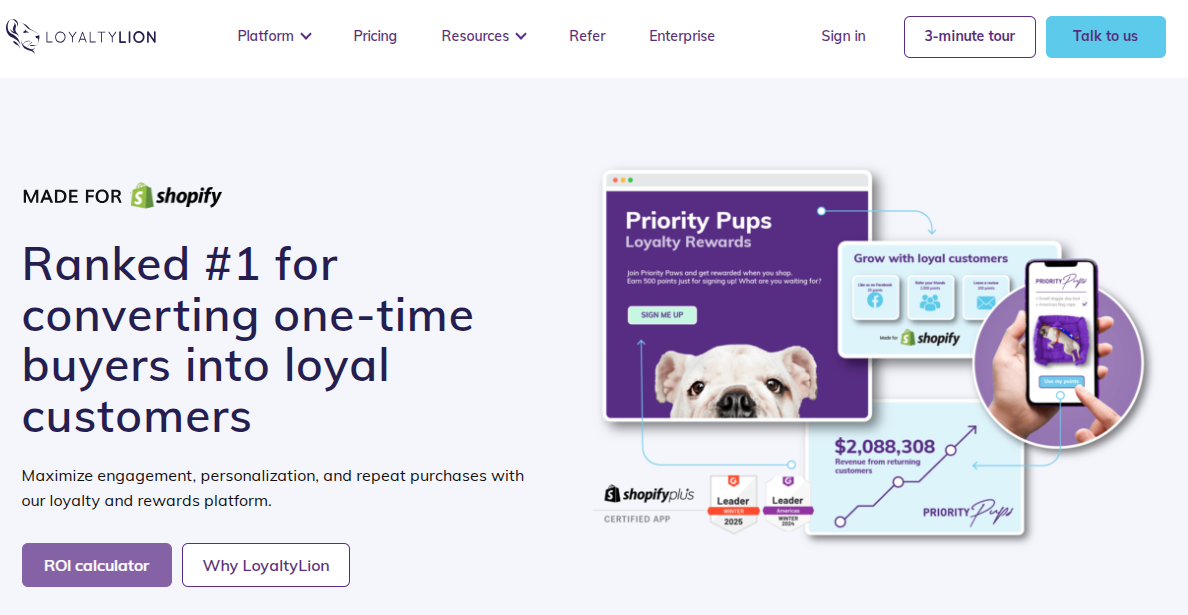
LoyaltyLion is known for its easy setup, making it simple for businesses to integrate and manage loyalty programs. The platform offers extensive customization, allowing businesses to tailor eCommerce loyalty to their brand and customers. However, its many features might feel overwhelming for those new to loyalty tools. LoyaltyLion builds an integrated, customized, and on-brand loyalty program fast.
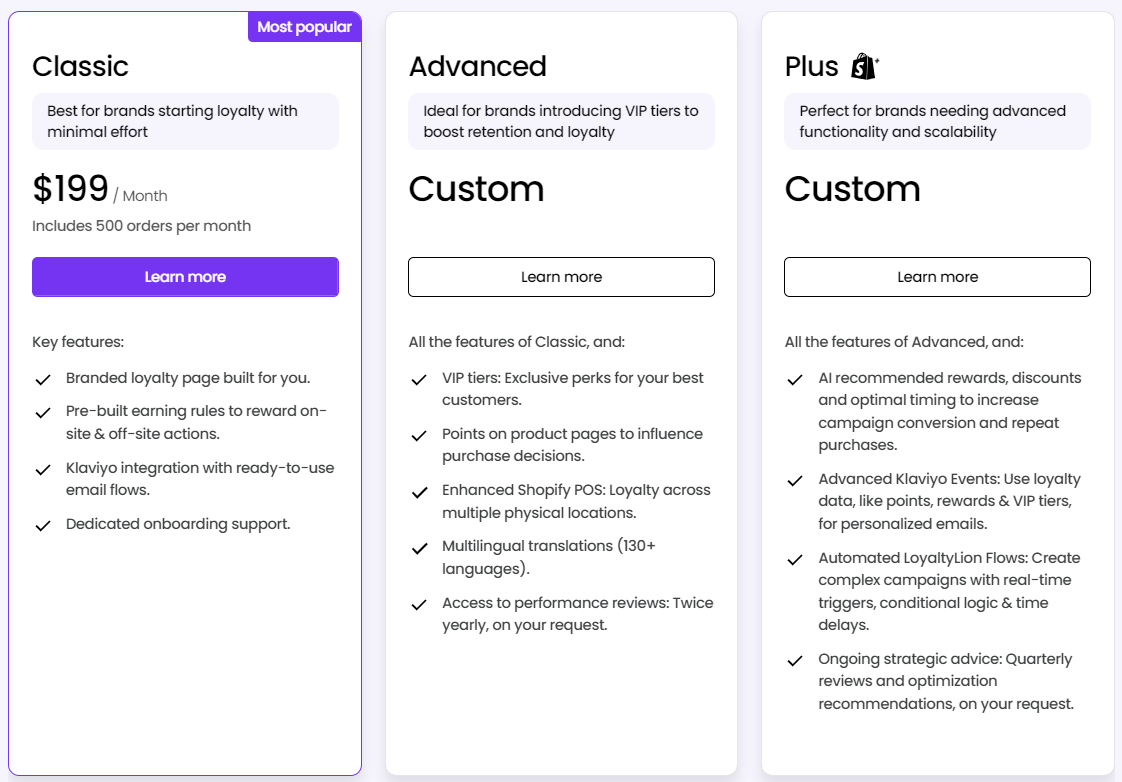
Pricing
Support
All plans receive basic live and email chat support, and onboarding support from either a Manager or Senior Manager, depending on your plan. They will also provide initial strategy and setup advice for all plans. Brands on the Advanced and Plus plans receive pre-launch support and access to a Customer Success Manager (CSM). On the Advanced plan, you’ll receive an Account Manager at renewal and access to business reviews bi-annually.
Key Features
- The first loyalty platform to integrate with Shopify and is 100% focused on loyalty.
- Rated #1 on G2Advanced analytics.
- Reward on-site and off-site actions with points and incentives, and flexible VIP tiers with exclusive perks.
- Offers a fully embedded loyalty experience rather than relying on a pop-up widget, making it feel like a natural part of your store.
- Platform segments customers into groups like Loyal, At Risk, and Win Back, allowing you to personalize communications.
- Lets your customers earn and redeem rewards online and in person.
Yotpo
Yotpo’s advanced modules allow to create highly customizable rewards pages without any technical expertise required. Merchants can easily make changes to fonts, colors, copy, images, layouts, and more—entirely out-of-the-box.
For Yotpo merchants on their annual plan, they offer a dedicated Implementation Manager to ensure a seamless onboarding experience. Your Implementation Manager will own and manage the project and ensure nothing falls through the cracks. For those on self-service plans, our 24/7 customer support team is always available to assist with any questions or guidance needed.
Pro tip: Yotpo is a bigger company than the others, and they have the whole suite of products they can offer. If you plan to use Yotpo for other services, their prices would be compatible.
Pricing

Support
In the Pro plan, customers get access to Live chat, helpdesk integration, and a community board, and on the Premium plan, Yotpo provides a Customer Onboarding Manager and Customer Success Manager. Yotpo’s Customer Success team is made up of over 100 dedicated professionals.
Key Features
- 20+ out-of-the-box earning rules, plus endless possibilities with custom campaigns
- Advanced segmentation that can be applied to specific earning rules directly in the UX
- Various points expiration options to protect your brand, as well as drive RPR
- Shopify new customer accounts support
- Advanced Klaviyo integration
- Onsite Modules
Smile.io
Smile has a guided, no-code-required walkthrough to help merchants configure and launch a rewards program using loyalty best practices. From there, they can add additional customizations and make use of all their plan’s features. Of course, if they have any questions, the chat widget (and fast access to help articles) are just a click away.
Merchants on Shopify who are on Smile’s Growth or Plus plan have access to the Loyalty Landing Page feature. With it, they can create a search engine-optimized landing page in the Shopify theme editor, with drag-and-drop page elements they can use to explain and showcase their program to customers.
Pricing
Pricing plans for the startups:
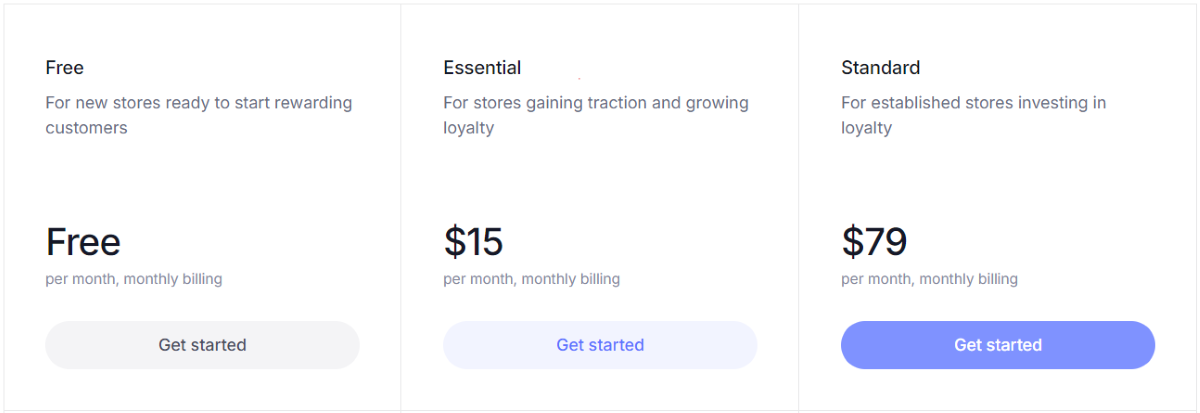
Pricing plans for scale:
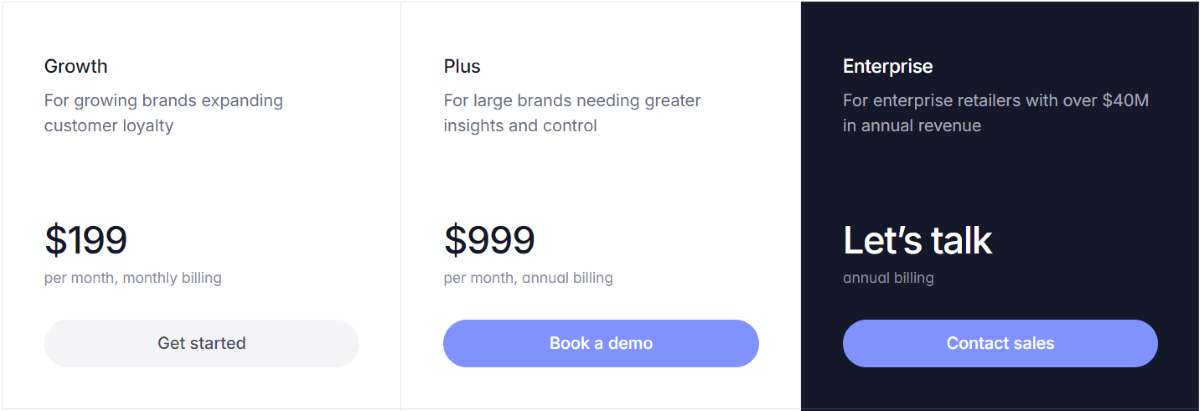
Support
Smile has 24/7 live chat support. They also have an incredibly detailed help center with over 200 articles to help walk merchants through commonly asked questions at their own pace.
Key Features
- On-site rewards content (Inject dynamic loyalty info on landing pages, PDPs, account page, and more)
- Over 25 specialized loyalty reports and benchmarks
- Automated bonus points campaigns
- Quick to launch and effortless to manage: launch a no-code loyalty program in literally minutes
- Built for Shopify and Shopify Plus Certified — Shopify certified for speed, security, and usability for the fastest-growing brands
Stamped
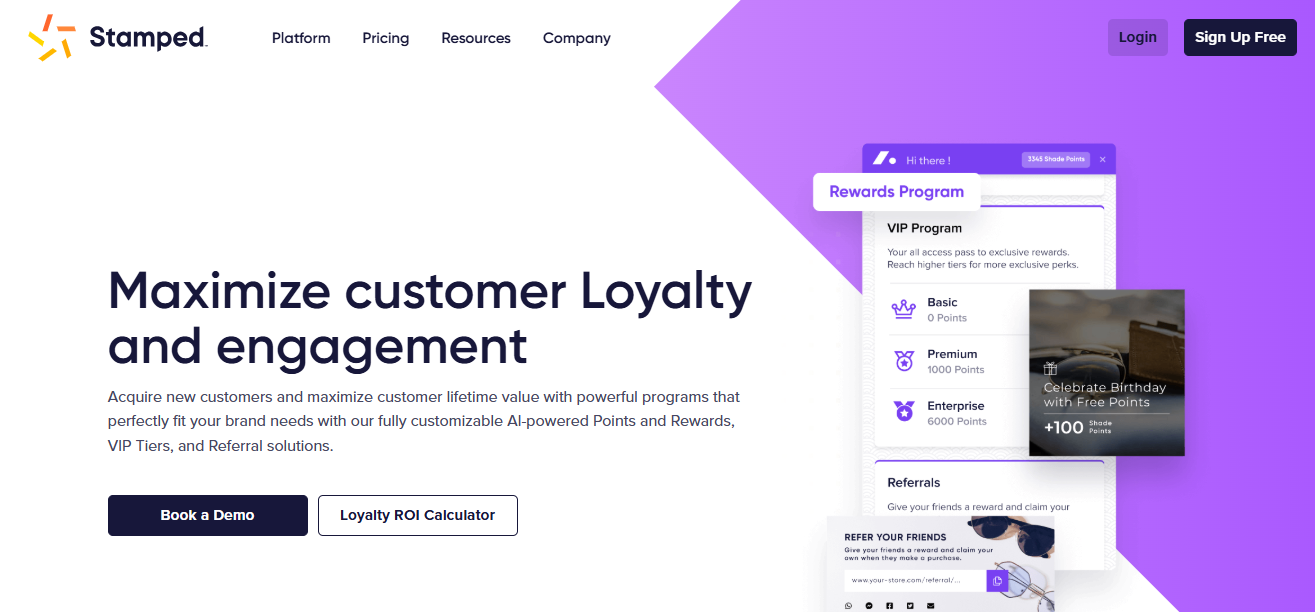
Stamped merchants who are on the Pro plan or higher will receive a Customer Success Manager to help advise merchants on their overall strategy and best practices to get the most out of the platform. The technical support manager will assist with implementing your program.
The steps include officially purchasing your Stamped Loyalty Program and setting up a call to kick off onboarding at their convenience. For lower plans, they support planning, implementation, onboarding, and optimization with technical support available via email 24/7.
With Stamped, you can take complete control of your loyalty landing page with custom CSS. Incorporate your logos, fonts, colors, and graphics to create a perfectly personalized program that matches your brand’s look and feel.
Pricing
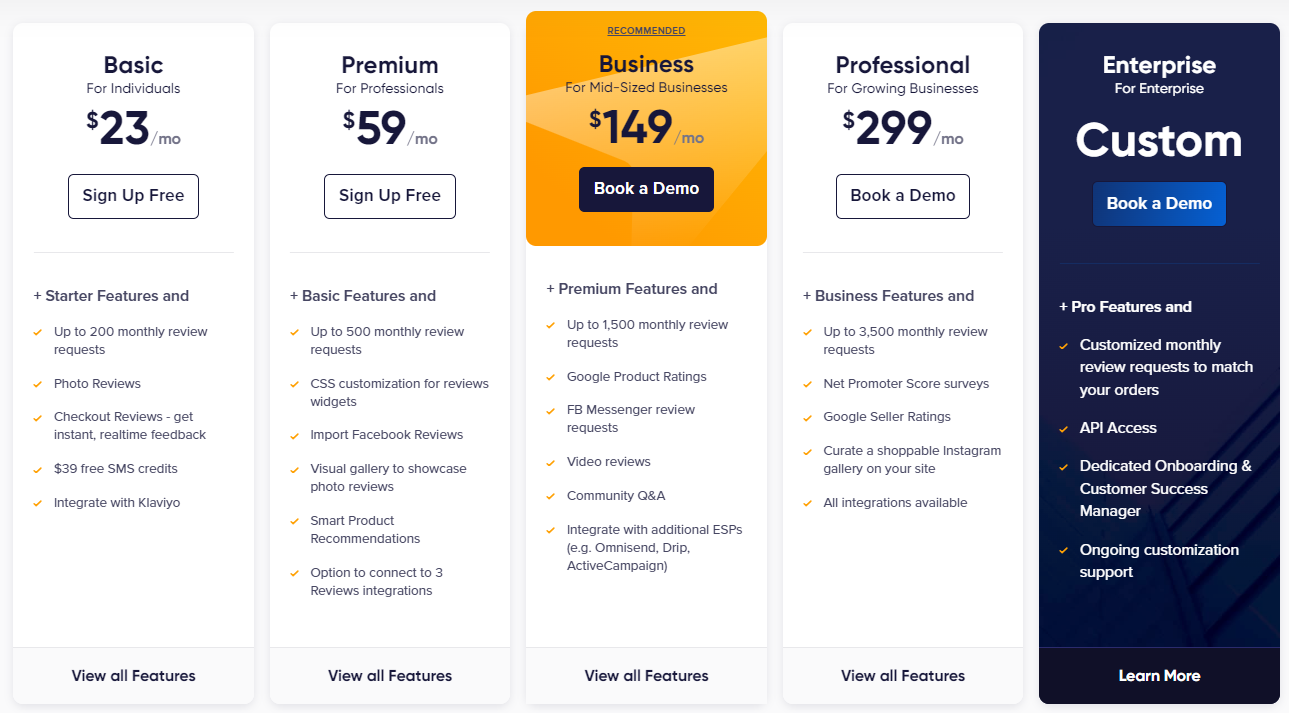
Support
With Stamped.io’s customer service, you can reach their customer support team through both live chat and email 24/7. Hands-on support is only available on Enterprise plans.
Key Features
- Expanded points and earning rules.
- Custom icons to keep brand storefront experience on-brand.
- Advanced customer profiles and data sync.
- Advanced analytics (you can see retention trends, LTV metrics, and granular retention campaign performance).
Antavo
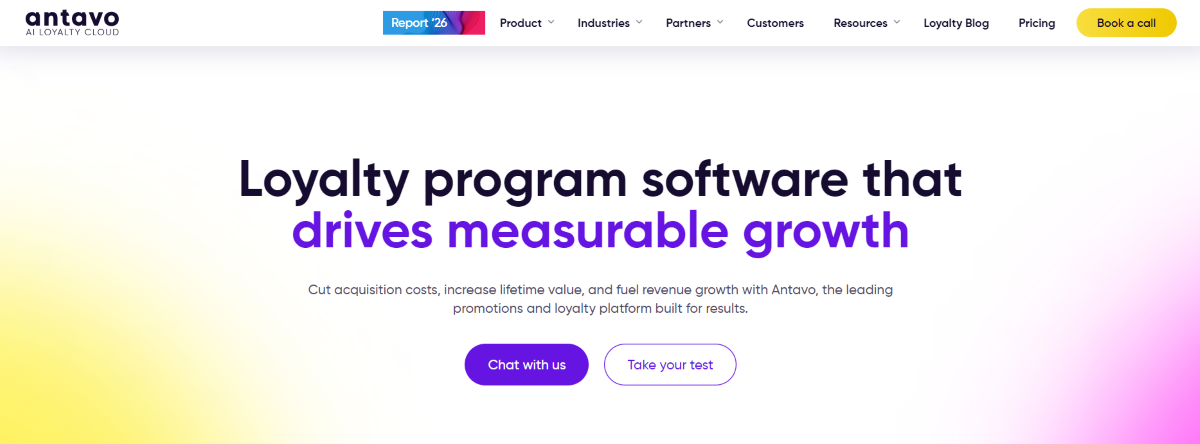
The Antavo platform stands out by positioning itself as an enterprise-level AI-powered loyalty platform. Certainly, most modern loyalty platforms now include AI as an additional feature; however, Antavo built it into the very foundation of its architecture. The platform brings together not only products such as “Loyalty and Membership” and “Promotions and Incentives,” but also “AI-Powered Loyalty.”
Pricing

Support
Antavo provides dedicated onboarding managers for all clients, regardless of their pricing plan. For requests regarding custom features or design, a dedicated team for solution development and deployment may also be assigned. However, Antavo does not offer 24/7 real-time support. Response times are up to 3 business hours on weekdays and up to 6 hours on weekends.
Key Features
- Full-featured AI-powered loyalty module.
- Omnichannel loyalty covering online and offline retail, with built-in support for Shopify, Magento, and Salesforce Commerce Cloud.
- Over 40 integrations, including Klaviyo, Bloomreach, and Braze.
- The annual “Global Customer Loyalty Report” one of the most frequently cited research sources.
Rivo
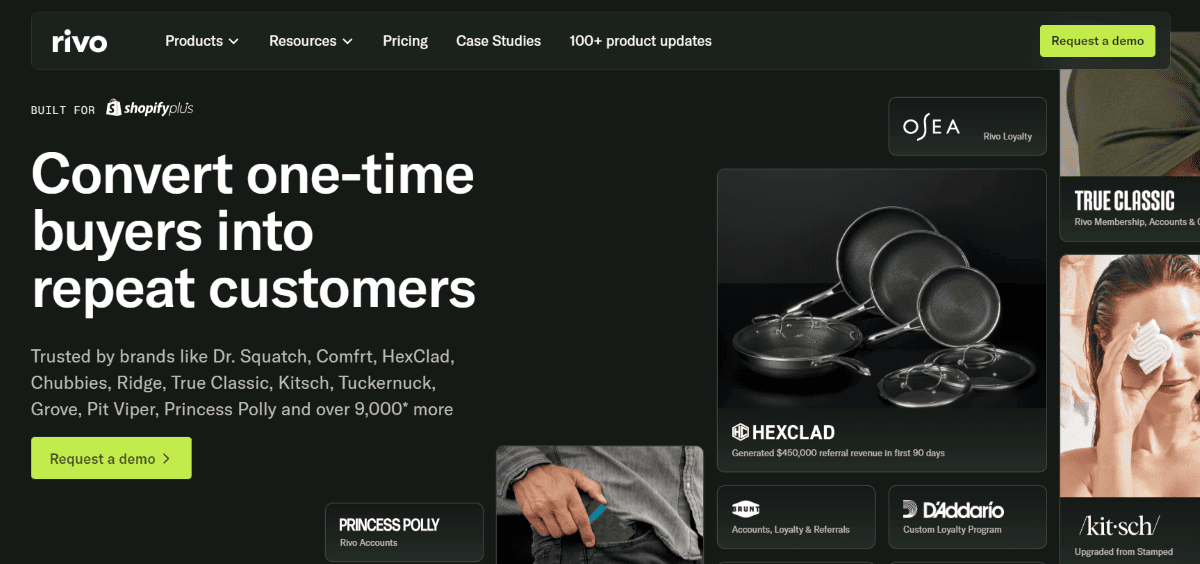
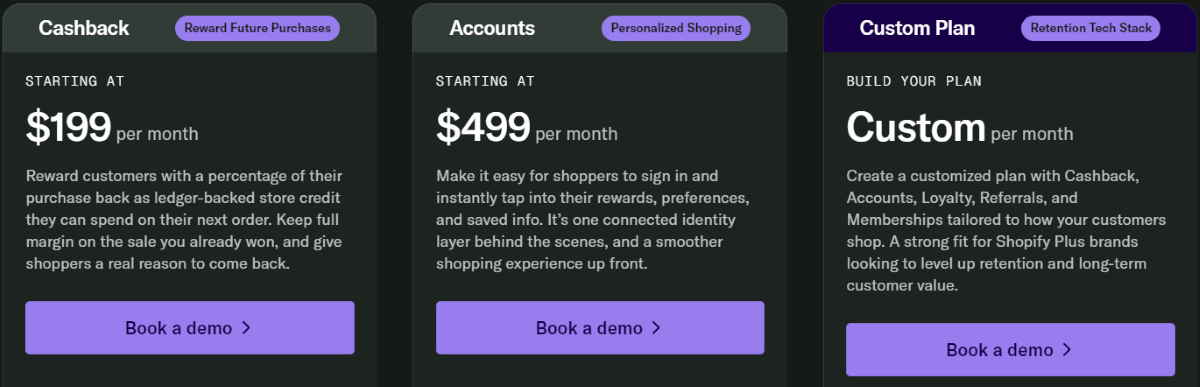
Rivo is featured in our review because it is the newest and most affordable platform. Although designed exclusively for Shopify, it’s geared toward small and medium-sized brands, providing them with a reliable foundation for a user-friendly loyalty program. Rivo stands out in this segment thanks to its combination of a truly convenient free plan and a built-in feedback collection tool.
Pricing
Support
Rivo offers 24/7 live chat support for all pricing plans, including the free one. Setup is also guided by step-by-step instructions. Enterprise-level clients have access to dedicated account managers. For standard pricing plans, there is no formal Customer Success Manager (CSM), so brands that need proactive strategic recommendations will eventually run into limitations.
Key Features
- Free plan with core loyalty program features.
- Built-in review app.
- User-friendly program builder with no coding required.
Bubblehouse
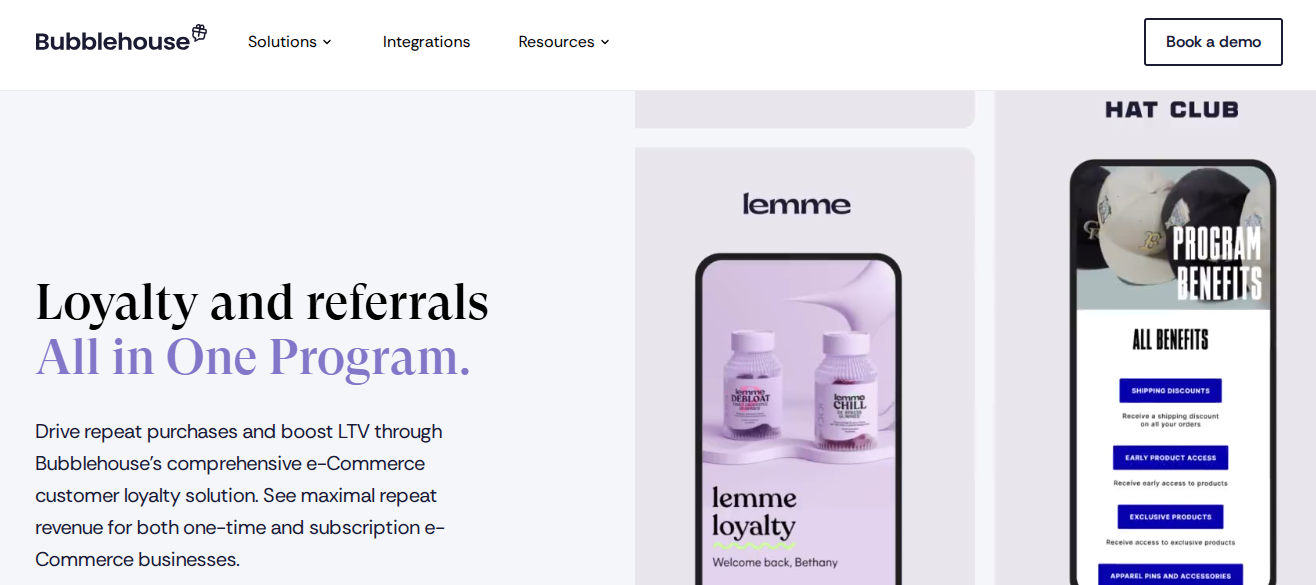
Bubblehouse offers white-glove onboarding services with dedicated onboarding managers for all their merchants. From custom-designed landing pages and strategic consulting to program configuration and more, these services are all handled by Bubblehouse in collaboration with the merchants’ teams.
A dedicated solution & launch engineering team can be assigned to each merchant as well to support custom feature or design requests. Bubblehouse merchants have the option to join their in-house UI/UX team to custom design their loyalty landing page, or Bubblehouse can also handle the process entirely.
Support
Bubblehouse’s customer support team has a response time within 3 hours on weekdays and 6 hours on weekends. Post-launch strategy & optimization with custom analytics reporting are also available at the merchants’ preferred cadence (typically on a quarterly basis).
Key Features
- 30+ out-of-the-box points campaigns.
- 4 points redemption methods.
- 5 criteria for upgrading the VIP tier. Rewards VIP customers with exclusive perks to encourage ongoing spending.
- 180+ achievements campaign combinations.
- Gamification of loyalty experience. Brands can create unique and personalized loyalty challenges to incentivize specific actions.
- Voting and Quizeez. These features enhance the shopping experience, help gather valuable insights for brand customers, and provide future marketing opportunities.
- Subscription Rewards. Unique rewards on subscription purchases.
Examples of the Best eCommerce Loyalty Programs
To give you a better understanding of how loyalty programs look and work and to give you a general idea, we’ve selected 3 of the best examples of loyalty programs. By focusing on them, you can see what really works and take the best time-tested strategies from them.
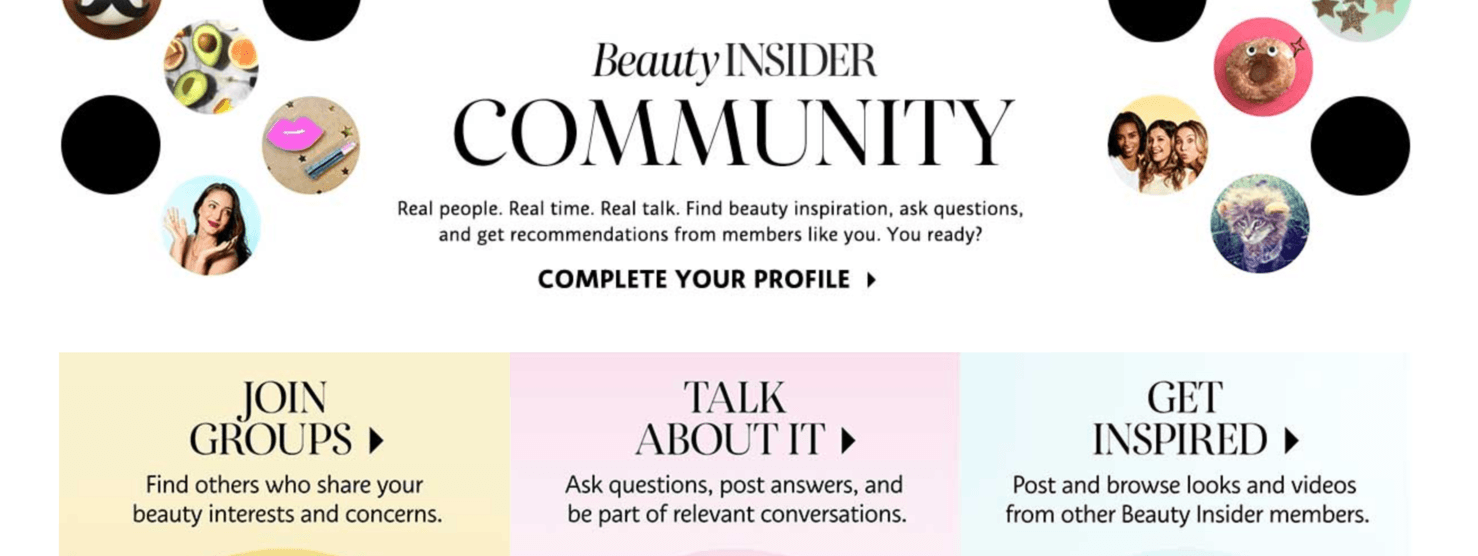
“Beauty Insider” by Sephora
Sephora’s Beauty Insider program has become one of the best-known and most successful loyalty programs, and it continues to be studied as a model of effectiveness. From 25 million members in 2020, it grew to 45 million in North America alone by 2025. That’s a 75% increase over five years.
Most importantly, program members are not passive and account for 80% of Sephora’s sales in North America. This is because its multi-tiered model encourages increased spending, while exclusive access to products and events helps build brand loyalty.
Program Structure:
The program has three tiers, each of which unlocks increasingly exclusive benefits:
- Insider (annual spending of $0–$349)
- VIB ($350–$999)
- Rouge ($1,000 and up)
A key differentiating strategy is that Sephora deliberately keeps cashback rates low (effectively 2% at the Rouge level), compensating for this with experiential rewards such as:
- exclusive product launches,
- brand workshops,
- In-person events like the Rouge Celebration.
The latest evolutionary stage has been gamification. “Beauty Insider Challenges,” a gamification layer added to the program, engaged 30% of the total member base within 18 months of launch.
Key Takeaways: Experiential rewards are significantly more effective for customer retention than standard discounts. Sephora maintains its profitability in a unique way by limiting the conversion of points into cash, while simultaneously investing heavily in exclusivity and personalized experiences.
Lego Insiders
The LEGO loyalty program is an example of effectiveness from another angle: customer retention through community engagement. Members can earn points by scanning the QR code on the instructions included in any LEGO set, regardless of where it was purchased.
Points can only be used on LEGO.com or at official LEGO stores. This ensures customers are always directed back to the brand’s own channels, which helps increase the rate of repeat purchases. LEGO research shows that 73% of people would download an app to earn loyalty points.
Program Structure:
The points structure is simple and balanced. A 5% conversion rate ensures that customers feel rewarded without compromising LEGO’s profitability. Members also earn points by participating in the community by:
- filling out surveys,
- engaging with LEGO content,
- registering sets.
Key Takeaways: LEGO uses its loyalty program primarily as a customer retention tool. Every interaction, whether via QR code, the app, or instructions in the packaging, directs customers back to LEGO’s own channels. Community engagement serves a different purpose: it creates non-purchase-related interactions that keep members active between purchases.
REI “Co-op Membership”
The REI program is fundamentally different from all the other examples on this list. It is a paid membership (a one-time fee of $29 for lifetime access) rather than a traditional loyalty program. In 2025, REI recruited one million new members, bringing its total membership to over 26 million.
Program Structure:
The main benefit is an annual cashback of 10% on full-price purchases, paid out every March as a one-time cooperative member reward. In 2024, REI members received a total of $189 million in annual rewards, in real money. This deferred payment strengthens the emotional connection to the brand more effectively than a typical discount.
Co-op members also receive:
- right to return merchandise within 365 days,
- access to members-only sales,
- opportunity to trade in used gear through REI’s “Re/Supply” program,
- right to vote in elections for the co-op’s board of directors.
The last point gives members a sense that they are co-owners, not just customers, which creates a completely different emotional connection.
Key Takeaways: REI proves that a one-time membership fee actually strengthens loyalty rather than diminishing it. When customers invest in the program, they become more actively engaged and stay longer, since it’s their own money. The unique features of their cooperative model, such as real cashback, a real share of ownership, and real voting rights, create the strongest sense of belonging.
How To Choose a Loyalty Program for Ecommerce
Choosing the right option among all these eCommerce rewards programs is a painstaking process. Your success depends on how well you choose the right program for you, including how much your retention rate, sales, and customer lifetime value will increase. The following key factors should be considered when comparing these programs:
- The size of your business
You need to choose a program that will match the scale of your business. Loyalty programs for eCommerce should be able to fully handle the volume of a large business and be able to unlock the full potential of a small business. Small businesses will be able to benefit from simple, reliable, and effective programs. Large businesses, on the other hand, will need revolutionary solutions to keep up with their growing customer base.
- Estimated budget
Calculate how much you are willing to spend on a particular rewards program to enable all the features and metrics you need. Choose the one that meets your revenue expectations among all the options.
- Seamless integration
You need to choose the right program that integrates seamlessly into your technology system and brings you and your customers enough convenience. Pay attention to whether the eCommerce loyalty program can integrate with your existing POS and CRM.
Properly integrated loyalty will help you conveniently track customer behavior and set up personalization and segmentation. Additionally, syncing loyalty data with your email and SMS channels enables automated, targeted messaging. You can send instant updates on point balances, tier status, or expiring rewards to drive repeat sales.
- Adapting functions
Some programs offer a whole range of functions, while others are limited but no less effective. Think about what functions you need to customize such integration to the needs and requirements of your business and its customers.
Requirements of Successful eCommerce Loyalty Programs
Before building your own eCommerce loyalty program, you should analyze and learn the basic requirements of every successful and effective rewards program. If your program prototype includes all the features we have listed below, it will definitely be successful and bring you many benefits and profits.
1. Mobile adaptation
eCommerce is constantly changing, adapting, and increasing purchase rates on mobile devices. Ensure your rewards program is tailored to mobile users by understanding their behavior. Don’t forget that they are more likely to choose a mobile app over a website.
2. A place of comfort
Make your rewards program more like a community of shared interests. Make it more than just a place to compete for rewards, but also a place to have fun with entertaining stories and experiences related to your brand.
3. Personalization
The loyalty program should feel personal enough for the customer. Collect additional customer data, and do whatever it takes to make the program feel as personalized as possible.
4. Flexibility
The approach to customers should be flexible and give them many ways. Not all customers will want to fulfill certain requirements that you demand for rewards. Introduce different ways to achieve rewards to attract more customers to your loyalty program.
How to Measure the Success of the eCommerce Loyalty
Of course, once you’ve implemented a loyalty program, you’ll want to measure how successful it is and in what areas it is most successful. Knowing these indicators, you will know how to develop it further, where to push it, and what is not working. We provide you with key metrics that will show you how your program has worked.
- Customer retention rate
If your customers are coming back for more and more purchases, then your program is really working. This is the main indicator by which you can judge the success of the program. It’s easy to measure if you have an organized customer base.
Most types of loyalty programs increase not only the frequency of purchases but also their average value. Keep an eye on this metric to see if your program is encouraging customers to climb the rewards ladder and increase their participation in the program.
CLV helps you understand how much a customer is worth over the entire time they shop with you. Members of your loyalty program should have a higher CLV than non-members.
- Engagement beyond transactions
Loyalty increases not only your profitability but also customer engagement. Keep an eye on customer engagement outside of the program, such as reviews or social media.
Final Thoughts
In our comprehensive review of loyalty programs, we identified the key benefits they offer, including increased customer lifetime value, repeat purchases that lead to higher revenue, and much more. In addition, we’ve broken down the main types of loyalty programs so that, once you’ve chosen the one that suits you, you can select the right platform. The 7 loyalty platforms we’ve reviewed are tailored to different needs and scales.
If you’d like to entrust the development of a successful loyalty program strategy for customer retention based on your specific needs to professionals, you can rely on Flowium as experts in retention marketing. Request a free audit and let our experts develop the most effective retention strategy for you.