It takes more than just generating traffic and sales to grow an ecommerce brand profitably. Brands must have a clear understanding of whether their marketing expenditures are generating long-term, sustainable value, as client acquisition costs are rising across all channels.
Leading ecommerce businesses, therefore, monitor three crucial metrics: Customer Lifetime Value (LTV), Return on Ad Spend (ROAS), and Customer Acquisition Cost (CAC). When combined, these KPIs help gauge customer profitability, marketing effectiveness, and acquisition efficiency. One of the most crucial measures of sustainable growth among them is the LTV to CAC ratio.
This article will teach you how to calculate the LTV:CAC ratio, understand industry standards, spot performance gaps, and improve your metrics by using better acquisition and retention tactics.
What Is the LTV to CAC Ratio?
Monitoring your Customer Lifetime Value to Customer Acquisition Cost ratio reveals the effectiveness of your customer acquisition, retention, and long-term value generation. This measure shows if your business approach generates long-term growth or spends money on each new client.
Two crucial figures are compared in the ratio.
- LTV calculates the gross profit you make from a typical client over the course of their business relationship.
- CAC is the amount of money you spend on marketing and sales to acquire that client.
To put it simply, CAC represents the marketing and sales expenses incurred in acquiring a customer, whereas LTV represents the overall gross profit a customer creates throughout their association with your business. Your acquisition activities are generating long-term value when LTV far exceeds CAC. Scalability and profitability become more difficult when the ratio is low.
Why LTV:CAC Matters
Fundamentally, the LTV/CAC ratio calculates ROI, or the amount of value your business receives for each dollar invested in customer acquisition. Long-term revenue growth is fueled by both growth efficiency and lucrative acquisition strategies, which are shown by a high ratio.
However, this measure is more complex than just ROI. The LTV/CAC ratio provides vital information about your current or future profitability, and investors are interested in a company’s solvency—its ability to meet its debt obligations. The ratio serves as a stand-in for how sustainably you’re growing.
Let’s look at more factors that make monitoring LTV to CAC so crucial for businesses.
- Assesses Growth Efficiency
The LTV ratio illustrates the amount of value your company creates for each dollar invested in acquiring new clients. A healthy percentage shows that your marketing expenditures are generating long-term, profitable growth as opposed to just boosting immediate sales.
- Directs the Allocation of Marketing Budgets
Knowing your ratio makes it easier to determine whether acquisition channels are producing enough long-term value to support further investment. While poorer results may indicate that targeting, retention, or channel mix need to be improved, strong performance may warrant scaling ad spend.
- Emphasizes Opportunities for Retention
The LTV ratio encourages organizations to concentrate on both acquisition and retention since recurrent purchases have a significant impact on customer lifetime value. SMS advertising, email marketing, loyalty programs, and customized consumer experiences can all help to raise the statistic.
- Enables Smart Customer Segmentation
The audiences that yield the best long-term profitability can be identified by analyzing LTV:CAC ratio by customer segment or acquisition channel. Ecommerce marketers can better manage resources and prioritize high-value client segments with the aid of these analytics.
How to Calculate LTV to CAC?
Accurately evaluating LTV and CAC criteria can be difficult, particularly for ecommerce companies that rely significantly on repeat business and acquire customers through a variety of channels.
We’ll show you a detailed instruction on how to calculate LTV/CAC, so you can do it easily and accurately.
LTV to CAC Ratio Formula
The general LTV to CAC formula is pretty straightforward.
You can determine the LTV/CAC ratio by dividing your client lifetime value by your customer acquisition cost.

Although the calculation is simple, the difficulty is in precisely computing LTV and CAC separately before combining them into a significant ratio.
Step 1. Calculate Customer Acquisition Cost (CAC)
The first step in calculating CAC is to total all acquisition-related costs. This ecommerce metric measures how much your business spends to acquire a new customer over a specific period.
To calculate your CAC, divide the total by the number of new clients you brought in during that time.

What to Include in CAC
For the most accurate calculation, include all customer acquisition expenses:
- Paid advertising (Meta, Google, TikTok, YouTube, etc.)
- SEO and content marketing costs
- Influencer and affiliate marketing expenses
- Agency and freelancer fees
- Marketing software and tools
- PR and brand awareness campaigns
- Sales team salaries and commissions (if applicable)
- Trade shows, events, and partnership costs
Example:
An ecommerce business has a total marketing spend of $30,000 and acquired 250 new customers.
CAC = $30,000 ÷ 250 = $120
Step 2. Calculate Customer Lifetime Value (LTV)
The average revenue you may anticipate from a customer over the course of their engagement with your firm is represented by your numerator, LTV (customer lifetime value). This helps you see long-term value in relation to customer retention more clearly.
Ecommerce LTV Formula
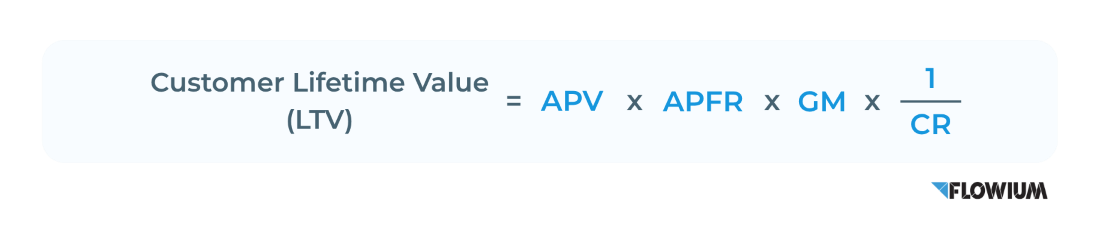
LTV = Average Purchase Value (APV) × Average Purchase Frequency Rate(APFR) × Gross Margin (GM) × 1/Churn Rate
Start by calculating your average revenue per user (ARPU) for a given time frame. After multiplying that by your gross margin (net revenue less cost of goods sold), reduce the outcome by your customer attrition rate for that time frame.
Example:
Suppose your store made $125,000 within a year. During that period, you had 750 unique customers who made 1,000 purchases in total.
APV = $125,000/1,000 = $125; APFR = 1,000/750 = 1.33
Let’s assume that your cost of goods sold for the entire year was $25,000 and your churn rate was 20%:
GM = ($125,000-$25,000)/$125,000 = 80%
LTV = 125*1.33*0.8*(1/0.2) = $665
Therefore, each customer is bringing $665 of gross profit, on average, during their lifespan with your business.
Step 3. Calculate the LTV to CAC Ratio
Once you have both metrics, divide LTV by CAC.
LTV:CAC Ratio = LTV ÷ CAC
Pro Tip: The LTV/CAC ratio can be computed at several levels, such as by a single client, a particular market segment, or a group of new or current clients over a predetermined amount of time. Because of this versatility, you may customize your analysis to better determine how effective your acquisition strategy is across different client categories.
LTV : CAC Ratio Example
For example, the LTV/CAC ratio is 3:1 if acquiring a customer costs $100 and they bring in $300 over the course of their lifetime. This demonstrates a solid return on investment since the company makes three times the acquisition cost. Thus, attaining sustainable expansion, gauging profitability, and drawing in investors all depend on a high LTV/CAC ratio.
Let’s use this with more variables. As an example, your typical order is $70. Consumers make three purchases annually. On average, they stay for 1.5 years. LTV is equal to $70 × 3 × 1.5 = $315. Your total CAC is $100
- LTV:CAC = 315 ÷ 100 = 3.15:1
This means the business generates approximately $3.15 in customer value for every $1 spent acquiring a customer.
What Is a Good LTV to CAC Ratio?
There is no universal benchmark for the ideal LTV/CAC ratio. Everything depends on your particular industry, business, and developmental stage.
The right target depends on factors such as your business model, industry, gross margins, customer retention rates, acquisition channels, and stage of growth. However, most economists and financial professionals agree that for ecommerce brands, 3:1 or 4:1 is an ideal LTV to CAC ratio. This means that your lifetime gross profit should be $3 for every $1 invested in customer acquisition. This ensures sustainable growth, pays for expenses, and finances reinvestment.
Maintaining a 3:1 ratio shows operational effectiveness and the capacity to convert acquisition costs into long-term customer value—qualities that are associated with higher valuations and better funding results.
Factors That Influence LTV to CAC Ratio
Several variables can impact what constitutes a good ratio for your business:
- Business model and growth stage
- Industry and competitive landscape
- Customer segments
- Marketing channels
- Gross profit margins
- Purchase frequency
- Customer retention and loyalty
Because these factors vary significantly between brands, it’s important to evaluate your ratio within the context of your specific business rather than relying solely on industry averages.
How to Interpret Your LTV:CAC Ratio
After calculating your LTV/CAC, you also need to know how to interpret it and make smart decisions based on this metric. You can utilize this data to strategically improve your business model and demonstrate to potential investors that you are a reliable investment.
What Different LTV:CAC Ratios Mean
More than just a measure of profitability, your LTV ratio gives you information about how well your acquisition strategy is working, how well your retention efforts are working, and how well your brand can grow over time. You may decide whether to reduce expenses, enhance customer retention, or make more aggressive growth investments by knowing where your ratio falls.
We’ve already established that 3:1 to 4:1 is the sweet spot for ecommerce. Below that, you’re using money you can’t afford to use to fund expansion. If the ratio is greater than 5:1, you are most likely not investing enough in acquisition, which implies that a rival will.
Let’s look at other possible ratios and what they mean for your business.
| Ratio Variants | What It Means | Recommended Startegy |
|---|---|---|
| Below 1:1 | Results in negative unit economics. | Reduce CAC, improve retention, and reassess acquisition channels. |
| 1:1 | After accounting for COGS, shipping, and operating expenses, profitability is unlikely | Focus on increasing LTV and improving acquisition efficiency. |
| 2:1 | Positive unit economics, but limited margin for sustainable scaling. | Optimize retention and repeat purchase rates to improve profitability. |
| 3:1 | Considered the benchmark for healthy ecommerce growth. | Continue scaling while maintaining acquisition efficiency. |
| 4:1 | Strong profitability and efficient customer acquisition. | Explore opportunities to increase marketing investment and accelerate growth. |
| 5:1+ | Customers generate significantly more value than acquisition costs. | Consider increasing acquisition spend to capture additional market share. |
- Below 1:1. Unsustainable Growth
A brand has an acquisition cost-to-profit ratio of 1:1.25 if it spends more on marketing each customer than it will ever earn from that customer. Every purchase is losing a significant amount of money when other costs are taken into account.
- 1:1. Even on Acquisition
If the ratio is 1:1, a brand’s customer acquisition cost is equivalent to the customer’s lifetime value. This may give the impression that the business is profiting from each new client, but in reality, it is losing money. When the cost of goods sold, taxes, and shipping are taken into account, a 1:1 LTV:CAC ratio shows that the brand is losing money.
- 2:1. Positive Dynamic but Limited Profitability
With a 2:1 or 3:1 ratio, a company may expect to earn two to three times as much from each customer as it did from the first expenditure in acquiring them.
- 3:1. Ideal for Ecommerce
A 3:1 ratio is seen by many as “excellent.” This is also a common goal for venture capitalists and other investors.
- 4:1. Strong Growth
A higher ratio, such as 4:1, can indicate more growth opportunities, therefore you should raise your marketing budget appropriately.
- 5:1 and More. Potential Underinvestment in Acquisition
If the LTV:CAC ratio favors LTV, a company can be missing out on significant growth. The time to boost marketing and advertising expenditures is now.
When the Ratio Is Too Low
Ratios less than 3:1 indicate poor retention or ineffective acquisition. Even a 2:1 ratio indicates low ROI or churn problems, whilst a 1:1 ratio indicates you are losing money on each new client. These situations require optimization through tighter product-market fit, enhancing marketing effectiveness, or modifying client onboarding and engagement.
When the Ratio Is Too High
Under-investment in growth is frequently indicated by ratios that are far higher than 3:1, such as 8:1 or 10:1. Even when profitability appears high on paper, it could indicate that your business is losing market share due to excessively cautious acquisition spending. Those chances could be seized first by rivals who are prepared to make more aggressive investments.
Pro Tip: Monitoring the statistics over time is crucial if you want to get the most out of it. Trends allow you to determine if changes are beneficial or detrimental. Just remember that the ratio won’t show any changes you make right away.
LTV to CAC Ratio Benchmarks for Ecommerce Verticals 2026
According to a recent report from Eightx, due to variations in margins, buy frequency, retention, and subscription acceptance, acceptable LTV:CAC ratios varied considerably by vertical.
| Ecommerce Vertical | Typical LTV:CAC | Interpretation |
|---|---|---|
| Ecommerce Average (General Benchmark) | 3:1–4:1 | Widely accepted benchmark for sustainable growth. |
| DTC Ecommerce (Overall) | 2.5:1–4:1 | Considered a healthy range when measured using contribution margin rather than revenue. |
| Pet Supplies | 3.5:1–4.5:1 | Strong retention and replenishment cycles support higher lifetime value. |
| Subscription Boxes | 3:1–5:1 | Recurring revenue models generally produce the highest ratios. |
| Beauty & Personal Care | 3:1–4:1 | Healthy retention and replenishment behavior support strong unit economics. |
| Supplements & Wellness | 3:1–4:1 | Repeat purchases and subscriptions drive profitability. |
| Food & Beverage | 2:1–4.5:1 | Performance depends heavily on reorder frequency and subscriptions. |
| Fashion & Apparel | 2:1–3:1 | High return rates and lower retention often compress LTV. |
| Home & Lifestyle | 2:1–3:1 | Longer purchase cycles make repeat revenue harder to generate. |
| Consumer Electronics | 1.8:1–2.5:1 | High CAC and infrequent purchases typically result in lower ratios. |
As you can see, the classic “3:1 rule” is still a helpful standard, but it should be viewed as a place to start rather than an all-encompassing goal. Fashion and consumer electronics firms can stay healthy at ratios closer to 2.5:1-3:1 because of structural variations in buying behavior and profitability, but subscription-heavy sectors like pet, wellness, and beauty sometimes need to surpass 4:1 to be deemed top performers.
How to Improve LTV to CAC Ratio: Our Recommendations
Without a doubt, you need a balanced strategy to improve your LTV ratio, which usually includes raising client lifetime value while keeping acquisition expenditures under control. Instead of depending only on higher advertising expenditures, we always recommend prioritizing customer experience, retention, and acquisition efficiency to our ecommerce clients.
Boost Customer Retention
One of the best strategies to increase LTV is to retain customers.
Increasing LTV is mostly dependent on improving customer retention, and statistics clearly show how loyalty and satisfaction affect long-term profitability. A Bain & Company study found that a just 5% increase in client retention rates can result in a 25% to 95% increase in earnings. Additionally, loyal consumers spend 31% more than new customers and are 50% more willing to try new products.
Optimize Customer Acquisition
Increasing the effectiveness of your marketing channels will help you acquire clients more quickly. You may concentrate on inexpensive channels like content development, SMS marketing, and email. By eliminating unnecessary ad expenditure through data-driven targeting and segmentation, you may also cut expenses.
Effectively Upsell and Cross-Sell
Another strategy to raise a customer’s lifetime value is to persuade them to purchase more goods or services. In addition to increasing income, providing complementary items through cross-selling or higher-value options through upselling improves the customer experience by satisfying more of their demands.
Modify Subscription and Pricing Strategies
Striking a balance between raising LTV and lowering CAC is the most sustainable strategy to maximize your LTV/CAC ratio. Therefore, reviewing your pricing structure might have a positive effect. Offering flexible payment methods, combining products, or introducing value-packed subscription levels can increase the appeal of your offers to prospective clients and entice current ones to spend more. A well-thought-out price strategy lowers entrance barriers and fosters customer loyalty, guaranteeing that clients will stick with your company over time.
Monitor Reorder and Churn Rates
The rate at which customers gradually stop making purchases from your store is known as the customer churn rate for subscription businesses. One of the most important aspects of raising lifetime value is lowering turnover.
A monthly churn rate of 2% to 4% is usually the goal of healthy subscription organizations. Customers don’t “churn” for single-purchase enterprises; instead, they just don’t place new orders. Unless your company sells expensive, one-time things, a healthy benchmark to aim for is a 50% reorder rate.
Improve Client Experience and Product Value
Maintaining client loyalty and increasing LTV requires ongoing quality and value delivery. Customers stay interested in and invested in your brand when you regularly update your product or service to incorporate new features, meet changing client wants, or reflect the newest trends.
Giving them exceptional quality boosts their confidence and discourages them from looking for other options. Businesses that put innovation and improvement first show their clients that their success and happiness are important, opening the door for enduring partnerships that boost LTV.
Optimize Conversion Funnel
By more successfully turning leads into clients, a good sales funnel is essential to lowering acquisition expenses. Reducing drop-offs and raising total conversion rates can be achieved by streamlining every step of the funnel, from initial lead generation to sealing the deal.
Sales teams can concentrate on high-value prospects by automating tedious processes and streamlining communication workflows with the help of tools like customer relationship management (CRM) software. This improves the customer journey and reduces CAC, resulting in a more seamless experience that promotes enduring loyalty.
Conclusion
Summing up, we want to emphasise once more the importance of striking a balance between customer acquisition and retention to promote sustainable growth. If you put too much emphasis on customer acquisition, you run the danger of poor LTV and high churn rates. If you prioritize retention above effective acquisition, expenses may skyrocket.
If you want to achieve the ideal LTV to CAC ratio but don’t know where to start, contact Flowium. Our experts will work together with your team to help you gain a potent competitive advantage and set you up for sustainable growth.
Frequently Asked Questions
What is the ideal LTV to CAC ratio?
The ideal ratio is thought to be 3:1. Your customer creates three dollars in lifetime value for every dollar spent on acquisition expenditures, demonstrating a sound balance between growth and profitability.
How frequently should my LTV:CAC ratio be recalculated?
At least once a month, with quarterly cohort-level analysis. Your monthly scorecard should include the aggregate ratio. To identify degradation early, break it down by acquisition cohort, product line, and channel every quarter.
What should I do if my LTV:CAC is less than 2:1?
Contribution margins should come first. Prioritize fixing price or sourcing if gross margins are below industry standards, since scaling with broken margins speeds up losses. Examine first-to-second purchase retention after that. Your highest-leverage solution is if less than 25% of first-time buyers come back. You shouldn’t optimize client acquisition costs by channel unless profitability and retention are strong. The most frequent error is attempting to reduce CAC when retention or margin weakness is the real issue.