In today’s competitive market, brand success is continually measured by the ability to convert first-time buyers into repeat purchasers. Acquiring new shoppers is expensive, but keeping existing customers engaged drives stronger ecommerce profitability, higher lifetime value, and more predictable revenue over time.
Customer retention rate serves as a key benchmark for evaluating customer loyalty and overall business health. It helps ecommerce companies understand how many customers continue purchasing over time, how effective their strategies are, and whether the brand is building lasting relationships.
In this guide, we’ll explain what customer retention rate is, how to calculate it, and what good ecommerce retention metrics look like in 2026. We’ll also share some insight from our marketing experts on which metrics and strategies brands can use to improve repeat purchases, customer loyalty, and long-term revenue growth.
What is Customer Retention Rate?
Customer retention rate (CRR) is a critical KPI for recurring revenue businesses since it has a direct impact on long-term profitability, customer lifetime value (LTV), and the overall sustainability in terms of operation and growth.
Definition:
Customer retention rate estimates the percentage of customers a business maintains over a given time period, allowing brands to assess how efficiently they sustain customer connections and encourage repeat interaction.
A high customer retention rate means that your clientele continues to value your company’s products, services, and overall experience. Marketers frequently connect high measurement of this metric with greater client loyalty, satisfaction, and recurring revenue—all crucial indicators that your brand is moving in the right direction.
Why Ecommerce Customer Retention Rate Matters
Customer retention is a key driver of long-term and profitable growth in direct-to-consumer ecommerce. While customer acquisition frequently takes the majority of marketing focus and expenditure, a brand’s ability to keep and consistently engage existing customers has a significant impact on long-term profitability.
Frederick Reichheld’s research from Bain & Company shows that a 5% improvement in retention rate can enhance profits by 25–95%. It demonstrates that small retention gains have an exponential effect on profitability. Baseline retention rates and industry variances are reflected in this striking range. Retained customers create referrals, make larger purchases, and have cheaper service expenses, all of which contribute to the multiplicative effect.
This strategy has emerged as a crucial growth lever for ecommerce companies dealing with escalating acquisition costs and heightened competition across paid channels. Generating revenue from existing clients is substantially less expensive than constantly gaining new ones, so retention marketing is critical for boosting total marketing efficiency and profitability.
Why Optimized Customer Retention Rate is Critical for Ecommerce
- Cheaper Marketing
The cost of acquiring new clients through influencer marketing, paid advertising, and other acquisition channels keeps rising, but you can make it work without spending more on ads. On the other hand, if you already have your former customers’ phone numbers or email addresses, retargeting and retaining their business is easy. You save time and money.
- Increased CLV
Recurring purchases, a growth in the average order value over time, and more consistent brand engagement are all characteristics of loyal customers. Stronger client lifetime value and long-term revenue growth are directly impacted by this.
- Higher Average Order Value
There is a 60–70% likelihood of success when selling to an existing customer, compared to a 5–20% chance when selling to new prospects. Consumers who are accustomed to your brand tend to purchase more items, increasing the average order value. Upselling and cross-selling other products becomes easier for your brand.
- Increased Revenue Predictability
Revenue streams are steadier and more predictable when retention rates are high. Ecommerce companies can foresee demand and scale more effectively with the support of returning consumers, who offer a consistent source of revenue.
- Enhanced Advocacy and Brand Loyalty
More than 77% of consumers say they have been with a brand for ten years or more, according to LoyaltyLion. Retained consumers are more likely to recommend friends, take part in loyalty programs, write reviews, and naturally promote the brand on social media and in local communities.
Takeaway:
Consistent monitoring of customer retention rate and prioritizing retention strategies (loyalty programs, post-purchase engagement, tailored lifecycle marketing, and others) puts brands in a stronger position for long-term, scalable ecommerce success.
How to Measure Customer Retention Rate
To estimate the customer retention rate, first calculate the net customer loss by subtracting new customers from existing customers. To get the percentage of retained consumers, divide this net loss by the initial number of clients. Lastly, to convert your client retention rate to a percentage, multiply it by 100.
Use the following formula:
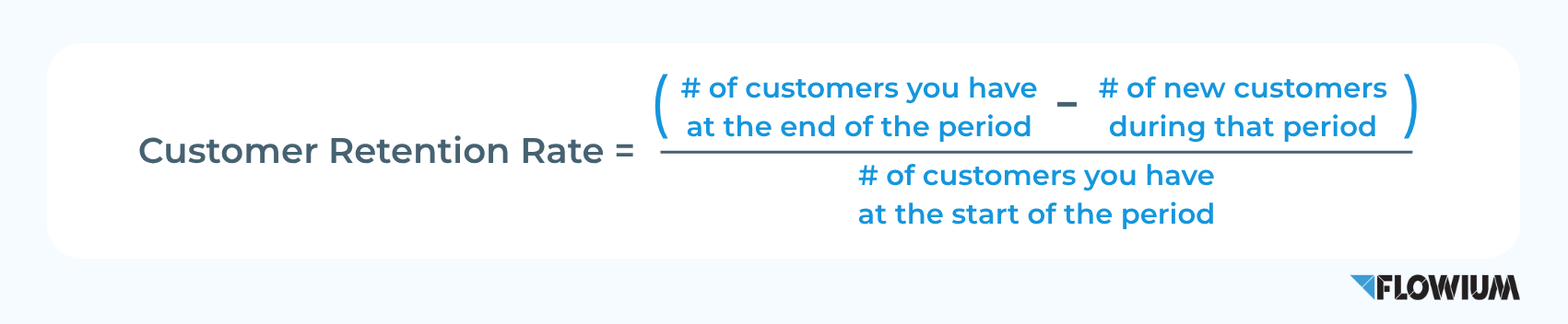
This calculation determines the percentage of initial consumers you’ve kept over time, or how well your company is at retaining customers.
You can get these figures by monitoring your user base on a monthly, quarterly, or annual basis. Higher rates usually signify higher levels of user loyalty and satisfaction.
Example of Customer Retention Rate Calculation
Let’s say a DTC online retailer has 1,000 clients at the beginning of the month.
Throughout the month:
- The company gains 300 new clients.
- The company has 1,100 overall clients at the end of the month.
Applying the formula:
CRR = 1100 – 300 / 1000 × 100 = 80.
So the CRR is 80%.
This indicates that during the assessed period, the business kept 80% of its current clientele. It is considered a strong retention rate that many businesses strive to achieve.
What is a Good Customer Retention Rate?
The industry, product category, frequency of purchases, and business strategy all influence what constitutes a “good” client retention rate in ecommerce. For instance, retail businesses typically have retention rates of roughly 63%, whereas travel and restaurant brands can be satisfied with a retention rate of 55%.
Every company would love to claim a 100% CRR in a perfect world. However, it is just not feasible to completely prevent client attrition. Rather, aim for the greatest possible number and make a consistent effort to raise or enhance your CRR.
What is a Good Customer Retention Rate for Ecommerce?
In 2026, the average customer retention rate for DTC ecommerce is 31%.
Top-performing firms, on the other hand, achieve 45-55% retention with effective lifecycle marketing campaigns. The presence (or absence) of a coordinated post-purchase email program and membership option accounts for nearly all of the difference.
Average Customer Retention Rate by Industry
When searching for benchmarks, you can come across different numbers. Some even state that the average rate for CRR is over 70%, but don’t get disappointed right away if your metrics don’t reach that result. While 70% or even more CRR is feasible for some businesses, the norm in your sector might be below that.
Since the average customer retention rate varies by industry, it’s pointless to compare yourself to top-performers overall. Instead, research benchmarks in your industry specifically to gain objective insight.
To give perspective on how your company is doing compared to competitors in your niche, let’s look at the customer retention rate by industry based on research from Focus Digital.
| Industry | Average CRR | Typical Range |
|---|---|---|
| Ecommerce | 31–38% | 25–55% for DTC |
| Subscription Ecommerce | 68–72% | 60–85% |
| Transactional Ecommerce | 25–38% | 20–40% |
| Hospitality & Travel | 55% | 50–80% |
| Retail | 63% | 60–70% |
| IT Services | 81% | 80–90% |
| Financial Services | 78% | 75–95% |
| Insurance | 83% | 75–95% |
| B2B | 70–85% | 65–90% |
| Professional Services | 84% | 70–90% |
| Healthcare | 77% | 65–95% |
| Telecommunications | 78% | 70–90% |
As you can see, ecommerce has one of the lowest average retention rates. The main reason for this is the fact that clients can easily switch brands, and their purchasing behavior is often more purely transactional.
At the same time, the ecommerce industry can have its own division by sectors. Let’s look at the average retention rates within ecommerce industry by different niches, based on the report by Upsella.
| Ecommerce Industry | Average CRR | Key Retention Performance Factor |
|---|---|---|
| Beauty and Skincare | 35–40% | Higher CRR due to replenishment behavior |
| Supplements and Wellness | 40% | Higher CRR due to recurring consumption |
| Food and Beverage | 35–40% | Higher CRR due to habitual purchasing and subscriptions |
| Pet Products | 30–40% | Higher CRR due to subscription models |
| Fashion and Apparel | 25–30% | Lower retention due to trend cycles and sizing challenges |
| General DTC Ecommerce | 30–31% | Average benchmark |
| Electronics | 15–20% | Lower due to infrequent purchase cycles |
| Home and Furniture | 10–15% | Long replacement cycles reduce CRR |
| Fitness and Wellness Apps | 48% | Strong retention when engagement is high |
| Food Delivery App | 37% | Moderate retention with high competition |
Other Important Customer Retention Metrics to Track
- Net Revenue Retention
The percentage of recurrent income kept from current clients over a given time period, accounting for upgrades, downgrades, and cancellations, is known as net revenue retention, or NRR. Strong client loyalty, your sales team’s capacity for upselling, and the value your product continues to provide are all indicated by a high NRR.
- Customer Churn Rate
The customer churn rate is the percentage of customers who discontinue using your product or service within a specific time frame. A high churn rate frequently indicates underlying problems that require immediate and long-term attention.
- Customer Lifetime Value
The overall revenue you may expect from a customer over the course of your relationship is estimated by CLV. Think of it as a clear indication of your efforts to sustain long-term client loyalty and satisfaction.
- Net Promoter Score
An overview of the entire client experience is provided by your Net Promoter Score (NPS). On a scale of one to 10, NPS evaluates the probability that your consumers will suggest your product or service to others based on data from customer surveys.
How to Improve Customer Retention Rate
If we look at the general meaning of customer retention strategies, they are a set of practices and methods that businesses utilize to keep their current client base interested, engaged, and loyal to their brands. Every business opts for its unique strategy and set of techniques based on the specifics of industry, clientele, organization, and many other factors. However, there are several practices that marketers recognize as the most efficient.
Here’s a shortlist of these customer retention methods.
- Provide positive experiences
- Get to know your clients through thorough research
- Organize a stable connection with the audience via email marketing
- Use of loyalty and rewards programs to strengthen client relationships
- Emphasize personalization
- Gamify your content and promotions
- Use client feedback for optimization
- Ensure accessible customer support
- Build community
- Offer membership and subscription programs
- Offer valuable content in convenient forms
- Make sure your mission aligns with customers’ needs
Read our comprehensive guide on effective retention strategies to find more working tactics, tips from professionals, examples from real brands, and more.
How Flowium Helps You Improve Ecommerce Retention Rate
Flowium focuses in using best lifecycle marketing techniques to assist DTC ecommerce firms in increasing client retention, repeat purchases, and long-term revenue development.
Email and SMS Marketing Lifecycle
Flowium creates automated customer journeys that boost engagement and retention through high-quality email campaigns, such as:
- Welcome flows
- Post-purchase campaigns
- Reminders for replenishment
- Win-back sequences
- Loyalty and VIP initiatives
Customization and Client Segmentation
In order to provide individualized customer experiences that increase engagement, repeat business, and client lifetime value, the agency uses behavioral and purchase data.
Strategy for Omnichannel Retention
In order to develop more consistent and successful retention marketing, Flowium assists organizations in coordinating email, SMS channels, and customer experience tactics throughout the customer lifecycle.
You can explore more examples of projects where Flowium’s lifecycle marketing and retention tactics helped brands to achieve retention goals and more on our Case Studies page.
Conclusion
The most effective way to fulfill the KPI and ROI goals in 2026 is to monitor your customer retention rate and make investments to increase it. Tracking your success in retaining clients will help you to ensure you’re selecting the most effective approach to increase sales and attract more devoted customers.
Get in touch with Flowium if you want great outcomes but lack the time or expertise to do it yourself. We have extensive expertise assisting clients across many industries in achieving high retention results.
Frequently Asked Questions
How can I assess the effectiveness of my retention strategy?
Pay attention to customer lifetime value, redemption rate (for loyalty programs), referral conversion rate, customer retention rate, and repeat purchase rate. These metrics show where your retention strategy is effective and where it needs to be improved, and they have a clear connection to revenue impact.
How frequently should a company calculate CRR?
Determine patterns on a monthly and quarterly basis. Annually conceals issues until they become serious; weekly is too noisy. Additionally, compute at each billing cycle milestone (Months 1, 3, 6, and 12) for subscription businesses. Repeat purchases are reevaluated at these decision points.
What are the three R’s in customer retention?
The following are three typical R’s of customer retention:
– Retention: Preserving the present clientele
– Related sales: Increasing revenue from clients by upselling and cross-selling
– Referrals: Requesting that clients recommend your company to their friends and relatives