In 2026, marketing executives face a distinct challenge: demand is rising, but budgets are not. According to industry benchmarks, marketing budgets have remained relatively flat, while many CMOs continue to report insufficient funding to fully execute their growth plans. This reality is changing how marketing operates. Increasing spending doesn’t ensure growth anymore. Instead, professional marketers must continuously look for innovative tactics and advanced technologies that will allow them to be more informed to make smarter decisions with existing resources. In such demanding conditions, better budget allocation, higher operational efficiency, and tighter execution have become essential for maximizing marketing performance.
In this guide, we’ll explore the working approach to marketing budget planning, examine how successful brands reallocate their budgets, and look into what is considered the norm for ecommerce businesses.
What Is an Ecommerce Marketing Budget?
An ecommerce marketing budget is a financial plan that outlines how much an online store will invest in marketing activities and how those funds will be allocated across different channels, campaigns, and initiatives.
It helps ecommerce brands establish spending priorities, allocate resources effectively, and ensure that marketing efforts support key business goals such as customer acquisition, retention, revenue growth, and brand awareness. A well-defined budget also helps teams forecast performance, measure ROI, and make informed decisions about where to invest for the greatest impact.
An ecommerce marketing budget typically includes spending across multiple channels, including:
- Search Engine Optimization (SEO)
- Paid Search and Shopping Ads (Google Ads, Bing Ads)
- Social Media Advertising
- Email Marketing
- SMS Marketing
- Content Marketing
- Influencer Marketing
- Affiliate Marketing
- Conversion Rate Optimization (CRO)
- Customer Retention and Loyalty Programs
However, an ecommerce marketing budget is more than a list of expenses. It serves as a strategic roadmap that aligns marketing investments with business objectives, growth targets, seasonal trends, and expected returns. When managed effectively, it enables brands to maximize revenue while maintaining profitability.
Why Marketing Budget Optimization Now Matters More Than Ever for Ecommerce
Marketing budget optimization has become a top priority for ecommerce brands as customer acquisition costs continue to rise and competition becomes increasingly intense. At the same time, many businesses are operating with limited marketing resources and greater pressure to prove the impact of every dollar spent. As a result, simply increasing ad spend is no longer a reliable growth strategy.
Successful ecommerce brands are focusing on optimizing their marketing budgets by investing in the channels, campaigns, and customer segments that generate the highest return on investment (ROI).
Budget optimization helps ecommerce businesses:
- Improve marketing ROI and profitability
- Lower customer acquisition costs (CAC)
- Increase customer lifetime value (CLV)
- Reduce wasted ad spend
- Allocate resources to top-performing channels
- Strengthen customer retention efforts
- Scale revenue more efficiently
This shift reflects a broader trend in ecommerce marketing: sustainable growth is increasingly driven by efficiency rather than spending. Brands that continuously analyze performance, refine budget allocation, and prioritize high-impact initiatives are better positioned to outperform competitors, even in challenging economic conditions.
Ecommerce Marketing Budget Benchmarks for 2026
Determining the right ecommerce marketing budget can be challenging, especially as acquisition costs continue to rise and marketing teams face increasing pressure to demonstrate ROI. While budget allocation varies by industry, business size, growth stage, and geographic market, several benchmarks can help ecommerce brands evaluate whether their spending aligns with current market trends.
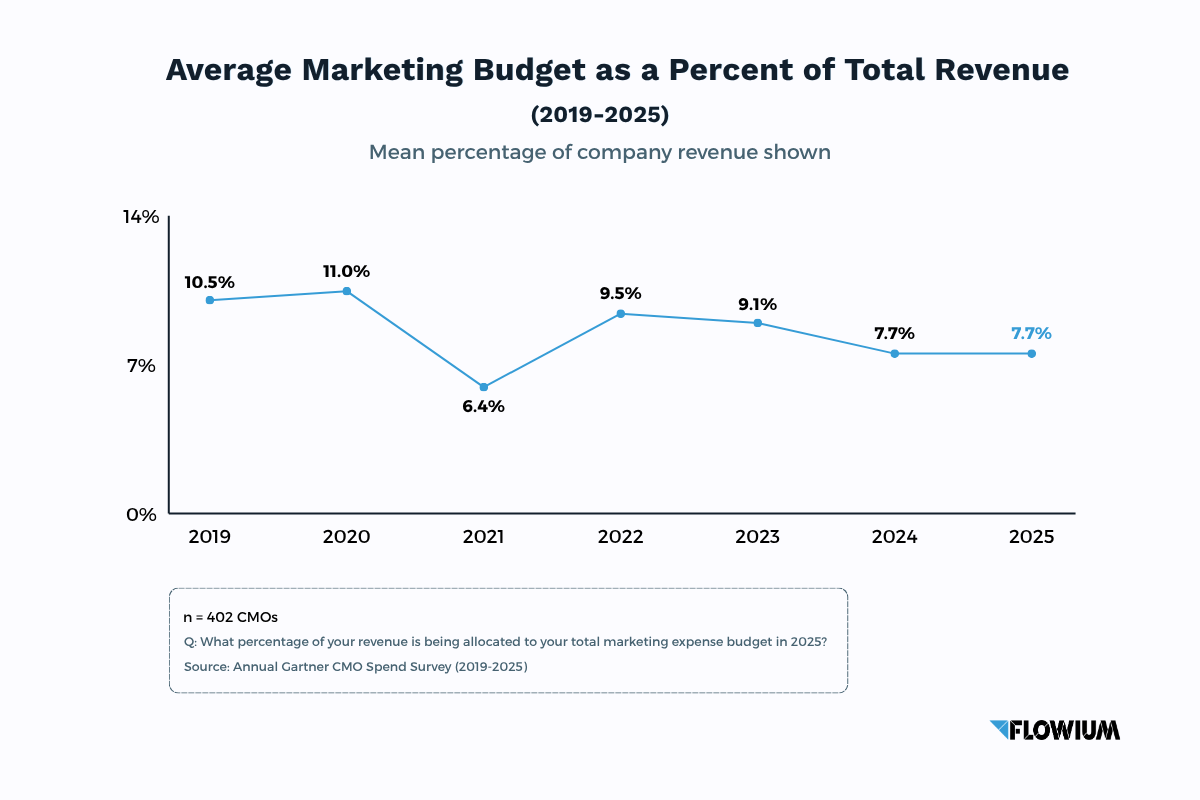
According to a Gartner, Inc. survey, CMOs report that their marketing budgets remained stable and unchanged at 7.7% of total business revenue in 2025. This is in line with the previous year, when marketing expenditures accounted for 7.7% of total business income. Despite stable budgets, 59% of CMOs reported that they lacked sufficient funding to fully execute their marketing strategies, highlighting the growing need for efficiency and budget optimization.
Marketing Budget by Revenue Size
Marketing spend typically decreases as a percentage of revenue as companies grow. Smaller ecommerce brands often need to invest aggressively in customer acquisition and brand awareness, while larger businesses benefit from established brand recognition, repeat customers, and stronger organic traffic sources. Industry benchmarks, presented by ScaleGrowth.Digital, suggest the following marketing budget ranges based on annual revenue:
| Annual Revenue | Recommended Marketing Budget (% of Revenue) | Primary Focus |
|---|---|---|
| Under $500K | 20-30% | Brand awareness, customer acquisition, product-market fit |
| $500K-$5M | 15-20% | Scaling paid media, growing customer base, and retention foundations |
| $5M-$50M | 8-12% | Channel diversification, retention, and profitability |
| $50M+ | 5-8% | Brand maintenance, loyalty, incremental growth |
This pattern reflects a common ecommerce growth cycle. Early-stage brands must spend heavily to acquire customers and establish market presence, while mature brands can rely more on existing customer relationships, organic traffic, email marketing, and word-of-mouth referrals.
Ecommerce Marketing Budget by Industry
Marketing budget requirements vary significantly across ecommerce industries based on competition, customer acquisition costs, purchase frequency, and customer lifetime value.
Let’s look at the relevant industry benchmarks by Eightx.
| Industry | Typical Marketing Budget (% of Revenue) | Key Marketing Drivers |
|---|---|---|
| Fashion & Apparel | 12-25% | Influencers, paid social, trend-driven demand |
| Beauty & Personal | 15-30% | Creator marketing, UGC, product launches |
| Health Care & Wellness | 15-25% | Education, subscriptions, customer retention |
| Food & Beverage | 10-20% | Repeat purchases, loyalty, subscriptions |
| Home & Garden | 8-15% | SEO, paid search, longer buying cycles |
| Luxury & Premium Brands | 5-15% | Brand awareness, exclusivity, customer experience |
Ecommerce Marketing Budget by Country
Marketing budget requirements vary across countries due to differences in ecommerce maturity, advertising costs, competition levels, and consumer behavior. Brands operating in more mature ecommerce markets typically need to allocate a larger share of their budget toward customer acquisition and paid media.
| Country | Recommended Ecommerce Marketing Budget (% of Revenue) | Ecommerce Market Characteristics |
|---|---|---|
| United States | 10-27% | Highest competition, highest ad costs |
| United Kingdom | 8-15% | Mature ecommerce market, strong online adoption |
| Canada | 8-15% | Smaller market, lower competition than US |
| Australia | 8-15% | High digital adoption, moderate competition |
The percentage of revenue allocated to marketing often depends less on geography and more on market maturity and competition. Brands operating in highly competitive markets such as the US and UK typically require larger acquisition budgets, while those in Canada and Australia can often achieve similar growth with slightly lower spending levels.
Typical Marketing Budget Breakdown
A practical way to structure your marketing budget is to allocate spending by business objective while understanding which channels support each objective.
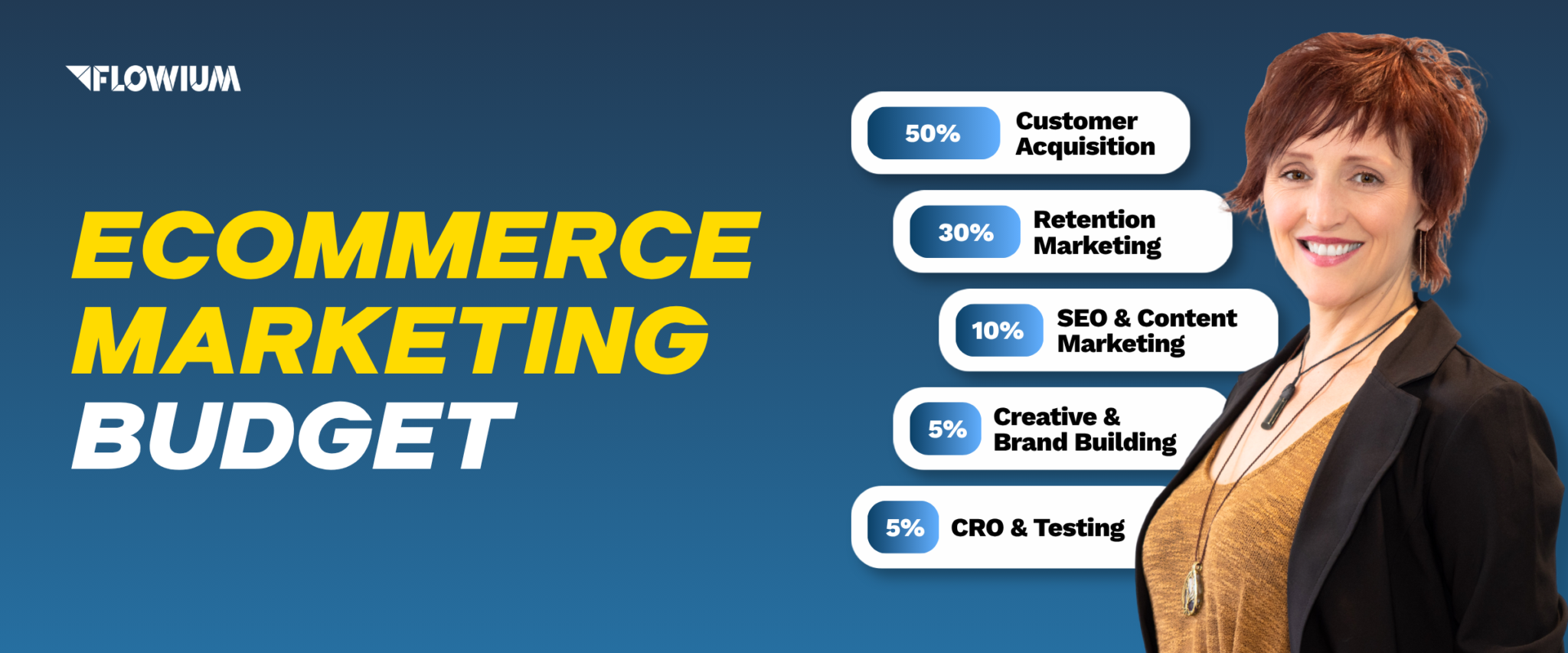
A typical growth-focused ecommerce brand may allocate its budget as follows:
| Marketing Area | Budget Allocation |
|---|---|
| Customer Acquisition | 50-70% |
| Retention Marketing | 15-30% |
| SEO & Content Marketing | 10-20% |
| Creative & Brand Building | 5-15% |
| CRO & Testing | 5-10% |
Customer Acquisition (50–70% of Marketing Budget)
Customer acquisition typically represents the largest share of marketing spend because it fuels business growth and introduces new customers to your brand.
Paid Search (20–30%)
Google Search and Google Shopping ads capture high-intent shoppers who are actively searching for products. Because these users already have purchase intent, paid search often generates some of the strongest returns among acquisition channels.
Goal: Capture existing demand and drive bottom-of-funnel conversions from shoppers actively searching for products like yours.
Paid Social (20–30%)
Platforms such as Meta, TikTok, Pinterest, and YouTube help brands generate awareness and introduce products to new audiences. Paid social is especially effective for visually appealing products and impulse purchases.
Goal: Build brand awareness, expand audience reach, and acquire new customers through targeted advertising and engaging creative content.
Influencer and Affiliate Marketing (5–15%)
Creator partnerships provide social proof and help brands reach highly engaged audiences. Affiliate programs allow brands to scale acquisition while paying primarily for performance. Key investments include:
- Influencer collaborations
- Creator partnerships
- Affiliate commissions
- Ambassador programs
- User-generated content (UGC)
Goal: Increase trust, reach new audiences, and generate cost-effective customer acquisition through third-party advocacy and recommendations.
Retention Marketing (15–30% of Marketing Budget)
Retaining existing customers is significantly more cost-effective than acquiring new ones. As brands mature, retention marketing often becomes a larger portion of the budget because it directly impacts customer lifetime value and profitability.
Email and SMS Marketing (10–15%)
For most ecommerce businesses, email and SMS remain the highest-ROI marketing channels. These owned channels enable brands to communicate directly with customers without paying for every interaction.
Key investments include:
- Email platform costs
- SMS platform fees
- Automated flows
- Campaign management
- List growth initiatives
Goal: Increase repeat purchases, recover abandoned carts, and maximize customer lifetime value through personalized communication.
Loyalty and Subscription Programs (5–10%)
Loyalty and subscription programs encourage repeat purchases while increasing customer lifetime value.
Key investments include:
- Rewards programs
- VIP tiers
- Referral programs
- Subscription retention initiatives
- Customer experience improvements
Goal: Strengthen customer loyalty, improve retention rates, and increase long-term revenue from existing customers.
SEO and Content Marketing (10-20% of Marketing Budget)
SEO and content marketing create long-term traffic assets that continue generating visitors and sales long after publication. Unlike paid advertising, organic traffic has no direct cost per click, making it one of the most profitable growth channels at scale.
Key investments include:
- Technical SEO
- Blog content
- Landing pages
- Product page optimization
- Category page optimization
- Buying guides
- Educational content
Goal: Build sustainable organic traffic, reduce customer acquisition costs, and establish long-term authority in your market.
Creative and Brand Building (5-15% of Marketing Budget)
Creative assets fuel the performance of every marketing channel. Strong creative improves ad performance, increases engagement, and helps differentiate brands in crowded markets.
Key investments include:
- User-generated content
- Video production
- Product photography
- Brand campaigns
- Creator collaborations
- Social content production
Goal: Strengthen brand recognition, improve campaign performance, and create a memorable brand experience that drives customer preference.
Conversion Rate Optimization (CRO) (5–10% of Marketing Budget)
Conversion rate optimization amplifies the effectiveness of every other marketing investment. Even modest improvements in conversion rates can significantly increase revenue without requiring additional traffic.
Key investments include:
- A/B testing
- User research
- Heatmaps and session recordings
- Landing page optimization
- Checkout improvements
- Website UX enhancements
Goal: Increase revenue from existing traffic by improving the customer experience and removing barriers to conversion.
Within those categories, individual channels such as Google Ads, Meta Ads, email marketing, influencer marketing, SEO, and loyalty programs can be adjusted based on performance and business objectives. The most successful ecommerce brands continuously monitor results and reallocate budget toward the channels generating the highest return while maintaining investments in long-term growth initiatives.
Marketing Budget Allocation by Growth Stage
Your business stage significantly influences the distribution of your budget. A well-established brand is unlikely to benefit from what works for a startup.
Startup Ecommerce Brands (Pre-Product-Market Fit)
At the startup stage, every marketing dollar should help validate your business rather than maximize scale. Most ecommerce startups invest 5-7% of annual revenue in marketing, prioritizing brand awareness, customer acquisition, and market validation.
Recommended Budget Allocation
| Marketing Activity | Budget Allocation | Primary Goal |
|---|---|---|
| Paid Advertising | 30-40% | Generate initial traffic and validate acquisition channels |
| Website UX & SEO | 20-25% | Build a conversion-ready storefront and organic visibility |
| Branding & Messaging | 15-20% | Define positioning and establish brand identity |
| Email Marketing & List Building | 10-15% | Capture leads and nurture first-time customers |
| Analytics & Testing | 10-15% | Measure performance and optimize campaigns |
Pro Tip: At this stage, businesses should focus on building a recognizable brand, testing messaging and acquisition channels, and creating a strong website foundation. Growing an email list and tracking campaign performance early provides valuable customer insights that support future scaling.
Early-Stage Ecommerce Brands
Once product-market fit has been established, marketing shifts from experimentation to consistent growth. The focus becomes scaling customer acquisition while improving conversion rates and beginning to invest in customer retention.
| Marketing Activity | Budget Allocation | Primary Goal |
|---|---|---|
| Paid Advertising | 35-40% | Scale customer acquisition |
| Website UX & SEO | 20-25% | Build sustainable organic traffic |
| Branding & Messaging | 15-20% | Define positioning and establish brand identity |
| Email Marketing & List Building | 15-20% | Increase repeat purchases and customer lifetime value |
| Conversion Rate Optimization | 10-15% | Improve website performance |
| Brand Building | 10-15% | Strengthen trust and recognition |
Pro Tip: The priority is to scale the marketing channels that have already proven effective while improving website conversions and expanding lifecycle marketing. Continued investment in SEO, content, and brand awareness helps create more sustainable growth beyond paid advertising.
Scaling Ecommerce Brands
As revenue grows, success depends less on increasing spend and more on improving efficiency. Marketing budgets should balance customer acquisition with retention while diversifying channels to reduce reliance on paid media.
Recommended Budget Allocation
| Marketing Activity | Budget Allocation | Primary Goal |
|---|---|---|
| Paid Media | 30-35% | Efficient customer acquisition |
| Customer Retention (Email, SMS, Loyalty) | 20-25% | Increase customer lifetime value |
| Content, SEO & Organic Growth | 15-20% | Reduce dependence on paid channels |
| Brand Marketing | 15-20% | Build long-term demand |
| Analytics & Marketing Technology | 10-15% | Improve attribution and decision-making |
Pro Tip: At this stage, businesses should prioritize improving marketing efficiency through better attribution, automation, and retention strategies while continuing to strengthen brand equity. Investing in owned channels such as email, loyalty programs, and organic marketing helps lower acquisition costs over time.
Mature Ecommerce Brands
Established ecommerce brands typically prioritize profitability, customer retention, and long-term brand equity over rapid customer acquisition. Marketing investments should focus on maximizing customer lifetime value while maintaining market leadership.
Recommended Budget Allocation
| Marketing Activity | Budget Allocation | Primary Goal |
|---|---|---|
| Customer Retention & Loyalty | 25-30% | Maximize lifetime value |
| Brand Marketing | 20-25% | Strengthen market leadership |
| Paid Advertising | 20-25% | Maintain profitable acquisition |
| Innovation & New Channels | 10-15% | Identify future growth opportunities |
| Data, Automation & AI | 10-15% | Improve efficiency and personalization |
Pro Tip: The primary objective is to optimize marketing ROI by strengthening customer loyalty, delivering personalized experiences, and investing in long-term brand growth. Mature brands should also dedicate part of their budget to testing new channels and technologies to maintain a competitive advantage.
Marketing Budget Allocation Example
Think about a mid-sized online retailer organizing its yearly marketing plan. The organization first determines its main marketing objectives, such as raising brand awareness and increasing online sales by 20%, in order to carry out an efficient marketing budget breakdown.
- To increase traffic and awareness, the marketing team first sets aside 40% of the budget for digital advertising on sites like Google Ads and social media.
- A further 25% is set aside for content marketing, which includes influencer collaborations, blog post writing, and video production with the goal of engaging viewers and encouraging conversion.
- They spend 15% on data analysis tools and software subscriptions that monitor consumer behavior and campaign performance because they understand the value of customer insights.
- 10% is also allocated for email marketing, which targets current clients with tailored updates and discounts.
- The remaining 10% is set aside as a contingency fund to take advantage of fresh possibilities or adjust to unforeseen changes in the market.
In addition to offering financial transparency, this methodical approach enables the business to make well-informed changes all year long, guaranteeing alignment with its strategic goals and maximizing return on investment.
Common Marketing Budget Planning Mistakes by Ecommerce
Many ecommerce brands devote most of their budget to paid acquisition while underinvesting in email, SMS, loyalty programs, and post-purchase experiences. Since retaining existing customers is typically more cost-effective than acquiring new ones, neglecting retention can reduce overall marketing ROI.
- Spreading the Budget Too Thin Across Multiple Channels
Trying to maintain a presence on every platform often results in mediocre performance everywhere. Instead, concentrate your budget on the channels that consistently generate the highest return and expand only after those channels are optimized.
- Making Budget Decisions Without Reliable Data
Allocating spend based on assumptions rather than performance metrics can lead to wasted budget. Regularly tracking attribution, customer acquisition cost (CAC), customer lifetime value (CLV), and return on ad spend (ROAS) helps identify where investment delivers the greatest impact.
- Prioritizing Short-Term Sales Over Long-Term Growth
Focusing exclusively on campaigns that generate immediate revenue often means underfunding SEO, content marketing, and brand-building initiatives. A balanced budget should support both short-term conversions and sustainable, lower-cost growth over time.
- Setting a Fixed Budget and Never Reassessing It
Consumer behavior, advertising costs, and market conditions change throughout the year, making static budgets inefficient. Review marketing performance regularly and reallocate spending toward the channels and campaigns producing the strongest results.
How Leading Ecommerce Brands Allocate Marketing Spend
While every ecommerce business has unique goals, leading brands allocate their marketing budgets based on revenue forecasts, customer acquisition costs, and long-term growth objectives. Rather than distributing spend evenly across channels, they invest where they can generate the highest return while maintaining a healthy balance between acquisition, retention, and brand building.
DTC brands typically allocate the largest share of their budgets to digital customer acquisition through paid search, social media advertising, influencer marketing, and creator partnerships. As these brands mature, they increase investment in email marketing, SMS, loyalty programs, and organic content to reduce customer acquisition costs and improve lifetime value.
- Subscription Ecommerce Brands
Subscription businesses prioritize customer retention alongside acquisition because recurring revenue depends on keeping customers engaged. Marketing budgets often emphasize lifecycle email campaigns, loyalty incentives, personalized offers, referral programs, and churn reduction strategies in addition to paid acquisition.
- Omnichannel Retailers
Retailers selling through both online and physical channels distribute marketing spend across digital advertising, local marketing, in-store promotions, SEO, and customer experience initiatives. Their budgets are typically guided by unified customer data, allowing them to coordinate campaigns across every touchpoint and accurately measure omnichannel performance.
- Enterprise Ecommerce Companies
Large ecommerce companies generally maintain diversified marketing portfolios that include paid media, brand advertising, content marketing, marketing technology, analytics, and experimentation with emerging channels. With greater resources, they invest heavily in first-party data, AI-driven personalization, advanced attribution, and marketing automation to continuously optimize budget allocation and maximize return on investment.
How to Handle Marketing Budget Allocation Process
- Step 1: Define Your Business Goals
Start by identifying your primary objective, whether it’s acquiring new customers, increasing brand awareness, improving customer retention, or maximizing profitability. Your goals should determine where the largest share of your marketing budget is allocated.
- Step 2: Forecast Revenue and Set Your Budget
Estimate your expected revenue for the upcoming period and determine how much you can realistically invest in marketing. Your budget should support growth targets while remaining financially sustainable.
- Step 3: Calculate Your Customer Acquisition Cost (CAC)
Measure how much it costs to acquire a new customer and compare it with your customer lifetime value. This helps you understand how aggressively you can invest in customer acquisition while maintaining profitability.
- Step 4: Analyze Historical Performance
Review previous campaign data to identify which channels generate the highest return on investment. If your business is new, use ecommerce benchmarks to guide your initial budget allocation and refine it as performance data becomes available.
- Step 5: Allocate Budget Based on Performance
Distribute your marketing spend across the channels most likely to achieve your objectives, prioritizing proven high-performing campaigns while reserving part of the budget for testing new opportunities.
- Step 6: Monitor, Measure, and Adjust
Track key metrics such as ROAS, CAC, conversion rate, and customer lifetime value throughout the year. Reallocate budget regularly to maximize ROI as customer behavior, competition, and market conditions change.
Ecommerce Marketing Budget Calculator: Best Methods
There is no universal formula for determining the right marketing budget. The best approach depends on your business stage, revenue, growth goals, and available data. Below are the four most common methods ecommerce businesses use to calculate their marketing budgets.
1. Percentage of Revenue Method
Allocate a fixed percentage of your gross revenue to marketing. This simple and predictable approach is commonly used by established ecommerce businesses.
Formula:
Marketing Budget = Total Revenue x Marketing Percentage
Example:
$500,000 × 10% = $50,000
Best for: Established businesses with stable revenue.
2. Goal-Oriented Method
Start with your growth goals and calculate the budget needed to achieve them based on your average Customer Acquisition Cost (CAC).
Formula:
Marketing Budget = Target Number of New Customers x Customer Acquisition Cost (CAC)
Example:
1,000 new customers x $50 CAC = $50,000
Best for: Growth-focused ecommerce brands.
3. Competitive Benchmarking Method
Use industry benchmarks and competitor spending as a reference to determine an appropriate marketing budget.
Formula:
Marketing Budget = Total Revenue x Industry Average Marketing Percentage
Example:
$500,000 × 10% = $50,000
Best for: Businesses comparing their investment with industry standards.
Conclusion
Setting a budget for ecommerce marketing is just as important as deciding on a course of action. You can position your brand for long-term success by comprehending industry benchmarks, carefully allocating across channels, and consistently optimizing.
Are you planning to optimize your ecommerce marketing budget? Contact our team of marketing professionals to get more insights on how to create a budget that supports your development, controls your spending, and produces significant results.
Frequently Asked Questions
Which four components make up a marketing budget?
Advertising, promotions, personnel expenses, and technology or tools are often the four primary components of a marketing budget. These areas guarantee that money is set aside for team projects, campaigns, and the tools required to monitor and maximize outcomes.
What is the marketing budget’s 70/20/10 rule?
According to the 70/20/10 guideline, a marketing budget should allocate 70% to tried-and-true techniques, 20% to novel or emerging tactics, and 10% to experimental approaches with room to expand.