Revenue leakage occurs when an ecommerce brand fails to collect revenue it has already earned due to different issues with strategy and operations. While each loss may seem small, the accumulation of these problems can have a snowball effect on your success, reducing cash flow, shrinking ecommerce profit, and limiting business growth.
Even if you’re investing in marketing, driving traffic, and generating sales, your revenue may still fall short of expectations if money is leaking somewhere throughout the customer journey. So, your top priority must be to identify where the revenue leakage takes place, measure its impact, and take action to eliminate it.
In this guide, we’ll explore the most common causes of ecommerce revenue leakage, how to detect them, and the successful strategies you can use to protect what you earned and even maximize profitability.
What Is Revenue Leakage in Ecommerce?
Revenue leakage in ecommerce is the loss of revenue that a business should have earned but failed to collect due to operational, technical, or customer experience issues. Unlike lost sales from a lack of demand, revenue leakage occurs when existing revenue opportunities are missed because of preventable process failures.
Think of it as a slow leak in your revenue pipeline. Your store continues to generate traffic and sales, but small issues throughout the customer journey reduce the amount of revenue that ultimately reaches your bottom line.
Typical causes for ecommerce revenue leakage include:
- A high rate of checkout drop-offs and cart abandonment
- Misuse of discounts and pricing errors
- Failed or declined payments
- Stockouts and inaccurate inventory
- Inefficiencies in refunds, returns, and fulfillment
- Low rates of repeat business and customer retention
- Gaps in tracking, attribution, and analytics
Although each issue may seem minor on its own, their combined impact can be significant.
The Merchant Risk Council’s 2026 Global eCommerce Payments & Fraud Report states that payment fraud alone costs businesses 3.5% of their yearly ecommerce revenue. The financial impact can be significantly worse when combined with other revenue leakage sources, such as checkout abandonment, pricing errors, unsuccessful payments, refund misuse, and inventory problems.
Signs That Your Company May Be Having Revenue Leakage
Businesses can take corrective action before losses become serious by identifying the warning signs of income leakage. Early diagnosis is essential for sustaining sound financial performance because these symptoms frequently emerge gradually and may at first appear to be typical business swings.
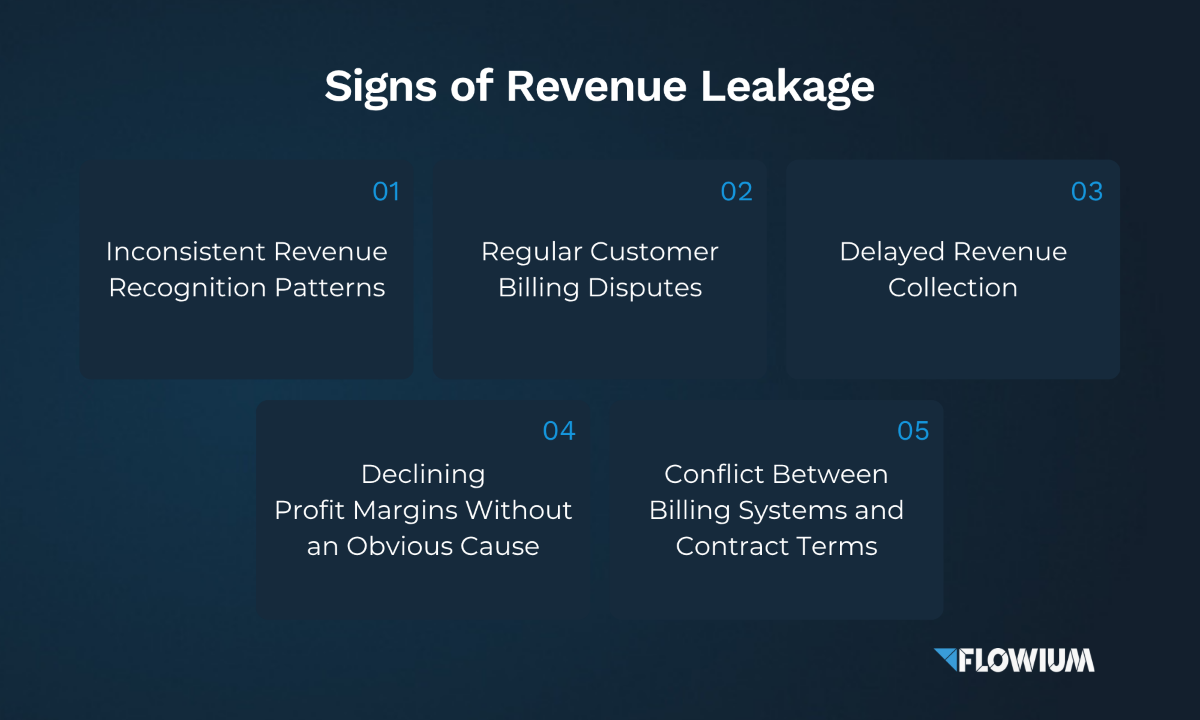
There are several signs that your company may be experiencing income leakage:
- Declining Profit Margins Without an Obvious Cause. Hidden revenue losses are sometimes a factor when margins decline despite consistent expenses and pricing strategies.
- Regular Customer Billing Disputes. A rise in billing-related grievances or late payments could be a sign of systemic problems with contract compliance or invoice accuracy.
- Delayed Revenue Collection. Billing mistakes or issues with contract administration may be impeding appropriate revenue collection when outstanding receivables rise without matching sales growth.
- Inconsistent Revenue Recognition Patterns. Unexpected differences between planned and actual revenue or irregular revenue flows may indicate underlying leakage problems.
- Conflict Between Billing Systems and Contract Terms. Inconsistencies between contract agreements and actual billing point to weaknesses in revenue tracking procedures.
Why Revenue Leakage Needs to Be Resolved Immediately
Revenue leakage should be resolved as soon as it’s identified because it directly reduces your profitability. Every dollar lost to payment failures, pricing errors, excessive discounts, fulfillment mistakes, or operational inefficiencies is revenue your business has already earned but failed to collect. Unlike generating new sales, recovering leaked revenue improves your bottom line without increasing marketing or customer acquisition costs.
- Reason 1. It Reduces Profitability and Cash Flow
Even small revenue leaks can have a significant financial impact when they occur repeatedly. Industry estimates suggest revenue leakage can reduce business earnings by 1% to 5% annually. Because these losses happen after a sale has already been generated, recovering them is one of the fastest ways to improve cash flow and increase profit margins.
- Reason 2. The Risk Increases as Your Business Grows
As ecommerce operations become more complex, the likelihood of revenue leakage also increases. Expanding product catalogs, multiple sales channels, dynamic pricing, promotional campaigns, third- party apps, and complex fulfillment processes all create additional opportunities for revenue to be lost.
- Reason 3. Small Issues Quickly Become Expensive
Many cases of revenue leakage begin as minor operational issues but compound over time. The longer these issues go unnoticed, the greater their impact on revenue and profitability. Regular monitoring and early intervention help ecommerce businesses protect their margins, improve cash flow, and capture the full value of every sale.
Top Common Ecommerce Revenue Leaks
Revenue leakage can occur in your business for a variety of reasons. Here are some of the most typical causes that you need to be aware of.
Slow Site Loading and Low Website Conversion Rates
A slow website doesn’t just frustrate shoppers—it directly impacts revenue. When pages take too long to load, visitors are more likely to leave before browsing products or completing a purchase, resulting in lost sales and lower conversion rates.
Studies from Akamai show that even a one-second delay in page load time can reduce conversions by up to 7%.
A company worth $1 million a year will lose a lot of money due to slow page loads. Inadequate hosting infrastructure, an excessive number of third-party scripts, or poor image optimization are the main causes of performance issues.
Don’t forget that a huge part of your website visits also come from mobile devices. In terms of mobile optimization and its correlation to conversion rates, all of the aforementioned points become even more crucial: 53% of mobile consumers will leave a page if it takes longer than three seconds to load.
Pro Tip: Regularly monitor your site’s performance using tools like Google PageSpeed Insights or Lighthouse and prioritize improvements to Core Web Vitals.
Shopping Cart Abandonment
Cart abandonment is one of the largest sources of revenue leakage in ecommerce. Customers who add products to their cart have already shown strong purchase intent, but many leave before completing checkout, resulting in lost revenue that could often be recovered.
According to the Baymard Institute, the average documented cart abandonment rate is around 70% across ecommerce websites. While not every abandoned cart is recoverable, reducing abandonment can have a significant impact on revenue.
Pro Tip: Use automated abandoned cart email and SMS campaigns to recover shoppers who leave before completing their purchase.
Checkout Friction
A complicated checkout process is one of the most common reasons shoppers abandon their purchase. The most typical barriers are removed by offering guest checkout, reducing the number of form fields, and displaying the shipping cost and return policy before the last step. Nearly 17% of U.S. online shoppers give up on checkout because it is too time-consuming or difficult, according to data from the Baymard Institute research that we mentioned above. Simplifying this process can significantly improve your conversions and prevent revenue leakage.
Pro Tip: Offer guest checkout and clearly display shipping costs before customers reach the final payment step.
Weak Email Marketing
Email marketing is one of the highest-ROI channels for ecommerce, yet many brands fail to realize its full revenue potential. Sending only promotional campaigns-or worse, relying on no email strategy at all- means missing opportunities to recover abandoned carts, nurture customers, drive repeat purchases, and increase customer lifetime value.
Automated email flows such as welcome series, abandoned cart reminders, post-purchase emails, browse abandonment campaigns, and win-back sequences consistently outperform one-time campaigns because they reach customers at the most relevant moments.
Pro Tip: Prioritize automated lifecycle email flows before increasing the volume of promotional campaigns.
Poor Customer Retention
Revenue leakage doesn’t stop after the first purchase. Brands that focus solely on acquiring new customers while neglecting existing ones lose valuable repeat revenue and customer lifetime value (CLV).
According to Salesforce, 90% of customers say the experience a company provides is as important as its products or services, while research from Emplifi found that 86% of consumers leave a brand after two poor customer experiences. Retaining existing customers is also more cost-effective than acquiring new ones, making retention a key driver of long-term profitability.
Pro Tip: Build a strong post-purchase experience with personalized emails, loyalty programs, and product recommendations to encourage repeat purchases.
Low Average Order Value
A low average order value means you’re generating less revenue from each transaction than you could be. Even with healthy traffic and conversion rates, failing to encourage larger purchases limits profitability and increases the pressure to acquire more customers.
Increasing AOV is often more cost-effective than driving additional traffic because it generates more revenue from customers who are already ready to buy.
Inefficient Paid Advertisement
Paid advertising becomes a source of revenue leakage when campaigns generate clicks but fail to produce profitable sales. Poor audience targeting, weak landing pages, inaccurate attribution, or rising acquisition costs can quickly erode marketing ROI.
Monitoring metrics such as Customer Acquisition Cost (CAC), Return on Ad Spend (ROAS), and the LTV:CAC ratio helps identify campaigns that are driving unprofitable growth and consuming budget without delivering sustainable returns.
Pro Tip: Continuously optimize campaigns based on profitability-not just clicks or conversions-and shift more budget toward your highest-performing channels and audiences.
Pricing and Discount Strategy
Revenue losses are sometimes caused by inconsistent price structures and unmonitored discounting methods. Sales teams may use unapproved discounts, out-of-date pricing models, or special rates that last longer than planned. These price variations have the potential to become systemic problems that reduce profit margins for entire client segments in the absence of appropriate approval mechanisms.
Promotional offers, early payment reductions, and volume-based price tiers must be closely monitored to guarantee proper implementation and removal as necessary. Businesses frequently find that short-term price changes have turned into long-term aspects of client relationships, drastically lowering income.
Inventory Problems
Inaccurate inventory frequently results in:
- Either understocking or overstocking.
- Losses brought on by duplicate or unfilled orders.
- Stock movement records that are not complete during returns.
Here, an integrated ecommerce inventory management system is essential. Businesses can match financial data with stock movement by connecting their order management system and warehouse inventory management software.
Poor Product Pages
The primary places where consumers assess the products are the product pages. The transaction won’t happen if the product site doesn’t give the buyer adequate details or credibility. This includes things like low picture resolution, vague descriptions, a lack of specifications, and no client feedback.
Pro Tip: Your product pages are more effective when they have high-resolution photos, a description tailored to the demands of the customers, and a review section.
Returns and Refunds
Returns and refunds are an inevitable part of ecommerce, but poor return management can quickly become a source of revenue leakage. Common issues include issuing refunds before returned items are received, duplicate refunds, missed reimbursement claims from marketplaces or carriers, and inaccurate reconciliation between returned products and refunded orders.
Without proper tracking, these errors reduce profitability and make it difficult to understand the true financial impact of returns.
Pro Tip: Automate return and refund reconciliation to ensure every refund matches a verified return and identify reimbursement opportunities.
Errors in Billing and Invoicing Systems
One of the most frequent causes of income loss in businesses is billing errors. These mistakes frequently happen when data falls between the cracks due to integration gaps between several software platforms, older systems fail to collect all billable items, or manual processes involve human error.
Issues like duplicate invoice creation, inaccurate price application, or missed billing cycles for recurring services are commonplace for businesses. While subscription-based organizations could have trouble with proration calculations during plan changes or cancellations, service-based businesses might neglect to bill for extra work completed outside the initial scope.
Customer Support Delays
Slow or ineffective customer support can contribute to revenue leakage by increasing cancellations, refunds, chargebacks, and customer churn. When shoppers can’t quickly resolve payment issues, shipping concerns, or product questions, they’re more likely to abandon purchases or stop buying from your brand altogether.
Fast, proactive support not only improves customer satisfaction but also protects customer lifetime value by increasing repeat purchases and reducing preventable revenue loss.
Pro Tip: Respond quickly to customer inquiries and use proactive support channels, such as live chat and self-service resources, to resolve issues before they lead to refunds or lost customers.
Lack of Analytics and Data Visibility
Organizations are unable to detect income leakage tendencies due to fragmented data systems and limited reporting capabilities. Businesses operate blindly when it comes to revenue optimization in the absence of comprehensive ecommerce dashboards that offer real-time visibility into billing cycles, contract performance, and client behavior.
Many businesses use month-end or quarter-end reconciliation procedures, which reveal issues weeks or months after they arise, making recovery efforts more challenging and ineffective. Because predictive analytics and automated anomaly detection are lacking, systemic problems go unnoticed until they have caused substantial cumulative harm.
How to Identify Revenue Leakage
Identifying revenue leakage starts with understanding where revenue is being lost throughout the customer journey. Rather than looking at sales alone, ecommerce businesses should regularly audit their pricing, payments, fulfillment, and customer retention processes to uncover hidden inefficiencies.
Step 1. Identify Potential Leakage Points
Start by mapping your ecommerce operations from product pricing to post-purchase support. Look for areas where revenue commonly slips through the cracks, such as checkout abandonment, failed payments, pricing inconsistencies, refund processing, inventory discrepancies, or declining customer retention. While large revenue streams deserve attention, smaller recurring issues often create the biggest cumulative losses.
Step 2. Prioritize the Highest-Impact Issues
Not every revenue leak has the same financial impact. Estimate how much revenue each issue is costing your business and prioritize the ones with the greatest effect on profitability. Focusing on high-value opportunities first allows you to generate faster financial improvements with fewer resources.
Step 3. Validate with Data and Regular Audits
Use analytics, payment reports, financial records, and operational data to confirm where revenue is being lost. Compare orders, payments, refunds, inventory, and customer behavior to identify discrepancies, then conduct regular audits to verify that new issues haven’t emerged as your business grows.
Revenue Leakage Audit Checklist
Use this checklist to identify common sources of revenue leakage across your ecommerce business:
☑️ Review cart abandonment and checkout completion rates.
☑️ Monitor payment failures and authorization declines.
☑️ Verify pricing, discounts, and promotional rules.
☑️ Reconcile orders, invoices, payments, and refunds.
☑️ Audit inventory records against fulfilled orders.
☑️ Review return, refund, and chargeback trends.
☑️ Track Customer Lifetime Value and repeat purchase rate.
☑️ Measure Customer Acquisition Cost (CAC) and LTV:CAC ratio.
☑️ Analyze conversion rate and AOV.
☑️ Review email automation performance and revenue attribution.
☑️ Evaluate paid advertising profitability (ROAS).
☑️ Monitor key dashboards regularly to detect unusual revenue trends.
Performing these audits on a regular basis helps identify revenue leakage early, allowing you to correct issues before they significantly impact cash flow and profitability.
How to Prevent Revenue Leakage
Reversing revenue leakage is an essential component of operational excellence and shouldn’t be viewed as a side activity. Businesses that already possess the essential traits of self-analysis and discipline, as well as those that employ technology to grow their operations, can leverage those attributes to generate revenue that was previously untapped.
The following six suggestions could be quite useful.
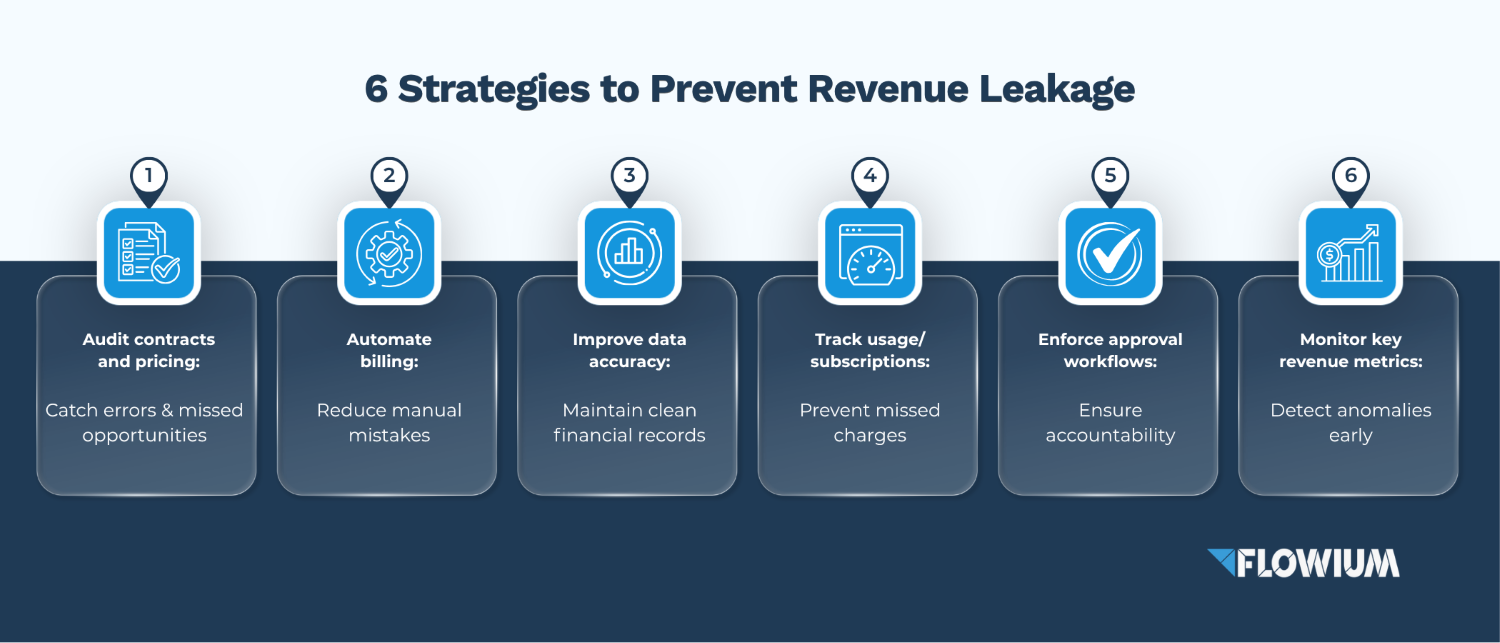
1. Audit Pricing and Promotions Regularly
Incorrect product prices, expired promotions, and unauthorized discounts can quietly reduce revenue. Regularly reviewing pricing rules, promotional campaigns, and discount codes helps ensure customers are charged the correct amount and margins remain protected.
2. Automate Billing and Financial Reconciliation
Manual processes increase the risk of billing errors, duplicate refunds, and missing payments. Automating order reconciliation, invoicing, payment processing, and refund verification reduces human error while ensuring every completed order is accurately recorded and collected.
3. Maintain Accurate Product and Customer Data
Revenue decisions are only as reliable as the data behind them. Regularly validate product pricing, inventory levels, customer information, and sales data to minimize pricing errors, stock discrepancies, and reporting inaccuracies that can lead to revenue leakage.
4. Monitor Customer Payments and Subscription Revenue
If your business offers subscriptions, memberships, or recurring orders, continuously monitor payment failures, expired payment methods, and customer usage to ensure recurring revenue is collected successfully. Even traditional ecommerce brands should track failed and declined payments to recover otherwise lost sales.
5. Establish Clear Approval Processes
Define approval workflows for price changes, manual discounts, refunds, and promotional campaigns. Requiring the appropriate authorization helps prevent unauthorized discounts, pricing inconsistencies, and costly operational mistakes.
6. Track Revenue Leakage KPIs
Regularly monitoring key performance indicators makes it easier to identify revenue leaks before they become major problems. Track key metrics to uncover trends and measure the effectiveness of your optimization efforts.
By combining these best practices with regular audits and continuous monitoring, ecommerce businesses can reduce preventable revenue losses, improve cash flow, and maximize the profitability of every customer and every order.
Revenue Leakage Ecommerce Metrics to Track
Professional marketers use several ecommerce metrics that will allow you to perform a comprehensive study of revenue leakage and promptly detect and stop revenue leakage from quote to contract management to cash. Let’s look at these critical metrics and KPIs for monitoring revenue leakage.
| Metric | Why Monitor |
|---|---|
| Revenue Leakage Rate | Measures the percentage of extended revenue lost due to payment failures, pricing errors, refunds, operational issues, or process gaps. |
| Conversion Rate | Tracks how effectively visitors become customers. A decline may indicate website or checkout issues that reduce revenue. |
| Cart Abandonment Rate | Identifies where potential customers leave without completing a purchase, which can indicate checkout friction. |
| Payment Success Rate | Measures the percentage of payments successfully processed. Low rates may point to gateway issues, declined cards, or checkout failures. |
| Billing & Pricing Accuracy | Ensures customers are charged the correct prices, taxes, shipping, and discounts, preventing undebilling. |
| Discount Leakage Rate | Measures Revenue lost through excessive discounts, coupon abuse, or misconfigured promo rules. |
| Customer Lifetime Value | Tracks long-term revenue generated by each customer and helps to identify retention-related revenue leakage. |
| Refund & Chargeback Rate | Measures revenue lost due to customer refunds and payment disputes, revealing possible fraud, fulfillment issues, or product quality problems. |
| Gross Margin | Shows whether revenue is translating into profit after accounting for product costs, discounts, and returns. |
| Revenue Recovery Rate | Measures the percentage of lost revenue recovered through payment retries, billing corrections, and dispute resolutions, showing if your recovery tactics work. |
Tools That Help with Revenue Leakage Detection
The right technology can help ecommerce businesses identify revenue leaks faster by monitoring payments, pricing, customer behavior, and financial data. Here are some of the most useful categories of tools:
- Ecommerce Analytics Platforms (Google Analytics 4, Triple Whale, Northbeam) — Track conversion rates, cart abandonment, customer journeys, and revenue attribution.
- Payment & Billing Platforms (Stripe, Shopify Payments, Recharge) — Monitor payment failures, declined transactions, subscription billing, and revenue recovery.
- Business Intelligence (BI) Tools (Looker Studio, Power BI, Tableau) — Combine data from multiple systems to identify revenue trends and operational anomalies.
- Email & Customer Retention Platforms (Klaviyo) — Recover abandoned carts, improve customer retention, and increase customer lifetime value through automated lifecycle marketing.
- Inventory Management Systems (Cin7, Katana, Inventory Planner) — Reduce revenue loss caused by inventory discrepancies, stockouts, and fulfillment errors.
- Accounting & Financial Management Software (QuickBooks, Xero, NetSuite) – Reconcile orders, invoices, payments, refunds, and financial records to identify billing discrepancies.
Using these tools together provides better visibility into where revenue is being lost and enables ecommerce brands to detect and resolve issues before they significantly impact profitability.
How Flowium Helps Ecommerce Brands with Revenue Leakage Prevention
Revenue leakage isn’t always caused by pricing or payment errors. In many cases, it’s the result of missed customer engagement opportunities that reduce conversions, repeat purchases, and customer lifetime value. That’s where Flowium helps.
As an ecommerce retention marketing agency, Flowium helps brands recover lost revenue by building automated customer journeys that engage shoppers at every stage of the lifecycle.
Flowium helps ecommerce brands reduce revenue leakage by:
- Offering a comprehensive marketing strategy audit.
- Recovering abandoned carts and browse sessions with automated email and SMS flows.
- Increasing repeat purchases through personalized post-purchase, replenishment, and win-back campaigns.
- Improving customer retention and customer lifetime value with lifecycle marketing strategies.
- Optimizing email segmentation and personalization to deliver more relevant messaging.
- Continuously testing and optimizing campaigns to improve conversions and maximize revenue.
By combining data-driven strategy, marketing automation, and ongoing optimization, Flowium helps ecommerce brands capture more revenue from existing customers while reducing the hidden losses that occur throughout the customer journey.
Conclusion
All sizes and types of businesses are impacted by revenue leakage. It is typically most prevalent in circumstances with continuing client relationships, complicated contract clauses, or poorly tracked data. Inadequate billing procedures and careless discounting also contribute to revenue leaks. Businesses may recover the great majority of lost revenue through better workflows, increased discipline, and new, more powerful software tools. When the leaks are fixed, earned but unrealized revenue typically goes straight to the bottom line. If you need professional assistance in identifying and fixing your issues with revenue leakage, contact Flowium. We’ll help you with the right strategies for optimization.
Frequently Asked Questions
What is meant by “revenue leakage”?
The process by which a business fails to collect the money it is entitled to, whether due to inaccurate pricing, inefficient billing, or several other factors, is known as revenue leakage.
How is revenue leakage discovered?
Perform a thorough financial audit, monitor key revenue KPIs, and identify the root causes of revenue leaks through a root cause analysis.
How can revenue leaks be avoided?
Setting explicit end dates for promotional methods, improving your order-to-cash process, developing a contract management system, and building an automated process to eliminate billing errors are among the most effective strategies for preventing revenue leakage.
How does revenue leakage result from poor inventory management?
Overstocking or stockouts brought on by poor inventory management can result in lost sales opportunities, higher storage expenses, and eventually income leakage.
How do shipping discrepancies result in revenue leakage?
Inaccurate weight estimates, volumetric pricing discrepancies, and invoicing errors are examples of shipping anomalies that can increase logistical costs and reduce profit margins.
Can revenue leakage result from returns and refunds?
Yes, because of the expenses associated with reverse logistics, damaged goods, and lost resale value, returns and refunds can greatly increase revenue leakage.