Margin is one of the most important indicators for any type of business. However, margin is merely a category that is divided into other sub-categories. If you’re reading this, you’re likely already familiar with the concept of gross profit margin and are probably very interested in managing and improving it. Gross profit margin is one of the key eCommerce indicators of a brand’s success. By monitoring this type of margin, business owners can determine how profitable their business is, or indeed whether it is profitable at all.
Having a high gross profit margin gives you the opportunity to expand your business. However, what is a good gross profit margin, why is it so important, and how can it be improved to earn more? You’ll find the answers to all these questions in our article.
What is eCommerce Gross Margin?
Before delving into strategies for improving the gross profit margin, we will briefly explain what it is.
Gross profit margin is a key financial metric that reflects a company’s revenue after deducting the cost of goods sold (COGS) but before accounting for marketing, salaries, rent, and other expenses. It is calculated using the following formula:
Gross Profit Margin = (Revenue – Cost of Goods Sold) / Revenue × 100%

The primary function of this metric is to demonstrate how profitably a company sells its products. The gross profit margin is closely dependent on the sales model, which is important to consider when comparing it to industry averages.
What is the Importance of Gross Profit Margin in eCommerce?
Every eCommerce metric can become key to a brand’s growth if it is properly analyzed and used to develop strategies. This is especially true for such a key metric as gross profit margin. Calculating profit after covering the cost of goods sold is just as important as a business’s net profit. It should not be underestimated, and here are the main reasons why:
Assessing Business Status
The profit margin reflects the overall health of the business. If you notice a steady decline in the profit margin during your regular performance calculations, this may signal significant underlying issues. These issues could include rising expenses, cost-ineffective marketing strategies, or shifts in consumer preferences. Each of these issues requires an immediate response before they lead to further losses. Monitoring metrics allows you to identify and address problems proactively before they escalate. The primary role of the gross profit margin is to serve as a metric that can be of interest to investors and partners seeking to understand the financial viability of the business.
Estimating the Scope for Reinvestments in Scaling
It is important to understand that a metric such as gross profit margin provides opportunities to reinvest funds into further development and scaling. By determining the percentage of nearly net funds, you can begin to develop reinvestment strategies to increase the company’s overall revenue and scale. Options for reinvestment may include marketing, product development, or simply expanding the product range.
Determining Future Pricing Strategies
A metric such as the gross profit margin provides specific insights into pricing effectiveness, which entrepreneurs can use to adjust future pricing strategies and improve their operational processes. Regular price adjustments will allow a company to stay afloat for the long term and not only maintain profits but also effectively grow them. You can do this by monitoring the gross profit margin to understand which products yield the highest returns and which may not be profitable and need to be reevaluated or discontinued.
Adapting to Changing Market Conditions
Continuing the topic of using gross profit margin for pricing strategies, regularly monitoring this metric allows businesses to adapt to the dynamic trends of eCommerce. Buyer preferences and market conditions are volatile and can change drastically in an instant, and gross profit margin is one of the solutions for anticipating unfavorable changes. A good example of market volatility is peak seasons accompanied by holidays or sales events, such as BFCM. By tracking fluctuations in the gross profit margin, you can make data-driven decisions regarding prices and offers during specific seasons. This will help you take advantage of trends and always stay on top of things.
What Is a Good Gross Profit Margin for eCommerce?
According to extensive research on eCommerce brands across various industries, as of 2026, a healthy gross profit margin for eCommerce brands falls between 50% and 70%, depending on the business model. Most brands with this rate already have good potential for profitable business scaling.
To answer the question “what is a good gross margin,” we’ve compiled a range for you, from a healthy percentage to a risky one in terms of potential expansion. Here are the key indicators for the gross profit margin in eCommerce in 2026:
- 70%+ is a figure that indicates an excellent position.
- 60-70% is a positive figure that can provide a stable range for reinvestment.
- 50-60% is a healthy figure, though it may be insufficient for scaling.
- Less than 50% means that growth can quickly become unstable.
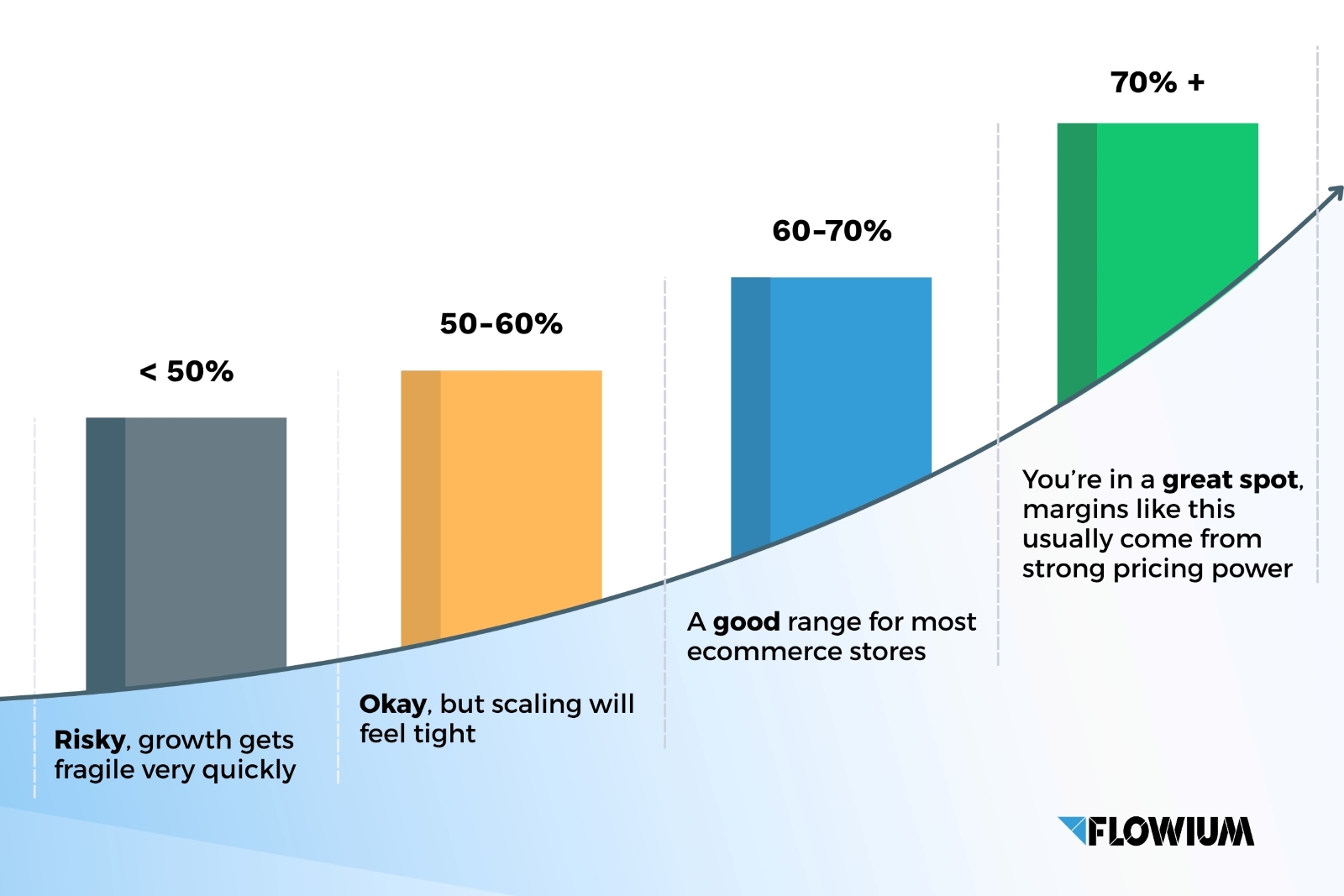
Please note that the gross profit margin can vary significantly depending on the business model, so before making any decisions based on our average figures, check whether they align with your business model.
Best Strategies to Improve Gross Profit Margin in eCommerce
Raising prices is the simplest way to increase gross profit margins, but there are other, more effective methods. Price increases often put excessive pressure on customers. We, however, offer strategies for auditing, cost reduction, and brand enhancement. Below, we’ve compiled the most effective strategies for improving gross profit margins for eCommerce brands.
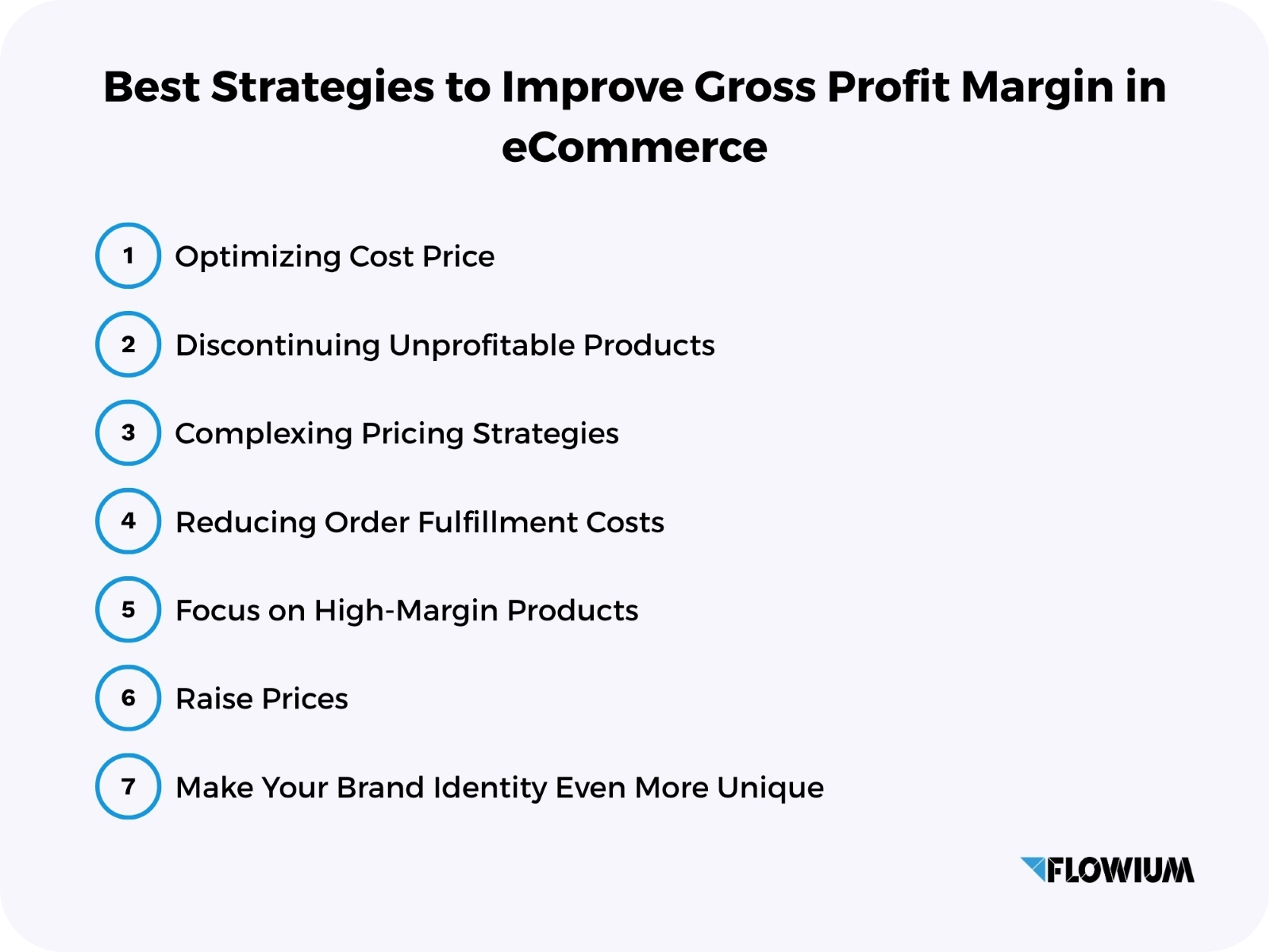
1. Optimizing Cost Price.
Your margin is based on the cost price. Even the smallest positive changes to this base will have a significant positive impact on a large scale. Reducing the cost price by just 3% is already a significant cost efficiency. A reduction of more than 3% will yield greater results than most large-scale pricing experiments. To optimize the cost price, regularly review your terms of cooperation with suppliers. It is best to do this when reviewing sales volume increases. Meanwhile, SKU consolidation can secure better prices while simplifying operations.
💡Many suppliers may offer discounts for early and timely payment of invoices. Discuss the possibility of such offers and take advantage of this slight but appealing bonus.
2. Discontinuing Unprofitable Products.
For your own benefit, never hesitate to discontinue low-margin products. They may even look promising in terms of revenue, but in reality, they can drain your financial resources and energy. If a product fails to improve its profitability after several iterations, it’s usually best to discontinue it.
💡When we say that low-performing products drain your energy, we mean that discontinuing them will allow you to focus on priority areas and free up resources to expand more successful products.
3. Complexing Pricing Strategies.
Offering discounts without applying pricing intelligence is simplistic and ineffective. Moreover, generic discounts gradually cause customers to expect lower prices. Another common tendency is for online stores to set prices too low to avoid the risk of failure or ineffectiveness. The solution is to test the price elasticity of your highest-demand products instead of holding constant, generalized sales. Create sets of complementary products to increase perceived value.
Explore the possibility of premium versions that give customers a reason to pay more without undermining your core offering. The goal is not to raise prices across the entire product line, but to provide high-value customers with a better option they’re willing to pay for.
💡Selling products as sets is one of the strategies that allows you to increase the average order value without directly lowering the prices of individual items.
4. Reducing Order Fulfillment Costs.
Order fulfillment costs are those silent, subtle profit reducers. Expenses such as delivery zones, carrier selection, packaging size, and materials constitute the hidden cost of your product. To avoid some of these unnecessary expenses, conduct regular order audits. Identify and analyze products that are unprofitable to ship and those that are most frequently returned. This way, you’ll achieve two goals at once: identifying flaws in order fulfillment and eliminating ineffective products.
Returns often occur due to vague product descriptions, inaccurate sizing, or failure to meet expectations. Understand that if a product has been returned only a few times, it may simply not have suited a few particular customers; however, if this happens regularly, the issue is definitely not due to picky customers. As with reducing the cost of goods sold, even the smallest percentage savings on order fulfillment costs significantly impact the gross profit margin.
💡A high return rate usually indicates broader issues with product presentation rather than customer behavior.
5. Focus on High-Margin Products.
A common mistake companies make is to boost sales just for the sake of revenue figures. However, more sales don’t always mean more money in the end. Sometimes it’s better to sell less but with a higher profit margin.
Find products that already offer a good margin and sell consistently. Focus on them, develop and scale them first. Don’t rush to add new items, as each new product complicates operations. Profitable products, on the other hand, give you more time and greater control over your business.
💡New businesses may show better product margin figures before the initial buzz wears off and they have to expand their production and services.
6. Raise Prices.
Don’t jump to negative conclusions about this advice right away. We understand that raising prices is a rather obvious way to improve gross profit margins and that you’ve likely already considered it. Of course, raising prices isn’t an option for every eCommerce brand, but as we mentioned earlier, some businesses may set prices too low simply to avoid the risk of failure. That’s why we still recommend analyzing competitors’ prices for similar products and reviewing prices for niche products or services that customers are unlikely to pass up.
💡By analyzing competitors’ prices for products similar to yours, you can determine the price limit to which you can raise the cost of these products before customers start looking for alternatives.
7. Make Your Brand Identity Even More Unique.
Building your brand identity means reshaping your business so that customers are willing to pay specifically for your products and services. By doing so, you can encourage customers to spend more money. One of the ways to grow your brand image is to position your brand as the premium option among others. To do this, stand out from your competitors, associate your products with additional features or capabilities, implement a premium pricing strategy, or at least update your brand design to project a prestigious, luxurious identity.
💡The strength of a brand that is perceived as prestigious lies in the fact that its identity can even justify higher prices than those of competitors. Prestige evokes emotions in customers, and that emotional connection keeps them coming back.
Final Thoughts
Based on our review of gross profit margins, we can confidently say that this is one of the most important metrics in eCommerce. Monitoring it, is important to avoid operating at a loss and to understand how effective your pricing strategies are compared to industry standards.
If your gross profit margin is lower than expected, don’t worry — our tips for improving it are practical and highly effective, not only for this metric but for your brand as a whole.
If you’re deeply concerned about your gross profit margin and our strategies for improving it seem too difficult to implement, you can trust the professionals. Our company, Flowium, specializes in retention marketing, and we are experts in improving eCommerce indicators. Contact us to conduct an audit of your business model.