Customer retention is rarely about one-size-fits-all solutions; it’s about optimizing your methods for maximum personalization. RFM analysis is exactly what brands need to understand where customers are in their buying journey and decide who to retain, re-engage, or prioritize.
The insight from RFM segmentation helps ecommerce teams build more relevant retention strategies—from rewarding loyal clients and nurturing new buyers to launching targeted winback campaigns for at-risk customers.
In this article, we’re going to give you an in-depth look at RFM analysis, explain how to build actionable customer segments, and show how brands use RFM data in ecommerce lifecycle marketing.
What is RFM Analysis?
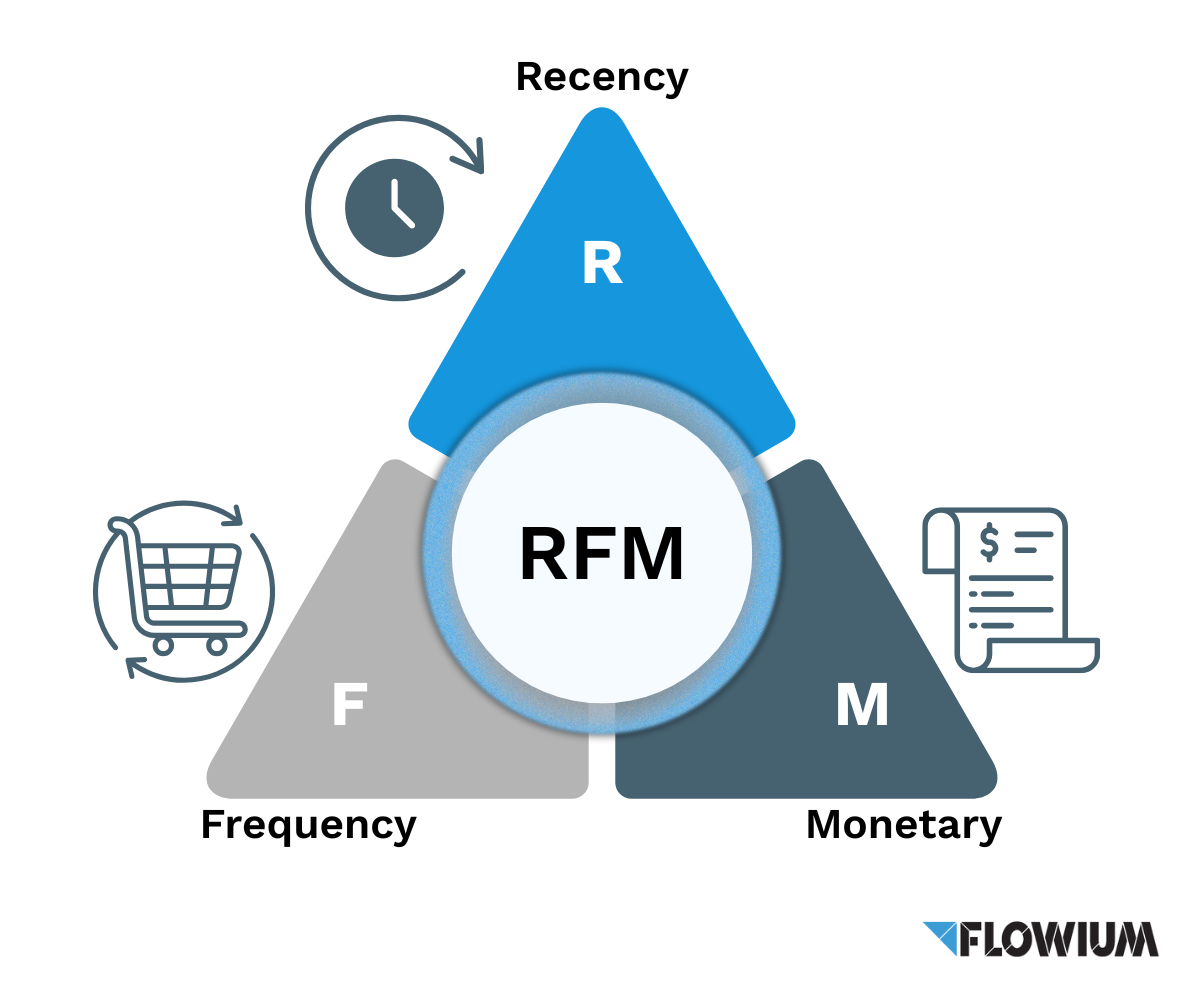
To begin with, we’ll decode the abbreviation. RFM stands for Recency, Frequency, and Monetary. By combining these three factors, you create a customer segmentation method that lets businesses divide their audience into groups for better personalization and a tailored approach to specific segments.
Let’s look more closely at the three metrics that define RFM:
- Recency: How long ago a customer bought something from you.
- Frequency: How many purchases they made during the analyzed period.
- Monetary: The total amount of money a customer spent during the analyzed period.
The analysis period matters because RFM scores relate to the data and timeframe you choose to assess. For example, a customer who purchased three times in a year will look different from one who made the same number of purchases in 3 months.
In other words, RFM is less about assigning a permanent segment ot a customer but more about understanding their current behavioral position.
Why RFM Analysis Matters for Ecommerce
RFM segmentation is practically a necessity for ecommerce brands who deal with intense competition and strive to maximize the relevance and personalization of their marketing. Let’s look at the actual benefits that this method can bring to your business.
- Identifying highest value customers
RFM highlights customers who purchase frequently, spend more, and have made purchases recently.
- Finding customers with potential to become repeat buyers
Brands can use this method to identify recent customers who have not yet developed clear purchasing patterns and target them with relevant campaigns to encourage repeat purchasing.
- Detecting customers whose activity is declining
You can see all changes in recency and frequency signaling that a previously active client is becoming less engaged.
RFM helps identify which at-risk customers are worth re-engaging based on their past purchasing behavior.
- Increased sales through effective lifecycle marketing
Thanks to more relevant messaging and better targeting, your approach will increase the motivation of different customer groups to buy more from you.
- Improved customer engagement
Some customers may not only want to buy from you but also become special friends of your business. This approach will help you find these customers. This also applies to developing B2B relationships.
- Higher number of reviews
This approach helps you identify groups of customers who can write you positive reviews. Using this method, you will find these groups and get a higher ranking thanks to quality reviews.
- More loyal customers
Another advantage of this method is that it increases customer loyalty because now they won’t consider your emails unnecessary spam.
- Allocating marketing spend more efficiently
The correct customer segmentation helps marketing teams focus on buyers with greater potential value, minimizing unnecessary spending.
- Tracking how customers move between lifecycle stages
You can monitor segment migration to see whether customers are becoming more loyal or moving towards inactivity. Based on the analysis received, you can adjust your strategies to reinforce or prevent the change to the desired outcome.
RFM Scoring: How Does It Work?
A common RFM approach assigns each customer a score from 1 to 5 for Recency, Frequency, and Monetary.
For example:
- Recency: 5 = most recent customers; 1 = least recent.
- Frequency: 5 = customers who purchase most often; 1 = customers who purchase least often.
- Monetary: 5 = highest spenders; 1 = lowest spenders.
The three scores can then be combined into an RFM profile.
For example, a customer with a score of 544 has:
- Recency = 5
- Frequency = 4
- Monetary = 4
This profile indicates a customer who purchased recently and has relatively strong purchase frequency and spend.
However, there is no universal RFM scoring scale or universal set of thresholds. Businesses can use different scoring ranges, percentile thresholds, analysis periods, and segment definitions depending on their customer base and purchase cycle.
For example, a brand may use 1-5 scoring based on customer quintiles, while another may use three scoring tiers.
Understanding Recency, Frequency, and Monetary for RFM Scoring
With this method, you evaluate all your customers by these 3 points—recency, frequency, and monetary. Let’s look at the importance of each section separately.
Recency
Recency quantifies the amount of time that has passed since a customer’s last purchase.
Compared to a consumer whose last purchase was 180 days ago, a customer who made a purchase 10 days ago is typically more current. However, the brand’s typical buying cycle determines what is “recent” in this context.
Example:
For a replenishment product purchased every 30 days, 60 days without an order may be significant. For furniture purchased every several years, it may not be.
The scheme for recency is quite simple. The rating is based on the time that has passed since the purchase. Of course, you can adjust this time to your business by setting your time frame.
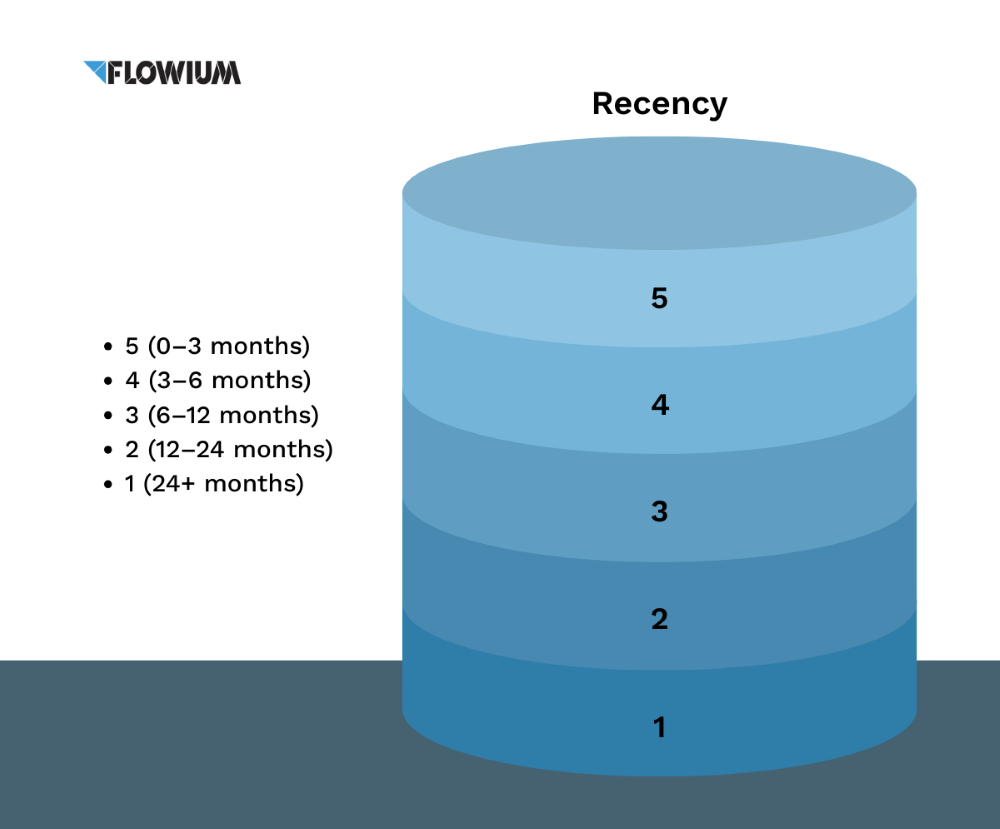
Experts point out this factor as the most important. In the marketing sector, potential is valued, and recent buyers have the most of it. Your future cooperation is based on your approach to such customers. That’s why, when calculating points on the scale, recency is often multiplied by 3 as the most important aspect.
Frequency
Frequency counts how many purchases a customer made over the course of the analysis.
Example:
If a consumer placed five orders within the specified 12-month period, their frequency is 5.
The business environment should be taken into consideration while interpreting frequency.
Those 5 purchases could mean that one category has very high involvement while another has only average behavior.
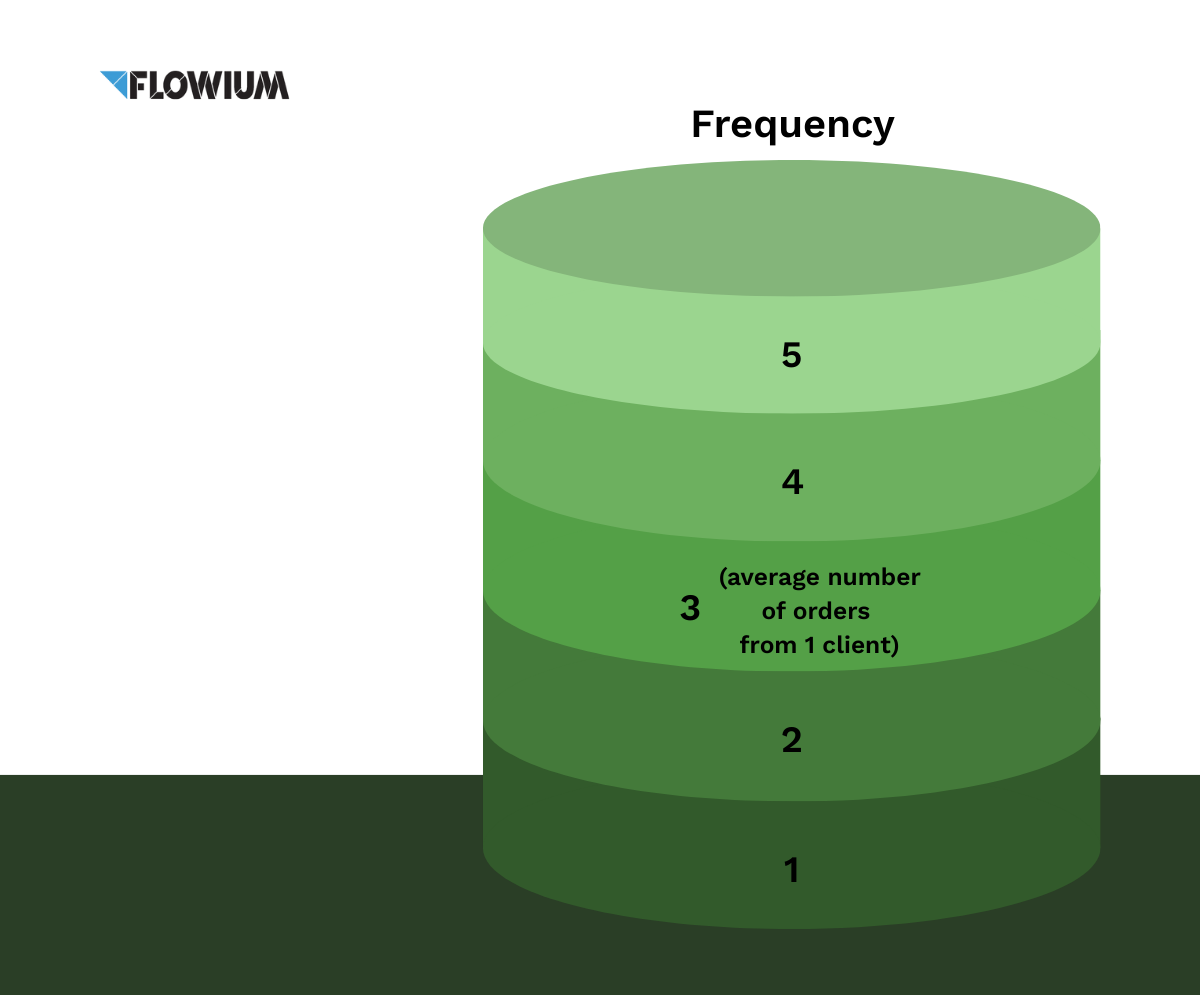
This metric is completely based on your industry. Here, you can calculate the average number of purchases per customer, and based on this number, evaluate customers as shown in the diagram. Frequency is also considered quite important, so customer ratings based on this principle are usually multiplied by 2.
Monetary
The Monetary metric indicates consumer spending across the study period.
Example:
A customer’s four orders totaling $75, $120, $90, and $150 would have a monetary value of $435.
Monetary is similar to the frequency principle. It is also based entirely on your business, taking into account your financial flow. And just like in frequency, you can calculate an average number and use it as a basis for estimation.
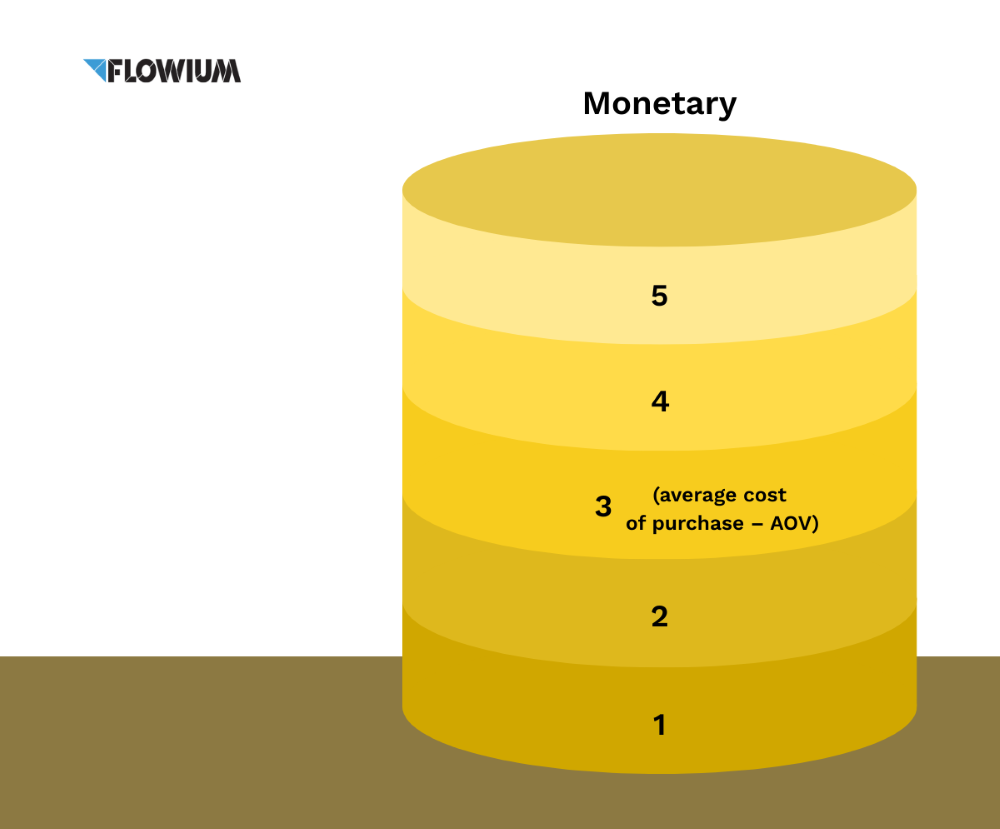
Pro Tip: In RFM analysis, AOV shouldn’t be used as the primary monetary metric. Standard RFM assesses the monetary value of the customer’s purchases instead of just utilizing average order value, although AOV can be a helpful extra metric.
How to Perform RFM Analysis
There are five steps involved in performing a basic RFM analysis.
Step 1. Get Your Transaction Data Ready
Start with purchase data at the customer level that includes at least.
- Client ID
- Date of order
- The order value
You might additionally require product, category, channel, discount, and acquisition-source data, depending on your research.
Ensure that test orders, refunds, cancelations, and duplicate transactions are handled uniformly.
Step 2. Select the Time Frame for Analysis
Establish the time frame you wish to examine, such as the preceding 12 months.
Your business model will determine the right time frame. A company with infrequent purchases would require a longer window, but a subscription or consumables brand might require a shorter one.
Step 3. Determine R, F, and M.
For each customer, calculate:
- Recency days since the last purchase
- Frequency = number of purchases made over the study period
- Monetary = total amount spent by customers over the course of the analysis
Step 4. Assign Scores
Use the scoring method of your choice to turn each metric into a score. Customer quintiles could be used in a 1–5 model, such as:
- Top 20% = 5
- Next 20% = 4
- Middle 20% = 3
- Next 20% = 2
- Bottom 20% = 1
Customers that have made the most recent purchases obtain the highest score for Recency.
Step 5. Divide Clients Into Useful Segments
Converting scores into segments with a distinct marketing goal is the last stage.
The behavior, retention objective, and action associated with a segment are more important than its name.
RFM Customer Segments
Based on the established RFM scores, you can see what actionable segments you can divide them into. We recommend grouping customers according to their purchasing behavior and assigning a specific retention goal and strategy to each group. Let’s see what segments you can create based on your RFM analysis and what strategies need to be put into action.
High-Value and Growth Segments
These customers are actively purchasing or show strong potential to become more valuable. The focus should be:
| RFM Segment | Typical RFM Scores Pattern | Customer Behavior | Retention Goal |
|---|---|---|---|
| Champions | R 5, F 4-5, M 4-5 | Very recent, frequent, and high-spending customers | Protect and grow loyalty |
| Loyal Customers | R 4-5, F 4-5, M 3-5 | Consistent repeat buyers with strong engagement | Increase frequency and customer value |
| Potential Loyalists | R 4-5, F 2-3, M 2-4 | Recent clients who show potential for repeat purchasing | Turn early engagement into loyalty |
| New Customers | R 5, F 1, M 1-3 | Recent first-time or very low-frequency buyers | Drive the second purchase |
| Promising/Active | R 4-5, F 2-3, M 1-2 | Recent or engaged customers who have not developed a clear purchasing pattern yet | Build momentum for purchase |
At-Risk and Re-Engagement Segments
These customers require a different approach because their purchasing activity is becoming weaker or has even stopped completely. In such cases, we recommend focusing on recovering valuable relationships while avoiding unnecessary marketing spend and over-relying on discounting.
| RFM Segment | Typical RFM Score Pattern | Customer Behavior | Retention Goal |
|---|---|---|---|
| Need Attention | R 3, F 2-3, M 2-4 | Clients whose activity is starting to weaken | Prevent further disengagement |
| At Risk | R 1-2, F 3-5, M 2-5 | Previously active clients whose recency has declined | Recover the relationship |
| Can’t Lose Them | R 1-2, F 4-5, M 4-5 | Historically frequent, high-value customers who are becoming inactive | Recover high-value customers |
| Hibernating | R 1-2, F 1-2, M 1-3 | Inactive clients with relatively low purchase frequency or value | Test reactivation selectively |
| Lost | R 1, F 1, M 1-2 | Long-inactive buyers with little purchase history or value | Minimize unnecessary marketing spend |
Note: These RFM score patterns are illustrative. We recommend adjusting the exact boundaries to your brand’s customer base, purchase cycle, and analysis period.
Top Retention Strategies for Each RFM Segment
After you figure out your segments, it’s time to put suitable retention strategies into action. Here are some of the most effective practices for each group.
| RFM Segment | Retention Strategy | Recommended Actions |
|---|---|---|
| Campions | Reward and strengthen loyalty | Offer VIP benefits, early access, exclusive launches, loyalty rewards, referral opportunities, and personalized product recommendations. |
| Loyal Customers | Increase customer value | Use cross-sells, upsells, personalized recommendations, loyalty incentives, and replenishment reminders to encourage more frequent purchases. |
| Potential Loyalists | Build repeat-purchase habits | Nurture customers with product education, complementary-product recommendations, social proof, and targeted second- or third-purchase campaigns. |
| New Customers | Drive the second purchase | Use post-purchase onboarding, product education, helpful content, complementary product recommendations, and timely follow-ups. |
| Promising/Active | Increase engagement and purchase frequency | Highlight relevant products, introduce complementary items, and use personalized recommendations or replenishment reminders to encourage another purchase. |
| Needs Attention | Prevent churn | Re-engage customers with personalized content, product recommendations, reminders, and relevant offers before their engagement declines further. |
| At Risk | Win back the customer | Create personalized winback campaigns based on previous purchases, preferences, and customer value. Use incentives selectively rather than automatically offering discounts. |
| Can't Lose Them | Recover high-value relationships | Prioritize personalized outreach, VIP winback messaging, exclusive offers, or customer service intervention to reconnect with historically valuable customers. |
| Hibernating | Test reactivation selectively | Run a limited reactivation campaign with relevant messaging or an incentive, then evaluate whether continued marketing investment is justified. |
| Lost | Deprioritize or suppress | Make a final reactivation attempt if the customer has potential value; otherwise, suppress them from regular promotional campaigns to reduce wasted spend and protect engagement. |
Conclusion
Using RFM analysis is a good strategy not only for email marketing but also for improving sales in general. To implement this type of segmentation, you only need to structure your customer base and then create relevant campaigns based on this method. Here at Flowium, we use this segmentation principle for ourselves and for client projects. Contact us if you’re looking for a professional agency to launch your email campaigns and get the fastest results.
Frequently Asked Questions
What does RFM stand for?
RFM stands for recency, frequency, and monetary segmentation. This method is used to increase sales and predict customer behavior based on the customer base.
What is the RFM technique?
This method is based on 3 main data points of your customers. By getting information about the recency, frequency, and money spent by your customers, you can add more structure to your marketing.
What are the three components of the RFM formula?
The main 3 components are the recentness of the contact, the frequency of purchases, and the monetary expenditure of the customer.
How to count RFM?
To calculate the RFM score, you need to evaluate each of the clients according to the main 3 criteria. Based on these scores, you will create your segmentation.