As soon as brands selling consumer goods or unique products that need to be replenished regularly gain momentum and decide to invest in marketing, they are presented with a unique opportunity to return previous customers.
This opportunity involves sending certain reminders to restock items as soon as they run out or wear out. Such reminders can be sent via retention marketing channels such as email, SMS, push notifications, and more. This type of promotion is part of replenishment marketing. In this guide, you’ll learn how to fully set up replenishment marketing, including what it is, why it works, and step-by-step instructions on how to create automated email and SMS Klaviyo replenishment flows.
What is Replenishment Marketing and Who Does It Apply To?
Replenishment marketing is the process of reaching out to customers at the moment when their supply of a purchased consumer good is likely to run out, with the aim of encouraging them to place a repeat order (replenishment) before they switch to an alternative option.
This marketing strategy is a subset of retention marketing, using not just the reactivation of customers but targeting precisely the moment when their stock naturally runs out. That’s when the intent to purchase is at its highest. Such reminders are sent via email or SMS, although it’s best to use all channels in replenishment campaigns, and we’ll show you how to do that below. Once replenishment campaigns are developed, they are automated and sent based on each customer’s purchase date and typical product consumption cycle.
Who Can Benefit from Replenishment Marketing?
Sure, this marketing strategy isn’t suitable for every business, but only for certain types of commerce with specific types of products. If your brand falls into one of the commercial categories listed below or you sell the types of products we’ll mention, you’re exactly the kind of brand that can reap significant profits from replenishment marketing.
The Razor and Blades Business Model: This model applies to sellers of a specific core device, such as a razor, coffee maker, or printer, that is sold once or at a low price. The brand itself generates revenue from the regular sale of compatible consumables, such as corresponding blades, capsules, or cartridges.
Direct-to-Consumer Subscription Brand: Companies that sell consumables directly to consumers without intermediaries through a recurring subscription.
Continuity Model: This marketing term refers to businesses with a continuous sales cycle, where the customer signs up for automatic payments and regular restocking of goods. This may apply to products such as vitamins or pet food.
Fast-Moving Consumer Goods (FMCG)/Consumer Packaged Goods (CPG): This is a general term for brands of everyday consumer goods with high turnover (cosmetics, household cleaning products, food).
Benefits of Replenishment Marketing for Customer Retention
Recent statistics from Klaviyo claim that 41% of total eCommerce revenue comes from just 8% of repeat customers, while the vast majority of new customers never return. This significant gap can be substantially bridged through replenishment marketing. As soon as a customer runs out of a product, a consideration phase begins, and the customer often finds an alternative simply because you didn’t remind them of your existence.
Higher Chance of Repeat Purchases
A message offering a restock solves this problem. It reaches customers before a competitor can win them over and before the convenience of a local store becomes the easier option.
Greater Competitiveness
Right now, your customers’ entire information space is flooded with offers and competitive alternatives, from social media feeds to dozens of emails. It’s important for your message to be there too, precisely when they need to restock, so that among all the competitors, the customer can find and remember the brand they’ve already purchased from.
Preventing Customer Churn to the Offline Sector
For many buyers of consumer goods, it’s very easy to develop the habit of shopping at physical stores, which causes disproportionately great harm to DTC brands. If your reminder reaches them just as their supplies are starting to run out, they can place an order immediately without even considering a trip to a physical store.
Increasing Profit Through Retention
According to a study by Bain & Company, increasing customer retention by just 5% can boost profits by as much as 25% or even 95%, not by increasing costs, but by leveraging the value of customers already in your database.
Automated Revenue
Unlike traditional retention marketing, automated replenishment provides nearly automated regular revenue from customers who will begin to regularly restock with you, bringing in significant LTV.
Klaviyo Replenishment Flow: Complete Setup Guide
The key to setting up flows/automations is not to get confused by the logic of triggers, timing parameters, and segmentation. However, setting up Klaviyo replenishment flows is actually not technically difficult, and now, as experts in Klaviyo and Klaviyo Master Elite Partners, we’ll show you how to do it.
How to Build an Email Replenishment Flow in Klaviyo
Step 1: Choose Trigger
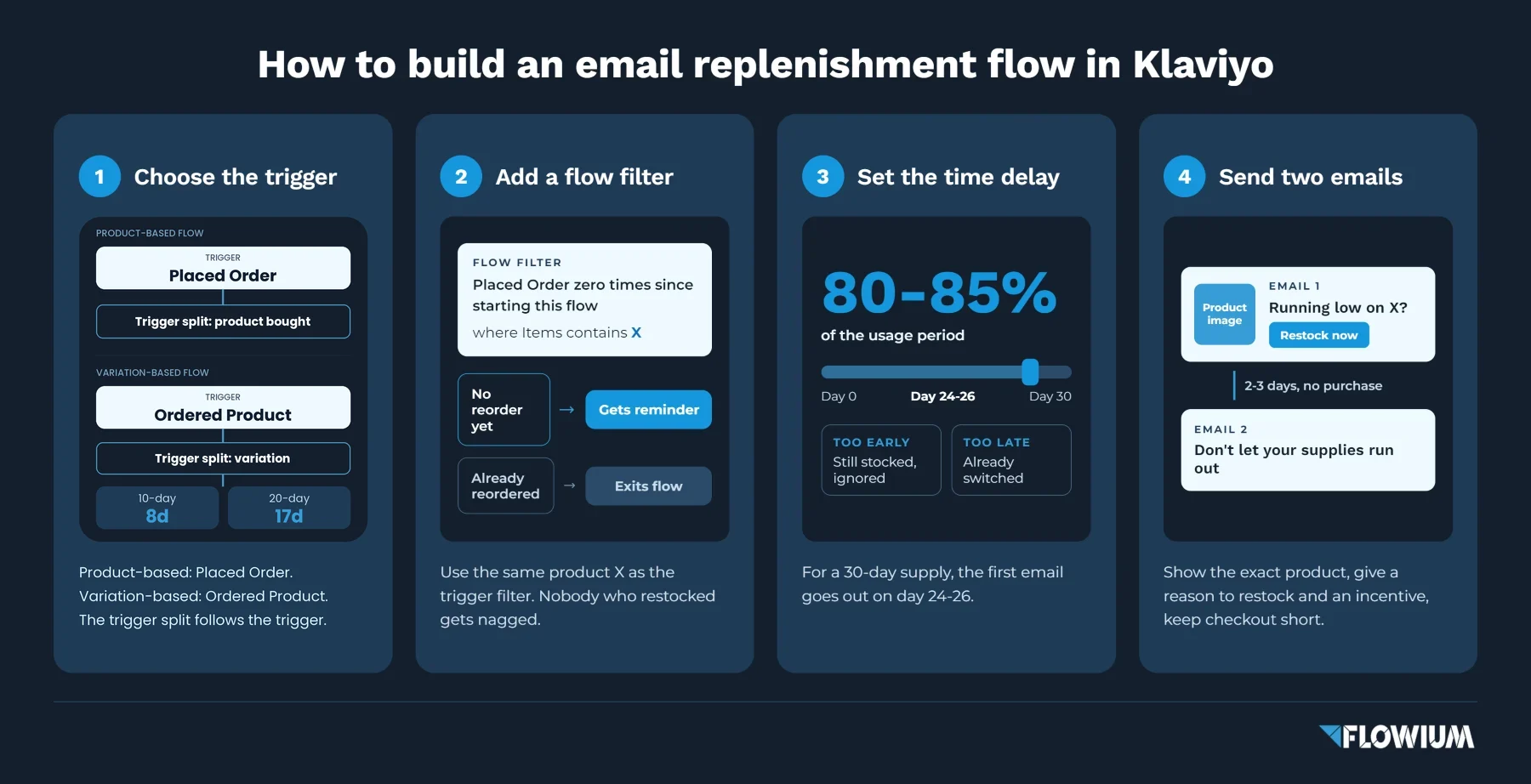
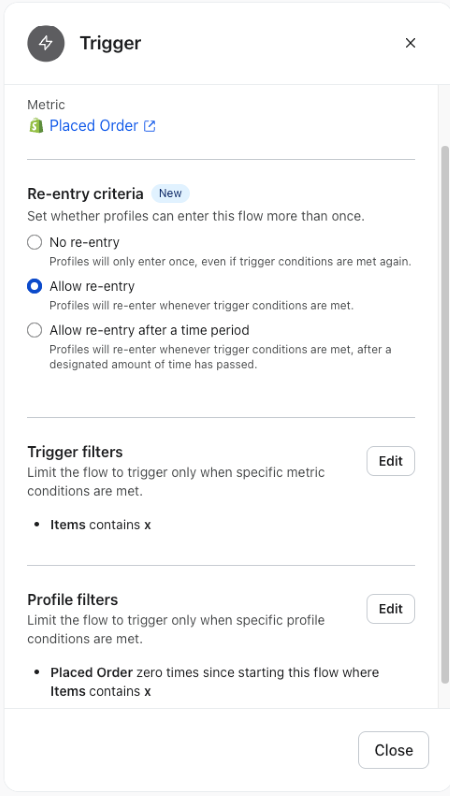
- First, go to the “Flows” section in Klaviyo and create a new automation triggered by the “Placed Order” event/metric.
- For a replenishment flow of a specific product, add a trigger filter that only allows customers who have purchased that specific product or a product from a specific category.
If a product comes in different sizes or portions, keep everything in one replenishment flow rather than building a separate flow for each variation. Add a conditional split at the start of the flow based on the variation purchased (for example, 10-day, 20-day, or 30-day pack), then give each branch its own time delay before the first email goes out.
For example, customers who bought the 10-day pack get the replenishment email after 8 days, those who bought the 20-day pack get it after 17 days, and so on. This way, every variation gets a timing that matches when they’re likely to run out, and you only have one flow to manage and update.
Important: For this setup to work, the flow trigger must be the Ordered Product metric instead of Placed Order. Only the Ordered Product event carries variation data (such as size or pack type), so the trigger split can’t filter by variation if the flow is triggered by Placed Order.
Step 2: Add a Flow Filter for Recurring Customers
This step ensures that replenishment emails are sent only to those who haven’t yet restocked, rather than to everyone. Without it, you’ll send restock notifications to customers who have already replenished on their own, thereby undermining their trust in your email campaigns.
- In Klaviyo, go to Flows → Flow Filters → add “Placed Order zero times since starting this flow where Items contains X.”
*X in both trigger filter and flow filter should be the same product you want people to replenish.
This ensures that the sequence will automatically end when Klaviyo detects a new purchase, regardless of which stage of the flow the customer is currently in.
Step 3: Set a Time Delay Based on Consumption Data
Time is the most important variable in the replenishment flow, since you shouldn’t send a replenishment reminder when there’s still enough stock and the customer will simply ignore you, nor should you send one too late, since the customer may already have found an alternative.
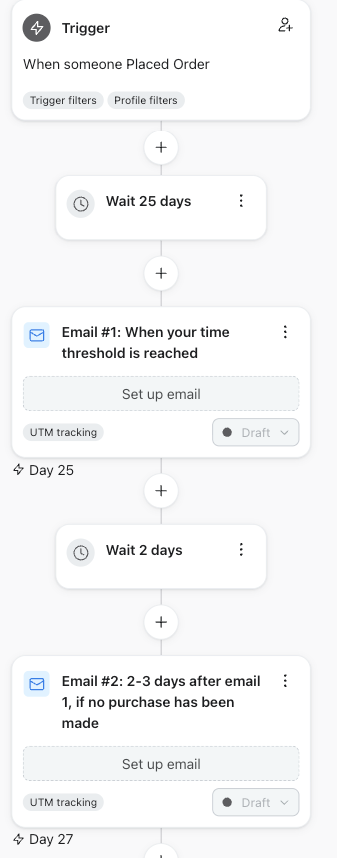
- Fixed consumption cycle: This approach applies to products with a defined period of use, such as 30-day packages. Set the time delay to 80-85% of the usage period. For example, for a 30-day supply, send the email on day 24-26.
Step 4: Create an Email Sequence
A standard replenishment flow consists of two emails:
- Email 1: When your time threshold is reached.
This serves as the main reminder to restock. Use Klaviyo’s dynamic product blocks to display the exact product name and image from the trigger event so the customer immediately recalls that specific product, rather than just thinking about “restocking.” In the text of the replenishment email, focus specifically on the underlying motivation rather than just the product’s features.
Make the path to purchase as simple as possible so that the steps from clicking the button are minimal and the customer won’t be too lazy to complete the order. Add a specific incentive to definitely encourage the customer to restock with you.
- Email 2: 2-3 days after Email 1, if no purchase has been made.
A short, direct reminder. Emphasize the urgency without being pushy. Use a phrase like “Don’t let your supplies run out” to create FOMO.
*Alternative setup for products without a fixed consumption cycle: Klaviyo’s predictive analytics includes an “Expected Date of Next Order” property, which estimates when each customer is likely to order again based on their purchase history. You can build a separate, general (not product-specific) flow around it. This flow is triggered by that date property rather than by a purchase, uses a general filter such as “placed order zero times since starting this flow,” and has no time delay before the first email. Because its trigger, filters, and timing all differ from the flow described in this guide, treat it as its own flow rather than a variation of this one.
SMS Replenishment Marketing in Klaviyo
Replenishment marketing via SMS uses the same timing logic as email, but this channel focuses on the highest level of urgency and delivery without restrictions from email providers. What’s more, according to verified research from Salesforce’s State of Marketing, SMS open rates consistently exceed 90%.
Role of SMS in the Replenishment Sequence
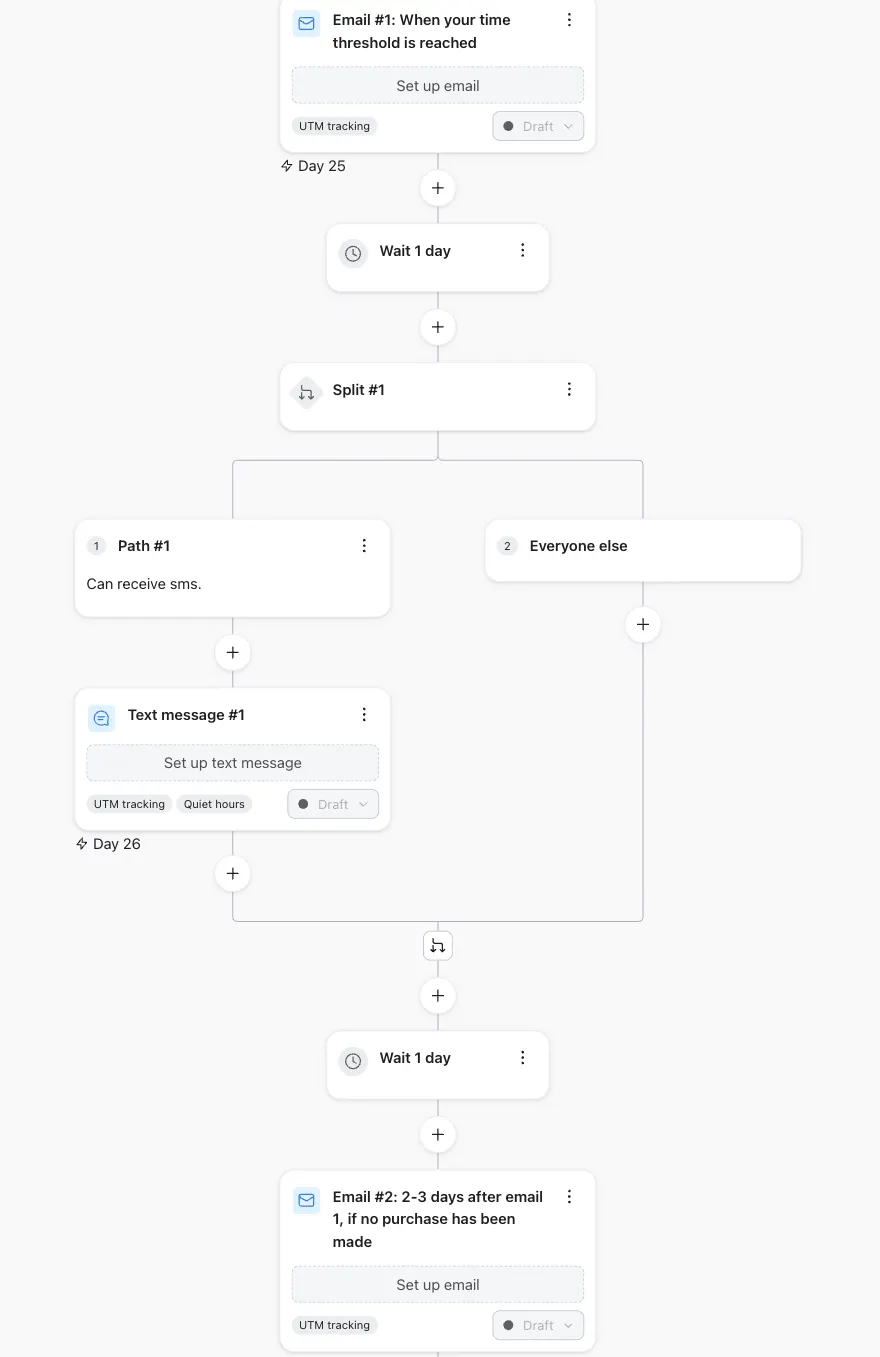
First and foremost, it’s important to understand that SMS should not replace the email channel but rather work in tandem with it. A high-quality replenishment sequence should send an SMS somewhere between the two main emails and look like this:
Email 1 → SMS → Email 2
If the first email didn’t result in a conversion, send an SMS 24-48 hours after it. The SMS message should not exceed 160 characters and should include a direct link to the product or a URL for one-click reordering.
Step 1: Complying with SMS Sending Requirements
‼️In the U.S., the TCPA requires explicit, separate consent to receive SMS messages. Make sure your Klaviyo sign-up forms are configured to obtain consent for SMS messages independently of email consent. If you’re unsure about your current settings, this is the first thing to check before creating the SMS layer of your replenishment process.
Step 2: Setting Up SMS in Klaviyo
Make sure SMS is enabled in your Klaviyo account and that consent to receive SMS messages has been obtained through a separate opt-in. Email subscribers who have not explicitly consented to receive SMS messages must not be sent text messages.
- In your replenishment workflow, add a conditional split right after Email #1 that checks whether the person has consented to receive SMS marketing (e.g., “Can receive SMS marketing” / “Consent to SMS = true”).
- Place the SMS message on the Yes branch. People without SMS consent follow the No branch and simply continue through the email-only flow.
- Compose the SMS message, including the product code, a direct question, and a short trackable link.
Pay attention to the time delays between your emails and SMS messages. Space them so the sequence feels natural (for example, a text a day or two after Email #1, not minutes later), and make sure the SMS doesn’t repeat the email word for word. Also check your SMS quiet hours so messages don’t go out at an inconvenient time for the customer.
Replenishment Email Examples
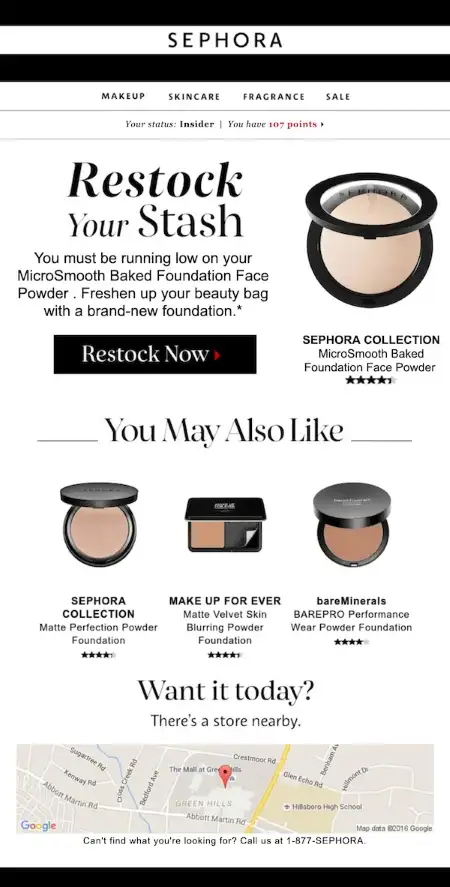
Sephora is a remarkable example of high-quality email marketing, and we’ve already reviewed their emails several times in our articles, here’s another one. The first thing to note is that Sephora expertly adapts its replenishment texts to match its brand’s style. In addition to the call to replenish a specific foundation face powder, Sephora strategically includes a “You Might Also Like” section featuring alternative powders for shoppers who might want to try something new.
What to borrow: Give your replenishment messages a personal touch instead of sending generic stock availability notifications. Combine the main product reminder with complementary or alternative products, and add an omnichannel “Store Nearby” option to drive customers to your physical store.
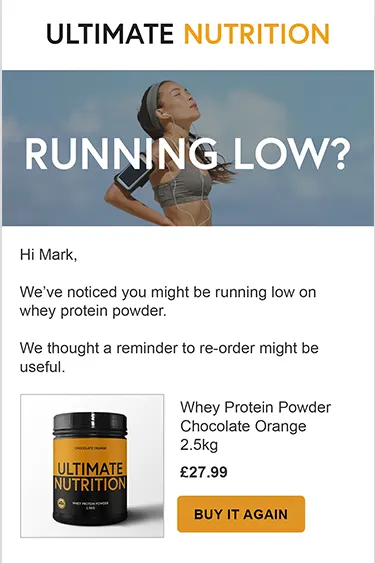
Ultimate Nutrition sets an exemplary standard for clear and personalized communication aimed at retaining customers. The email opens with a vibrant contextual banner that immediately pulls in dynamic product data to display the exact SKU, flavor, and quantity of the customer’s previous order.
What to borrow: Use dynamic product information blocks to remind customers of their exact order history. Replace generic calls to action with action-oriented phrasing.
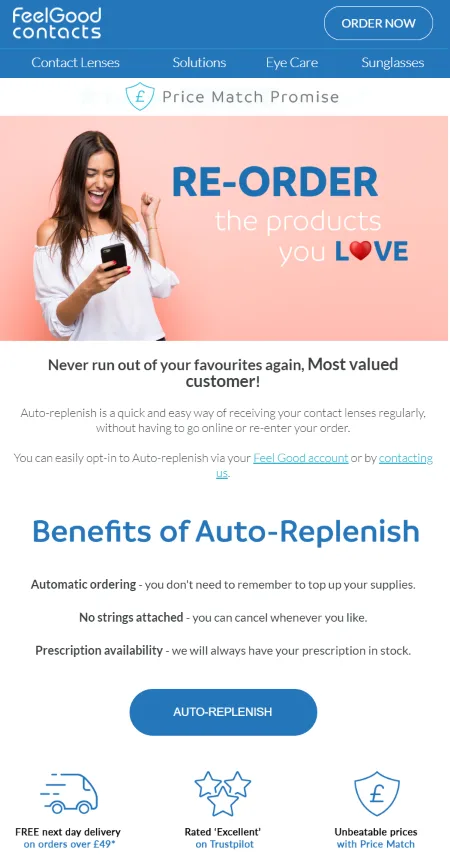
In this replenishment marketing example, we have a specific case study that demonstrates how to promote auto-replenishment. FeelGood Contacts effectively leverages the customer touchpoint during replenishment to transition repeat customers who place orders manually to a predictable, automated subscription model. The strength of this layout lies in its clear focus on reducing barriers, explicitly highlighting the benefits of features such as prescription tracking, automated inventory management, and a simple cancellation process.
What to borrow: Use replenishment processes not only to drive one-time sales but also as a strategic channel for promoting recurring subscriptions. Place trust signals, price-match promises, and fast-delivery guarantees next to the main call-to-action to help eliminate purchase hesitation.
Key Elements of a Successful Replenishment Campaign
Near the end of this article, we’ve also included a checklist of best practices that should be present in your replenishment campaigns to ensure their success.
- Send time
Send emails at 80-85% of the consumption cycle, before the product runs out, not after. Segment your audience by product if usage cycles vary across your product lineup.
- Personalization
Don’t limit yourself to just the recipient’s name. Mention a specific product, variant, and order date using Klaviyo’s dynamic content blocks.
- One clear call to action
The primary action is reordering. Call-to-action texts like “Restock Now” or “Order…” consistently outperform generic “Buy Now” messages.
- Concise, product-focused design
The product image should be prominently displayed, the text should be brief, and the path to purchase should be clear. One product, one goal, one click, you’re encouraging replenishment, not sending a newsletter.
- Strategic incentives
A minor incentive, such as free shipping or a small discount, should be included in the second email, not the first. Start by addressing the need for the product, and let your offer eliminate hesitation rather than simply encourage the recipient to open the email.
Final Thoughts on Building Replenishment Marketing
The replenishment flow is an efficient infrastructure that runs automatically, intelligently filters data, and scales as your customer base grows. Most campaigns fail to deliver the expected results due to fixable issues, such as an incorrect launch time, a lack of SMS follow-up, or a workflow filter that doesn’t exclude customers who have already placed a repeat order on their own.
To avoid such mistakes and boost your revenue through replenishment marketing, you can reach out to the email and retention marketing professionals at Flowium. If you already have replenishment campaigns set up but they aren’t delivering the success we described in this article, you can contact us for an email audit, during which we’ll identify all issues and help you get the most out of your potential.
Replenishment Marketing Frequently Asked Questions
What should I do if a product is out of stock at the exact moment a reminder is sent?
Set up a stock check in Klaviyo before sending reminders. This is configured via a Conditional Split based on the product’s availability attribute. If the SKU is out of stock, direct the customer to a branch with an alternative product or route them to the “Back in Stock” workflow.
How can I avoid sending replenishment emails to customers who are already subscribed to auto-delivery?
Set up a Flow Filter that excludes active subscribers. For example, using the Recharge/Skio integration parameter: Active Subscription is true.
How do I correctly set up a flow if a customer purchased multiple products with different usage periods in a single order?
Set the trigger for the product with the shortest consumption cycle, or set a sending frequency limit (Smart Sending in Klaviyo) so the customer doesn’t receive 3-4 different reminders in a row. In the email itself, you can use a dynamic block that displays all products from the last receipt in a single list.