Acquiring a large number of subscribers may look like predictable growth, but sign-ups alone do not guarantee recurring revenue. What matters is whether customers renew after the first order and continue to see enough value to stay. Churn begins long before someone reaches the cancellation page. Customers may receive too much product, miss the expected results, disengage from brand communications, or leave after a failed payment.
At Flowium, we build email and SMS lifecycle programs around customer behavior, not attributed revenue alone. A subscription flow is useful only when it improves renewal behavior, retained revenue, and customer LTV. The subscription retention strategies below show how to measure that outcome, locate churn across the lifecycle, improve onboarding and upcoming-order communication, offer pause or skip options, recover failed payments, and personalize cancellation prevention and win-back.
What Is Subscription Retention?
Subscription retention shows how consistently a brand keeps subscribers active from one renewal to the next. A strong sign-up count can still hide a sharp drop after the first recurring charge.
At Flowium, we treat retention as the alignment between three rhythms: when customers use the product, when they receive it, and when the brand communicates with them. If those rhythms drift apart, churn follows. A customer who likes the product may still cancel because unopened bottles are piling up or the next delivery arrives too late.
Subscription Retention vs. Customer Retention vs. Churn
| Metric | What It Tracks |
|---|---|
| Subscription retention | Subscriptions that remain active and renew. |
| Customer retention | Customers who keep buying through recurring or one-time orders. |
| Churn | Subscriptions lost through cancellation or payment failure. |
Don’t collapse these numbers into a single dashboard tile. A healthy repeat purchase rate can hide subscription churn, and strong email engagement can hide weak renewal behavior.
Strong customer retention in a subscription business raises customer lifetime value (LTV), shortens customer acquisition cost (CAC) payback, and makes recurring revenue easier to forecast.
How to Calculate Subscription Retention Rate
Retention is easy to overstate when new sign-ups, long-term subscribers, and reactivated customers all sit in the same dashboard total. We use two views to separate them: period retention for a broad snapshot and renewal cohort retention for the point where customers start leaving.
Subscription Retention Rate Formula
Period retention measures how many subscribers from the starting group remain active at the end of a selected month, quarter, or year.
Period Retention Rate = ((Subscribers at End – New Subscribers During Period) / Subscribers at Start) × 100
Suppose a brand starts the month with 1,000 active subscribers and ends with 950. Of those 950, 150 joined during the month: (950 – 150) / 1,000 × 100 = 80%. The brand retained 800 subscribers from its starting base.
That snapshot does not reveal whether customers leave after their first box or their sixth. Renewal cohort retention does.
Renewal Cohort Retention = (Original Cohort Still Active at Renewal N / Original Cohort Size) × 100
If 500 customers started a subscription in January and 360 remained active after their third renewal, third-renewal retention for that cohort would be 72%.
Before adding either calculation to a dashboard, set five rules:
- Choose customers or subscriptions. Customer-level retention measures how many people stay. Subscription-level retention measures how many recurring plans remain active. A customer with two subscriptions counts once in the first calculation and twice in the second.
- Separate reactivations. A returning customer is not continuously retained. Remove reactivations from the ending total or report them as a separate cohort. Otherwise, a strong win-back month can hide weak ongoing retention.
- Match the billing cadence. Compare cohorts after the same number of renewal opportunities. A 30-day coffee subscription and a quarterly beauty box should not be compared at the same calendar date.
- Define renewal numbering. Some platforms count the initial subscription order as order one, while others label the first recurring charge as renewal one. Choose one convention and use it across every report.
- Set a rule for paused subscriptions. A paused subscriber has not canceled, but they are not generating a paid renewal either. Report pauses separately and apply the same status rule across all cohorts.
Subscription Retention Metrics That Reveal Why Customers Leave
One retention rate tells you that something changed. It rarely tells you what changed. A useful scorecard pairs the headline number with metrics tied to specific points in the subscription lifecycle.
| Metric | What It Measures | What It Can Reveal |
|---|---|---|
| Subscription retention rate | The share of starting subscribers still active after a set period | Whether overall retention is improving or declining |
| Renewal retention by cycle | The share of a cohort reaching renewal 1, 2, 3, and later cycles | The exact renewal where churn spikes |
| Voluntary churn rate | Customer-initiated cancellations | Price concerns, excess product, weak results, or poor experience |
| Involuntary churn rate | Subscriptions lost through payment failure | Gaps in billing, card updates, or dunning |
| Failed payment recovery rate | Failed charges successfully recovered | Whether retry timing and email or SMS reminders work |
| Skip or pause rate | Subscribers choosing a temporary alternative to cancellation | Product buildup or a delivery cadence that does not match usage |
| Cancellation save rate | Cancellation attempts converted into a pause, skip, swap, or continued subscription | Whether reason-based save offers match the actual problem |
| Reactivation rate | Former subscribers who restart | The performance of win-back campaigns and re-entry offers |
| Average orders per subscription | Orders completed before cancellation | Whether the average subscription relationship is getting longer |
| Subscription LTV | Revenue or contribution margin generated during the subscriber relationship | Whether retention gains produce a meaningful financial return |
A cohort view makes the timing of subscriber loss easier to see.
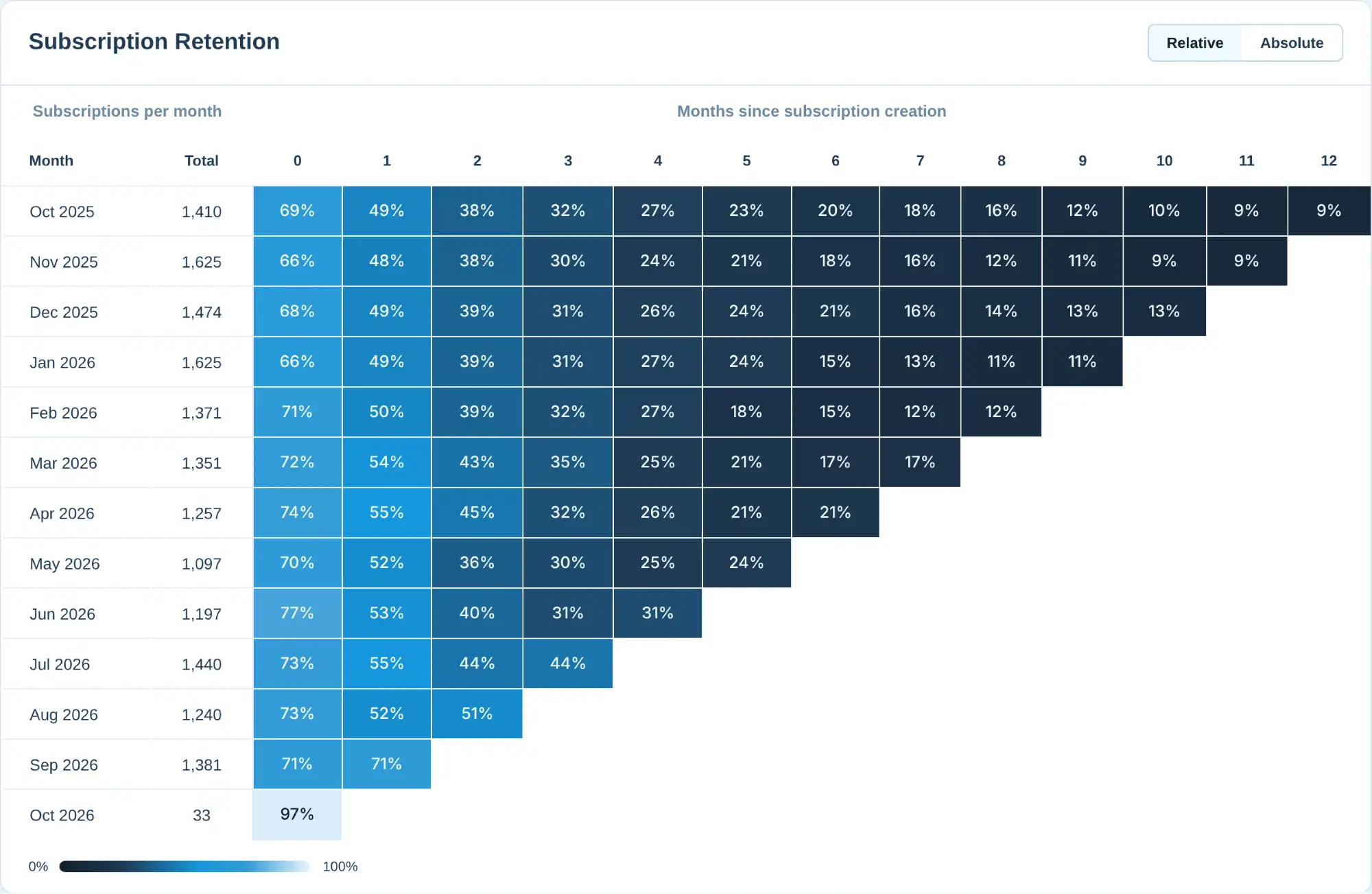
Open rate, click rate, and Klaviyo-attributed flow revenue still help diagnose message performance. They do not prove that retention improved. A pre-renewal email can attract plenty of clicks while second-renewal retention continues to slide.
Where Subscription Churn Actually Happens
A cancellation is recorded at the end of the relationship, but the reason often appears much earlier. Sending every at-risk customer to the same discount popup misses that history.
We call this the Subscription Retention Leak Map. It connects each lifecycle stage with the metric that exposes the problem and the intervention that fits it.
| Lifecycle Stage | Common Retention Leak | Metric to Watch | Primary Intervention |
|---|---|---|---|
| Sign-up | Low-intent subscriber attracted by an aggressive first-order discount | First-renewal retention by offer and acquisition source | Refine the offer, expectations, and acquisition segmentation |
| First 14 to 30 days | Customer does not use the product correctly or know what results to expect | Onboarding engagement, support contacts, and renewal 1 | Product education, usage guidance, and progress checks |
| Before renewal | Product buildup or a delivery cadence that does not match consumption | Skip, pause, and cancellation rate by product and cadence | Upcoming-order reminder, skip, delay, quantity change, or frequency change |
| Billing | Declined card, expired payment method, or poorly timed retry | Involuntary churn and failed payment recovery rate | Smart retries and coordinated card-update email and SMS |
| Cancellation | Price, low perceived value, poor fit, or unresolved service issue | Cancellation reasons and save rate | An alternative matched to the stated reason |
| Post-cancellation | The original issue has been fixed, but the customer receives no relevant reason to return | Reactivation rate by cancellation reason and win-back cohort | Targeted win-back after the underlying problem is resolved |
Voluntary and involuntary churn tell you how a subscription ended. The lifecycle stage and cancellation reason show where the experience needs work.
Flowium Case: Build the Lifecycle Foundation Before Optimizing Churn
Flowium worked with a subscription beauty brand that had no email or SMS strategy. We built its lifecycle program from scratch, including segmentation, tailored copy, branded design, and coordinated email and SMS. Over four months, attributed email revenue rose from $17,422 to $30,800, the list grew from 7,682 to 17,838 contacts, and opt-ins increased from 1,754 to 4,422. See the subscription beauty case study.

How to Improve Subscription Retention Rate Across the Customer Lifecycle
At Flowium, we connect subscription data with lifecycle messaging. Product experience, email and SMS timing, account controls, and billing recovery all shape renewal behavior. The nine strategies below follow the full subscription lifecycle.
1. Acquire Subscribers Who Are Likely to Stay
Start with the cohort, not the sign-up total. Break first-renewal retention down by acquisition source, subscription offer, product, and discount depth.
A steep first-order discount can fill a dashboard with new subscriptions while attracting customers who planned to buy only once. Judge the promotion by what happens next:
- How many subscribers reach renewal one?
- How quickly does the cohort recover its acquisition cost?
- How much contribution margin remains after the discount?
- Which products and sources produce the strongest later renewals?
If one source produces cheap sign-ups but weak retention, it is not a strong subscription channel. It is discounted customer acquisition wearing a subscription label.
2. Match Quantity and Delivery Cadence to Actual Consumption
A default 30-day cycle may suit the platform, but customers do not consume every product on the same schedule. Offer 30-, 60-, or 90-day delivery where the product allows it, along with flexible quantities and bundles.
A short on-site quiz can recommend a starting plan based on usage, household size, or product goals. After sign-up, skips and cancellation reasons show where that recommendation is wrong. Repeated skips may call for less product or a longer cadence. Customers who run out early may need a larger bundle or faster delivery.
3. Win the First Renewal With Better Onboarding
The first renewal is usually won through the post-purchase experience, not the day before the next charge. Customers need to use the product correctly, understand what to expect, and see enough value to continue.
A practical onboarding sequence can include:
- Order confirmation: Explain what ships, when the next charge occurs, and where the customer can manage the subscription.
- Delivery-day guidance: Show how to use, store, prepare, or introduce the product.
- Mid-cycle check-in: Address common mistakes, answer FAQs, and set a realistic timeline for results.
- Pre-renewal support: Ask whether the quantity and frequency still fit before sending the upcoming-order notice.
A strong subscription welcome email confirms the recurring order, directs the customer to account management, and keeps support close.

This matters most for supplements, skincare, pet care, coffee, and other replenishable products. If customers use the product inconsistently, they may conclude that it did not work. More promotional emails will not fix that.
4. Build Email and SMS Around Subscriber State
Subscription messaging should follow customer behavior, not just the campaign calendar. Sync events from the subscription platform into Klaviyo or another ESP, then build communication around moments that change the relationship:
- Subscription started: Welcome and onboarding.
- Order delivered: Product education and usage guidance.
- Renewal approaching: Order details, expected charge, and management options.
- Renewal completed: Reassurance, progress, and relevant support.
- Order skipped: Confirmation and a better-timed follow-up.
- Payment failed: Card update and recovery sequence.
- Subscription canceled: Feedback capture and reason-based win-back.
The upcoming-order reminder deserves separate attention. Treat it as a retention touchpoint, not just notice of another charge. Show the product, quantity, order total, charge date, expected delivery, and direct links to skip, delay, swap, or change frequency.
Track skips and cancellations in the days after each reminder by template and renewal number. If one version creates a churn spike, improve the context and account controls. Hiding the upcoming charge only creates surprise later.
We use email as the educational backbone. SMS adds value when timing matters, and the subscriber has provided consent. For brands using Klaviyo, SMS marketing should follow the same subscriber state as email instead of running as a separate program.
Active subscribers also need campaign suppression. Someone already receiving a product every month should not keep seeing “Subscribe and save” promotions for that same item. It is irrelevant, may expose a better introductory offer, and can remind the customer to reconsider a cost they were not questioning.
5. Make Pause, Skip, Reschedule, and Swap Easy
Subscribers should be able to change an upcoming order without contacting support:
- Pause the subscription;
- Skip the next shipment;
- Delay the delivery date;
- Change the frequency;
- Reduce the quantity;
- Swap to another product.
Make each action available in the customer portal and link to it from the upcoming-order email or SMS. Losing one transaction is usually cheaper than losing the customer and paying to acquire a replacement.
6. Treat New, Established, and At-Risk Subscribers Differently
A subscriber’s needs change after each renewal. Sending the same campaign to everyone ignores that progress.
| Subscriber State | Primary Need | Messaging Focus |
|---|---|---|
| New subscriber | Confidence and early product success | Onboarding, education, expectations, and support |
| Established subscriber | Recognition and continued value | Loyalty benefits, VIP treatment, useful add-ons, and relevant cross-sells |
| At-risk subscriber | Help removing a specific point of friction | Progress checks, cadence changes, support, and subscription controls |
Do not push cross-sells before the original product proves its value. For established subscribers, tie bundles, perks, or add-ons to meaningful renewal milestones. At-risk customers need help resolving friction, not another sales campaign.
7. Detect Churn Before the Cancellation Page
Customer churn often lives in different systems. Track warning signs such as:
- No clicks across three or more subscriber messages;
- Repeated skips, delays, or frequency changes;
- Support tickets, refund requests, or recurring delivery complaints;
- Low product ratings or negative reviews;
- Visits to cancellation or subscription-management pages before renewal;
- Failed charges or an expiring payment method;
- A growing mismatch between expected consumption and shipment frequency, inferred from skips, quantity changes, and cancellation reasons
Normalize support tags for delivery delays, damaged items, product fit, usage questions, billing disputes, and refund requests. Sync those categories to Klaviyo profile properties or renewal reporting where the integration allows it, then compare tag frequency by renewal number. A support issue that repeatedly appears before cancellation is a retention signal, not just a CX ticket.
Start with simple risk segments. A subscriber who skipped twice, contacted support, and stopped engaging deserves attention before the next billing date. The response might be a usage check, a frequency adjustment, a product swap, or a direct support message.
AI can help score large subscriber bases and prioritize high-risk customers. It cannot compensate for missing subscription events, weak segmentation, or a delivery schedule that does not match product use. A sophisticated model built on poor lifecycle data gives a faster wrong answer.
8. Reduce Involuntary Churn With Dunning
Not every lost subscription reflects a customer decision. Cards expire, banks decline charges, and accounts run short on the wrong day.
Payment recovery should begin before the decline where possible. If the billing stack supports it, use card-expiry reminders and automatic account-updater services before the next charge instead of waiting for the payment to fail. A dunning sequence should combine payment logic with clear communication:
- Use smart retries instead of attempting every failed charge on the same rigid schedule.
- Send a branded email explaining what happened and linking directly to a secure payment update page.
- Add an SMS reminder if the customer has consented and has not responded.
- Send a final notice before the subscription is canceled.
The message should sound helpful, not accusatory. State which order is affected, what action the customer needs to take, and what happens if the payment is not updated.
Test subject lines, send timing, message order, and CTA language. Judge the sequence by failed payment recovery rate and recovered revenue. An impressive click rate means little if the charge still fails.
9. Personalize Cancellation Prevention and Win-Back
Ask why the customer wants to cancel before showing an offer. The answer should determine the next step.
| Cancellation Reason | Better Response |
|---|---|
| Too much product | Skip, pause, reduce quantity, or lower delivery frequency |
| Too expensive | Smaller quantity, lower-priced plan, or a limited incentive |
| Not seeing results | Usage guidance, expectation setting, or direct support |
| Wrong product | Product swap or personalized recommendation |
| Delivery or service issue | Resolve the failure before asking the customer to stay |
A blanket “20% off if you stay” treats every problem as a price problem. It can also train customers to open the cancellation flow whenever they want a discount.
Win-back comes after the leak is fixed. Segment former subscribers by cancellation reason, product, and previous renewal history. Reach out when the timing makes sense, such as the expected replenishment date, the return of a seasonal product, or a genuine improvement to the subscription experience.
Do not stop measuring at reactivation. Check whether returning customers complete another renewal. A customer who comes back for one discounted order and leaves again has not been recovered.
Subscription Box Customer Retention Strategies by Model
The best subscription box customer retention strategies start with what the customer believes they are paying for. Replenishment promises convenience, curated boxes promise discovery, and memberships promise continued access. Each model needs different messaging, controls, and save offers.
Email and SMS cannot compensate for a subscription program with weak value or unnecessary friction. In our video below, we explore how memberships, loyalty, customer education, and convenience give buyers concrete reasons to stay.
Replenishment Subscriptions
For replenishment products such as supplements, skincare, coffee, and pet food, the value should stay visible between shipments. Help customers get consistent use from what they already received: a skincare routine, a supplement regimen, brewing tips, or feeding guidance. Collect product feedback after delivery and use it to improve the next recommendation.
Curated Subscription Boxes
Curated boxes sell anticipation as much as the products inside. Beauty boxes, snack subscriptions, and hobby kits need enough novelty to remain interesting without becoming random. The lifecycle should collect preference data after every shipment:
- Which products did the customer like?
- Which items felt irrelevant?
- Did the box match their stated preferences?
- What would they like to receive next?
Use those answers to improve future selections and personalize upcoming-box messages. After delivery, ask for ratings and show customers how to use the products. Between shipments, share tutorials, customer photos, recipes, or project ideas. Before renewal, tease the next theme without revealing the entire box.
The unboxing experience matters here. Packaging, product order, notes, and previews can make each shipment feel like part of a continuing series rather than another parcel on the doorstep.
Too much repetition kills novelty. Too much randomness kills relevance. Retention sits between the two.
Membership and Access Subscriptions
Membership subscriptions may offer exclusive pricing, early product access, free shipping, store credit, limited releases, community access, or other ongoing benefits. Customers stay when they use those benefits, not because the membership exists in their account.
Lifecycle messages should make the value visible between purchases. A useful member email might show:
- Available credit or points;
- Savings earned through member pricing;
- Products available only to members;
- Upcoming early-access releases;
- Community content or events;
- Unused benefits that are about to expire.
Low benefit usage is an early churn signal. Segment members who have not redeemed a perk, placed an order, or visited a members-only page within the expected period. Give them a clear reason to return before renewal.
If a customer cannot name a benefit they used last month, the membership fee becomes the most visible part of the relationship.
Subscription Retention Tools and Infrastructure
Subscription retention tools only help when they share subscriber data. A polished portal, an email platform, and several dashboards can still leave a team unable to explain why renewal two is falling.
| Stack Layer | What It Should Handle | Data and Actions It Should Support |
|---|---|---|
| Subscription platform and customer portal | Subscription management and customer self-service | Start, renew, pause, skip, reschedule, swap, cancel, reactivate, and update payment details without contacting support. |
| Ecommerce and customer data integration | A consistent view of purchases and subscriber status | Customer ID, products, quantities, discounts, acquisition source, order history, fulfillment status, and current subscription cadence. |
| Email and SMS automation | Communication based on subscriber state, not just campaign engagement | Onboarding, upcoming-order reminders, usage education, failed-payment messages, at-risk interventions, and win-back. Platforms such as Klaviyo can connect email and SMS flows to customer behavior and subscription events. |
| Payment retries and dunning | Recovery of declined or expired payments | Smart retries, card-update links, recovery email and SMS, and reporting by failure type. The subscription platform or a dedicated service may handle this. |
| Support and cancellation data | Context behind complaints and cancellation decisions | Ticket history, issue type, resolution, cancellation reason, product feedback, and delivery problems. A help desk such as Gorgias can keep this information connected to ecommerce customer records. |
| Retention and LTV reporting | Measurement beyond subscription starts and attributed flow revenue | Renewal retention by cycle, cohort performance, voluntary and involuntary churn, recovery rate, cancellation save rate, reactivation, average orders, and subscription LTV. |
The Stack Needs a Shared Subscriber Record
The tools become a retention system only when they agree on who the customer is and what is happening in that customer’s lifecycle. A useful subscriber record should show:
- The active product, quantity, and delivery cadence.
- The customer’s current renewal number.
- Recent skips, pauses, swaps, or frequency changes.
- Payment status and recovery attempts.
- Support issues and cancellation reasons.
- Email and SMS consent, messaging, and engagement.
- Whether the subscriber is active, canceled, or reactivated.
Before adding another platform, test the connections you already have. Can a skipped order change the next Klaviyo message? Can support see an upcoming renewal before responding to a complaint? Can reporting separate retained subscribers from reactivations?
If not, another tool will add another dashboard. It will not fix retention.
What Should You Fix First?
Do not rebuild the entire subscription program every time churn increases. Find the lifecycle signal that changed, identify the likely leak, and fix the step immediately before customers leave.
| Retention Signal | What to Check First | Priority Fix |
|---|---|---|
| Churn spikes after renewal 1 | Acquisition source, sign-up offer, product expectations, and first-order onboarding | Tighten the offer and prepare customers for product usage, results, and the next charge |
| Subscribers repeatedly skip orders | Quantity, delivery frequency, and actual consumption rate | Add smaller quantities and flexible 30-, 60-, or 90-day delivery options |
| Involuntary churn is high | Decline reasons, retry timing, card-update process, and recovery messaging | Rebuild dunning with smarter retries and a coordinated email and SMS sequence |
| Cancellations rise after billing reminders | Reminder timing, tone, order details, and whether the charge feels unexpected | Send clearer reminders earlier, including the charge date, amount, products, and account-management link |
| Cancellation save rate is low | Whether every customer receives the same offer regardless of cancellation reason | Match the alternative to the problem, such as pause, skip, lower frequency, product swap, or smaller quantity |
| Reactivation rate is low | Original cancellation reasons and whether those issues were resolved | Fix the cause of churn first, then build win-back campaigns around customers who can now have a better experience |
Test one intervention at a time and follow the affected cohort through its next renewal. Match the success metric to the leak: first-renewal retention for onboarding, recovery rate for dunning, and save rate by cancellation reason.
Conclusion
Subscription retention is not a cancellation popup or a last-minute discount. By the time a customer reaches that screen, the real problem may have been building for weeks: the product arrived too soon, onboarding missed a key question, a payment failed, or lifecycle messages ignored the subscriber’s actual state.
If renewal behavior is not improving, request a free email marketing audit to identify gaps in flows, segmentation, analytics, and subscriber communication. For a broader lifecycle review, schedule a consultation with Flowium and map the leaks limiting retained revenue and customer LTV.
Frequently Asked Questions
Does a skipped shipment count as subscription churn?
Not by itself. A skip postpones a shipment; cancellation ends the recurring plan. Flag the subscriber as active without a paid renewal for that cycle, and report completed renewals separately. If subscribers repeatedly skip without completing another charge, the active subscriber count may look healthy while retained revenue falls.
How do you know a retention campaign increased renewals?
Compare subscribers who received the change with a similar group who did not. Align their renewal number, product, offer, and billing cadence, then measure completed paid renewals and retained revenue after both groups have reached the next charge. Klaviyo-attributed revenue alone cannot tell you how many customers would have renewed anyway.
What is a good subscription retention rate for ecommerce?
There is no universal good rate. Compare cohorts with similar products, price points, billing cadences, acquisition offers, and subscription models. Your strongest benchmark is the brand’s own trend from renewal 1 to renewal 2 and renewal 3. Use external figures only when the dataset isolates physical ecommerce subscriptions over a clearly defined period.
When should a brand stop sending win-back messages?
Stop when someone reactivates, opts out, or says they are not interested. Suppress customers with unresolved refunds, delivery disputes, or product complaints until support addresses the issue. A later message may be useful if the brand has fixed the reason for cancellation. Another discount without a fix is just another message.
Can a higher subscription retention rate still mean lower LTV?
Yes. Retaining more subscribers through deep discounts may raise the retention rate while reducing contribution margin. The reverse is possible if fewer subscribers stay but buy larger bundles. Track cohort retention alongside paid renewal revenue, average order value, incentives, and contribution-margin LTV. A cancellation save is useful only if the economics hold beyond the next charge.