If you manage an eCommerce brand, you probably already know that real profit comes not from a one-time purchase, but from the second, third, and tenth purchases made by repeat customers. Achieving this level of repeat purchases requires a well-coordinated system.
This system is customer lifecycle marketing software.
In this guide from retention marketing experts, you’ll learn all the details about how a customer lifecycle marketing platform works. We’ll explain which features to look for based on your industry and business model. Most importantly, we’ll review the leading customer lifecycle marketing platforms in great detail so you can choose the best fit right away.
What is Customer Lifecycle Marketing Software?
Customer lifecycle marketing software is a platform that tracks, automates, and personalizes your marketing interactions at every stage of the customer journey. Everything from a customer’s first visit to your website to their tenth repeat purchase. This isn’t just a basic automated email marketing tool. Customer lifecycle marketing software combines behavioral data, purchase history, and predictive signals to trigger highly relevant touchpoints.
Simply put: it’s your automated executive assistant that works throughout the customer lifecycle. You prepare all the strategies, communications, and materials for your customers, and the platform implements them, delivers them precisely via multiple channels, and collects all of the corresponding data on customer actions throughout the lifecycle.
For eCommerce brands that have surpassed 50,000 monthly visitors and offer products that customers buy again and again, this is already a must-have automation tool that drives the business every minute.
Please Note! Most likely, your competitors already have such a tool, so simply implementing it isn’t enough. The uniqueness of the customer experience still rests with your marketing team. Having such a tool doesn’t make you better than your competitors — it merely optimizes your marketing. What makes your brand stand out is how well you use it.
Who Needs Customer Lifecycle Marketing Software?
It’s important to note that a customer lifecycle platform is a must-have only for traditional eCommerce brands with:
- Traffic well over 20,000 visitors. For eCommerce brands with lower traffic or those still in the startup phase, such a platform would be an unnecessary expense that wouldn’t yield significant benefits.
- Long customer lifetime value (LTV). If your products are the kind that people buy to last for years, you don’t need a customer lifecycle automation platform, since there isn’t actually a lifecycle. Simple remarketing and basic CRM will be much more relevant.
Why Do You Need Customer Lifecycle Marketing Software? Must-Have for eCommerce
You already know that acquiring new customers costs 5-7 times more than retaining existing ones. As your brand grows, customer acquisition can become increasingly expensive. Don’t let your existing customer base lose interest. Before increasing your customer acquisition costs, make sure your existing customers are sufficiently engaged.
With more than 20,000 visitors, you can implement customer lifecycle software that will keep your customers constantly engaged by automating touchpoints that maintain buyer interest, re-engaging customers before they leave, and systematically increasing customer lifetime value (LTV).
Example of How Customer Lifecycle Software Works
Here’s an example of customer lifecycle software in action for a brand focused on repeat purchases:
1. A customer purchases a product.
2. Your customer lifecycle management platform captures the purchase, waits a certain period (based on your product’s consumption rate), for example, 25 days, and sends a personalized restock reminder tailored specifically to the product the customer purchased.
3. If the customer does not make a repeat purchase, a sequence of customer re-engagement actions is automatically triggered.
4. If they do make a repeat purchase, they are enrolled in a loyalty program that offers a discount on their third order.
This is just a brief overview of the automation capabilities of such a platform. As of 2026, modern, advanced lifecycle marketing tools offer comprehensive options for customizing the customer journey with the integration of AI, which we’ll discuss further below.
What to Look for in Customer Lifecycle Management Software? Key Features to Focus On
Customer lifecycle software isn’t always designed solely for traditional eCommerce; some are specifically tailored for B2B, SaaS or general email marketing. Therefore, it’s worth seeking out features specifically geared toward DTC models. There are also features you absolutely need. Before purchasing a customer lifecycle management software plan, look for the following capabilities:
Deep eCommerce Data Integration
Your customer lifecycle management platform must be closely integrated with the platform your store runs on, such as Shopify, WooCommerce, or any other. You need built-in integrations that retrieve real-time data on:
- orders,
- product catalog information,
- browsing behavior,
- shopping cart activity.
Behavioral Segmentation and Customer Profiling
Superficial segmentation has become commonplace. You need the opportunity to detail to create relevant offers. To provide this, you’ll need segments based on:
- average order value,
- category preferences,
- number of days since the last purchase,
- predicted date of the next order,
- RFM (Recency, Frequency, Monetary) metrics.
Coordination of Email and SMS on a Single Platform
Effective lifecycle marketing isn’t just about email but about omnichannel coordination. Today, your flows need to intelligently switch between email and SMS based on customer preferences, interaction history, and the urgency of the message.
Restock reminders can gradually become more urgent as they transition from email to SMS. It is precisely this logic that sets customer lifecycle management software apart.
Advanced Automation and Flow Logic
The more detailed your automated trigger logic is, the more relevant your messages will be. When evaluating automation, look for the following features:
- conditional branching,
- time delays,
- A/B testing at the flow level,
- trigger-based registration that activates during specific events (purchasing a product, viewing a collection, leaving a review, starting a subscription).
Reporting Metrics and Revenue Attribution
You can’t optimize what you can’t measure. Your platform should provide clear attribution showing exactly how much revenue each flow, campaign, and individual email generates.
Pay attention to click maps, flow performance dashboards, segment-based unsubscribe tracking, and comparisons of the number of emails delivered versus the number of orders placed. Brands with revenue ranging from $5 million to $50 million need reporting detailed enough to inform strategic decisions — not just open rates.
Registration Forms and List Management Tools
In addition to all these features, high-quality customer lifecycle management tools also help expand and refine the list targeted by your marketing efforts. To evaluate this feature, pay attention to:
- pop-up windows,
- built-in forms with conditional logic,
- multi-step forms that collect phone numbers for SMS consent,
- form variations that can be tested using A/B testing.
Brief Comparison of the Leading Customer Lifecycle Marketing Software Platforms
Before we dive into the specifics and reviews of customer lifecycle software, we’ll give you a quick comparison of the platforms. It’s easier to choose a platform when you can compare the key differences all in one place.
The specific pros and cons highlighted in this quick comparison will already be of great help. To finalize your choice, you can read the full review of each platform further down in the article. Here’s how the four leading options compare based on the criteria that matter most to eCommerce brands selling repeat-purchase items:
| Feature | Klaviyo | Omnisend | Drip | ActiveCampaign |
|---|---|---|---|---|
| Built for eCommerce | Native | Native | Partial | Partial |
| Best Revenue Stage | $1M+ | $500K–$5M | $500K–$3M | Any |
| Best For | Repeat-purchase DTC brands on Shopify scaling retention | Growing eCommerce brands wanting a fast multichannel setup | Email-first brands needing flexible workflow logic | Hybrid DTC + B2B brands with a sales component |
| Key Disadvantage | Past 100K contacts, without list hygiene, costs increase gradually | Lacks segmentation logic for complex RFM programs | Outdated UI; weak SMS and predictive features | Interface needs expertise; steep learning curve for new marketers |
| Shopify Integration Depth | ⭐⭐⭐⭐⭐ Best in class | ⭐⭐⭐⭐ Strong | ⭐⭐⭐ Good | ⭐⭐⭐ Good |
| Email Automation | Advanced | Intermediate | Advanced | Advanced |
| Native SMS | Yes | Yes | Limited | Yes |
| Push Notifications | ✅Yes | ✅Yes | ❌No | ❌No |
| Predictive Analytics | ✅Built-in AI | Basic | ❌No | Basic |
Quick Summary:
- Klaviyo leads across all metrics relevant to eCommerce.
- Omnisend stands out for its wide range of multichannel capabilities for early-stage brands.
- Drip is suitable for email-focused workflows.
- ActiveCampaign is the only choice if CRM management is a must-have requirement.
Leading Software Platforms for Customer Lifecycle Marketing in eCommerce
As a retention marketing agency, we have extensive experience working with hundreds of eCommerce brands using a variety of professional platforms. Using our experience and the latest trends as a guide, we’ve identified the platforms that consistently deliver results for DTC businesses at scale.
1. Klaviyo — Best Overall eCommerce Platform
Best suited for: eCommerce brands with repeat customers on Shopify and annual revenue over $1 million.
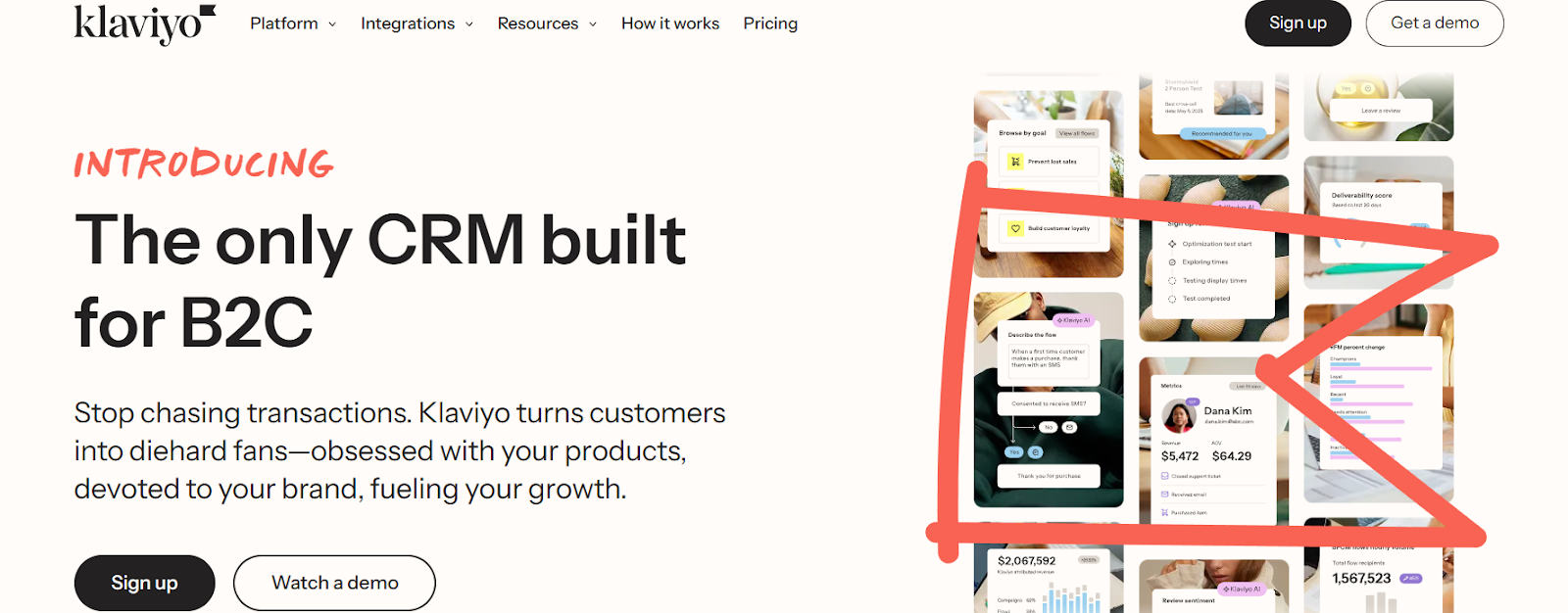
Klaviyo is a customer lifecycle marketing platform designed for eCommerce brands, built specifically for DTC.
- Klaviyo’s unique data model tracks every customer action: page views, product interactions, checkout stages, purchases, and returns. Everything serves as a signal that can be used to trigger workflows, create segments, and personalize content.
- Klaviyo’s integration with Shopify is the most comprehensive in the industry: it provides two-way synchronization, ensuring the detailed tracking of customer actions mentioned above.
- The platform’s suite of predictive analytics tools includes predicted customer lifetime value, predicted next order date, and customer churn risk.
- Klaviyo’s workflow builder supports complex conditional branching, multichannel logic (email + SMS), and A/B testing at the message and journey levels.
- The platform’s detailed reports allow you to track revenue across specific flows and campaigns, providing your team with data-driven insights for optimization.
🔴 Real drawback: The cost of Klaviyo’s services depends largely on the number of contacts. As soon as your list exceeds 100,000, the cost becomes noticeably high. Brands with large but inactive lists will need to maintain list hygiene to control cost-effectiveness per contact.
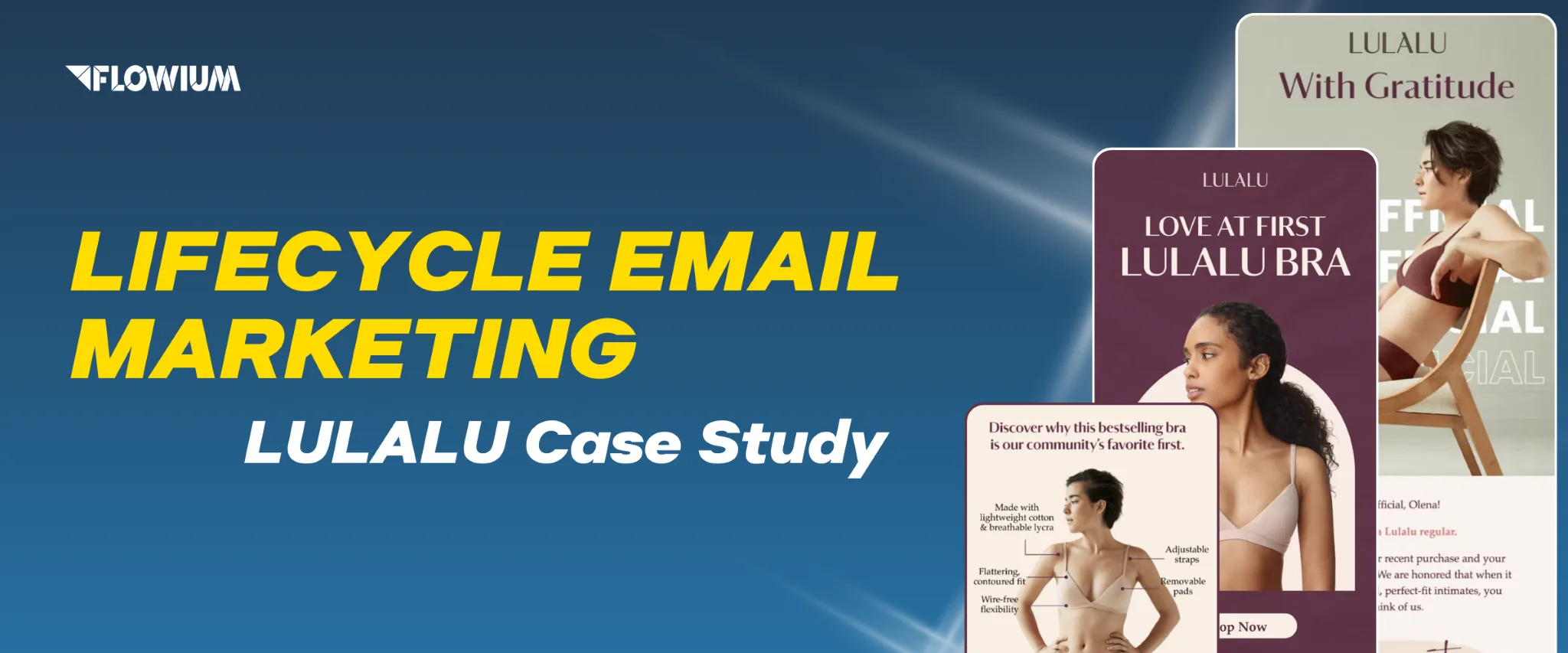
Use Case: Our practical use case for Klaviyo is email automation for the women’s lingerie brand Lulalu. Thanks to Klaviyo, we created a full set of sequences covering the entire customer lifecycle — welcome emails, abandoned cart, abandoned product page, post-purchase engagement, customer retention, and a personalized sequence featuring a bra-fitting quiz.
As a result, Klaviyo-driven revenue grew from $46,000 to over $519,000, representing a 46% increase in total revenue and a 62% increase in campaign click-through rates. These results were achieved in just 4 months.
2. Omnisend — Best Choice for Simplified Multichannel Marketing
Best suited for: Brands in the early stages of growth that need a multichannel solution without complex setup requirements.
Omnisend is a platform that positions itself as a multichannel marketing solution, combining email, SMS, and push notifications into a single tool.
- One of the largest automation libraries includes ready-made lifecycle workflows for welcome email campaigns, abandoned carts, post-purchase follow-ups, and customer retention, making it ideal for brands that want to get started quickly without building everything from scratch.
🔴 Real drawback: Fast-growing brands will quickly hit the limits of segmentation when using Omnisend. You won’t be able to create RFM-based segments with multiple behavioral conditions.
Use Case: A brand with $2 million in revenue can use Omnisend’s pre-built workflows to go from zero automation to five active sequences in less than two weeks, a practical advantage when launch speed is more important than customization depth.
3. Drip — Best for Email-First Brands with Custom Workflows
Best suited for: DTC brands focused on email and prioritizing workflow flexibility over multichannel capabilities.
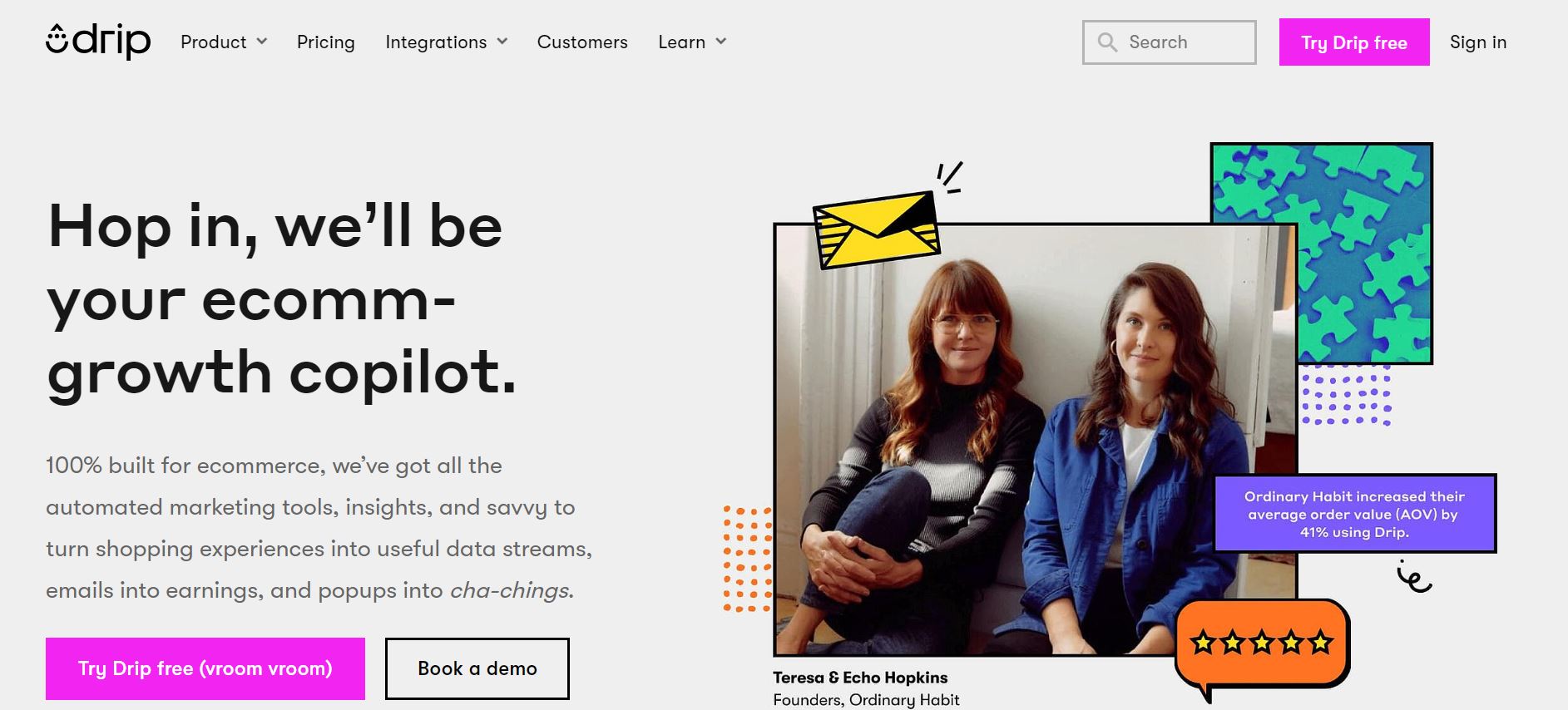
Drip stands out thanks to its visual workflow automation and customer tagging. This makes it an excellent choice for brands whose customer lifecycle strategy is heavily focused on email and behavioral triggers.
- The platform’s rule-based automation engine is flexible and powerful for granular control over workflow logic. It integrates seamlessly with Shopify and WooCommerce and provides revenue attribution at the workflow level.
🔴 Real drawback: Drip has noticeably slowed its product development. The platform lacks features that competing platforms introduced as early as 2023. Including more powerful predictive models, enhanced SMS capabilities, and deeper data synchronization with Shopify.
Use Case: For a brand implementing a single-channel email marketing strategy with Drip’s tagging system for customer segmentation and highly personalized post-purchase sequences, this will drive a noticeable increase in subscription conversions among one-time buyers.
4. ActiveCampaign — Best for Combining DTC and CRM Needs
Best suited for: Brands that need CRM features alongside lifecycle marketing, or those whose customer journey involves support from the sales team.
ActiveCampaign started out as a CRM and marketing automation platform. Gradually expanding its functionality, it began to focus more and more on eCommerce. As a result, the platform now combines lifecycle marketing with sales management. This has created a unique solution for brands with a hybrid model that combines direct-to-consumer sales with a B2B component.
- The platform’s automation builder is feature-rich, and the platform itself supports SMS, email, and website visit tracking.
🔴 Real drawback: ActiveCampaign’s interface is known for being cluttered. The navigation is truly confusing when trying to simply set up a post-purchase email sequence. It takes time to learn, which creates additional challenges for growing teams.
Use Case: A brand that sells its products both directly to consumers online and through corporate programs uses ActiveCampaign. It can manage email campaigns across all stages of the retail customer lifecycle and B2B deal pipelines within a single platform. As a result, avoiding the additional costs of maintaining two separate tools for two different types of customers.
Customer Lifecycle Management Software vs. CRM: What’s the Difference?
It’s incredibly important to understand the difference between these two tools, so you don’t accidentally choose the wrong one, wasting your time or, even worse, your money. So let’s draw a clear distinction.
In short:
- A CRM platform is about managing relationships with specific clients: B2B partners, wholesalers, and VIPs.
- Customer lifecycle marketing software is about scaling through marketing automation.
A CRM (Customer Relationship Management) platform is designed to manage relationships with individual customers, track deals, and coordinate sales team activities. Leading providers include Klaviyo, HubSpot, Salesforce, and Pipedrive.
Customer lifecycle marketing software is built for scalability. It is designed to automate marketing activities simultaneously for thousands or hundreds of thousands of customers, guided by behavioral data rather than manual data entry.
eCommerce brands that sell products to a large number of customers online need customer lifecycle marketing software. It helps manage customer interactions when you have over 50,000 visitors per month and thousands of transactions per month, whereas CRM serves a different purpose. However, this doesn’t mean you can’t use both. You likely have or will have wholesale customers or VIPs. That’s where CRM would come in handy.
How to Choose the Right Customer Lifecycle Management Platform
There are many options on the market for customer lifecycle management platforms, ranging from expensive and professional to inexpensive but capable of performing the most essential functions. That’s why the choice comes down to a few questions specific to your business:
- What are your primary marketing channels? Most eCommerce brands focus on email and SMS channels, so it’s important that the platform is tailored to these. This is significant because most platforms implement SMS only superficially, as an add-on feature.
- How complex is your product catalog? Brands with large catalogs and numerous categories need advanced product recommendation and segmentation mechanisms. It’s important to balance the scope of features with the volume of products.
- How connected are you to Shopify? If you work closely with Shopify and take customer retention marketing seriously, high-quality integration will be essential. Built-in integration will bring you a great deal of convenience and benefit. Brands with complex, custom storefronts should carefully evaluate the depth of integration before making a decision.
- How many resources does your team have? When choosing an advanced platform, it’s important to use it to its full potential. Assess whether your team has enough time to manage the platform or if it’s better to hire a professional agency. Feel free to reach out to Flowium. We are Klaviyo’s master elite partners and can seamlessly integrate you into the customer lifecycle management platform.
- At what stage of customer retention are you currently at? If you’re just launching your first series of welcome messages, choose features you’re ready for now, but with plans for the future in mind. Don’t opt for overly complex interfaces right from the start.
Conclusion
Customer lifecycle marketing software is key to scaling your eCommerce business. Therefore, if you sell products that are purchased repeatedly and have a sizable customer base, you can start looking for a suitable platform without hesitation. To find the right one, you should evaluate the channels features and consider the long-term potential for scaling.
If you’re ready to build an effective automated customer retention system, our Flowium retention marketing team works exclusively with eCommerce brands to transform your customer list into a stable and scalable revenue stream. Contact us for services today!