Customer acquisition keeps getting more expensive, yet many ecommerce brands still send the same campaign and the same 15% off code to everyone. A first-time buyer, a loyal repeat customer, and someone responsible for thousands in lifetime revenue can all land in the same Klaviyo segment.
Building a VIP customer strategy starts with identifying which customers create the most long-term value and deciding how the brand should treat them differently. Flowium has experience developing VIP strategies through Klaviyo, email, and SMS, and the article turns that experience into practical guidance for retaining high-value customers.
What Is a VIP Customer?
A VIP customer is someone whose purchase behavior, predicted value, engagement, or advocacy makes the relationship unusually valuable to the brand. Lifetime spend is part of the picture, not the whole definition.
A customer can place one expensive order and never return. Another may buy every two months, shop at full price, open product-launch emails, and bring in referrals. The second customer may be worth far more over time.
A repeat customer is not automatically a VIP, and loyalty program membership does not confer VIP status. Repeat purchases and program enrollment can signal loyalty, but VIP status should reflect the customer’s wider value across the customer lifecycle. A shopper who places six full-price orders may be worth more than someone who made one large purchase during a 40% sale and later returned half of it.
VIP status should reflect current and future relationship value, not a single order or loyalty program signup. The next step is choosing the signals that prove customer value.
What Makes a Customer “VIP”?
VIP customers can create several kinds of value, and each signal tells the brand something different.
- High purchase frequency points to consistency. A customer who returns every six weeks gives the brand more predictable revenue and creates more room for replenishment, cross-sell, and new product discovery.
- High predicted lifetime value helps brands spot strong customers earlier. Someone with three recent full-price orders and a short time between purchases may be a better candidate than a long-time customer whose activity has slowed.
- Strong engagement shows current interest. Email clicks, SMS responses, loyalty activity, product views, and survey participation can reveal purchase intent before the next order happens.
- Brand advocacy creates value outside the checkout. Reviews, referrals, user-generated content, and product recommendations can lower acquisition costs and build trust with new shoppers.
Profitability keeps revenue signals in context. Customers who rely on deep promotions, return a large share of each order, or create unusually high service costs may look valuable in a revenue report without being especially profitable.
How to Identify High-Value Customers
Customer scoring is only as reliable as the data behind it. Fully refunded and canceled orders should not inflate lifetime value, while duplicate customer profiles can split purchase history across several records.
Check whether loyalty activity, returns, email engagement, SMS consent, and ecommerce orders are reaching the same customer profile before building VIP segments. A precise scoring model built on incomplete data will still select the wrong customers.
Start with the Core Customer Value Metrics
| Metric | What It Shows | What It Can Miss |
|---|---|---|
| Customer lifetime value | Current or predicted value of the relationship | Profit margin, returns, and service costs |
| Purchase frequency | How consistently a customer returns | Differences between product categories |
| Average order value | Typical transaction size | Whether the customer buys repeatedly |
| Recency | Whether the relationship is still active | Longer natural purchase cycles |
| Engagement | Current interest across email, SMS, loyalty, and onsite activity | Engagement that never leads to revenue |
| Profit contribution | Value left after discounts, returns, and other costs | Future potential that has not appeared yet |
The numbers need context. A customer who orders coffee every month should not be measured against the same frequency standard as someone buying a sofa. Ninety days without an order may signal trouble for supplements, but it looks normal for a durable product.
Use RFM Segmentation as a Starting Point
RFM segmentation groups customers by recency, frequency, and monetary value. It gives ecommerce teams a practical first pass at the database without building a complex scoring model from scratch.
Customers with strong scores across all three categories are likely active VIPs. High frequency and recent activity with lower total spend may point to promising customers who are still growing. High historical spend paired with weak recency can expose customers whose value is starting to fade.
RFM is not the final answer. It does not capture margin, referrals, returns, or email and SMS engagement unless the brand adds those signals separately.
From Our Team: Our RFM segmentation episode goes deeper into the scoring process, the data needed to support it, and the campaign priorities that come out of the analysis.
Turn Customer Scores into Actionable Segments
Customer segmentation should tell the marketing team what to do next.
| Metric | What It Shows | What It Can Miss |
|---|---|---|
| Customer lifetime value | Current or predicted value of the relationship | Profit margin, returns, and service costs |
| Purchase frequency | How consistently a customer returns | Differences between product categories |
| Average order value | Typical transaction size | Whether the customer buys repeatedly |
| Recency | Whether the relationship is still active | Longer natural purchase cycles |
| Engagement | Current interest across email, SMS, loyalty, and onsite activity | Engagement that never leads to revenue |
| Profit contribution | Value left after discounts, returns, and other costs | Future potential that has not appeared yet |
Internal customer segments are not the same as public loyalty tiers. A brand may classify someone as an at-risk VIP inside Klaviyo without showing that label to the customer. Public tiers explain benefits and progress. Internal segments decide which message or flow should run next.
The labels matter less than the action attached to each group. A segment that looks impressive in a Klaviyo dashboard but does not change the message, offer, or timing is not doing much work.
How to Build a VIP Customer Strategy
A VIP strategy needs more than a segment and a reward. The brand has to decide which customer behavior it wants to change, who should qualify, what the experience will include, and how each step will run across email, SMS, loyalty, and customer support. The framework below turns that into a practical system.
1. Define What the VIP Strategy Should Change
Start with the customer behavior that the brand wants to improve. Possible goals include increasing second and third purchases, shortening the time between orders, retaining high-margin customers, growing referrals, or keeping established buyers from lapsing.
The goal should shape the program. A long reorder gap calls for better replenishment timing and product reminders. Weak referral activity needs an advocacy offer, not another coupon. If the brand cannot name the behavior it wants to change, the VIP strategy will turn into a loose collection of rewards with no clear business result.
2. Set Qualification Rules Around Your Business Model
A universal rule, such as “spend $1,000 and become a VIP,” rarely fits the economics of an ecommerce brand. The threshold could be far too easy for a furniture retailer and almost unreachable for a skincare subscription business.
Set qualification rules around average order value, normal reorder timing, product margin, return rates, and the typical length of the customer relationship. Five orders in one year could signal strong loyalty for a furniture brand and early cancellation for a monthly skincare subscription.
Choose a qualification window as well. A rolling six- or twelve-month period often gives a clearer view of current value than lifetime spend alone.
3. Build Customer Loyalty Tiers People Can Understand
Customer loyalty tiers should make progress clear without turning the program into a spreadsheet. For most brands, two or three levels are enough.
Each tier needs a simple entry rule, a qualification period, and benefits that customers can clearly distinguish from the level below. Brands also need rules for upgrades, downgrades, and grace periods. Status should update soon after a customer qualifies, while a grace period prevents a strong customer from losing access because of a normal gap between purchases.
4. Offer More Than Another Discount
A VIP rewards program built around discount codes can become expensive quickly. Customers learn to wait for the next offer, while the brand gives away margin on purchases that may have happened anyway.
Better VIP benefits usually fall into three groups:
- Access: early product releases, reserved inventory, and members-only products;
- Service: faster shipping, priority support, and more flexible assistance when an order goes wrong;
- Recognition: anniversary gifts, private events, and invitations to test new products.
The right mix depends on the product. A fashion brand may offer first access to limited collections. A premium beauty brand might invite top customers to test a product before launch.
5. Personalize the VIP Customer Experience
VIP marketing should reflect customer behavior, not attach a gold banner to the same campaign everyone else receives.
A replenishment customer can receive a reminder near the usual reorder date. A shopper who repeatedly buys one category may get early access to the next launch in that category. A high-AOV holiday buyer may value gift curation and earlier shipping deadlines more than a summer coupon. A customer who regularly leaves reviews may be a better fit for a referral campaign or product-testing group.
Good personalization often changes timing and content before it changes the discount.
6. Automate the Moments That Affect VIP Customer Retention
Manual VIP campaigns miss too many moments. A customer may qualify days after the monthly campaign was sent, approach a new tier without knowing it, or begin disengaging while still sitting inside an active VIP list. Retention marketing automations can cover the moments that deserve a response:
- Near-VIP progress: show how close the customer is to qualifying;
- VIP welcome or tier upgrade: introduce the new benefits;
- Early access: promote a relevant product launch;
- Milestone recognition: respond to an order, spend, or customer anniversary;
- At-risk outreach: react when purchase or engagement activity declines.
An at-risk VIP should not receive a copy of the standard win-back series. The brand already has purchase history, category preferences, and a longer relationship to work with. The message can acknowledge that history, ask about the customer experience, or offer help before reaching for a coupon.
For the Klaviyo build, Flowium’s win-back flow tutorial walks through three trigger options, including a setup based on purchase count.
7. Connect Marketing, Support, and Operations
A VIP promise breaks when only the marketing platform knows the customer is a VIP. Status and available benefits should be visible to customer support and, where relevant, fulfillment teams. A priority-support promise means little if the help desk treats the ticket like any other request.
Early access also needs inventory and launch timing behind it. Define who owns each benefit, how exceptions are handled, and where the customer’s current status appears before promoting the program.
8. Keep VIP Segments Dynamic
VIP segments should update as customer behavior changes. New high-value customers need to enter quickly, and customers who no longer meet the criteria should move into the right retention path.
Review the thresholds as prices, margins, products, and purchase patterns change. A segment built around last year’s AOV and reorder cycle will not stay accurate forever.
Flowium’s Klaviyo segmentation walkthrough shows how condition-based segments are built, how they differ from static lists, and how inactive segments can be reviewed.
VIP Customer Strategy Examples by Flowium
VIP treatment does not have to follow a single model. A brand may reserve early access for established customers during a major sales event, build a permanent loyalty journey, or create a temporary VIP segment around a specific offer. The following Flowium projects show how the strategy changes with the business goal.
Lulalu: Build a Separate VIP Journey Around BFCM
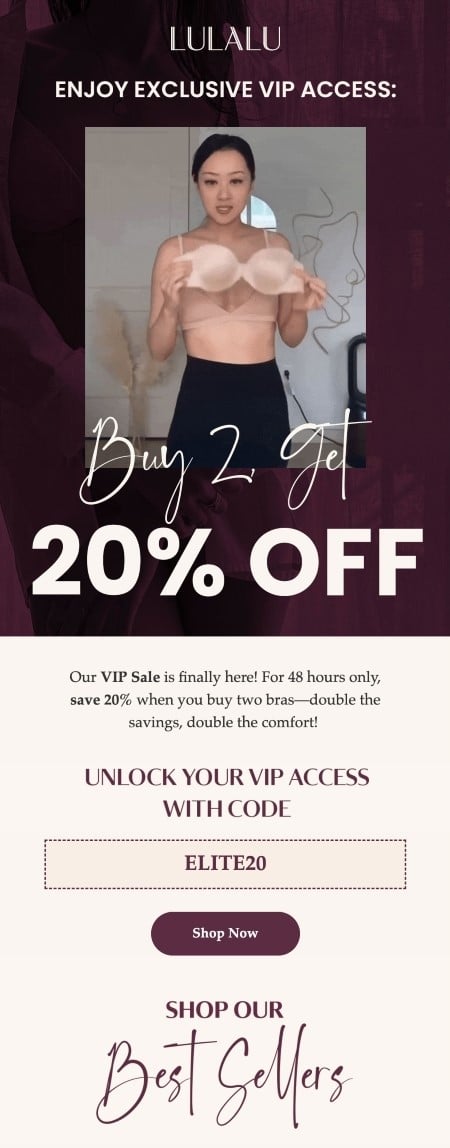
In the Lulalu case study, Flowium combined an ongoing loyalty and referral program with a separate VIP activation for Black Friday. The holiday campaign did not treat VIP access as another label added to the general sale email. The campaign followed a clear sequence:
- Invite interested subscribers to request VIP access. The signup created a high-intent audience for the upcoming promotion.
- Confirm the signup. Flowium sent a thank-you email to customers who joined the VIP audience, reinforcing the sense of access before the sale began.
- Launch a time-limited offer. The main email used the subject line “Exclusive VIP Sale: 48 Hours Only!” and presented the requirements, products, and purchase links without forcing customers to search for the details.
- Support the campaign with loyalty infrastructure. Flowium also built Yotpo referral and loyalty campaigns designed to encourage repeat purchases beyond BFCM.
Results: The VIP email became Lulalu’s highest-revenue campaign of the year, with a 60.4% open rate, 3% click rate, and 1% placed-order rate. The wider engagement also included lifecycle flows, product-specific automations, a fit quiz, and loyalty communications.
DORADO: Give VIP Customers a Head Start
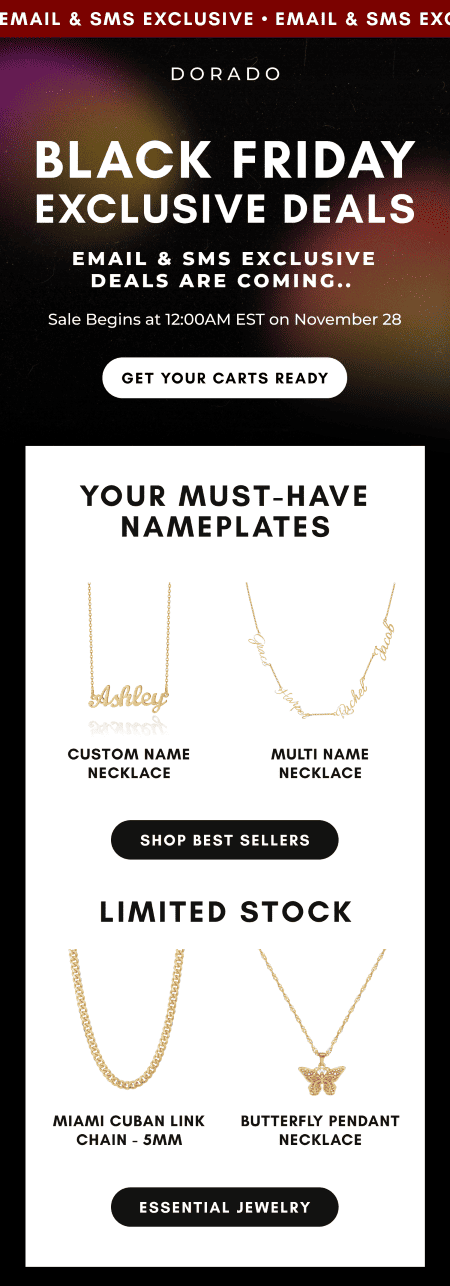
The DORADO BFCM case study used VIP status to control sale timing rather than create another discount tier. Flowium separated the holiday rollout into several stages:
- Re-engage inactive subscribers in early November. The campaign schedule gave colder contacts time to interact before the main promotion.
- Send a BFCM teaser in mid-November. The teaser prepared the audience without revealing the full sale.
- Start VIP early access on November 22. Multiple emails gave VIP customers roughly one week of advance access.
- Open the sale to the general audience later. Public promotion ran from Thanksgiving through Giving Tuesday.
The sequence gave established customers a meaningful advantage: access before the largest volume of shoppers arrived. Flowium did not rely on a single early-access announcement; several VIP emails maintained visibility across the advance window.
Results: DORADO’s email-attributed revenue increased by 138.8% during the BFCM engagement. The staged rollout also gave VIP customers a clear advantage before the promotion opened to the wider audience.

Loyalty Program: Make Points and VIP Benefits Visible
In Flowium’s loyalty program case study, the retailer already had a points program, but customers struggled to understand their balances, available benefits, and next actions. Program membership alone was not creating a clear customer journey. Flowium addressed the gaps in four stages:
- Send a monthly points statement. Members received their current balance without needing to log in to the loyalty platform.
- Change the CTA according to the point balance. Customers with enough points saw a redemption prompt. Customers below the threshold received ways to earn more.
- Build a dedicated loyalty landing page. The page explained how to join, earn and redeem points, refer customers, and qualify for VIP benefits. Flowium linked the page from website navigation, the footer, and marketing emails.
- Create three loyalty funnels. The system included the monthly balance automation, a four-email sequence for non-members, and an onboarding journey that thanked new members and explained the program. The non-member sequence ended with a survey for subscribers who still chose not to join.
Results: The points-statement emails generated more than $4,000 in additional monthly revenue. Loyalty membership doubled in less than three months, while the three email sequences produced more than $15,000 per month in email-attributed revenue.
How to Measure VIP Customer Retention and Profitability
Before launch, record the current repeat purchase rate, average time between orders, customer lifetime value, and gross margin for each target segment. Without a baseline, the team cannot tell whether the VIP program changed customer behavior or simply rewarded existing demand.
Step 1: Track Retention by Tier
Measure VIP performance by tier and over time, not by total program revenue alone. Repeat purchase rate, VIP retention rate, and average time between orders show whether customers are staying active. CLV by tier and tier progression show whether the program is moving customers into more valuable relationships.
Step 2: Check Profitability
Retention gains still need a profitability check. Compare gross margin per customer and incremental profit after discounts, free shipping, gifts, returns, and premium service costs. A tier can generate more revenue while producing less profit.
Step 3: Separate Incremental Revenue from Existing Demand
A high reward redemption rate does not prove that the program created additional sales. Customers may apply a benefit to an order they would have placed anyway. Cohort analysis can compare benefit recipients with a similar customer group that did not receive the offer.
Step 4: Monitor VIP Churn
Track customer churn within each VIP tier to see how many established customers become inactive over time. Strong upgrade numbers can hide a retention problem when valuable customers are leaving at the same rate.
Common Mistakes That Weaken a VIP Customer Strategy
- Rewarding only high spenders. A spending rule is easy to manage, but it can ignore frequency, future value, advocacy, returns, and margin. The threshold should reflect the type of customer the brand wants more of.
- Replacing the entire experience with discounts. Permanent coupons turn VIP status into a cheaper way to buy. They do not create much reason to stay loyal when a competitor offers a larger code.
- Leaving VIP segments unchanged. Customer value moves. A static list eventually fills with outdated profiles while newly qualified customers keep receiving standard campaigns.
- Ignoring engagement signals. Purchase data can show the problem later. Falling email clicks, product views, loyalty activity, or SMS responses can expose a weakening relationship before the next expected order is missed.
- Treating every VIP the same. A subscription customer, a luxury shopper, and a brand advocate may all qualify for different reasons. Segment by product preference, purchase pattern, lifecycle stage, or advocacy instead of relying on one broad VIP audience.
Build a VIP Retention System with Flowium
At Flowium, we treat undifferentiated customer messaging as a retention problem, not a campaign problem. Our email marketing and retention services connect customer segmentation, lifecycle strategy, Klaviyo flows, email, and SMS to build stronger repeat behavior and customer lifetime value instead of chasing another short sales spike.
Our work can include qualification rules, milestone flows, tier upgrades, early-access campaigns, and retention sequences for customers whose activity begins to decline.
After launch, we track movement between segments, repeat purchases, customer lifetime value, and margin. The reporting shows whether the VIP program changes customer behavior or only rewards purchases that were already likely to happen.
Schedule a free strategy call to review your VIP segments, retention gaps, and the next steps for building a stronger lifecycle program.
Conclusion
A VIP customer strategy should fit the brand’s economics, purchase cycle, and available customer data. Qualification rules need to separate lasting customer value from one large order, while internal segments and public loyalty tiers should serve different purposes. Marketing, customer support, and operations also need the same view of VIP status for the program to work beyond the inbox.
At Flowium, we use a simple standard: VIP status should change the customer experience and produce a measurable retention result. Strong programs identify the right customers, assign relevant benefits, respond to changing behavior, and track repeat purchases, customer lifetime value, and profit. A status label without a different experience or measurable result is not a VIP strategy.
Frequently Asked Questions
Are VIP customers always the highest spenders?
No. High spend is one signal. Frequency, recency, margin, engagement, and future value can matter just as much.
What is the difference between a VIP strategy and a loyalty program?
A VIP strategy decides who the brand should prioritize and how to retain them. A loyalty program is one tool inside that strategy. Points and tiers do not replace segmentation, lifecycle messaging, or profitability tracking.
How often should VIP customer segments be updated?
Segment membership should update automatically as customer behavior changes. Review the qualification rules every few months and after major changes in pricing, margins, product mix, or reorder timing.