Personalization at scale is a strategic lever of modern marketing strategy, enabling organizations to deliver consistent, revenue-driving experiences across all stages of the customer journey. For CMOs and marketing professionals, it moves beyond inserting clients’ names or static segmentation into a system for activating data as a competitive edge. It’s about generating truly meaningful engagement based on a thorough understanding of individual preferences and behaviors.
In this guide, we’ll explore major tactics that CMOs use to implement personalization at scale, helping businesses achieve their profit goals without compromising a customer-centric approach set on long-term relationships.
What is Personalization at Scale?
Personalization at scale is a strategy that businesses employ to give tailored experiences to a large number of customers. It is not enough to design a product or service for a single consumer; thousands, if not millions, of customers must be served simultaneously.
This strategy uses data analytics and artificial intelligence to analyze client behavior, preferences, and needs on an individual basis. The information is then used to deliver personalized experiences at scale across numerous channels, including websites, mobile apps, email marketing, and more.
Personalization at scale aims to make each client feel understood and valued, which can lead to improved customer loyalty and engagement, ultimately driving corporate success.
Why Marketing Personalization at Scale Matters More Than Ever
In today’s digital age, one of the most important jobs for marketing teams is to scale targeted marketing material. However, the path to effective customization is nuanced. Marketers must strike a balance between the desire to send highly personalized communications and the requirement to respect client boundaries. Too much personalization can be intrusive, whereas too little can make messages unimportant.
According to Gartner, 48% of personalized messages miss the goal and are seen by customers as irrelevant or obtrusive. The issue for marketing leaders is to strike the appropriate balance, ensuring that each touchpoint offers value and improves the brand-customer relationship.
The goal of personalized marketing is to provide the appropriate message to the right person at the right time, resulting in higher conversion rates and customer satisfaction. This takes more than simply advanced technology and data collection. It requires a defined strategy that is connected with corporate objectives, a realistic assessment of opportunities, and a commitment to continuous improvement. Customer centricity must be central to these efforts, directing marketing professionals in prioritizing methods based on their impact, feasibility, and alignment with customer perceptions. This guarantees that personalization efforts are effective and lasting.
Raising Customer Expectations
Over the years, consumer expectations have shifted dramatically. Customers now compare your brand experience not just to your competitors in your niche but also to the best experiences they’ve had across industries. If before personalized recommendations, dynamic content, tailored offers, and context-aware messaging were considered exceptional, now they have become expected of brands.
Businesses that fail to meet these expectations are at risk of losing the loyalty and interest of their clients. That’s one of the main reasons why personalization at scale is the top trend among marketing and business development strategies. Those who deliver relevant, timely experiences can create stronger engagement and stand out in the market.
Higher Acquisition Costs Demand Better Retention
As paid media becomes more expensive and brands seek ways to decrease their ad spending, relying solely on acquisition is no longer sustainable. This is where email marketing and personalization at scale becomes critical.
Retention-focused email strategies help brands:
- Reduce dependency on paid ads
- Maximize the value of existing customers
- Build long-term relationships
Instead of constantly chasing new customers, brands can use personalized email flows (welcome, post-purchase, winback) to increase repeat purchases and customer lifetime value.
Personalization Is a Revenue Driver
When done correctly, email marketing personalization has a direct effect on sales. It is a growth lever that promises substantial benefits for your business.
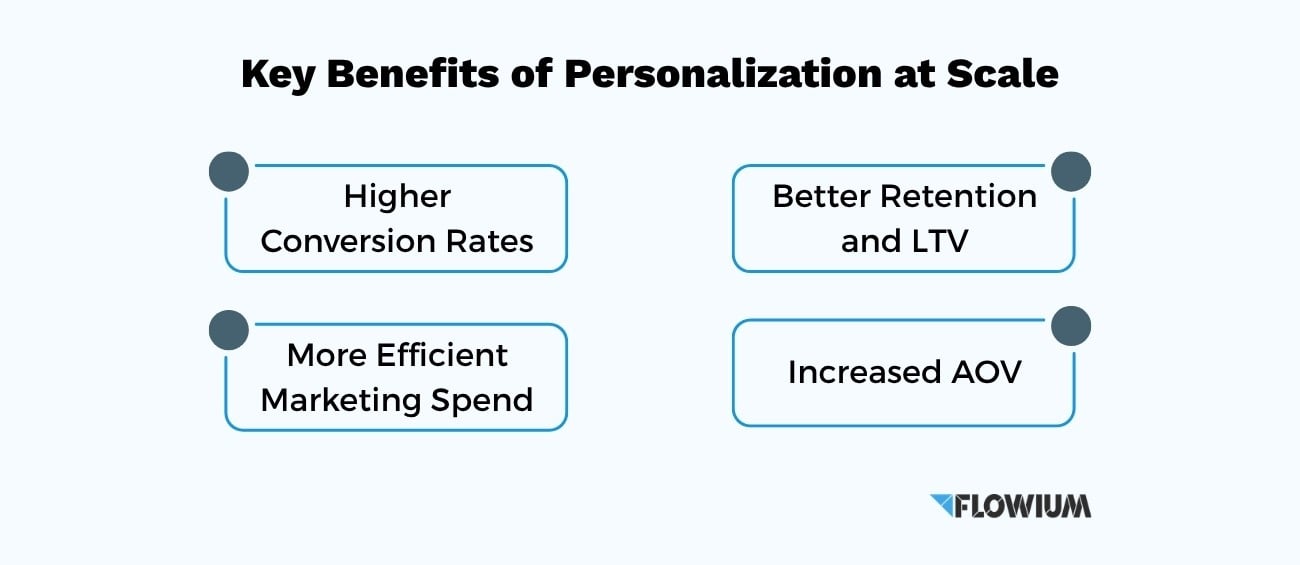
- Higher Conversion Rates
Compared to generic ads, targeted emails based on behavior and preferences have a much higher conversion rate.
- Better Retention and LTV
Over time, personalized lifecycle emails increase lifetime value and repeat business by keeping clients interested.
- More Efficient Marketing Spend
Brands increase ROI across campaigns and decrease wasted impressions by delivering pertinent content to the appropriate segments.
Customers are encouraged to spend more per transaction via intelligent product recommendations and customized offers.
The Core Principles of Personalization at Scale
While personalization at scale is a broad term in marketing that contains many methods and strategies, there are 4 main components considered the basis for this approach.
Unified Customer Data
Just like you can’t build a house without a good foundation, you can’t personalize successfully without accurate client data. The difficulty is that for many brands, the data is spread across disparate systems such as CRMs, CMSs, legacy systems, and so on.
This stops marketers from developing a thorough understanding of their customers. It also conceals important insights from them that should be considered during the decision-making process when developing personalization campaigns.
That’s why integrating your consumer data is the first step toward successful, scalable personalization.
There are several methods for doing so, but possibly the most popular is to employ a customer data platform. Innovative CDPs like Klaviyo are solutions designed specifically to aggregate consumer data from both online and offline sources into a single, unified database.
AI and Predictive Intelligence
When it comes to large-scale customisation, artificial intelligence is a true game changer. Let’s look at how it contributes to this process.
AI can process massive volumes of data far faster than any human. It can filter through massive amounts of data to reveal previously unknown patterns, correlations, and trends. These insights can then be applied to forecast customer behavior. For example, AI may use a customer’s previous purchases, browsing history, and social media interactions to anticipate what products or services they might be interested in next. This enables organizations to adjust their marketing efforts to particular customer preferences, hence increasing customisation.
Automation
In the context of personalization, automation can be used to offer personalized content at the correct moment and through the right channel.
For example, an automated email marketing system could send a personalized email to a customer as soon as they abandon their shopping basket, encouraging them to complete the transaction. Automation guarantees that these individualized interactions occur on a consistent and timely basis, hence improving the customer experience.
Pro Tip: Many CMOs and professional marketers believe that using AI-powered atomation tools is a must for building effective marketing strategies. When AI and automation work together, they can provide real-time customisation to vast consumer bases. AI delivers the information required to understand each customer’s preferences and habits, and automation guarantees that personalized content is delivered quickly and reliably.
Omnichannel Orchestration
People do not cling to a single channel, and neither should your personalization strategy. With cross-channel orchestration, businesses can combine email, push, SMS channel, in-app, and online into a single flow, making each communication feel like it’s part of the same discussion.
Tools make this orchestration scalable. Instead of handling many disconnected platforms, marketers can visually map trips, automate journeys, and adjust paths in real time as customer behavior changes. As a result, outreach goes with people rather than to them, whether they’re opening an email at work or checking a mobile app on the go.
Common Personalization at Scale Challenges CMOs Face
CMOs are under increasing pressure from customers to create tailored experiences at scale, while CIOs are responsible for enabling that delivery through technology innovation. Even with the correct tools and strategies in place, many firms fail to demonstrate ROI on their personalization investments.
- Data Silos
Customer data is frequently dispersed across several systems—purchase history in one place, app usage in another, and email interaction elsewhere. Without bringing this all together, it’s difficult to gain a whole view of who a consumer is and how they connect with your business.
- Legacy Tech Stack
Many businesses still use antiquated equipment that can only manage one channel at a time. This makes it challenging to design journeys that feel cohesive, with each message flowing seamlessly into the next.
- Manual Testing Bottlenecks
Scaling personalization entails modifying topic lines, offers, imagery, and timing. Doing it by hand, with numerous A/B tests, rapidly becomes daunting. Teams spend more time planning experiments than acting on the outcomes.
- Privacy and Compliance Concerns
Customers desire both personalization and control over their data. Balancing relevance with privacy while remaining compliant with new legislation adds another element of complication.
How Marketers Can Personalize at Scale: Practical Tips for CMOs
Sending more emails is not the goal of scaling personalization; rather, the goal is to send more thoughtful ones. Managing operational customization in a way that generates quantifiable income without overburdening teams or complicating the IT stack is a problem for CMOs.
Use High-Impact Segmentation First
Instead of overcomplicating your approach with excessive segmentation, concentrate on a few key audience categories that immediately affect revenue, such as new subscribers, first-time buys, repeat customers, and high-value or churn-risk users.
Build Automation Before Campaigns
Give lifecycle automation such as winback sequences, post-purchase emails, welcome flows, and abandoned cart reminders priority as they consistently provide customized experiences without requiring ongoing human labor.
Employ Behavior Rather Than Just Demographics
Use behavioral data such as browsing habits, past purchases, and engagement trends to shape your marketing because it offers more powerful signals of purpose than static demographic data.
Use Al Where It Really Adds Value
Use Al sparingly in applications where it may significantly boost speed without introducing needless complexity, such as product suggestions, send-time optimization, and predictive analytics.
Personalize Content, Not Just Names
Use dynamic content that adjusts to each user, such as customized product recommendations, pertinent offers, and messages in line with their lifecycle stage, to go beyond simple personalization.
Align SMS and Email
Make sure SMS and email enable quick, high-impact touchpoints like urgent offers and reminders while email handles richer communication as part of a cohesive plan.
Establish a Testing Practice
Try different subject lines, scheduling, content, and segmentation techniques to see what produces the greatest outcomes over time. This will help you continuously test and improve your strategy.
Make a Data Infrastructure Investment
Since dependable and easily accessible data is essential for efficient customization, establish a solid data foundation with consistent, clean client profiles and precise event tracking.
Strike a Balance Between Privacy and Personalization
By avoiding excessively intrusive messaging, being open about data consumption, and granting customers control over their settings while still providing relevant experiences, you can uphold trust.
Key Point:
Scalable personalization is now a must for contemporary email marketing, not a choice. In addition to increasing performance, brands that make investments in clever segmentation, automation, and customer-centric tactics will forge closer, more enduring bonds with their target audience.
How CMOs Can Build a Marketing Personalization Roadmap
CMOs who move swiftly and wisely will have a big advantage in the age of AI-powered marketing. Particularly in resource-intensive areas like content production and lifecycle interaction, a well-structured customization roadmap helps organizations maximize spend, enhance customer experiences, and unleash new efficiencies. To provide personalization that scales well and promotes long-term growth, it is essential to combine robust data infrastructure, cross-team alignment, and constant iteration.
1. Begin with High-Impact Use Cases and Strategy
Instead of automating discrete processes, concentrate on redefining important customer journeys, including as onboarding, retention, and winback, to make sure customization efforts are clearly linked to revenue-driving moments.
2. Establish a Robust Data and Technology Base
Integrate client data from various systems and collaborate closely with IT to build a scalable infrastructure that allows for continuous learning and real-time personalization through linked data flows.
3. Integrate Automation and Al Throughout the Marketing Lifecycle
Make strategic use of Al for content personalization, timing optimization, segmentation, and suggestions, and organize your roadmap around complete client lifecycle stages rather than one-time campaigns.
4. Function as a Cross-Functional, Iterative System
Align leadership, data, marketing, and products; view customization as a continual optimization process; and make constant improvements based on performance indicators.
How Flowium’s Clients Achieve Personalization at Scale
Lastly, we’ll round out this guide by showing how three brands implemented personalization at scale (and across channels) with Flowium. Let’s explore some of our case studies to give you a better understanding how professionals handle personalization at scale for diverse marketing projects. We’ll also see how their marketing initiatives performed in terms of revenue and some other key profitability benchmarks.
Pet Brand Marketing Personalization Case
Our client had to switch to Klaviyo and expand personalization without becoming irrelevant to its expanding clientele.
Flowium combined email and SMS for more accurate targeting, developed a full lifecycle flow system, and used advanced segmentation.
Personalization at Scale Practices Applied:
Our specialists customized messages based on pet-related interests and consumer behavior, enabling dynamic communication across several segments.
Results:
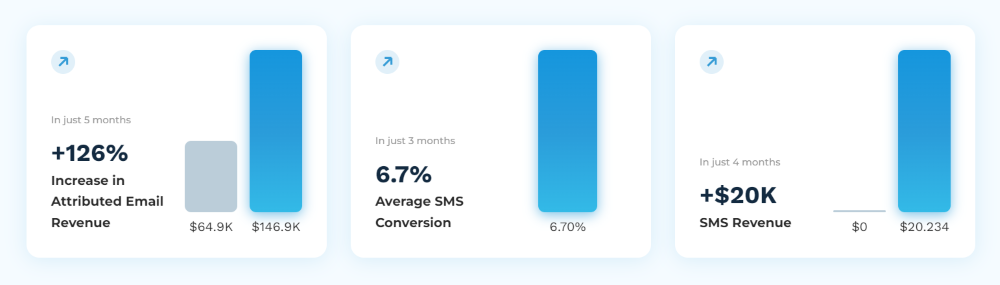
Email became a scalable and insight-driven channel as a result of the brand’s significant revenue growth and increased engagement.
Personalization at Scale for RSVLTS
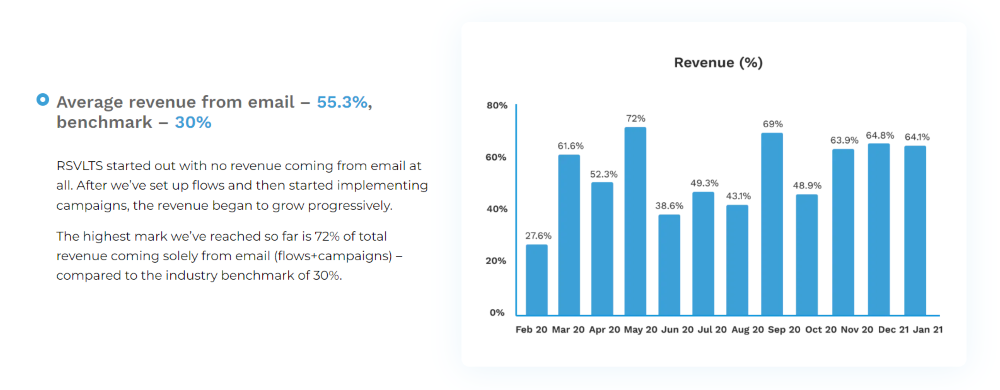
Flowium and RSVLTS collaborated to expand email marketing through behavior-driven campaigns and highly targeted segmentation.
Our team created behavior-based segmentation and tailored automated flows and campaigns to consumer preferences. In order to provide more personalized engagement with a quickly expanding audience, we concentrated on matching messaging to consumer preferences and purchasing behavior.
Actionable Personalization at Scale:
The brand was able to scale volume while maintaining relevance thanks to advertising strategy and streamlined flows. This illustrates how fast-growing DTC firms can benefit from structured personalization without compromising the quality of connection.
Results:
RSVLTS was able to increase email revenue while keeping a high level of customer alignment and engagement.
Marketing Personalization Case Study for Health & Wellness Brand
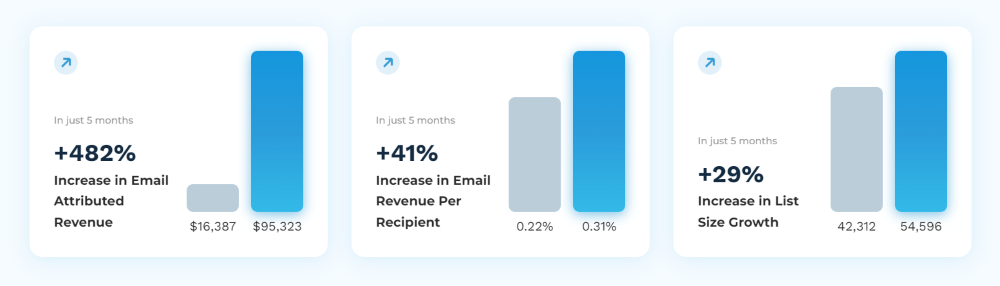
Low engagement and an ineffective email marketing campaign plagued the brand of our client. Using lifecycle flows, data-driven segmentation, and targeted re-engagement initiatives, Flowium’s team managed to optimize the strategy.
Personalization at Scale Methods We Used:
To ensure relevance across both active and inactive segments, messaging was matched with customer lifecycle stages and demands.
Results:
The brand made email a key revenue-generating channel and greatly increased engagement.
Conclusion
Personalization at scale is about demonstrating how much you care rather than proving how much you know. In 2026, the most effective marketing teams will be those who combine data and empathy, allow customers to set boundaries, and prioritize helpfulness above hyper-targeting. That is not only smart marketing; it is also more human.
Get in touch with our team if you need expert help in starting your marketing personalization journey that will strengthen your connections with clients. Flowium is a skilled marketing agency that expertly employs all the greatest strategies and tools for profitable campaigns.
Frequently Asked Questions
What does it mean to personalize at scale?
Delivering customized content and experiences to millions of consumers across channels is known as personalization at scale. Every interaction feels relevant thanks to automation and real-time data.
What distinguishes personalization from personalization at scale?
Simple strategies like adding a name to an email are common examples of personalization. Personalized marketing at scale employs data, automation, and orchestration to give unique experiences to millions of individuals at once.
What are the two main approaches of personalization?
The two main approaches to personalization are:
Rule-based personalization: Making use of pre-established segments and criteria, such as displaying product recommendations based on demographic information or the most recent purchase.
AI-driven personalization: Using machine learning and predictive models to evaluate large amounts of data, forecast intent, and provide dynamic, personalized, real-time experiences across channels.
What tools do I need to to provide personalization on a large scale?
Journey orchestration systems, AI-powered personalization engines, and customer data platforms are important tools.