Email marketing is a complex process with many variables that are not easy to manage. That is why many business owners give up on email marketing, believing that it is not worth the effort. This could not be further from the truth. Email marketing has always delivered high results, and according to research, the average return on investment (ROI) in 2025 is $36 for every dollar spent, delivering a 3600% ROI.
So, if you want to get the most ROI out of email marketing, we recommend an email audit. In this guide, we will share everything you need to know about email marketing audits: what they are, why they are important, and, most importantly, how to conduct them.
What is Email Marketing Audit and Why Conduct It?
Regardless of the industry, conducting audits is extremely important to ensure that everything is moving toward the originally set goal. If this is not the case, audits are the most effective method for identifying potential concerns and finding ways to solve them. Another purpose of an audit is to find solutions for improving performance and coming up with breakthrough strategies. Now, let’s define what an email marketing audit is.
An email marketing audit is an assessment of the performance of your email marketing strategy. It is designed to identify its strengths and weaknesses in order to find opportunities for improvement. In practical terms, an email marketing audit involves analyzing numbers, reviewing statistics, and creating a comprehensive overview of your entire email marketing strategy, effectively identifying its strong and weak points.
The overall goal of email auditing is to optimize the effectiveness of your email marketing strategy as a whole. In digital terms, the goal of an email audit is to help improve key email marketing metrics such as open rates, click-through rates, and conversion rates.
Don’t delay your email audit and get one free from Klaviyo right now! If you are a user of one of the most popular email tools, Klaviyo, and have an account there, you can get a free check of its effectiveness. In addition to checking with best practices, the tool will also give you tips on how to increase your reach and revenue.
- Quick & Easy – Complete your audit in under 15 minutes.
- 100% Free – Get valuable insights at no cost.
- Instant Results – No calls, no waiting — your report is ready right away.
- Tailored to You – Receive personalized recommendations for your business.
Just three steps and 15 minutes of your time: fill out the form, answer additional questions, and get the results. Conduct a quick free email audit now!
Why Conduct an Email Marketing Audit?
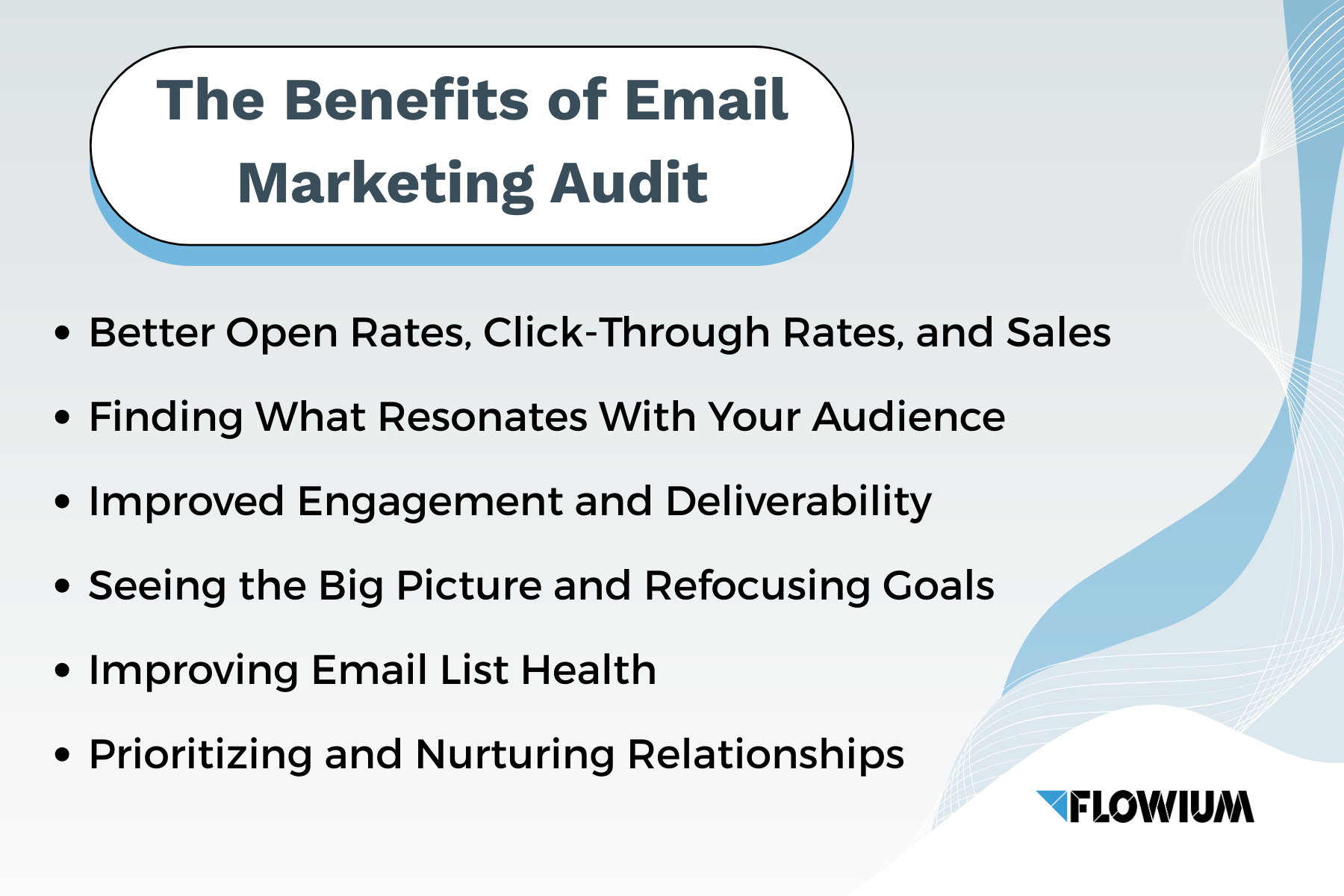
Below, we list the reasons why you should conduct email audits, their objectives, and how they can help optimize your email campaigns.
- Improving email deliverability
Email auditing can help you ensure that emails are successfully landing in your subscribers’ inboxes. It can identify issues with email authentication, spam filters, and email list hygiene that may be sending your emails into people’s spam folders.
- Optimizing email performance metrics
Another goal of an email audit is to identify areas where your email campaigns are underperforming. It can help you understand what’s causing unfavorable metrics, such as low conversion rates or high unsubscribe rates. On the other hand, it can also help you figure out how to improve engagement rates (such as open and click-through rates) by analyzing where the content and design of your email campaigns fall short.
- Ensuring compliance with relevant regulations
An email marketing audit can help you keep up with relevant privacy regulations, such as GDPR and CCPA, and ensure that your company is complying with them. It can identify issues with opt-in processes and unsubscribe procedures that may be violating these regulations.
- Optimizing subscriber engagement
By focusing on engagement metrics, you can learn more about how users interact with your emails. Analyzing metrics to audit email will help you understand what your audience likes and what they don’t. You will be able to plan strategies for optimizing sending times and targeted marketing, thereby achieving better results and greater engagement.
- Reaching the highest ROI
According to OptinMonster, the ROI of email marketing in 2025 could reach as high as 3600%. These are quite impressive numbers, showing how important it is to implement email marketing effectively. Regardless of what is being discussed, optimizing your email marketing efforts, which is the main goal of an email audit, is guaranteed to bring growth in ROI. Get the most out of your email audit to achieve the highest possible ROI rates.
- Understanding your audience
An email audit will help you analyze and understand everything about your audience. You will be able to identify the people who make up your audience and their preferences. This will let you find the most relevant content by adapting the copy and design of your emails.
- Detect flaws and fix mistakes
During a detailed audit analysis, you will see and identify all the flaws and weaknesses of your email marketing strategy and your email marketing process as a whole. Even if you don’t find any flaws, you can always discover hidden growth opportunities that you may have missed and use them to achieve better results.
- Stay on top of trends
During audits, you will learn about new trends and tendencies and decide which ones are worth following. This practice will allow you to remain competitive, relevant, and interesting in the industry.
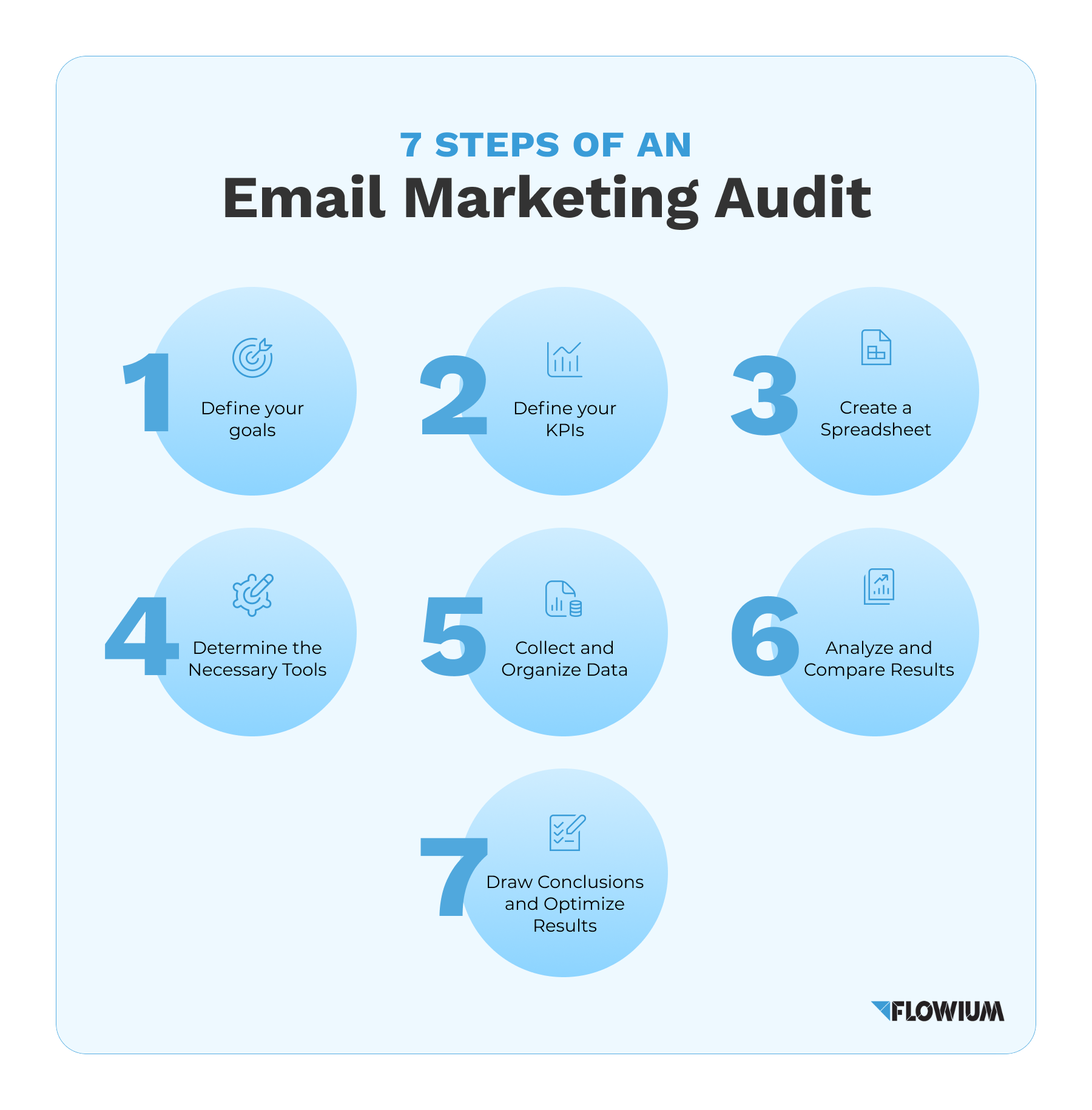
7 Steps of an Email Marketing Audit
Now that you know how important email marketing audits are to the success of your email marketing strategy, you may want to learn how to conduct them. Let’s take a look at the process of conducting an email marketing audit in 7 steps.
1. Define Your Goals
Before starting an audit, you need to define its goals. What do you want to achieve, and what should you focus on?
It is important to know that there are different types of email marketing audits depending on your goals. You can conduct a general audit, with the focus on checking the overall effectiveness of your strategy and discussing each aspect briefly. Alternatively, you can conduct a more detailed audit that focuses on one specific area of your strategy. Depending on your goals, there are the following types of email campaign audits:
- Performance audit,
- Deliverability audit,
- Content audit,
- Design audit,
- Automation audit,
- List segmentation audit,
- Compliance audit.
📌Pro tip: Once you have decided on the type of audit you want to conduct, make a list of the goals you want to achieve. This will help you stay focused and succeed.
2. Define Your KPIs
Defining key performance indicators (KPIs) is essential for effective measurement of your email campaign performance levels. Once you have defined the goals you want to achieve with the audit, analyze the most relevant metrics to track and set realistic targets for each metric. Here are the main KPIs you can analyze and discuss during the audit:
- Open rate,
- Click-through rate (CTR),
- Conversion rate,
- Deliverability rate,
- List growth rate,
- Unsubscribe rate,
- Spam complaint rate,
- ROI of email campaigns,
- Bounce rate,
- Number of email campaigns sent and delivered.
📌Pro tip: Analyze your metrics thoroughly; don’t rely only on averages. Break down your KPIs by campaign types. Among these campaigns, you can consider newsletters and promotions, or various automated campaigns and audience segments. By breaking down KPIs by campaigns, you can identify hidden patterns or groups with low performance.
3. Create a Spreadsheet
When conducting an email marketing audit, it all comes down to evaluating each campaign, focusing on each statistic, and analyzing how it all fits together. You need to be able to assess how each aspect of your campaign contributed to its overall success or lack thereof.
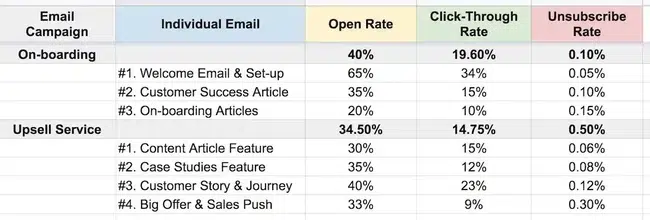
Create a spreadsheet to organize all the analyzed information. A spreadsheet will help you accurately track all important information about your email campaigns. That way, you’ll have a place to store your analysis results so you can refer to them when needed. You can prepare a spreadsheet with special columns to track things like:
- Campaign name,
- Date,
- Subject line,
- Audience segment,
- Open rate,
- Click-through rate (CTR),
- Conversion rate,
- Unsubscribe rate.
📌Pro tip: Creating a spreadsheet will allow you to compare different aspects of each campaign and see how they correlate with each other, forming a complete picture of your results.
4. Determine the Necessary Tools
Successful email marketing is not possible without email marketing tools, as they assist in many aspects of marketing. During the audit, consider which of your email marketing processes can be optimized with tools to achieve the best results.
📌Pro tip: If you want to implement several new email marketing tools, pay attention to integration capabilities at first. Without them, your workload may become more difficult.
5. Collect and Organize Data
Once you have created your spreadsheet, fill it with as much relevant data and metrics as possible. Take data from your email marketing tools, colleagues, and other sources. Once you have organized your data in a spreadsheet, compare your metrics to industry benchmarks, past results, and goals to determine where your email marketing strategy is effective and where it can be improved. Conversely, analyzing and comparing campaign data may reveal that some things are working great! Having this information will help you build on what works.
📌Pro tip: Note the source and time range for each data set you enter. When data comes from different platforms or periods, it’s easier to miss discrepancies.
6. Analyze and Compare Results
The next step in the email marketing audit process involves comparing the results of your campaigns. It is important to look at your email marketing from both a negative and positive perspective. Focus on the underperforming and the good results. This way, you can figure out what works so you can continue doing it, and what doesn’t work so you can fix it.
📌Pro tip: Run an A/B test to compare high and low rates. Compare differences in tone, send time, device display, and even sender name. Small details can have a big impact.
7. Draw Conclusions and Optimize Results
The final step in conducting an email marketing audit is to summarize the results in a detailed report that you will send to your entire email marketing team. This report should contain the most important auditing conclusions, as well as recommended changes and an action plan to improve the effectiveness of your email marketing strategy. Once your entire email marketing team is acquainted with the audit results, proceed to implement the changes by assigning specific tasks.
After conducting an email marketing audit and identifying areas for improvement, it is very important to correctly and consistently apply the insights gained to increase overall performance and improve your email marketing strategy.
The first thing to do with the valuable information from the audit is to address critical issues and the simplest tasks. These may include:
- Updating outdated content
- Fixing deliverability issues
- Implementing changes that will improve key metrics
Once the initial issues have been resolved, you can move on to long-term strategies that require significant effort and time to develop. These include:
- Improving your overall email marketing strategy
- Enhancing your subscriber engagement and interaction strategies
- Implementing new email marketing tools
📌Pro tip: As you start experimenting with new ideas, make sure to A/B test the results of these changes and observe how your subscribers react to them.
Email Marketing Audit Checklists
Now that you know the steps to follow when conducting an email audit, we provide you with a checklist of points that you should consider when discussing and analyzing.
General Email Audit Checklist
In this section, we will take a detailed look at a general checklist for email marketing audits. The items on this checklist should only be checked once, superficially at the beginning of the audit.
Email Marketing Infrastructure
The first thing you need to check is your email marketing infrastructure. To improve the deliverability of your email campaigns, ensure that all of these elements are configured correctly. This refers to the technical aspects of your email marketing strategy, such as:
- Authentication protocols: Email authentication protocols like DKIM, SPF, and DMARC verify email authenticity and prevent fraud and phishing attacks.
- SMTP server: The Simple Mail Transfer Protocol (SMTP) server is responsible for sending your emails.
- DNS records: DNS records are used to map domain names to IP addresses.
- Feedback loops: Feedback loops can help you identify issues with your email content or frequency that may be causing subscribers to complain or mark your emails as spam.
Email Marketing Tools
To be competitive in the email marketing market, you need to rely not only on your skills but also on advanced email tools. Email tools cover a wide range of features, from analytics and reporting to list management and automation, simplifying your processes and increasing efficiency. When conducting an audit, consider which of your email marketing processes could be optimized with tools to achieve the best results.
Suggest and discuss tools that would be a good addition and would really come in handy for analytics, list management, monitoring, and optimization. When choosing a tool, pay attention to integration capabilities before implementation to facilitate data exchange. Finally, analyze your budget for tools and the required scale, and only then select the appropriate ones.
Sender Name and Email Address
Your sender name and email address are also part of the success of your email campaigns. No one trusts emails from a fishy-looking email address or sender name. Make sure yours are recognizable and trustworthy. Use a professional email address that includes your brand name, such as in**@*******me.com or similar. Avoid using a no-reply email address if possible. No reply addresses make you seem unapproachable and disinterested.
Email Marketing Software
Choosing the wrong email marketing software can set up your entire email marketing strategy for failure. An email marketing audit is a great opportunity to evaluate whether you’re satisfied with your current email marketing software and whether it aligns with your needs and budget. Make sure that your email marketing provider offers all the features you need and is up-to-date with the latest technology. If you happen to identify potential issues, it might be worth considering switching providers.
Opt-in Performance
Opt-in forms are crucial for growing your email list and reaching potential customers, making it important to evaluate their performance. For evaluating, you should review things like:
- The placement of your opt-in forms on your website and landing pages,
- The design of your opt-in forms,
- The copy of your opt-in forms, including the headlines and calls-to-action,
- The incentive you offer for signing up for your email list.
Email Marketing Analytics
One cannot effectively manage email strategies based on irrelevant and inaccurate metrics. Moreover, potential errors in data will lead to misguided decisions, hindering the success of your email marketing strategies. During an email audit, make sure that your email marketing analytics are set up correctly and that data is being collected accurately.
Email Workflows
An insufficiently structured workflow can lead to errors, delays, and missed opportunities. An email audit is a perfect opportunity to review all your workflows and procedures to identify gaps and improve structure. Review the structure of your email workflows by answering the following questions with your team:
- Is the workflow optimized and easy to follow?
- Do all participants in the process have access to all the necessary information?
- Is the workflow documented and easily accessible to everyone?
- Are there any inefficient elements in the workflow?
- Is there a simple process for testing and approving emails before they are sent?
- How reliable is the process of testing and approving emails before they are sent?
Email Lists
The email list is an essential component of your email campaigns. If it is not segmented correctly, it will negatively impact your email marketing efforts. If your email list contains invalid or inactive email addresses, you might be wasting money and effort; however, most email service providers are updating their policies on inactive email contacts.
Analyzing the quality of your email list will allow you to remove invalid addresses and keep your list in proper condition. After checking the quality of your email list, thoroughly analyze your targeted marketing as a whole. Ask yourself if your current segmentation is bringing the expected results.
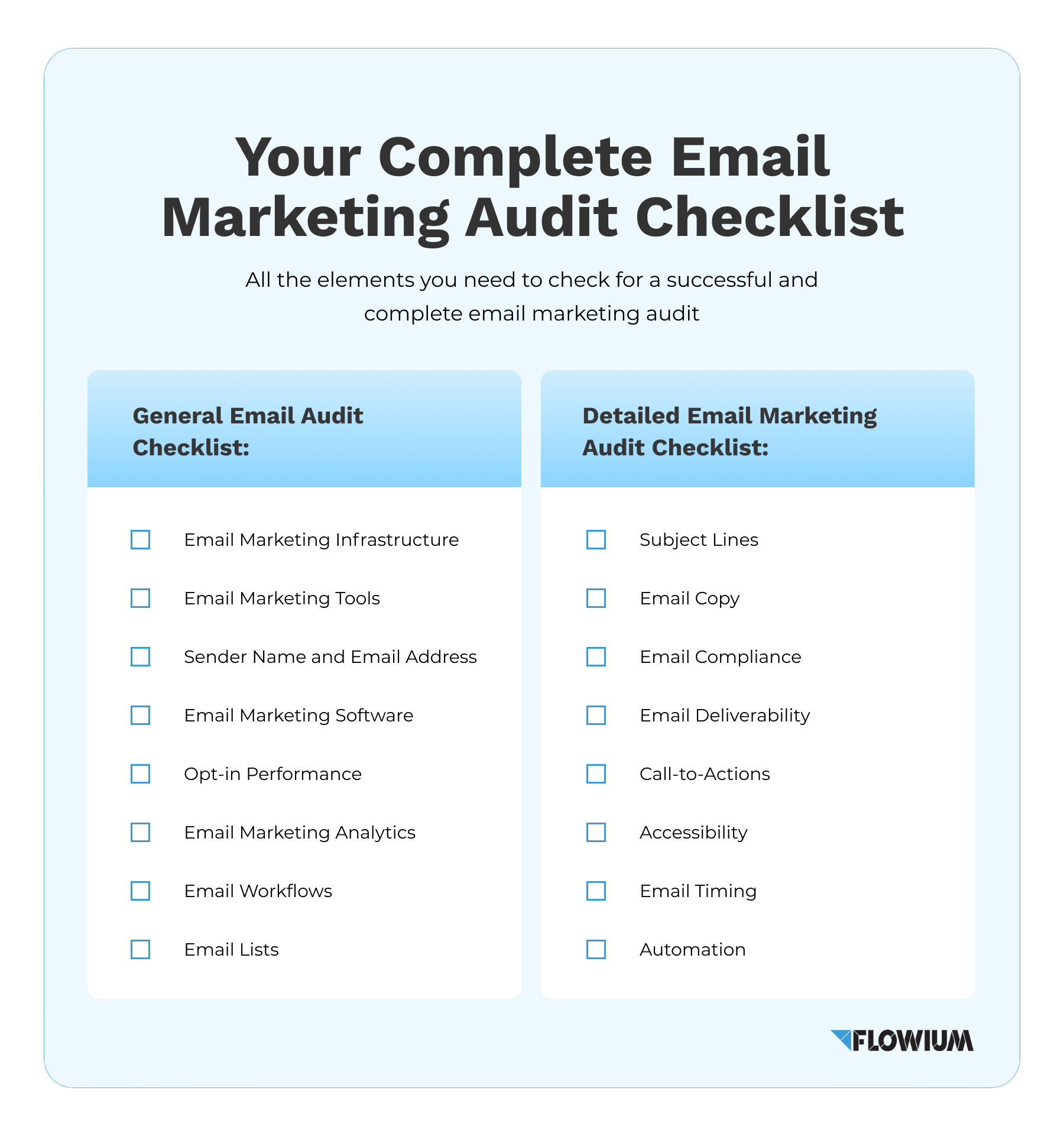
Detailed Email Marketing Audit Checklist
In this section, we will move away from the general checklist points and examine the detailed components specifically related to email marketing audits.
Subject Lines
The subject lines are one of the key components of your open rate. They may seem insignificant, but writing them correctly is important. If your emails have a low open rate, you should reevaluate this aspect of your email campaign. Continuous A/B testing will help you determine how good your subject lines are. During the audit, pay attention to the following aspects:
- Which subject lines outperform others?
- Which subject lines consistently show poor results?
- How accurately do your subject lines reflect the content of your emails?
- How can you make them more compelling and attractive?
Email Copy
The copy of an email is the foundation of your email campaign and directly affects engagement and conversion rates. In short, the text of an email can determine the success or failure of your campaign. During the audit, make sure that the text of your advertising emails is entertaining and interesting to read, because that is what attracts users to read them.
Email Compliance
Non-compliance with email requirements can have serious consequences, such as email delivery problems, legal disputes, and damage to your brand’s reputation. Compliance assessment involves reviewing your email marketing practices for adherence to regulations such as the CAN-SPAM Act in the US and the GDPR in the European Union. This includes verifying that you have obtained proper consent from subscribers to receive your emails, providing an easy way to unsubscribe, and including accurate sender information.
- The General Data Protection Regulation (GDPR) is a comprehensive data protection law designed to regulate the processing of personal data of individuals in the EU. It applies to businesses operating in the European Union (EU). The GDPR protects an individual’s right to receive marketing emails only after giving their consent and their right to receive clear and transparent information about data processing practices, along with the ability to opt out of receiving further communications. The GDPR requires marketers to comply with the regulation or face penalties and fines.
- The CAN-SPAM Act was created to establish and regulate rules for commercial email messages, giving recipients the right to opt out of receiving them. CAN-SPAM applies to the US region. This law is another reason to be responsible with your subject lines, as the law also applies to misleading subject lines and false information in headers. According to CAN-SPAM, email marketers must provide accurate information about the sender. Marketers must provide users with a clear and conspicuous way to opt out of receiving emails and, equally important, must comply with opt-out requests immediately. Violations of CAN-SPAM can result in significant fines imposed by the Federal Trade Commission.
Email Deliverability
An email audit is an opportunity to evaluate the deliverability of your email campaigns and identify factors that lead to the unsuccessful delivery of your emails, such as spam filters or IP address issues.
Email Design
Email design is as important as copy, but while text takes time to read, design is responsible for capturing users’ short-term attention. The design of your emails can significantly influence how your subscribers interact with your brand and the likelihood that they will take certain actions, such as visiting your website or making a purchase. Analyzing your email design templates and patterns as part of an email marketing audit can help you identify what works and what doesn’t. Make sure your design doesn’t contain:
- Layout overload
- Too much text
- Incorrect use of colors
- No optimization for mobile devices
Call-to-Actions
It often happens that the recipient reads the email, sees the design, enjoys it, but does not understand what to do next or how to interact. In this case, CTAs serve as instructions for further actions. Analyze the design, text, placement, and relevance of your calls-to-action to find out which ones work better or worse than others, and why.
Accessibility
Accessibility is important in all spheres, including email marketing. Accessibility in your emails will allow all subscribers to perceive your messages even if they have vision, hearing, or motor impairments.
- Add alt text to images.
- Make sure the text is easy to read so that customers with dyslexia won’t have any difficulties.
- Focus on a color scheme that is accessible to colorblind people.
- Prepare subtitles for embedded media.
Email Timing
Proper timing is also key to a successful campaign. Failing to choose the right moment can ruin your campaigns, even if all other aspects are well executed. Sending too many emails can cause email fatigue and result in people unsubscribing. Sending too few emails can result in low activity or make your subscribers forget about you. Conducting an email marketing audit allows you to find the optimal frequency and analyze which sending times are most effective for specific campaigns.
Automation
While automated email campaigns are a great way to optimize your email marketing efforts, many marketers set them up and abandon them, never developing or updating them. If you don’t check your automated campaigns from time to time, it can lead to mistakes in your emails, which can negatively impact your subscribers’ experience and damage your brand reputation. Regularly auditing your automated campaigns can also help you identify opportunities to improve their effectiveness.
Tools for Conducting Email Marketing Audits
There is a way to make your email audits even easier, more efficient, and more advanced. To do this, you can use third-party tools for various purposes. Here are the main types of tools and software that will come in handy:
- Email service providers
The most important tool in email marketing is an email service provider. All workflow revolves around it, and all strategies are implemented thanks to it. If you are involved in email marketing, you are sure to have an email service provider that you work with. During the email audit, make sure that your provider is the best possible option, consider other available choices, and if necessary, think about switching. We recommend that you try Klaviyo. It is the most popular, best, and most functional email service provider on the market. During the audit, consider Klaviyo’s pricing and innovative features and think about switching.
If you are already a Klaviyo customer, be sure to take advantage of the free email audit service. It is a quick tool that will conduct an internal audit of your account in just 15 minutes and provide you with all the necessary information about shortcomings and areas for improvement.
- Email component testing tools
If your email service provider does not include testing capabilities or includes them but is not comprehensive, we strongly recommend that you use third-party testing tools. Tools dedicated to testing can provide more accurate metrics and useful advice. With their help, you can check your templates, identify accessibility issues, check URLs, fix broken ones, and preview the appearance of your inbox.
- Domain reputation testing and monitoring tools
Tools dedicated to checking domain reputation will give you an accurate assessment of your domain so you can understand if it is on a blacklist or considered spam. Such tools for you may include MxToolbox, Google Postmaster, or others.
- Website analytics tools
Website analytics tools may seem unnecessary in a list of email audit tools, but they are not. Although they are designed to obtain website metrics and eCommerce statistics, determining these metrics will help you understand how users will respond to your emails, whether they will follow links, and how likely they are to become buyers.
- Customer relationship management software (CRM)
CRM is an indispensable marketing tool and a must-have. A tool like CRM will show you how effectively your email strategy is moving potential customers through the sales and marketing funnel.
How Often Should You Conduct an Email Marketing Audit?
The recommended frequency for conducting an email marketing audit is every three months. The frequency is approximate, but it takes into account the period that will allow you to evaluate a significant number of campaigns and review a significant amount of recent patterns.
However, the frequency may vary depending on the size of your business, the volume of emails sent, and the dynamic nature of your marketing strategies. Therefore, if you send a small number of emails and your campaigns are not very complex, it is sufficient to conduct audits twice a year. If you want to create your own audit schedule, consider the following features:
- If your campaigns are complex, i.e., they include detailed segmentation with different content, conducting audits more often will help maintain efficiency, optimization, and quickly correct errors.
- Conducting an audit without gathering all the necessary resources or without having enough of them will be useless and a waste of your time.
- The market is always dynamic, and some industries are even more dynamic than others. To keep up with trends, you need to conduct audits more often, and sometimes even unscheduled.
Frequently Asked Questions
What is the cost of an email marketing audit?
With our specialists from Flowium, you can get an email marketing audit absolutely free of charge. All you need to do is contact us and request an audit. Our team of specialists brings industry-leading expertise to help you boost performance, improve strategy, and drive more revenue. The email marketing audit from Flowium includes:
– In-Depth Email Marketing Strategy Review
– Opt-In Performance Improvement
– Email Campaign Performance Enhancement
– Revenue-Generating Flow Review
– Expert Feedback on Analytics
– Technical Email Suggestions
– Revenue Improvement Report
How long does an email marketing audit take?
The duration of the audit depends on you. The average audit can take anywhere from a few days to several weeks, depending on the scale of your email marketing and how you organize the audit itself. However, the free audit from Flowium, which you can get right now, takes an average of 2 business days.
What are the most common issues that an email marketing audit helps to identify?
The most common issues that are usually identified during an email marketing audit are mostly related to rates and metrics. The issues identified usually show:
– Low open rate
– High unsubscribe rate
– Low click-through rate
– High bounce rate
In addition to negative metrics, other common problems include inactive subscribers and ineffective segmentation. If you don’t have much time and the funds to conduct an audit, check your performance based on these metrics and make sure they are at the highest level.
Why should you conduct email marketing audits regularly?
Regular audits allow you to instantly identify weaknesses in your strategy, improve communication with your audience, increase conversion rates, and optimize marketing costs, which in turn contributes to the growth of your business’s profitability.
How can you ensure compliance with legal requirements and regulations during an email marketing audit?
Legal requirements are mandatory. Before engaging in email marketing, it is important to check whether your strategy complies with GDPR and other legal requirements. These requirements relate to the proper processing of data, the proper registration of subscribers, and the use of legitimate grounds for the collection and processing of personal data. Read more about the General Data Protection Regulation (GDPR) and the CAN-SPAM Act in the article.
Final Thoughts
After detailed research into the importance of email marketing audits, their necessity and usefulness have been proven beyond doubt. Regular audits are a must-have for any business. In our research, we have collected everything you need to conduct the best audits. If the email audit causes you difficulties, you can contact us, Flowium, email marketing experts, and we will provide you with professional assistance in any matter.

![How to Do a Klaviyo Audit? [Expert Guide]](https://flowium.com/wp-content/uploads/2023/02/klaviyo-audit.png.webp)