Growing your business while controlling customer acquisition costs is a priority for many ecommerce brands. Direct-to-consumer (DTC) marketing offers a way to achieve both by helping brands reach customers directly, build stronger customer relationships, and drive sales without relying on third-party retailers or intermediaries.
However, a successful DTC strategy involves more than selling products through your own website. You must choose the right marketing channels, understand your target audience, and create consistent experiences across every stage of the customer journey.
In this guide, we’ll explain what DTC marketing is, its benefits and challenges, main channels with examples, as well as give you some valuable tips from Flowium’s experts for sustainable business growth.
What is DTC Marketing?
Direct-to-consumer marketing is the strategy ecommerce brands use to promote and sell their products without relying on third parties or distributors. It allows brands to manage their marketing activities, own customer relationships, and control the buying experience across multiple sales channels.
Unlike traditional wholesale marketing, where retailers also control the final customer interaction, DTC marketing gives brands greater control over:
- Customer acquisition
- Customer data
- Brand messaging
- Customer experience
- Customer retention
A simple example – instead of selling products to Walmart as a supplier for further distribution and promotions, you open your own brand store and promote your products by yourself. That’s how you become a DTC brand.
Why DTC Marketing Matters for Brands
One of the greatest advantages of the DTC model in ecommerce is that you can control how you attract customers, communicate your brand, and build long-term relationships. However, this approach also comes with certain challenges. Brands must invest in customer acquisition, build their own audiences, and manage marketing activities.
Let’s look into both sides of this coin and determine the major pros and cons that you should be aware of. Understanding these advantages and disadvantages can help your ecommerce business decide how to allocate resources and develop a sustainable growth strategy.
Benefits of DTC Marketing
- Greater control over brand messaging. DTC marketing allows brands to manage how they communicate their value, present products, and engage with customers across channels. From website content and social media to email and SMS campaigns, businesses can maintain consistent messaging and adjust their positioning without coordinating every marketing initiative with retail partners.
- Direct customer engagement and stronger relationships. Brands can communicate with customers throughout the entire buying journey, from initial discovery to post-purchase interactions. Email marketing, SMS, loyalty programs, and personalized product recommendations help businesses nurture customer relationships, encourage repeat purchases, and increase customer lifetime value (CLV).
- First-party data and data-driven marketing decisions. Direct interactions through ecommerce websites and owned marketing channels give brands access to valuable first-party data, including purchase history, browsing behavior, and customer preferences. Marketers can use these insights to segment audiences, personalize campaigns, test messaging, and optimize marketing spend based on actual customer behavior.
- Faster campaign testing and optimization. DTC brands can launch, measure, and adjust marketing campaigns without waiting for approval or coordination from third-party retailers. They can test different offers, landing pages, email subject lines, audience segments, and promotional strategies, then use performance data to improve results more quickly.
- More flexibility in channel selection. DTC marketers can choose and coordinate channels based on their audience, budget, and business goals. For example, paid social and search can support customer acquisition, while email and SMS can nurture leads, recover abandoned carts, and drive repeat purchases.
Challenges of DTC Marketing
- High customer acquisition costs (CAC). Without relying on retailers’ established customer bases, DTC brands must invest in attracting their own audiences. Paid advertising, influencer partnerships, content creation, and SEO all require resources. As competition for digital ad space increases, profitably acquiring new customers can become particularly challenging.
- Time and resources required to build an audience. Unlike established retailers, DTC brands cannot automatically access a reseller’s existing customer base. They need to generate brand awareness, attract qualified traffic, grow email and SMS subscriber lists, and build customer trust. These activities require consistent investment in content, campaigns, and audience development.
- Complex multichannel marketing management. Running campaigns across paid search, social media, email, SMS, and other channels requires coordination, specialized expertise, and consistent measurement. Without a connected marketing strategy, brands risk fragmented messaging, duplicated efforts, and inconsistent customer experiences.
- Greater responsibility for marketing performance. DTC brands must generate demand, convert website visitors, and retain customers through their own marketing efforts. Poor targeting, ineffective campaigns, or weak retention strategies can directly affect revenue and profitability. Brands need reliable analytics, ongoing testing, and clear performance metrics to identify problems and improve results.
Best DTC Marketing Strategies
Here are some of the best strategic moves that DTC brands can put in place to acquire customers and then grow their lifetime value through owned channels. We gathered them all in one list that follows the customer lifecycle to help you set up your marketing for successful retention.
Build and Perfect Your Brand Identity
Lifecycle stage: Awareness, loyalty
Best channels: Website, email, and social media
Companies operating in the DTC marketing funnel must focus on creating a powerful brand image. Having an established and consistent brand identity makes your brand recognizable recognizable and earns the audience’s trust in your DTC product offers and the value of your mission. This is what brings customers back after the first purchase.
How to implement:
- Create a one-page brand guide to introduce your mission, branding style and visuals, packaging elements, etc.
- State your mission in one sentence and put it on the website homepage, product pages, and about page to create consistency.
- Send a brand introduction email as part of your welcome sequence, and support it with storytelling campaigns through later lifecycle stages (retention, advocacy) to strengthen loyalty.
- Audit every touchpoint across channels (ads, site, order emails, support replies) for consistent voice and visuals.
- Treat post-purchase experience moments, like shipping emails and the unboxing, as brand moments, since they shape whether customers buy again.
- Back your claims with proof, such as sourcing details, certifications, or impact numbers, to show credibility and foster trust.
DTC brand example: A comfort-focused socks and apparel brand, Bombas, donates a pair of socks for every pair sold. This directly supports their mission and makes it a part of the purchase.
Choose Omnichannel Approach to DTC Marketing
Lifecycle stage: Awareness through repeat purchase
Best channels: A mix of paid social, search, email, and SMS
Remember the marketing rule of seven: a person needs to see your brand’s message about seven times before they decide to buy. This shows why it’s important to use lots of different ways to share information and ads. Putting all your resources and effort into developing campaigns only for one channel is like putting all the eggs in one basket. It can cost you success since there’s no guarantee it’ll work. Owned channels like SMS and email also keep customers in touch with you between purchases.
How to implement:
- Map one or two channels to each lifecycle stage: for example, paid social and SEO for awareness, email and SMS for conversion and retention.
- Start with two or three channels you can run well. Add more only after you set up processes on the core ones.
- Use omnichannel automation to make your marketing more seamless and relevant.
- Use retargeting and email so a prospect who saw an ad sees the same message again.
- Track results by channel and by customer cohort (repeat rate, LTV), not only first-purchase CAC.
DTC brand example: Warby Parker, a well-known eyewear brand, successfully reaches customers through its website, Home Try-On program, and retail stores.
Use the Full Potential of Collected Data
Lifecycle stage: Acquisition through retention
Best channels: On-site forms, email and SMS signup flows, and your analytics or CDP tools
One of the best practices in direct-to-consumer marketing for brands is building better bonds with buyers by focusing on getting and analyzing top-quality user data. Since cookies are declining, DTC companies need to develop strong ties with media providers and online advertising platforms to collect data from their marketing campaigns. A collected and thoroughly analyzed data can help you to form a clear vision about each consumer’s identity and measure the success of your direct-to-consumer marketing strategy, including lifecycle segmentation and post-purchase personalization.
How to implement:
- Connect your store, email/SMS platform, ad account, and analytics so each customer has one unified profile.
- Collect zero-party data (what customers tell you directly) through quizzes, signup questions, or post-purchase surveys.
- Set up server-side tracking or conversion APIs on your ad platforms to offset cookie loss.
- Build lifestyle segments: new customers, repeat buyers, VIPs, ar-risk, and lapsed.
- Track a core set of ecommerce metrics: repeat purchase rate, time to second order, LTV, and churn.
DTC brand example: Function of Beauty, a hair care brand, collects customer preferences through a hair care quiz and then turns them into a custom formula, using the gathered data for offer personalization.
Focus on Personalization
Lifecycle stage: Purchase and retention
Best channels: Email and SMS
Making each customer’s buying journey unique is important. Customers don’t want to be seen as just another data point. Personalization in your email marketing, SMS campaigns, targeted ads, etc., makes your audience feel more appreciated and involved, which naturally leads to higher engagement and sales rates.
How to implement:
- Start with simple rules: personalize by product purchased, category browsed, and time since last order to deliver only relevant offers.
- Send post-purchase messages that match what the customer bought, such as usage tips, product recommendations, and replenishment reminders timed to the product’s usage cycle.
- Include customer preferences from your collected data in your messaging.
- Split-test your personalized messages against generic ones and personalize where the lift is clear.
DTC brand example: BarkBox offers personalized boxes that are customized to fit each dog’s needs, such as size, play style, or allergies, using data their customers shared during the subscription process.
Set Up Customer Loyalty Programs
Lifecycle stage: Retention through advocacy, LTV growth
Best channels: Email, SMS, and the account dashboard
Show appreciation to your loyal clients in the form of perks and benefits. Boosting client loyalty is a proven method of direct consumer marketing. Offer them gift cards, bonus points, and discounts for joining your community, social media, email subscriptions, published reviews, or tags on their accounts, etc. This tactic will be beneficial for both parties – clients gain bonuses, and your DTC company gains more engagement. If a client is happy, they’re more inclined to stick with the brand and recommend it to others.
How to implement:
- Choose a structure that fits your margins and purchase cycle: points, tiers, or paid membership.
- Reward actions beyond purchases: reviews, referrals, social follows, birthdays, and account signups.
- Add early access, free shipping thresholds, or exclusive products for top customers. Announce the program in your welcome flow, post-purchase emails, and checkout. Show points balance and tier progress in emails and the account page to prompt the next order.
- Track repeat purchase rate and average order value for members versus non-members.
DTC brand example: Fabletics. Its VIP membership ties perks and pricing to ongoing purchasing.
Build a Community for Your Direct-to-Consumer Brand
Lifecycle stage: Loyalty, advocacy
Best channels: Social groups, branded apps, and online forums
A tactical plan for boosting engagement and sales includes creating a lively brand community. This is done by directly communicating on digital social platforms or setting up internet discussions where clients can talk about their experience with the product and ideally recommend it to others. Forming these interaction spaces like social media sites and online forums not only fortifies the brand’s community but also increases client happiness.
How to implement:
- Pick one home for the community (a private group, forum, or Discord) rather than spreading across many platforms.
- Invite new customers in post-purchase emails and package inserts.
- Post regularly: how-tos, behind-the-scenes content, polls, and Q&As.
- Have team members reply to posts and comments, so customers see the brand is present.
- Feature member stories and reward active members with early access or recognition.
- Use community feedback to inform product and messaging decisions, and tell members when you do.
DTC brand example: Peloton. Its instructors, leaderboards, and member groups keep customers engaged between workouts.
Involve UGC and Micro-Influencers
Lifecycle stage: Consideration, post-purchase, advocacy
Best channels: Instagram, TikTok, YouTube, and product-page reviews
Since many buyers nowadays seem to be suspicious of openly advertised products, DTC marketing often relies on user-generated content on social media and online forums. Instead of trusting ads right away, most of the time people look through reviews and experiences of others before purchasing. Professional DTC marketing teams know how to use this fact to their advantage. Another key aspect of DTC’s strategy is influencer marketing. Even if you don’t have the resources to collaborate with the most famous creators, you can involve micro-influencers to review and advertise your brand offers in more local niches.
How to implement:
- Trigger a review request by email or SMS a few days after delivery, once customers have used the product.
- Create a branded hashtag and invite customers to share photos, with a chance to be featured.
- Get permission before reusing customer content, then place it on product pages, emails, and ads.
- Find micro-influencers whose audience matches your customer: search your branded hashtag, existing customers who post about you, and niche creators in your category.
- Start with product seeding or small paid collaborations, then keep working with creators who perform well.
- Give each creator a unique code or link to track sales and new customers.
- Measure repeat purchases from creator-acquired customers, not just first orders.
DTC brand example: Gymshark. Its growth leaned heavily on fitness creators and athletes.
How to Start Building a DTC Marketing Strategy
Starting a DTC marketing strategy means defining who you serve, setting up the data to
understand them, and building both acquisition and retention from the beginning. Here’s a step-by-step guide to follow.
- Define your customer and positioning. Identify your best customers, the problem you solve for them, and why they should buy from you instead of a competitor or a retailer. Everything else, from channel choice to messaging, builds on this.
- Set up data collection and tracking. Connect your store, email/SMS platform, ad accounts, and analytics so each customer has one profile. Add a quiz or signup question to collect zero- party data, and use server-side tracking to offset cookie loss.
- Choose two or three acquisition channels. Pick channels where your customers already spend time, such as search, paid social, or creators, and run them well before adding more. Capture an email or phone number from as many visitors as you can.
- Build your core lifecycle flows. Start with welcome, abandoned cart, and post-purchase emails or SMS. Add replenishment and winback flows once those are running, so the second purchase gets as much attention as the first.
- Add loyalty and referral mechanics. Reward repeat purchases, reviews, and referrals with points, tiers, or perks. Announce the program in your welcome flow and at checkout.
- Track retention metrics alongside acquisition metrics. Track repeat purchase rate, time to second order, and LTV alongside CAC. Review them by customer cohort, not just in aggregate.
- Test and iterate. A/B test offers, subject lines, flow timing, and landing pages, and change one thing at a time. Keep what lifts repeat purchases and retire what doesn’t.
Common DTC Marketing Mistakes
- Over-relying on paid ads. Paid channels get more expensive as you scale, and you don’t own the audience.
- Ignoring the post-purchase experience. Many brands put everything into the first sale and then go quiet.
- Using discounts as the main retention tool. Constant promotions train customers to wait for a sale and erode margin.
- Poor data hygiene. Duplicate profiles, outdated records, and disconnected tools lead to wrong segments and irrelevant messages.
- Measuring only first-order ROAS. A campaign that looks unprofitable on the first order may be strong on lifetime value, and the reverse is also true.
- Treating every customer the same. First-time buyers, repeat customers, VIPs, and lapsed customers need different messages.
More Successful Direct-to-Consumer Marketing Examples
Warby Parker – Successful DTC Email Marketing
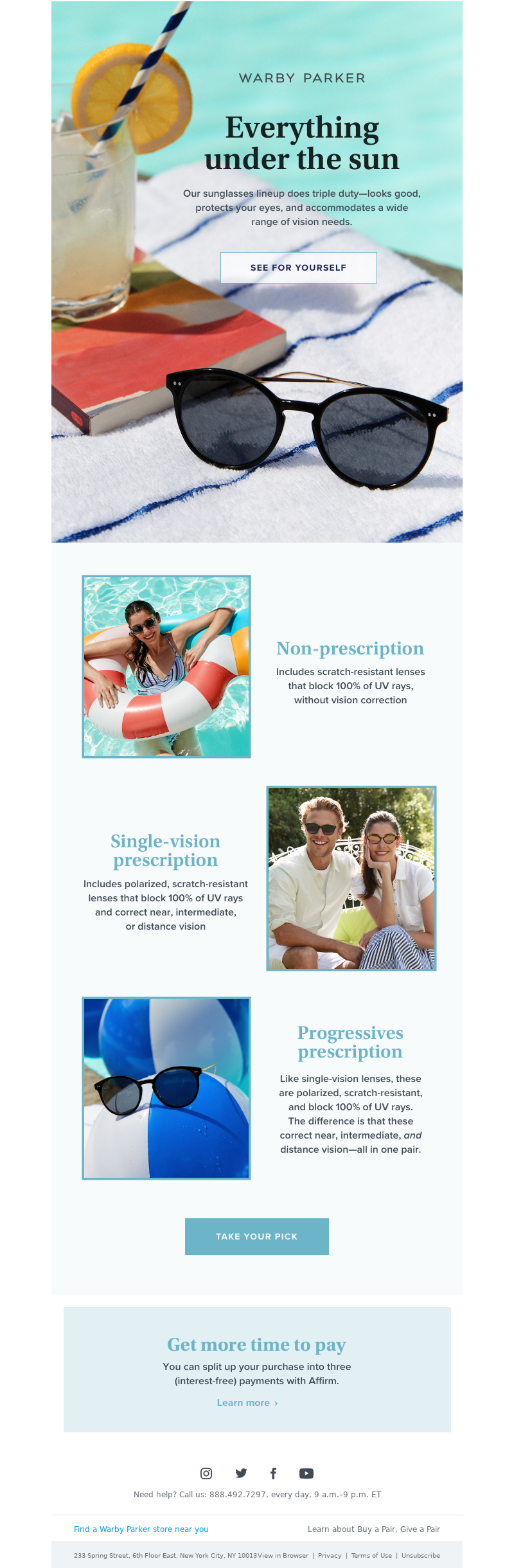
Warby Parker takes its rightful place as one of the successful direct-to-consumer marketing examples. With a straightforward mission to make glasses more affordable and accessible through direct-to-consumer sales, Warby Parker challenged the industry’s leading eyewear brands. But because of their original concept (for the eyeglass market) and smart direct-to-consumer marketing, they’ve now achieved the highly sought-after unicorn designation. Ecommerce email marketing is crucial for a company like Warby Parker, which operates mostly online. This is one of the great D2C marketing examples where a company professionally uses email to connect with clients. Just look at the well-designed product recommendation email campaigns by Warby Parker.


Flowium is ready to assist your DTC company in gaining success through email marketing. Our team creates even more spectacular and engaging emails to keep your clients hooked on your brand and interested in your new offers. Contact us anytime to start a productive collaboration right away.
Stanley 1913 – Viral on TikTok
Although Stanley isn’t fully a direct-to-consumer brand, a considerable segment of the company’s revenue comes from their DTC e-commerce. We decided to include this brand in the list of prominent DTC marketing examples because of the recent event (or rather, an accident) that allowed this company to go viral on social media and gain astonishing engagement rates.
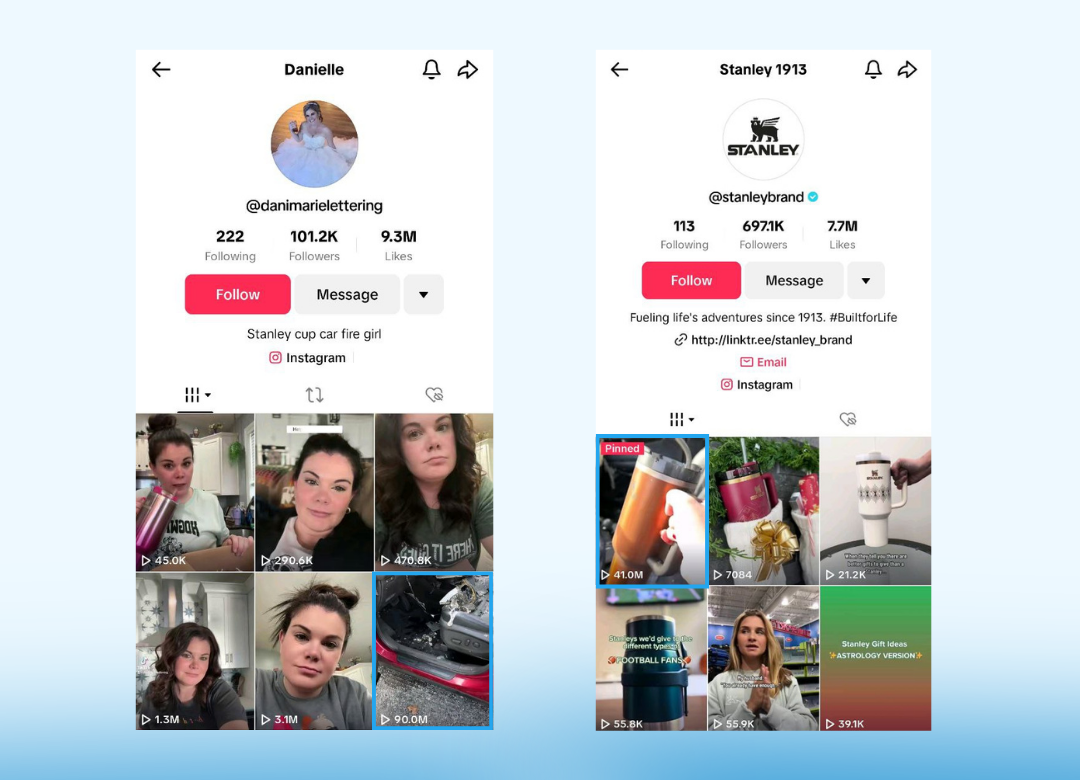
Not so long ago, a TikTok user, Danielle, posted a video about an unfortunate accident when her car caught on fire. What amazed her and the viewers was that a branded “Stanley” cup, despite being in the burning car, wasn’t just undamaged but even still had ice in it! The video blew up, and now more than 75 million people have seen this unintentional and unpaid advertisement of Stanley’s products. What brings our attention to this case is the reaction of Stanley 1913. The company’s marketers were able to pull out all the benefits of this situation for their DTC marketing efforts and promotion. Stanley’s president also made a TikTok and posted it on the company’s official page promising to help Danielle to replace her vehicle. Both videos are unprecedented in terms of engagement, gaining millions of likes, comments, and shares and even making it to the news. For sure, Stanley gained many new clients and a considerable return on investment from this whole ordeal.
This case is a great direct-to-consumer marketing example of how smart businesses can make social media and user-generated content work for their promotion and growth.
Funboy – DTC Rocking SMS Marketing
Funboy is a DTC company that designs luxury pool floats and other backyard essentials for summertime. Their marketing strategy incorporates various channels and methods, but what makes this DTC brand stand out is their incredible SMS marketing. Overall, SMS campaigns have a 98% open rate on average. Compared to channels like email or display ads, SMS marketing is still relatively young. However, over 50% of consumers have already chosen to receive marketing SMS campaigns. Funboy has made the right decision to seize opportunities to connect with their clients through SMS and take full advantage of this channel for their DTC market. The company’s team puts in their best effort while working on foundational messages like this welcome SMS below. In general, Funboy’s SMS strategy is one of the best-thought-out marketing direct-to-consumer examples.


Conclusion
We hope this article fully explains the matter of direct-to-consumer marketing, its main strategies, benefits, and other characteristics. Now, you know that in general, DTC brands have many tools, like email marketing services and text message marketing, to drive sales. By using time-tested practices and channels, your businesses can better tailor customer experiences, solve problems, build solid relationships, and stay on top of new trends.
Flowium can help you build an effective DTC marketing strategy using our experience and skills to set your brand up for successful customer acquisition and sustainable growth through retention. Contact our team now!
Frequently Asked Questions
What are the best DTC marketing channels?
The best DTC channels depend on your product and customer, but most brands combine a few types: search and content for discovery, paid and organic social for awareness, and creators for social proof. Email and SMS are the core retention channels because you own the audience and the data.
How do DTC brands retain customers?
DTC brands retain customers by managing the experience after the first purchase: onboarding and post-purchase emails, replenishment reminders, subscriptions, loyalty programs, community, and winback campaigns for lapsed customers. First-party data lets them time and personalize each message, so the second order comes sooner, and the relationship lasts.
What metrics matter most for DTC brands?
Track acquisition and retention together: customer acquisition cost, repeat purchase rate, time to second order, customer lifetime value, churn, and average order value. Comparing CAC with LTV shows whether growth is profitable, and repeat purchase rate shows whether customers are coming back.
How much should a DTC brand spend on marketing?
There’s no single right budget. It depends on your margins, CAC, and customer lifetime value. A practical approach is to work backward: determine how much you can spend to acquire a customer while staying profitable over their lifetime, then fund channels that meet that target and reserve budget for retention.u003cbru003e