If you haven’t heard about it before, you’ll be surprised to learn that email marketing leads the way in terms of return on investment (ROI) among other promotional methods. According to email marketing statistics, the payback can be as high as 1:36 for every dollar invested.
Your email marketing ROI figures are not reaching these levels? In this article, we will tell you how to improve them. If you are not yet involved in email marketing, we will prove its profitability to you here. Once you’ve verified this, don’t waste a second and contact us, a professional retention marketing agency, to take advantage of potential earning opportunities.
Email ROI Overview: Highest Profit Marketing
When determining profitability in any industry, it is important to consider the key indicators of the ratio between each dollar invested and the corresponding amount earned. Most relevant studies report the following indicators:
On average, for every dollar that brands invest in email marketing, they earn $36, creating a return on investment rate of 1:36. The average is even higher for the retail, eCommerce, and consumer goods industries, with a profit of $45 for every dollar invested. These ratios are equivalent to an ROI of 3600% to 4500%.
As you can see, email marketing is extremely profitable regardless of the industry, and especially for retail, eCommerce, and consumer goods brands. Despite all the current trends and growth of social media, email ROI outperforms most other marketing channels. However, the development of omnichannel marketing, led by email marketing, will have an even higher combined ROI.
According to research, sending just 5-8 marketing emails per month can deliver a peak ROI of 1:48. The highest return on investment is provided by customer engagement emails, promotional emails, and newsletters.
The rate may also depend on the number of subscribers in the brand’s email list. The study found that brands with over 10 million subscribers achieve an ROI of $46 for every dollar spent, compared to $39 for lists with fewer than 500,000 subscribers. Even with such a huge difference in the number of subscribers, email ROI remains the highest among other channels.
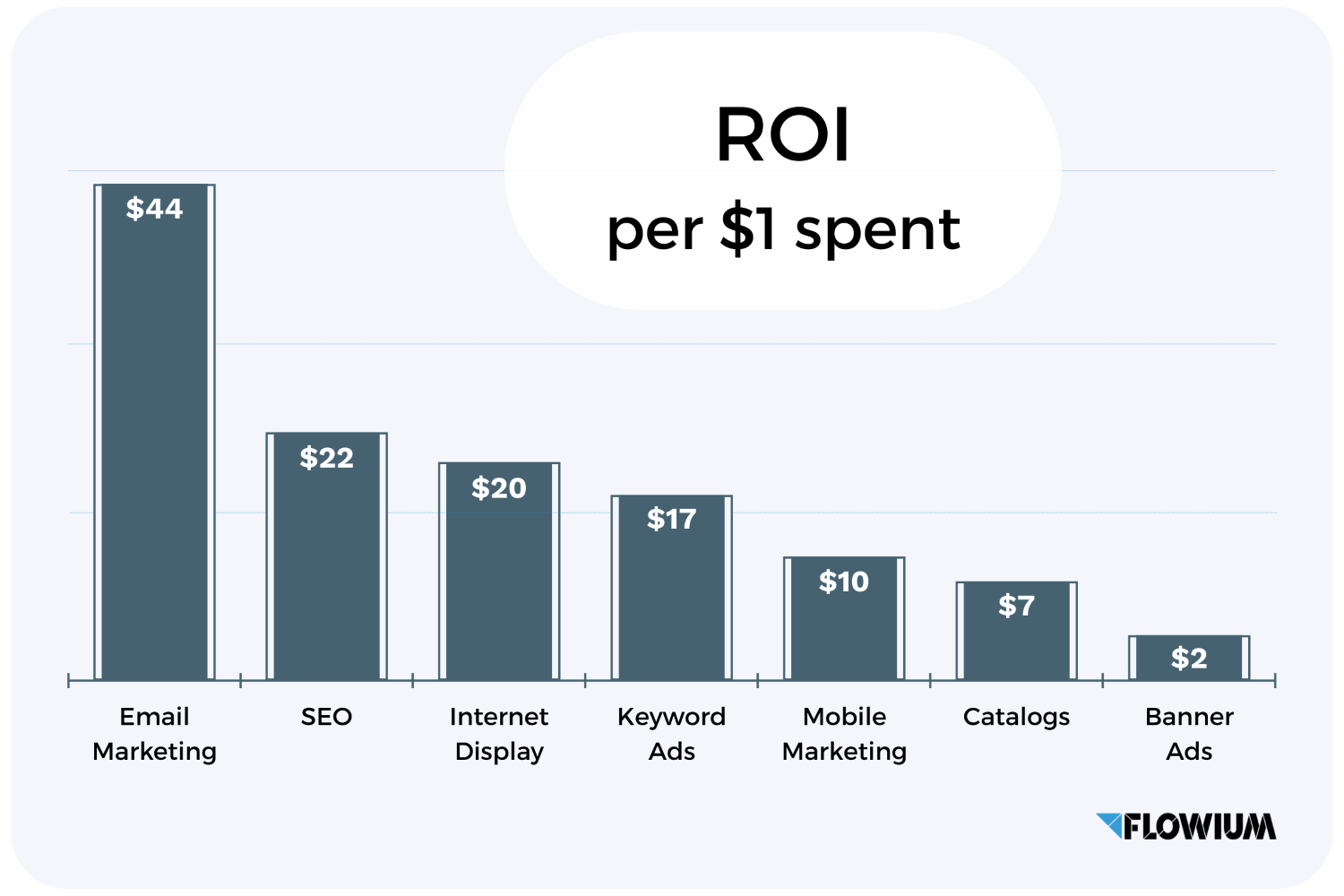
Referring back to other channels, the outstanding email marketing return on investment is confirmed by a comparison with the ROI of other marketing channels. As we mentioned, email ROI is approximately 3600-4500%, compared to 317-1389% for SEO and 250% for social media. In the chart below, you can see the ratio per dollar invested in different promotion channels.
Finally, the study also notes a difference in the ratio based on the type of opt-in. Companies that primarily rely on the double opt-in (DOI) method to attract subscribers report a 1:45 ROI on email marketing, while those that primarily use single opt-in (SOI) see a lower return of 1:40.
ROI of Email Marketing by Industry
Research into the profitability of email marketing across different industries shows some interesting results that are worth noting for particular industries, as for some of them, the return on investment is even higher than the average rate.
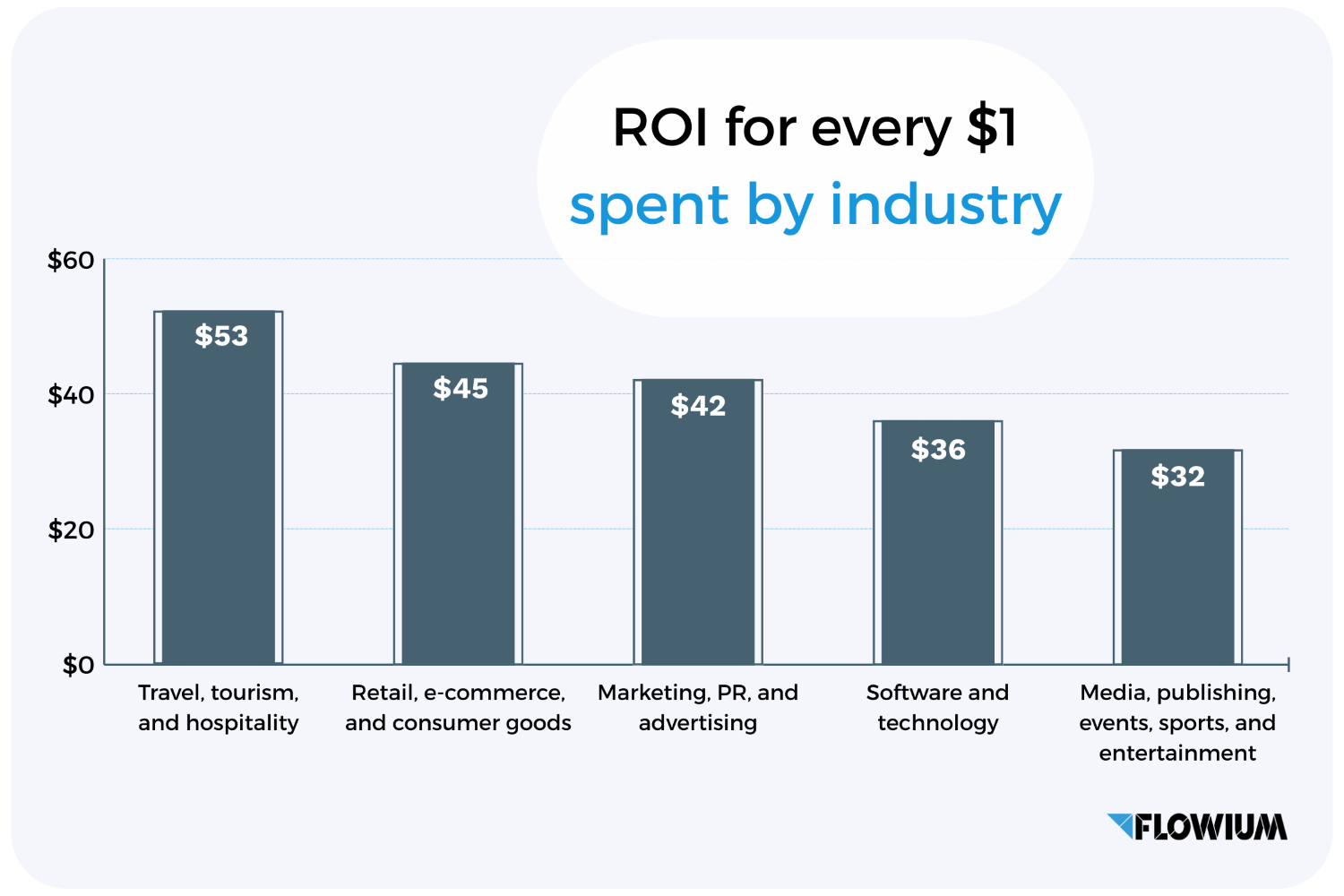
- This is particularly true for the travel, tourism, and hospitality industry, where the ROI is significantly higher than average, reaching $53 for every dollar invested.
- The brands we mentioned earlier that focus on retail, eCommerce, and consumer goods also have a higher-than-average ROI of $45 for every dollar invested. Insight: For companies focused on retail, promotional emails show the highest ROI.
- Even marketing, PR, and advertising agencies themselves benefit greatly from email marketing, spreading their B2B offers and more, they achieve an ROI of $42 for every dollar invested. Insight: For companies focused on B2B, customer engagement emails are proven to be the most effective in achieving high ROI.
- The average ROI is achieved by companies involved in software and technology, which receive a return on investment of $36 for every $1 spent. Insight: Customer engagement emails are also the most effective tool for achieving a high ROI for tech companies.
- The media, publishing, event organization, sports, and entertainment industries report a slightly lower but still impressive ROI of $32 for every $1 spent.
For a better visual comparison of this email marketing data on ROI achieved through email campaigns in different industries, take a look at this chart:
ROI on Email Marketing Differences by Region
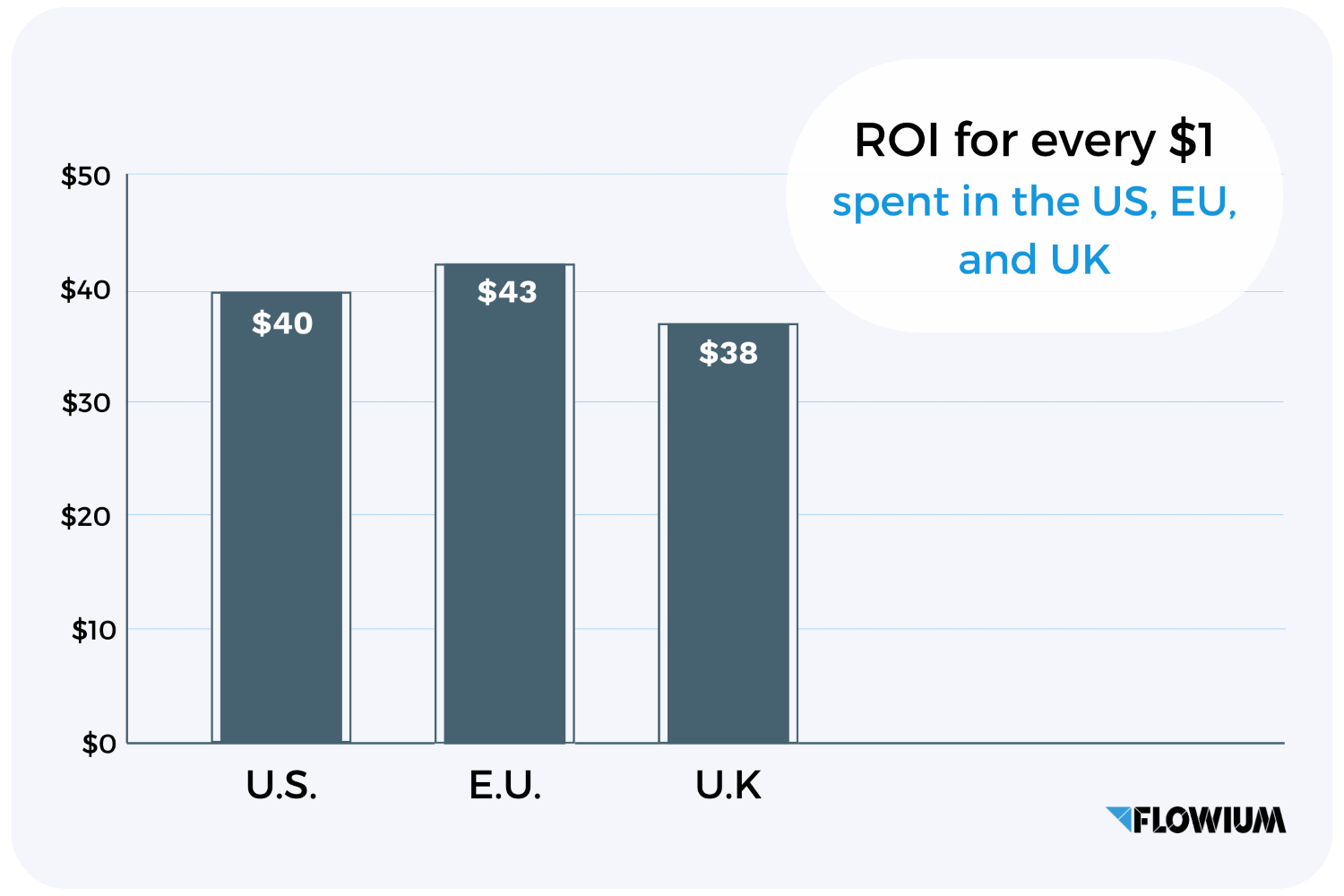
Research into the difference in ROI for email marketing depending on region focused on three main regions: the United States, the United Kingdom, and Europe.
- The highest average ROI was found among European brands, at $43 for every dollar invested.
- American brands achieved a slightly lower average ROI of $40 for every dollar invested in email marketing.
- Back in 2020, the United Kingdom had the highest rate among the regions at 1:45, reflecting a high annual growth rate. However, as of 2026, DMA reports an average ROI of $38 (£28.50), showing a slight decline.
Average ROI for Email Marketing Based on Company Size
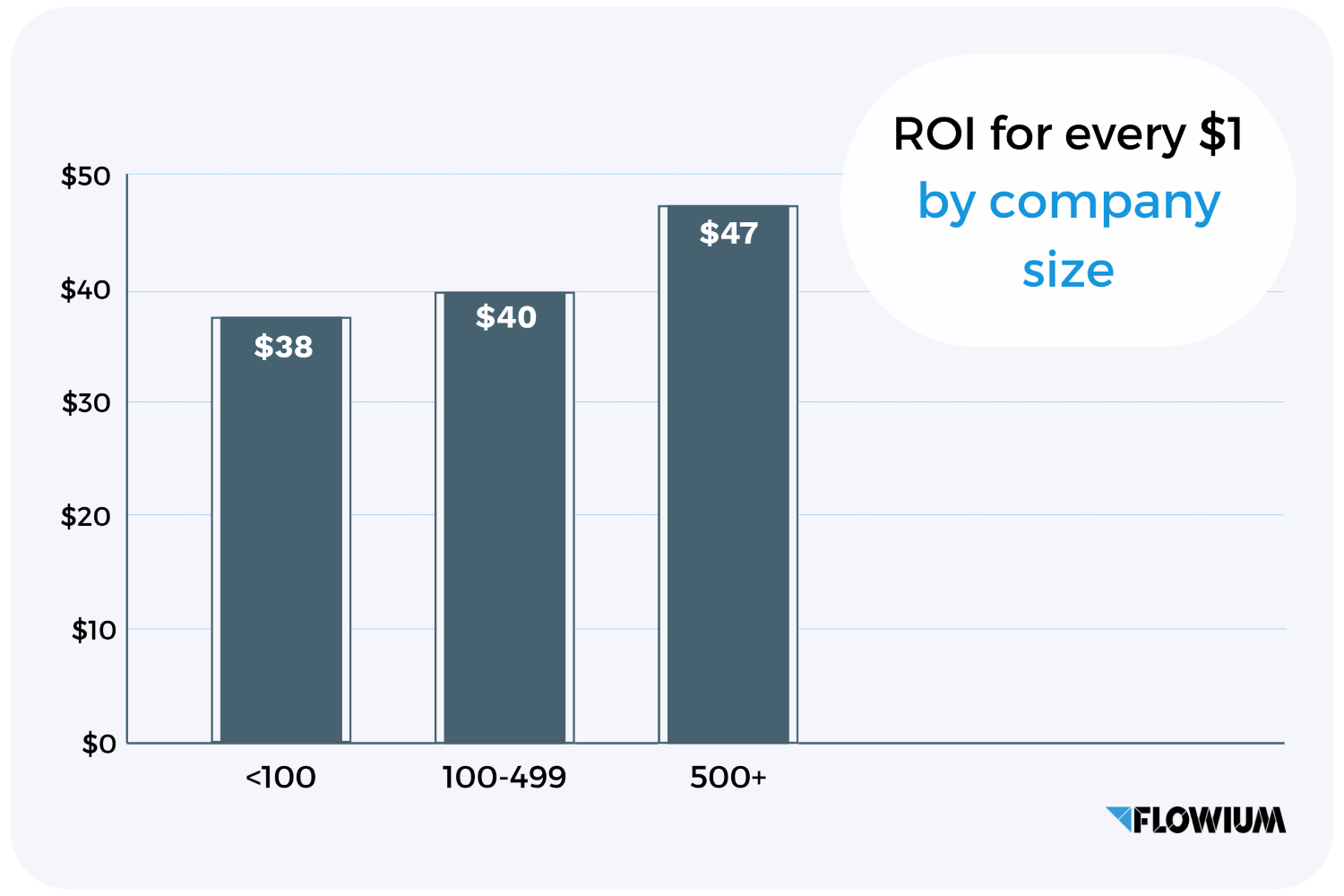
The size of the company’s team also has an impact on the return on investment in email marketing. However, this does not simply depend on the number of people, as one might think. The logic is that the more people a company has, the larger it is and the longer it has been on the market.
The scale and experience of the company mean a larger subscriber base, more data for segmentation, and greater potential for automation. As a result, the same email from companies of different sizes can generate significantly more sales. We can see this in the example of email marketing reporting with ROI from companies with varying team sizes.
- Companies with fewer than 100 employees had a lower average return on investment than larger companies, reporting $38 for every dollar spent.
- Slightly larger companies with 100 to 499 employees reported $40 for every dollar spent.
- The largest companies in the survey, with more than 500 employees, had the highest average return on investment, at $47 for every dollar spent.
Email Marketing Research on ROI According to Mailing List Size
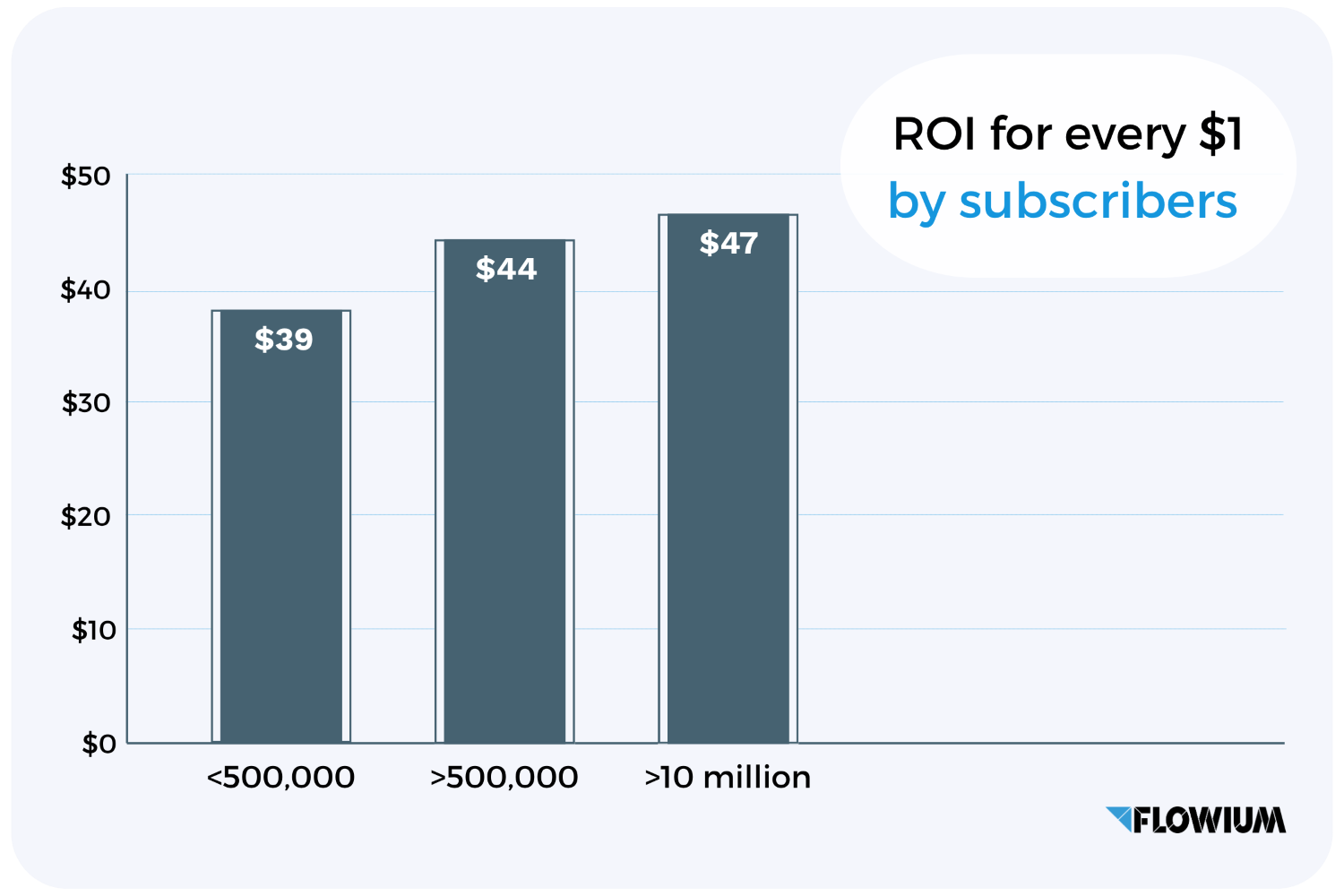
Just like the size of the company, the number of subscribers on the mailing list also affects ROI. For the mailing list, it’s the same as for the size of the team: the larger the number, the higher the ROI. Studies report the following email marketing results:
- Brands with a mailing list of less than 500,000 subscribers had an average ROI of $39 for every dollar spent. A large mailing list = significant results. Mailing lists smaller than this may show a significantly lower ROI.
- Brands with more than 500,000 subscribers had an ROI of $44 for every dollar invested.
- However, having far more than 500,000 subscribers does not have such a strong impact on ROI, and the difference is significant in the above-mentioned ranges. As confirmation, brands with over 10 million subscribers showed an ROI that was only $2 higher, with a ratio of 46 to 1.
What is the ROI on Email Marketing Based on Sending Frequency
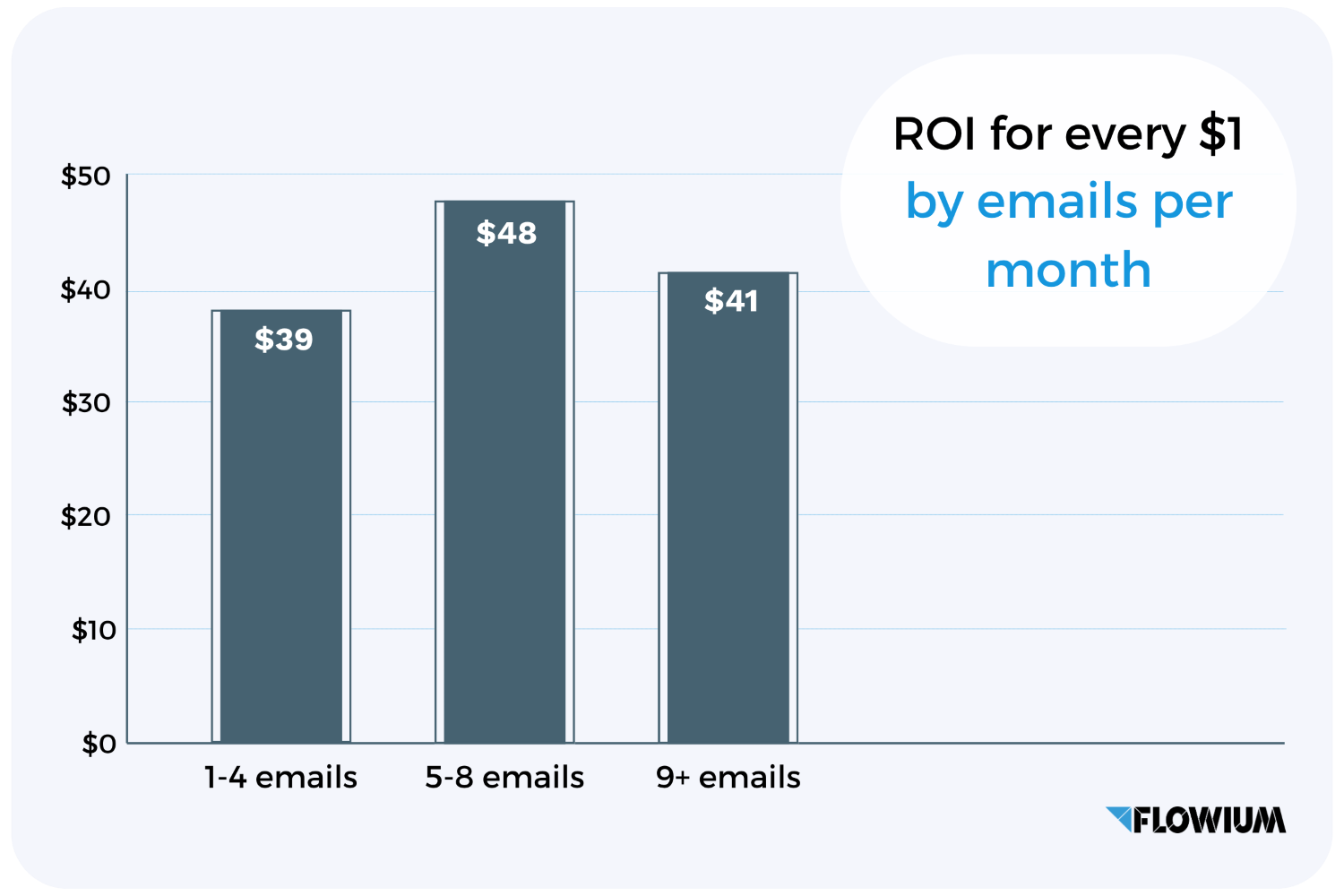
Data on how sending frequency affects the return on investment in email marketing is more important for marketers than for commercial companies themselves. Based on this data, email agency teams can effectively plan future campaign strategies. Research shows that quantity does not equal success:
- Sending 1-4 emails per month yielded a return on investment of $39 to $1.
- Sending 5-8 emails per month yielded the highest return on investment of $48 to $1.
- Sending 9 or more emails per month yielded a return on investment of $41 to $1.
How to Calculate Email Marketing ROI
To find out whether your investments are paying off or whether your strategies need optimization, you will need to regularly measure the ROI of your email marketing. The basic formula is very simple, but we recommend holding off before making your first calculations. This is because email marketing is a long-term promotion channel; it will develop slowly but will eventually bring incredible results. Of course, you can make calculations in the first month, but the least amount of information about the return on your investment will be known no earlier than 3 months.
To calculate the return on investment in email marketing, subtract the total cost of the email campaign from the total revenue it generated and divide the result by the total cost. Multiply by 100 to get the percentage. The formula should look like this:
ROI = (Revenues – Expenses) ÷ Expenses × 100
What to Count as Revenues and Expenses?
- Revenue from email campaigns usually refers to direct sales specifically related to clicks or conversions in email. It is typically measured within a defined attribution period, such as 7 or 30 days.
- Expenses include all investments you may have made during the campaign, such as subscription fees for an email service provider (ESP), design and content creation costs, campaign promotion costs, and costs for any additional analytics tools or third-party software.
To accurately measure the effectiveness of your email marketing strategies, it is best to use a consistent approach and the same tracking tools when calculating your email marketing ROI over time. Tools such as Google Analytics or the dashboards of your ESP can help you track revenue.
As a bonus to the direct ROI, email marketing will bring indirect, but no less significant, value. This value includes increased brand awareness, strengthened customer loyalty, improved lead nurturing, and more. These benefits cannot be measured by any tool and will not be visible when calculating ROI, but they will have a positive impact on your brand.
Meticulous ROI of an Email Marketing Calculation Using the 3×36 Formula
Email marketing reporting on ROI differs slightly from the simple principle of dividing the funds generated by marketing by the funds invested in it. In simple terms, measurement is largely based on the 3 x 36 formula. It is used to measure the actual result, rather than the superficial ROI over 7-30 days.
What does 3×36 mean in simple terms? The basic profitability threshold for email marketing is not 1, but 3. A minimum return of 3 times will indicate the exact ROI. That is, you invested $1, but received $3+ in revenue.
What does 36 mean? 36 is the number of months for which ROI is calculated, i.e., the exact return on investment will be calculated over 3 years. This does not mean that you have to wait 3 years to find out if your investment has paid off; the effectiveness of email campaigns can be determined after they are conducted using special metrics. Simply put, a 3-year period will provide the most accurate data on how much your investment has paid off, and this data will allow you to understand how much you need to optimize your strategies to increase ROI.
Why such a long period? A period of 30 days is too short to evaluate email revenue because this type of marketing:
- works with conversion
- affects LTV
- convinces the user over time
The basic logic of the 3 x 36 formula is as follows:
Email ROI = (marketing revenue for 36 months) / (email costs x 3)
If the result is lower than the average ROI figures we mentioned above, then your marketing has scope for growth and development, and you should pay attention to the ways of increasing profitability that we will mention below. If the indicator is minimal, or worse, negative, you need to radically change your promotion strategy. It is important to change, not abandon, this marketing channel, because the negative indicator is caused not by the type of channel, but by the methods you used to engage with it. We do not recommend abandoning email marketing if the results are disappointing, because the earning potential you can take advantage of will exceed all your expectations.
Why is it important to measure using this formula? A common mistake is to measure overall email marketing results and revenue in the first 30 days and then conclude that it is ineffective and that the promised ROI is a myth made up to lure people into spending money. In reality, email:
- influences repeat purchases
- increases average order value (AOV)
- reduces customer acquisition cost (CAC)
- works through retention
The main thing to remember is that you will see results at the start, but significant revenue results will not be visible until 60-180 days.
How to Increase Email Marketing ROI
By analyzing the information we provide from ROI studies in email marketing, you can already draw conclusions about where to go and what to achieve to increase your profit ratio. However, most of them are designed for long-term gradual improvement. There are also measures that can be implemented immediately to increase your return on investment straight away:
- Improve the quality of your copy, design, subject lines, calls to action, and, most importantly, optimize mobile compatibility so you don’t lose a significant percentage of your audience. These measures will optimize conversions.
- Increase the number of segments in your mailing list to send targeted, personalized content that matches the interests and behavior of your subscribers, increasing engagement.
- Pay attention to the ROI metrics of companies using dynamic content. Invest in interactivity, take advantage of dynamic content such as personalized recommendations or countdown timers to increase the number of clicks.
- Don’t forget about regular incentives to encourage subscribers to take action, such as limited-time discounts, free resources, or exclusive content.
- Balance your email sending frequency. Take note of our email statistics showing that sending 5-8 emails per month yields the highest profit.
- Regularly test your emails, focusing on A/B testing of subject lines, content formats, and mailing frequency to optimize engagement.
- Take advantage of advanced analytics tools, rather than limiting yourself to basic dashboards, for a deeper understanding of campaign performance.
Campaigns That Have a Beneficial Impact on Email ROI
Some specific email marketing campaigns have outstanding performance metrics that often yield higher results than other campaigns. These results also affect ROI. By taking advantage of these campaigns and implementing them in your strategies, you can increase your email marketing profits. The secret to these campaigns’ performance usually lies in targeting subscribers at key moments in the customer journey. Here are the main campaigns with great potential that you can take advantage of:
- Abandoned cart emails are effective reminders to return to the purchase. The revenue per recipient (RPR) data for these emails shows a high rate of up to $3.65. Other high averages include an open rate of 50.5%, a click-through rate of 6.25%, and a conversion rate of 3.33%.
- Welcome emails generate 320% more revenue per email than the average promotional email, with high averages of 50% open rate and 14.4% click-through rate.
- Post-purchase emails often focus on detailed targeting, providing product recommendations. This approach delivers a 90% higher RPR, a 217% higher open rate, and a 500% higher click-through rate compared to regular email campaigns.
- Win-back emails give users a sense of exclusivity and specialness, resulting in 45% of them continuing to open future emails from the brand. However, there is a weakness in the form of an average open rate of only 12%.
- Birthday greeting emails create many times more of a sense of connection with the brand. In addition, many brands offer great exclusive deals to those celebrating their birthdays, which encourages them to open every commercial email with congratulations. Birthday emails have 481% higher transaction rates and 342% higher revenue per email than standard promotional emails.
What Kind of Email Content Will Bring the Highest ROI?
Research into email marketing campaign statistics has yielded a wealth of interesting information for marketing. Thanks to the significant amount of information gathered, it was even possible to find out how the use of certain content in emails affects the ROI figure. In general, these statistics do not reveal anything new, except for ways to increase ROI, since they only confirm the effectiveness of using interactive content. Here is a table showing the difference in ROI between brands that used or did not use a certain type of content:
| Dynamic content | Animated GIFs | Live content | |
|---|---|---|---|
| Frequently/constantly used ✅ | $44:1 | $46:1 | $50:1 |
| Infrequent/no use ❌ | $36:1 | $38:1 | $39:1 |
Conclusion
All the statistics we have collected prove that email marketing is still at the top of the channels and methods of brand promotion in 2026 and onwards. The overall average ROI of email marketing is already the highest, not to mention that, depending on the specifics of the brand, it can be almost twice as high. We advise you not to hesitate before investing in email marketing, and if you have already invested and are not seeing such results, now you know what the outcome depends on. You can be sure that the statistics and advice in our article will help you achieve the best results.
If you have already decided to invest or change your email service provider, we’ve got you covered. Book a consultation with Flowium and get the maximum return on your investment right now.