Customer acquisition has become more expensive, making cash flow efficiency a critical factor for ecommerce growth. One of the most valuable metrics for measuring acquisition efficiency is the Customer Acquisition Cost (CAC) Payback Period, which shows how long it takes to recover the cost of acquiring a new customer. Whether you run a fast-growing direct-to-consumer (DTC) brand or a multi-channel ecommerce business, understanding your CAC payback period can help you make smarter marketing investments, improve profitability, and scale more sustainably.
In this guide, we’ll explain what CAC payback period is, how to calculate it, why it matters for ecommerce brands, and proven strategies to shorten it.
What Is CAC Payback Period?
The CAC payback period measures how long it takes an ecommerce business to recover the cost of acquiring a new customer through the gross profit generated from their purchases. Unlike metrics that focus solely on revenue, CAC payback Period highlights how quickly your marketing and sales investments begin generating a positive return, making it a key indicator of cash flow efficiency and sustainable growth.
What CAC Payback Period Means for Ecommerce
For ecommerce brands, a shorter CAC payback period means marketing dollars are recovered faster, allowing you to reinvest in customer acquisition, inventory, and business expansion with greater confidence. Monitoring and optimizing this metric helps improve profitability, reduce financial risk, and build a more resilient growth strategy.
Why CAC Payback Period Matters for Ecommerce
For ecommerce businesses, CAC payback period is more than a marketing metric. It reflects how efficiently your business turns customer acquisition spending into profitable growth. Monitoring this KPI helps you make smarter decisions about marketing budgets, inventory, pricing, and long-term expansion.
Improves Cash Flow Management
A clear CAC payback period shows how quickly your marketing investment is recovered through customer purchases. Faster payback improves cash flow, giving ecommerce brands more flexibility to reinvest in advertising, purchase inventory, launch new products, or expand into new markets without straining working capital.
Measures Marketing Efficiency
A shorter CAC payback period indicates that your marketing campaigns are attracting higher-value customers who generate profit more quickly. It helps you evaluate the effectiveness of your acquisition channels and optimize spending across paid search, social media, influencer marketing, email, and other campaigns.
Supports Sustainable Growth
Growing revenue isn’t enough if acquisition costs continue to outpace profitability. Tracking CAC payback period helps ensure your business is scaling efficiently rather than simply spending more to generate sales. As payback periods decrease, brands can confidently increase marketing investment while maintaining healthy unit economics.
Increases Investor and Stakeholder Confidence
Investors and lenders often view CAC payback period as an important indicator of financial health and operational efficiency. For many ecommerce and direct-to- consumer (DTC) brands, recovering customer acquisition costs within 6 to 12 months is generally considered a healthy benchmark, although the ideal timeframe depends on the business model, margins, and customer retention.
Improves Budgeting and Forecasting
Knowing how long it takes to recover acquisition costs makes financial planning more predictable. Ecommerce businesses can forecast cash flow more accurately, allocate marketing budgets with greater confidence, and determine when additional investment in customer acquisition is financially sustainable.
Helps Identify Growth Opportunities
Monitoring CAC Payback Period over time reveals whether improvements in conversion rate, average order value (AOV), gross margin, or customer retention are translating into faster profitability. If the payback period begins to increase, it can signal rising acquisition costs, declining margins, or weaker customer quality before these issues significantly impact the business.
Optimizes Ecommerce Profitability
Understanding exactly when a customer becomes profitable allows ecommerce brands to make better decisions about pricing, product bundles, loyalty programs, subscriptions, and lifecycle marketing. Reducing CAC Payback Period means every customer reaches profitability sooner, creating more capital to fuel future growth.
How to Calculate CAC Payback Period
Calculating your CAC payback period helps determine how quickly your ecommerce business recovers the cost of acquiring a new customer. The shorter the payback period, the faster you can reinvest your marketing budget into growth.
CAC Payback Period Formula
To calculate it, follow these four steps:
Step 1: Calculate Customer Acquisition Cost (CAC)
Divide your total customer acquisition expenses by the number of new customers acquired during the same period.
Formula: CAC = Total Marketing & Sales Costs ÷ Number of New Customers
Include costs such as:
- Paid advertising
- Marketing software
- Agency or freelancer fees
- Sales team expenses (if applicable)
- Creative production costs
Step 2: Calculate Monthly Revenue per Customer
Determine how much revenue the average customer generates each month.
Formula: Monthly Revenue per Customer = Monthly Revenue ÷ Number of Customers
For subscription brands, this is typically Monthly Recurring Revenue (MRR) per customer. For traditional ecommerce stores, use the average monthly revenue generated by an acquired customer.
Step 3: Calculate Monthly Gross Profit per Customer
Because CAC payback period measures profitability—not just revenue-you should use gross profit rather than sales.
Formula: Monthly Gross Profit = Monthly Revenue per Customer x Gross Margin
Or, if you know your costs:
Monthly Gross Profit = Monthly Revenue – Cost of Goods Sold (COGS) – Fulfillment Costs
Step 4: Calculate the CAC Payback Period
Divide your CAC by the monthly gross profit generated by each customer.
Formula: CAC Payback Period = CAC ÷ Monthly Gross Profit per Customer
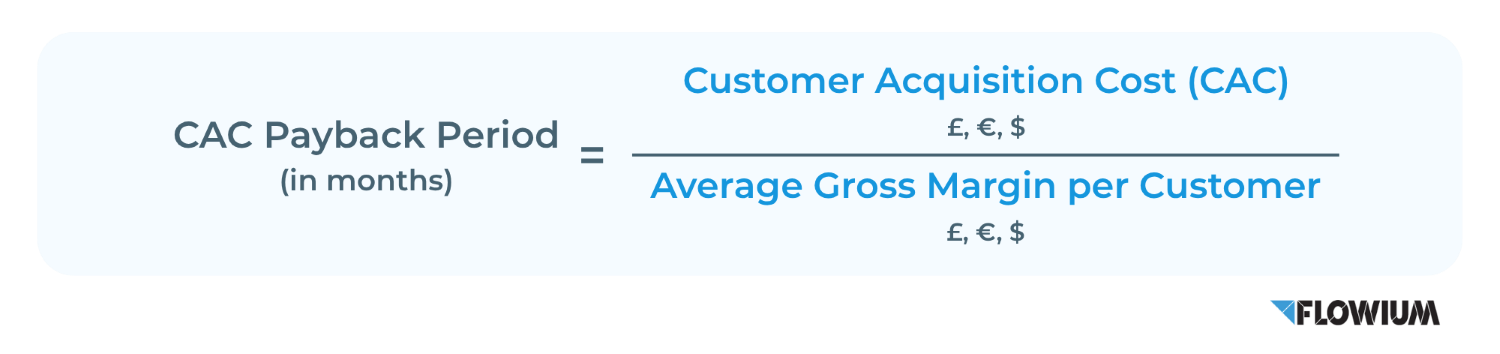
The result tells you how many months it takes to recover your customer acquisition investment.
CAC Payback Calculation Example
Suppose your ecommerce DTC skincare brand spends $60,000 on marketing in one month and acquires 1,000 new customers.
Step 1: Calculate CAC
$60,000 ÷ 1,000 = $60 CAC
Each customer spends an average of $40 per month. After accounting for product costs, packaging, and fulfillment, your monthly gross profit is $20 per customer.
Step 2: Calculate CAC
Payback Period $60 ÷ $20 = 3 months
This means your business recovers its acquisition costs in just three months. After that point, the customer generates positive gross profit, giving you more capital to reinvest in advertising, inventory, and customer retention.
What Is a Good CAC Payback Period?
There isn’t a universal “good” CAC payback period because the ideal benchmark depends on your business model, profit margins, customer retention, and available cash flow. However, for most ecommerce brands, recovering customer acquisition costs as quickly as possible improves liquidity, reduces financial risk, and allows you to reinvest in growth sooner. As a general guideline, ecommerce businesses can use the following benchmarks:
| CAC Payback Period | Performance |
|---|---|
| Less than 3 months | Exceptional |
| 3-6 months | Excellent |
| 6-12 months | Healthy |
| 12-18 months | Needs improvement |
| More than 18 months | High risk |
While these benchmarks provide a useful starting point, they should always be evaluated alongside other profitability metrics. Brands with high customer retention, frequent repeat purchases, subscription revenue, or strong customer lifetime value (LTV) can often sustain a longer CAC payback period because customers continue generating profit long after the acquisition cost has been recovered.
Conversely, businesses with low repeat purchase rates or thin profit margins should aim for a shorter payback period. Recovering acquisition costs quickly gives them greater flexibility to reinvest in advertising, purchase inventory, and maintain healthy cash flow without relying on external financing.
It’s also important to review your CAC payback regularly. Customer acquisition costs, advertising platforms, consumer behavior, and competitive landscapes change constantly. Continuously optimizing your marketing campaigns, conversion rates, average order value (AOV), gross margins, and customer retention helps keep your payback period moving in the right direction.
As your ecommerce business matures and cash reserves grow, you may be able to tolerate a slightly longer payback period without affecting day-to-day operations. Even so, reducing CAC payback period should remain a priority. The faster you recover your acquisition costs, the sooner every additional purchase contributes to profit, creating a stronger foundation for sustainable, long-term growth.
Factors That Affect CAC Payback
The CAC Payback Period can be affected by several circumstances, such as:
- Customer Lifetime Value (CLV). Since a higher CLV shows that customers are making more money over the course of their lifetime, it may result in a shorter CAC Payback Period.
- Churn Rate. A high churn rate indicates that consumers leave before the business can recoup its acquisition costs, which may lengthen the CAC Payback Period.
- Sales Cycle Length. An extended sales cycle may result in a higher CAC and a longer payback period. To guarantee efficiency, businesses must balance their sales tactics.
- Market Conditions. The payback period may be impacted by market demand, competition, and economic conditions that affect both CAC and customer revenue.
How to Reduce CAC Payback Period
Reducing your CAC payback period isn’t just about lowering customer acquisition costs. It’s about increasing the amount of profit each customer generates-and how quickly they generate it. By improving the customer experience, increasing repeat purchases, and optimizing your marketing spend, ecommerce brands can recover acquisition costs faster and accelerate profitable growth.
1. Improve the Post-Purchase Experience
The customer journey doesn’t end after the first sale. A strong onboarding and post-purchase experience encourages customers to make another purchase sooner, shortening your CAC Payback Period.
Effective tactics include:
- Welcome and onboarding email sequences
- Product education and usage tips
- Personalized product recommendations
- Loyalty program enrollment
- Post-purchase SMS campaigns
The sooner customers experience value, the more likely they are to become repeat buyers.
2. Increase Repeat Purchase Rate
Every additional purchase helps recover your acquisition costs faster. Brands with strong customer retention often achieve significantly shorter CAC Payback Periods than those relying solely on first-time purchases.
Strategies to encourage repeat orders include:
- Automated email and SMS flows
- Replenishment reminders
- Subscription programs
- Loyalty and rewards programs
- Personalized product recommendations
Improving customer retention not only shortens payback but also increases LTV.
3. Increase Average Order Value (AOV)
The higher your gross profit per order, the faster you recover your customer acquisition investment.
Ways to increase AOV include:
- Product bundles
- Upsells and cross-sells
- Volume discounts
- Free shipping thresholds
- Premium product recommendations
Even modest increases in AOV can meaningfully reduce your CAC Payback Period without increasing advertising spend.
4. Optimize Paid Advertising
Not every marketing campaign generates profitable customers. Regularly analyzing campaign performance helps reduce wasted ad spend and lower your overall CAC.
Focus on:
- High-performing audiences
- Creative testing
- Keyword optimization
- Channel diversification
- Eliminating low-performing campaigns
Rather than optimizing solely for ROAS, evaluate campaigns based on how quickly acquired customers become profitable.
5. Target Higher-Value Customers
Some customer segments naturally generate higher lifetime value, purchase more frequently, or return fewer products. Prioritizing these audiences can improve both profitability and CAC Payback. Directing more budget toward high-value segments can significantly improve marketing efficiency.
6. Diversify Customer Acquisition Channels
Reducing reliance on paid advertising can lower acquisition costs over time. Organic channels often attract highly engaged customers while helping improve blended CAC. A balanced acquisition strategy reduces risk while improving long-term profitability.
7. Improve Website Conversion Rate
Increasing your conversion rate allows you to acquire more customers from the same amount of advertising spend, effectively lowering CAC and shortening the payback period. Focus on optimizing:
- Landing pages
- Product descriptions and images
- Site speed
- Mobile shopping experience
- Checkout process
- Trust signals, reviews, and guarantees
Even small improvements in conversion rate can have a significant impact on acquisition efficiency and overall profitability.
Conclusion
You have to spend money to earn money, although this may sound cliché. CAC payback ensures that the money you invest is not spent on ineffective marketing initiatives or clients who leave shortly after signing up.
To make sure you’re getting the most out of your clients, it’s crucial to continuously learn and improve your strategies.
The age of your company, the services you provide, and the level of competition in the market can all affect the CAC payback period. However, you can adjust this figure in a variety of ways, so it’s important to calculate the total to obtain a clear picture. Then, collaborate with your team to shorten the payback period and boost revenue. If you need professional assistance in finding the right strategies for your ecommerce brand to optimize your CAC payback, contact Flowium. Our retention and marketing specialists will help you identify inefficiencies in your current tactics and give actionable recommendations to fix them.
Frequently Asked Questions
What is a good CAC payback period?
SaaS companies usually have a strong CAC payback period of 12 months or less, with some aiming for 5-7 months. You might be able to handle a longer payback window if your client retention rate is good. However, your sector, clientele, and go-to-market approach will ultimately determine the appropriate benchmark.
Is it always better to have a shorter CAC payback?
No. An extremely quick payback period may indicate that you are underinvesting in acquisitions and missing out on opportunities for growth. The objective is not the lowest feasible amount, but a payback that is sustainable in relation to your retention and liquidity position.
What is the distinction between LTV:CAC and CAC payback?
CAC payback calculates the rate at which acquisition costs are recovered (in months); LTV:CAC calculates the magnitude of the difference between acquisition costs and total customer lifetime value. Read them together: LTV:CAC indicates whether the customer is worth it, and payback indicates whether you can close the cash gap.