Customer acquisition and customer retention are both essential when it comes to ecommerce growth, but their importance changes as the brand evolves. While acquisition brings new shoppers into your ecosystem, retention helps you maximize the value of those customers over time. For established ecommerce brands, retention often delivers a stronger ROI because retaining existing customers is far more cost-effective than constantly acquiring new ones.
In this guide, we’ll break down customer acquisition and retention, outlining why each strategy is important for business, common characteristics, differences, and more. We’ll also share insights and tips from our marketing professionals on how to balance both strategies, and show why investing in retention is critical fr long-term ecommerce profitability.
Customer Acquisition vs Retention: What Are They in Ecommerce?
First, let’s outline customer acquisition and retention definitions to give you a general understanding before we dive deeper into their characteristics.
What Is Customer Acquisition?
Customer acquisition is the process of attracting new clients to your company and encouraging them to make their first transaction.
Consider it the first step toward establishing a devoted customer base. There is a lot that goes into it, including introducing your business to people for the first time, piquing their attention, earning their trust, and demonstrating the value you have to offer.
There are numerous ways to recruit new clients, including social media marketing, paid advertising, influencer collaborations, word of mouth, and more.
Each channel has its own expenses and success rates; thus, you must calculate the customer acquisition cost (CAC) to determine the optimal growth channel for your company.
What Is Customer Retention?
Customer retention refers to a company’s ability to keep customers as repeat customers while keeping them from switching to a competitor. It is the process of converting current customers into repeat buyers. It demonstrates whether your current customers are satisfied with the quality of your service and products.
Client retention goals are centered on maintaining genuine connections with your clients, understanding their evolving needs, and engaging with their core values.
By focusing on client retention, you may foster a pleasant climate and atmosphere in which your customers will consistently choose your brand over competitors and comprehend the value of your products.
Why Customer Acquisition and Retention Are Important for Ecommerce
- Customer Acquisition Fuels Ecommerce Growth.
Customer acquisition drives sustainable ecommerce growth by helping brands reach target audiences, expand into new markets, and increase revenue. Businesses that employ strong acquisition strategies can improve brand awareness, build customer trust, and create scalable growth opportunities across different marketing channels.
- Customer Retention Drives Ecommerce Profitability
Customer retention is essential for maximizing the profitability of your ecommerce business, especially since acquisition costs continue to increase. Retaining customers aims to grow the number of repeat purchases, boost LTV, strengthen brand loyalty, and support long-term growth through referrals and recurring revenue.
Customer Retention and Acquisition: What’s in Common?
While client acquisition and retention have different goals and requirements, they share many similarities. Both focus on providing a wonderful customer experience and generating revenue for businesses.
Let’s look at some of the fundamental similarities between these two concepts and how they both necessitate thoughtful planning and hard work on your behalf.
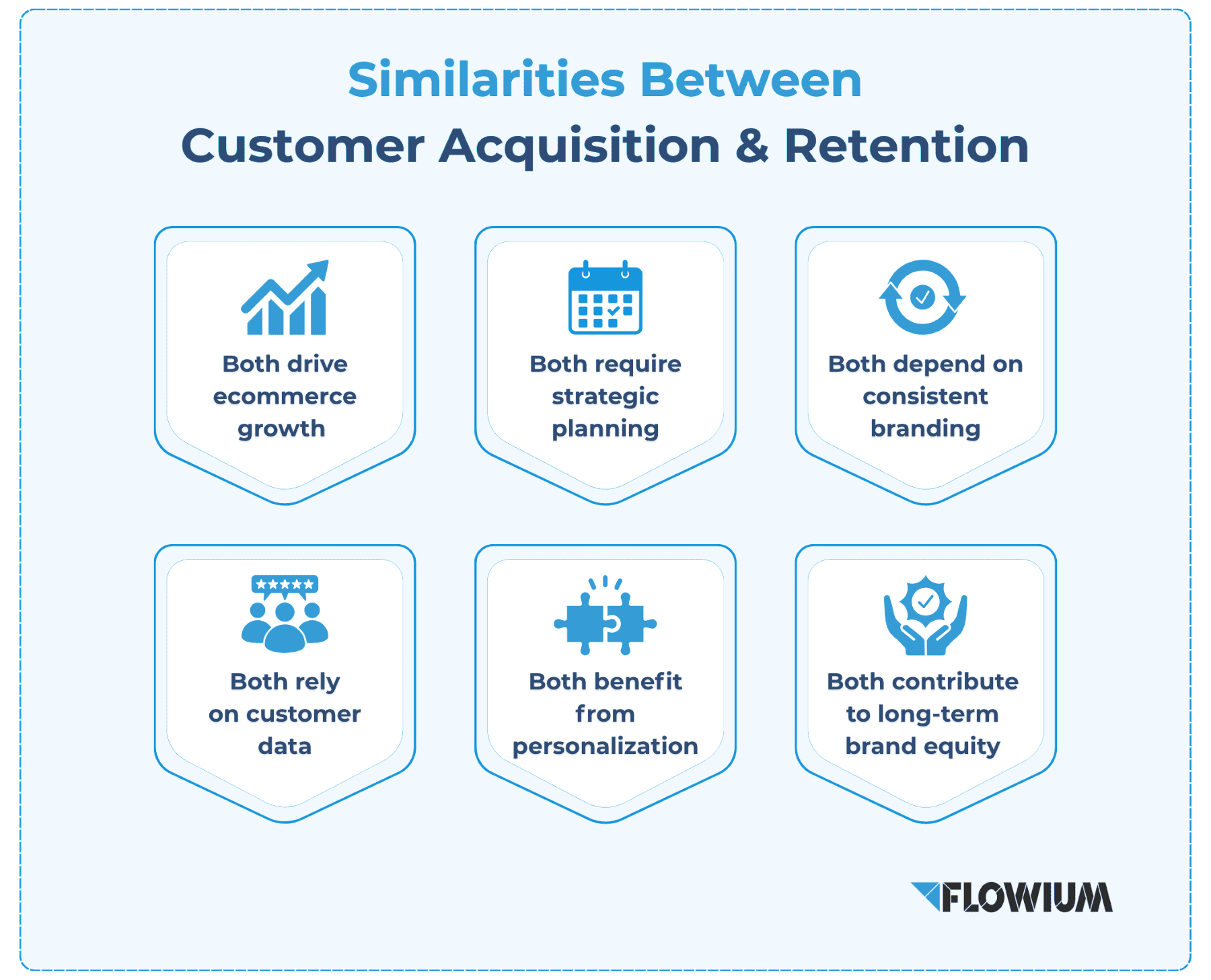
Both Drive Ecommerce Growth
For ecommerce firms, customer acquisition and retention are crucial growth drivers. While retention increases profitability through recurring business and enduring client loyalty, acquisition broadens the customer base by generating new revenue prospects. Brands cannot grow without acquisition. Growth becomes costly and unsustainable without retention. Both approaches are used by the most prosperous ecommerce companies to generate consistent income and predictable long-term growth.
Both Require Strategic Planning
Without a clear approach, neither acquisition nor retention is successful. Understanding target groups, choosing effective marketing channels, and presenting a compelling value offer that wins over new customers are all essential to customer acquisition. A thorough grasp of current clients’ habits, interests, and reasons for making purchases is necessary for retention. To promote repeat business and enduring loyalty, ecommerce companies must constantly improve post-purchase experiences, personalization, and lifecycle marketing.
Both Depend on Consistent Branding
Having a strong brand is essential for attracting and keeping consumers. While retention depends on continuously providing the experience that customers were promised, effective acquisition campaigns draw in customers through clear messaging, trust, and brand positioning. Customer trust rapidly deteriorates if branding, message, or the customer experience seems inconsistent. Ecommerce companies may increase conversion rates and foster client loyalty by maintaining a consistent brand throughout advertisements, online experience, email marketing, SMS, and customer service.
Both Rely on Customer Data
Data-driven marketing plays a major role in both customer acquisition and retention. Customer insights are used by acquisition techniques to boost conversion rates, target high-intent audiences, and maximize ad performance. In order to tailor communications, make product recommendations, and develop pertinent lifecycle campaigns, retention strategies rely on behavioral and purchase data. In both situations, data enables brands to boost productivity, boost return on investment, and provide more pertinent consumer experiences.
Both Benefit From Personalization
Throughout the customer journey, modern ecommerce customers anticipate individualized experiences. Tailored offers, customized messaging, and personalized product suggestions boost client retention and lifetime value while improving acquisition success. Brands are more likely to increase engagement, conversions, and customer loyalty if they invest in personalization across both acquisition and retention efforts.
Both Contribute to Long-Term Brand Equity
Customers’ perceptions of a brand are shaped over time by both acquisition and retention. While retention methods foster advocacy, trust, and emotional connection, acquisition strategies increase exposure and awareness. When combined, they assist e-commerce companies in forging closer bonds with their clients, boosting word-of-mouth advertising, and building sustained competitive advantages.
Customer Retention vs Acquisition Differences
Each of these initiatives produces a distinct result. Let’s examine the main distinctions between acquiring and retaining customers:
| Area | Acquisition | Retention |
|---|---|---|
| Primary Goal | Acquire new customers | Keep existing clients |
| Focus | Clientele growth and market expansion | Customer loyalty and LTV |
| Cost | Higher due to ad and prospecting costs | Lower because it targets existing clients |
| ROI Timeline | Often short-term and slower to recover CAC | Higher long-term ROI through repeat purchases |
| Core Metrics | CAC, ROAS, conversion rate | CLV, repeat purchase rate, retention rate, AOV |
| Main Channels | Paid ads, SEO, affiliates, social acquisition | Email, SMS, loyalty programs, subscriptions, personalization |
| Customer Journey Stage | Before and during the first purchase | After the first purchase |
| Team Ownership | Primary marketing and sales teams | Marketing, customer support, operations |
| Growth Impact | Drives customer base expansion | Drives profitability and sustainable scaling |
| Dependency on Experience | Focuses heavily on attracting attention and conversion | Relies heavily on post-purchase customer experience |
| Revenue Pattern | Immediate new revenue opportunities | Recurring and predictable revenue |
Goals and Business Focus
The goal of customer acquisition is to increase the number of customers and draw in new ones. Creating new revenue prospects, expanding market reach, and raising brand awareness are the main objectives. The goal of customer retention is to maximize the long-term value of current clients. The goals of retention strategies are to boost customer lifetime value, foster client loyalty, and encourage repeat business.
Cost and Investment
Cost is one of the main distinctions between acquisition and retention. Because organizations need to spend a lot of money on advertising, lead generation, influencer relationships, and conversion campaigns to draw in new clients, customer acquisition is usually significantly more costly. Because it focuses on consumers who are already familiar with and confident in the brand, retention marketing is typically more economical. Personalized experiences, loyalty programs, SMS advertising, and email marketing frequently produce better outcomes at a lower cost.
Return on Investment (ROI)
Compared to acquisition, retention often yields a higher long-term return on investment. Securing the initial purchase is a common goal of acquisition campaigns, which might not instantly offset growing customer acquisition costs. However, over time, retention raises the overall amount of money made from each client. Stronger profitability and increased LTV are a result of brand loyalty, upsells, subscriptions, and repeat business.
Teams and Operational Ownership
Marketing and sales teams that handle lead nurturing, paid advertising, traffic creation, and conversion optimization are usually in charge of customer acquisition. Increased cooperation between marketing, customer service, customer success, operations, and fulfillment teams is necessary for client retention. Retention is influenced by both marketing effectiveness and the general post-purchase customer experience.
Marketing Channels and Tactics
Although acquisition and retention may use some of the same channels, the execution and priorities differ significantly.
Acquisition strategies often rely on:
- Paid advertising
- Influencer marketing
- SEO and content marketing
- Affiliate partnerships
- Social media campaigns
Retention strategies focus more on:
- Email and SMS marketing
- Loyalty and rewards programs
- Personalized product recommendations
- Subscription programs
- Post-purchase engagement
Retention channels are often more cost-efficient because they leverage owned audiences rather than continuously paying to acquire new traffic.
Customer Experience and Relationship Building
Creating curiosity and turning shoppers into first-time customers are the main goals of customer acquisition. By concentrating on the continuing client relationship, retention goes considerably deeper. Ecommerce companies must provide outstanding customer experiences at every touchpoint to implement successful retention tactics. Poor customer experiences cannot be made up for by effective marketing strategies.
Time Horizon and Growth Impact
Because acquisitions create instant traffic and revenue opportunities, they typically result in shorter-term growth. By boosting customer loyalty, stabilizing revenue, and lowering reliance on paid acquisition channels, retention fosters more long-term, sustainable development. The most successful ecommerce companies are aware that while retention promotes profitability and long-term company stability, acquisition drives growth.
The key takeaway from this is that customer service, support, and ongoing interactions are all part of retention, which goes beyond your marketing team or initiatives. A rewards program is a simple strategy, but if you can’t deliver on consumer perks like quick delivery or round-the-clock chat help, it won’t do anything.
Should Ecommerce Prioritize Customer Acquisition or Retention?
In general, experts recommend balancing out acquisition and retention to achieve the perfect conditions for sustainable expansion and profitability. However, there are special situations for businesses in different stages of their development to focus on one strategy first. Let’s look at these cases.
When Customer Acquisition Should Be the Priority
This strategy should take priority for new or emerging brands that are only starting to build awareness, generate traffic, and establish market presence.
Here are more concrete cases:
- Launching a new ecommerce business or product
- Entering new markets
- Experiencing stagnant traffic or declining customer growth
- Having a limited clientele
- Needing a faster revenue growth and brand visibility
When Customer Retention Should Be the Priority
This strategy should become the priority when an ecommerce brand already has a solid customer base but struggles with profitability, repeat purchases, or rising CAC.
We recommend focusing on retention when:
- CAC is increasing
- You have a low repeat purchase rate
- You have shrinking profit margins
- Your brand has a large existing customer base
- Your revenue growth starts being overdependent on paid advertising
Why Ecommerce Brands Struggle to Balance Acquisition and Retention
Many ecommerce brands struggle to balance acquisition and retention because even though both are essential for growth, they compete for the same budget and resources. Since acquisition delivers faster short-term revenue, companies tend to prioritize it more, wanting to see the results of their campaigns right away. This tips the balance between the two strategies, lessening the opportunities for enhancing long-term profitability, usually generated by retention.
Aside from the mentioned reason, there are also other factors that make it difficult for businesses to find a balance.
Key Challenges of Balancing Acquisition and Retention:
- Rising CAC
It’s an unfortunate tendency, but customer acquisition costs continue to rise due to increased competition, privacy changes, and higher ad saturation. The increasing budget needed for CAC may shift the focus from developing retention strategies.
- Declining customer loyalty
Since modern consumers have more purchasing options, ecommerce brands struggle with low repeat purchase rates and inconsistent retention. This means that even successful acquisition campaigns can become inefficient if the acquired customers leave right after.
- Overreliance on paid advertising
Being overly dependent on paid advertising channels can create vulnerability and impact profitability without a strong retention system.
- Low repeat purchase rates
Many brands invest mere into acquiring clients without optimizing the post-purchase experience, which results in problems with increasing LTV and monetizing clients they already acquired.
- Pressure to scale revenue quickly
Fast growth expectations from founders, investors, and competitive markets often push ecommerce firms toward acquisition-first strategies. However, experienced CMOs know that it only leads to unstable growth patterns and long-term profitability challenges.
The Hidden Cost of Overprioritizing Acquisition
Focusing too heavily on acquisition alone can make ecommerce growth expensive and unsustainable.
Risk:
Brands that rely primarily on paid ads often face rising CAC, lower profit margins, weak customer loyalty, and other challenges we mentioned. Businesses continuously spend to replace customers instead of maximizing the value of existing ones.
Solution:
Strong retention strategies help stabilize revenue, reduce dependence on paid channels, and increase overall marketing efficiency.
The Risk of Focusing Only on Retention
Although retention improves profitability, naturally, you can’t rely only on existing customers to reach your profit goals. This can limit long-term growth.
Risk:
Without consistent acquisition, brands can experience market saturation, reduced audience expansion, and slower scalability.
Solution:
After all, customer acquisition remains essential for bringing in new clients into the funnel and expanding market reach.
How to Find the Right Balance Between Customer Acquisition and Retention
As you understand now, sustainable ecommerce growth depends on balancing both acquisition and retention strategies. Let’s look at the best tips from our specialists on how to achieve it.
- Align Your Strategy With Your Growth Stage
Depending on the stage of growth of your business, our experts recommend changing your focus to acquisition and retention. While established firms should focus more on client lifetime value and retention, early-stage e-commerce brands should prioritize acquisition.
- Track Acquisition and Retention Metrics Together
Professionals advise monitoring CAC, ROAS, repeat purchase rate, and CLV together to understand true business performance. Focusing on only one side of the funnel can create unbalanced and unsustainable growth.
- Invest in Post-Purchase Experience
To boost recurring business, retention specialists advise enhancing customer service, fulfillment, and post-purchase communication. First-time purchasers become loyal clients when they have a positive experience.
- Reduce Reliance on Paid Ads
Our team recommends strengthening retention channels like email, SMS, and loyalty programs to reduce dependency on paid acquisition. This helps stabilize revenue and improve overall marketing efficiency.
Read one of our previous articles to learn how to acquire clients and increase sales without spending more on ads.
- Use Customer Data Across the Entire Lifecycle
Marketing experts advise utilizing consumer data to maximize retention, personalization, and acquisition targeting. Higher conversion rates and more relevant experiences are the results of improved consumer insights.
- Build Full-Funnel Growth Strategy
Marketing professionals suggest using customer data to optimize both acquisition targeting and retention personalization. Better customer insights lead to more relevant experiences and higher conversion rates.
Building a Full-Funnel Ecommerce Growth Strategy with Flowium
The question is not exclusively acquisition vs. retention — it’s understanding exactly when each strategy should take priority. Ecommerce brands that align both strategies with their stage of growth are better positioned for sustainable revenue and long-term profitability.
Flowium’s team can help you strike a balance between acquisition and retention, thanks to our extensive knowledge of progressive automation tools, precise targeting and personalization practices, re-engagement tactics, and more. We work closely with many ecommerce brands to build effective marketing strategies and campaigns that engage new clients and successfully retain existing clientele. If you struggle to develop a detailed roadmap for ecommerce growth and find it difficult to place acquisition and retention on this map, contact our professionals. We are always ready to provide you with expert insights and qualified assistance.
Frequently Asked Questions
When should a company put retention ahead of acquisition?
When you have a solid client base and need to lower attrition or raise customer lifetime value for consistent income, give retention top priority.
Which retention strategies are affordable for small teams?
Personalized messaging, loyalty incentives, and prompt customer service can help small teams sustain engagement without incurring significant expenses.
If retention is successful, should I cut back on acquisition spending?
No, keep making investments in both, if you can. While retention ensures continued income and client loyalty, acquisition propels fresh growth.
Does retention matter more in B2B or B2C?
Both require retention, but B2B relies more on long-term partnerships to sustain consistent revenue and profitability.