Every business owner wishes to have accurate, predictable revenue figures. That’s why finance, marketing, and retention teams spend so much time forecasting growth. The answer is out there, but to get it, you need a structured revenue forecasting process. You can find your own forecasting method right here.
In this article from retention marketing experts, we’ll cover everything about revenue forecasting for eCommerce. Starting with what revenue forecasting is, how to create a forecast based on customer retention and lifecycle data, and ending with the models that eCommerce companies actually use. We will also cover in detail subscription-based eCommerce. Read on to find the revenue forecasting model that will work best for you.
What Exactly Is Revenue Forecasting?
Revenue forecasting is a method of estimating future revenue based on historical data, market trends, sales portfolio information, customer behavior patterns, and retention trends. Simply put, it’s a figure or range that reflects your best chances for future profits.
By forecasting your business’s revenue, you’ll always be one step ahead, with a quantitative understanding of how successful you’ll be in the near future. When we talk about the future, we mean predicted data for the next quarter, financial year, or even a multi-year period.
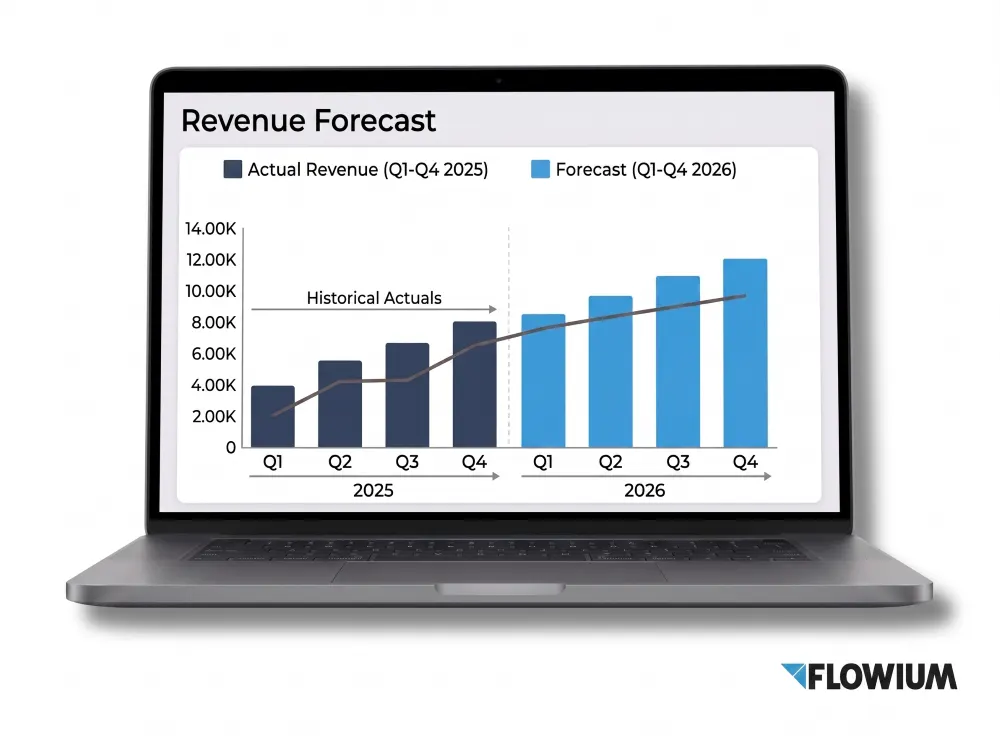
Your forecasting model will not only provide an approximate revenue projection but also explain which factors influence it, including customer retention and churn risk. Most importantly, the model will give you an understanding of how accurate this estimate can be, so you know whether to trust it completely or not to get your expectations too high.
Revenue forecasts can be built using the following principles:
- Bottom-up, starting with individual deals or customers,
- Top-down, starting with market size and working inward.
The most experienced B2B companies use both approaches in parallel and combine them with retention and lifecycle insights.
It is important to understand that revenue forecasting is usually not just a one-time report, but an effective strategic model. By using this model as a continuous process, regularly updating data on deal closures, customer churn, lifecycle engagement, upselling opportunities, and macroeconomic changes, you will gain increasingly accurate forecasts.
What Makes Revenue Forecasting Important for eCommerce and Subscription Brands?
Forecasts are most often used as reports for investor presentations, but their significance goes far beyond that. For example, forecasting is critical for DTC (direct-to-customer) brands, as they rely on it to calculate inventory levels and staff schedules. Given these factors, revenue fluctuations of even 15% in either direction have real operational consequences.
Revenue forecasts are even more critical for subscription-based and B2B businesses, where a slight shift in customer retention metrics can significantly impact the brand’s overall success.
More broadly, for all types of commerce, having predictive data can provide a significant competitive advantage in the market — something that’s always needed when competitors are closing in on you. Looking beyond our example of DTC and B2B businesses, revenue forecasting has the following aspects that underscore its importance:
- Predicting guaranteed revenue = space for customer acquisition. Revenue forecasting also includes capturing guaranteed revenue through subscriptions, loyalty program behaviors, and lifecycle automation. Based on this certainty, you can plan your CAC (customer acquisition cost) budgets in advance. However, limit yourself to planning only, as over-reliance on forecasts can lead to inflated customer acquisition costs and reduced margins.
- Information for planning advertising campaigns. Revenue forecasts based on customer retention focus on customer segments that are likely to make a purchase or extend their subscription without a discount. Such data significantly aids segmentation, allowing you to avoid substantial advertising costs for the general audience and target specifically those who need an incentive to return.
- Reporting framework for investors and the board of directors. For funded eCommerce and subscription brands, consistent forecast accuracy demonstrates operational maturity. Boards of directors want to see that growth driven by customer retention is supported by effective, repeatable systems — not just advertising spend — and that your existing customer base provides a stable, predictable baseline of revenue.
- Preparedness for any scenario. By exploring the revenue forecasting model, you can anticipate all possible scenarios and be prepared for them like no one else. Sudden reactivation of a customer segment through a loyalty program, revenue from subscription price increases, and other scenarios can be predicted based on data regarding customer behavior and retention.
Key Steps to Creating Your Own Revenue Forecasting Model
We’ve gathered key steps to help you build a unique revenue forecasting model that’s best suited to your business. It will reflect the actual revenue of your eCommerce or subscription business. Our guide will help you understand the structure and data entry procedures, including customer retention and lifecycle modeling, and will incorporate CLV and growth forecasts that tie the model together.
1. Separate your revenue categories.
All of your revenue categories should be modeled separately, specifically:
- Revenue from new customers,
- Revenue from repeat customers,
- Subscription revenue and recurring revenue,
- Revenue from business expansion,
- Revenue from reactivating inactive customers.
These metrics should not be combined in one model, as this will yield a figure that cannot be acted upon when actual results diverge, and which cannot be linked to specific marketing levers in the customer lifecycle.
2. Select the forecasting scope and set the update frequency.
The classic revenue forecasting models used by most eCommerce brands forecast 90 days ahead, updating the data monthly. If a brand has more stable revenue from recurring subscribers, such as in subscription-based businesses, it can extend the forecast up to 12 months thanks to reliable, strong recurring revenue components.
3. Collect and match behavioral data for customer segments.
The accuracy of your revenue forecasting model depends on the accuracy of your input data. Before making assumptions based on customer segments, ensure that the overall picture includes behavioral aspects such as:
- Email engagement data from Klaviyo or another provider,
- Purchase history,
- Subscription history from your eCommerce platform,
- Loyalty program data,
- SMS response rates.
Most forecasting errors are caused by inconsistencies in data across these sources, yet companies often attribute this to the model itself.
4. Build retention assumptions at the cohort level.
Segment customers and apply cohort-specific retention, repurchase, and renewal rates. For subscription businesses, apply cohort-specific renewal forecasting rates rather than blended averages. This single step typically produces the largest improvement in forecast accuracy for brands moving away from top-line growth rate models.
5. Model revenue from new customers based on verified acquisition data.
Forecasts of future profits from new customers should be based on conversion rates for particular channels and average first-order values. Different acquisition channels have significantly different projected CLV trajectories, which in turn lead to substantially different contributions to revenue. For example, a customer acquired via email and one acquired via a discount ad will naturally have completely different levels of loyalty.
6. Focus on the range of uncertainty.
No forecasting model will give you an exact number, and it is important to understand this. A good revenue forecasting model is not a single number, but a range. You need to have the baseline and most optimistic scenarios as well as the most pessimistic one, so as not to set expectations too high and to be prepared for anything. A professional planner makes decisions based on a range, not on unlikely precision.
7. Compare actual results with forecasts every month.
Revenue forecasting reports aren’t just about potential outcomes — they’re also a powerful tool for self-analysis. The point is that by making forecasts, you can see the best possible outcome and what needs to happen to achieve it. If, upon receiving the actual results, you didn’t achieve that outcome, you can cross-check the data and identify why you weren’t as effective as expected. Perhaps the issue was with email delivery, customer retention efforts, or subscribers canceling their subscriptions early. By identifying the cause, you’ll uncover a flaw in your system or at least be able to refine the accuracy of your next forecast.
How to Forecast Revenue Using Customer Retention or Retention Forecasting
Behavioral signals collected through lifecycle marketing channels, or customer retention data, are a highly informative source for forecasting revenue. As a source of information, it is often underestimated, overlooking one important fact. Although not for all, but for most businesses, 40-60% of total revenue is generated by existing customers, even though they represent a smaller share of the total customer base. These figures demonstrate that data from a marketing function as significant as customer retention should play a major role in revenue forecasting.
Key Steps for Revenue Forecasting Based on Retention
Effective revenue forecasting based on retention follows these key steps:
1. First things first, the customer base is segmented into retention cohorts, which are typically grouped by:
- acquisition date
- acquisition channel
- product categories
- subscription tier
- purchase frequency
2. For these cohorts, specific retention coefficients are applied instead of a single combined average value, due to significant differences in purchasing potential and customer lifespans across these cohorts.
3. Next come key behavioral indicators reflecting churn risk, such as:
- decreasing email open rates,
- declining click-through rates across life cycle stages,
- non-use of loyalty points,
- an increase in time since last purchase,
- decreasing SMS response rates.
Each of these behavioral aspects is a reliable and clear signal of a potential customer loss or service cancellation. The appearance of such a signal usually warns of a potential customer loss 30-60 days before it happens. It’s really helpful to know this in advance so you can prevent it, right? Our partner, the Klaviyo platform, and similar customer lifecycle platforms can identify these engagement patterns by segment in a way that aggregated analytics tools completely miss, transforming your customer lifecycle platform into an asset for predicting retention, not just a campaign management tool.
Revenue Forecasting at Expansion Through Retention
Another important aspect is that retention data also reveals revenue from expansion. This happens through new customer data indicating growth in average order value, cross-category purchases, increased loyalty, and changes in subscription plans. This data will significantly aid expansion by providing predictable results.
Examples of the Most Common Revenue Forecasting Models Used in eCommerce
There is no universal revenue forecasting model that works for all brands. Every brand is unique, and so is its forecasting model. Key variables that make models differ from one another are the frequency of customer purchases, the share of recurring revenue in your revenue portfolio, and the volume of accumulated data on customer behavior. Here are examples of the most relevant revenue forecasting methods for brands in eCommerce, DTC, and subscription-based:
The Simplest Method: Model Based on Historical Growth Rates
The simplest revenue forecasting model is based on applying last year’s growth rate to current revenue. It is useful for a preliminary, surface-level assessment or for brands in the very early, slow-growth stage.
🔴 Drawback: Its obvious drawback is that it does not account for changes in the customer base structure, the effectiveness of sales channels, or customer retention dynamics. In other words, if the repeat purchase rate has dropped by 10 percent compared to last year or subscriber churn has increased imperceptibly, this model will not detect it until the losses show up in actual figures.
The Most Effective Method: The Cohort-Based Customer Retention Model
This model is most effective for brands characterized by frequent repeat purchases or customer subscriptions to services. The process begins by grouping customers into retention cohorts based on their month of acquisition, and then tracking how revenue from each cohort changes over time. The goal is to identify patterns in different marketing campaigns. For example, a cohort acquired through a holiday promotion might churn twice as fast as one acquired through an email referral program. The key point is that you won’t notice these trends in revenue growth rates, but they become very visible and useful in accurate revenue forecasts.
🔴 Drawback: Not suitable for startups, as it is complex to build due to the need for a significant amount of historical retention data and high-quality customer segmentation. Overall, this model is quite demanding, requiring effort to build and maintain.
Model for Businesses of Consumer Replenisable Goods
Such brands tend to have some of the highest rates of repeat purchases, especially if their products are unique. Examples include skincare products, pet food, coffee, and so on. Based on this, their revenue forecasting models focus on predicting repeat orders. Such forecasts are highly accurate because, based on average repeat purchase intervals, order frequency distribution, and each customer’s lifecycle stage, they can estimate how many repeat orders will occur within a specific time frame.
🔴 Drawback: Suitable mainly for brands with products that have consistent purchase cycles. Forecast accuracy depends heavily on the stability of customer behavior and the quality of lifecycle tracking.
Customer Engagement Scoring Model
Certain teams with significant experience develop specialized customer engagement scoring systems. These systems typically assign a score to each customer based on their recent behavior. High-scoring customers are highly likely to make a purchase or renew their subscription soon, while low-scoring customers, conversely, are at risk of churn or cancellation. By applying revenue expectations at the segment level to each engagement level, you get a “bottom-up” forecast. This model is particularly effective when your lifecycle marketing platform collects detailed engagement data — email clicks, SMS responses, loyalty program reward usage, and subscription activity.
🔴 Drawback: A high customer score driven by user activity does not always indicate actual purchase intent, which can lead to inaccurate forecasts. Like most other models, such a forecast may be relevant depending on your customers’ buying patterns.
Subscription and Recurring Revenue Model
For brands offering subscriptions or auto-renewal programs, a significant share of projected revenue is effectively guaranteed. This involves a specific subtype of projection known as subscription renewal forecasting. Customers may predictably cancel their subscriptions due to price increases or less predictable life cycle stages. However, thanks to lifecycle data, subscription cancellations can be detected in advance, making this data among the most critical for forecasting subscription revenue.
🔴 Drawback: The model’s accuracy relies entirely on the expertise of correctly forecasting churn and renewals. Even the slightest changes in pricing or customer experience can significantly or even drastically distort the forecast.
The majority of well-established eCommerce and subscription brands combine several of these models — using retention cohort data for the existing customer base, forecasting repeat orders for consumables, modeling subscriptions for guaranteed recurring revenue, and assessing engagement to identify forecasting risks in real time.
How Retention Marketing Agencies Improve the Accuracy of Revenue Forecasts
Every eCommerce brand must understand that the reliability of its forecasts depends on the reliability of its customer retention infrastructure. Retention marketing agencies like Flowium are the ones who, better than anyone else, can provide this infrastructure, and here’s why:
- Every automated email flow and SMS sequence created by a customer retention agency also serves as a data collection mechanism. When these flows happen, you track open rates, click behavior, and customer return conversion rates — all signals that improve churn predictions, renewal forecasts, repeat order models, and engagement metrics.
- As part of their services, retention marketing agencies provide retention automation, which in turn reduces forecast discrepancies. Since the most common causes of forecast discrepancies are deviations in customer behavior, this is a significant solution to inaccuracies.
- Loyalty programs, upsell sequences, cross-sell automation, subscription upgrade campaigns, and loyalty tier progression flows — all of these generate growth revenue. When these programs are systematically built, measured, and attributed, expansion revenue ceases to be an unpredictable surprise and becomes a predictable component of the revenue model — one that the customer retention agency can optimize quarter over quarter, and the finance team can confidently forecast.
Conclusion
In conclusion, our research shows that revenue forecasting is a valuable tool for eCommerce businesses that justifies the efforts put into it. It offers numerous benefits, allowing business owners to stay one step ahead and operate as efficiently as possible. Additionally, forecasting reports serve as a powerful tool for analyzing performance gaps.
Revenue forecasting is particularly accurate for businesses based on service subscriptions. They have a solid revenue guarantee, but data on future subscription renewals by customers relies heavily on retention forecasts. For the most accurate revenue forecasts based on retention data, contact Flowium, an agency of marketing experts.
Frequently Asked Questions
What is the difference between revenue forecasting and profit forecasting?
Revenue forecasting estimates general future income generated by sales, while profit forecasting additionally accounts for expenses, operational costs, taxes, and margins.
Which metrics are most important for forecasting subscription revenue?
The most important metrics for forecasting revenue of subscription-based commerce include churn rate, renewal rate, customer lifetime value (CLV), average revenue per user (ARPU), and monthly recurring revenue (MRR).
What tools can help automate revenue forecasting?
Most helpful tools for automating revenue forecasting are platforms like Klaviyo, Shopify, CRM systems, subscription analytics software, and BI dashboards.