When you’re setting up digital marketing for your online store, after launching campaigns and investing money, the question “Is it actually working?” might arise. Without clear KPIs and benchmarks, it’s easy to lose track of your progress and spend valuable resources on strategies that don’t bring results. Such a mistake can cost you success, especially with modern levels of competition. That’s why knowing and understanding key email marketing benchmarks for 2026.
In this guide, we share insights from our professional email marketing experts on the meaning of email marketing benchmarks and industry standards you should use to measure your performance.
What Are Email Marketing Benchmarks?
An email marketing benchmark is a metric that measures how effective email marketing campaigns are. Companies use benchmarks to evaluate results, identify gaps, and understand how their performance compares to industry averages.
When measuring a campaign’s performance, email marketing benchmarks use a variety of metrics, including the email open rate, click-through rate (CTR), conversions, and others, which together provide a comprehensive view of campaign engagement and reach.
Why Are Email Marketing Benchmarks Important?
By monitoring the fundamental email marketing KPIs, you can learn all about the efficiency of your operations, assess client relationships, and marketing strategies. To determine whether your emails are effective, it’s critical to monitor data like click-through and open rates. However, statistics by themselves don’t provide a complete picture. It’s difficult to determine whether a 20% open rate is excellent or needs improvement in the absence of context.
Benchmarks are useful in this situation. They provide you with a better understanding of how you compare to competitors, assist you in identifying areas for progress, and demonstrate what good looks like in your business.
You’ll need a platform that tracks outcomes and makes them simple to comprehend if you want to get the most out of your data.
- Provide performance context
You can use benchmarks to determine whether your metrics are in line with, above, or below industry averages.
- Identify optimization opportunities
Identify areas that are not functioning well, such as poor segmentation, bad subject lines, or low engagement.
- Set realistic and data-driven goals
With benchmarks, you can establish attainable KPIs based on accepted industry standards rather than guesswork.
- Measure progress over time
Monitor campaign improvements and assess the results of strategic adjustments.
- Improve decision-making
Data-driven insights help select the best strategies and minimize the likelihood of errors.
- Align teams around clear expectations
Marketing, sales, and leadership teams all have a common definition of success thanks to benchmarks.
- Increase ROI from email marketing
Businesses can maximize returns and spend resources more effectively by concentrating on KPIs that matter.
Key Email Marketing Benchmarks
We are frequently asked what constitutes a good email open rate or click-through rate. In a nutshell, it depends. These kinds of important engagement measures might differ significantly depending on your industry and other variables. So, to answer these questions altogether, we researched the topic based on our own data and the Klaviyo email benchmark report and prepared a comprehensive guide. Let’s take a look at core email marketing benchmarks relevant to the current state of the market at the beginning of 2026.
Email Open Rate Benchmarks
Your email open rate is the percentage of recipients who receive and open marketing emails from your company. Email open rates are a clear measure of how effectively you are drawing in your target audience. A high open rate indicates that people are interested in the content you provide, which could result in additional actions like clicks and conversions. The frequency of your emails, as well as the day, time of day, and season in which you send them, may affect the open rate.
Average Across Industries
According to Klaviyo’s benchmark statistics, the average email open rate for all e-commerce email marketing segments as of 2025 is 37.93%. This indicates that almost four out of ten subscribers open e-commerce emails on average, underscoring the importance of having engaging subject lines and targeted content. Top performers in the same market study have open rates significantly higher than this average, demonstrating the substantial potential for marketers who optimize their audience segmentation and campaigns.
Open Rate Email Marketing Benchmarks by Industry
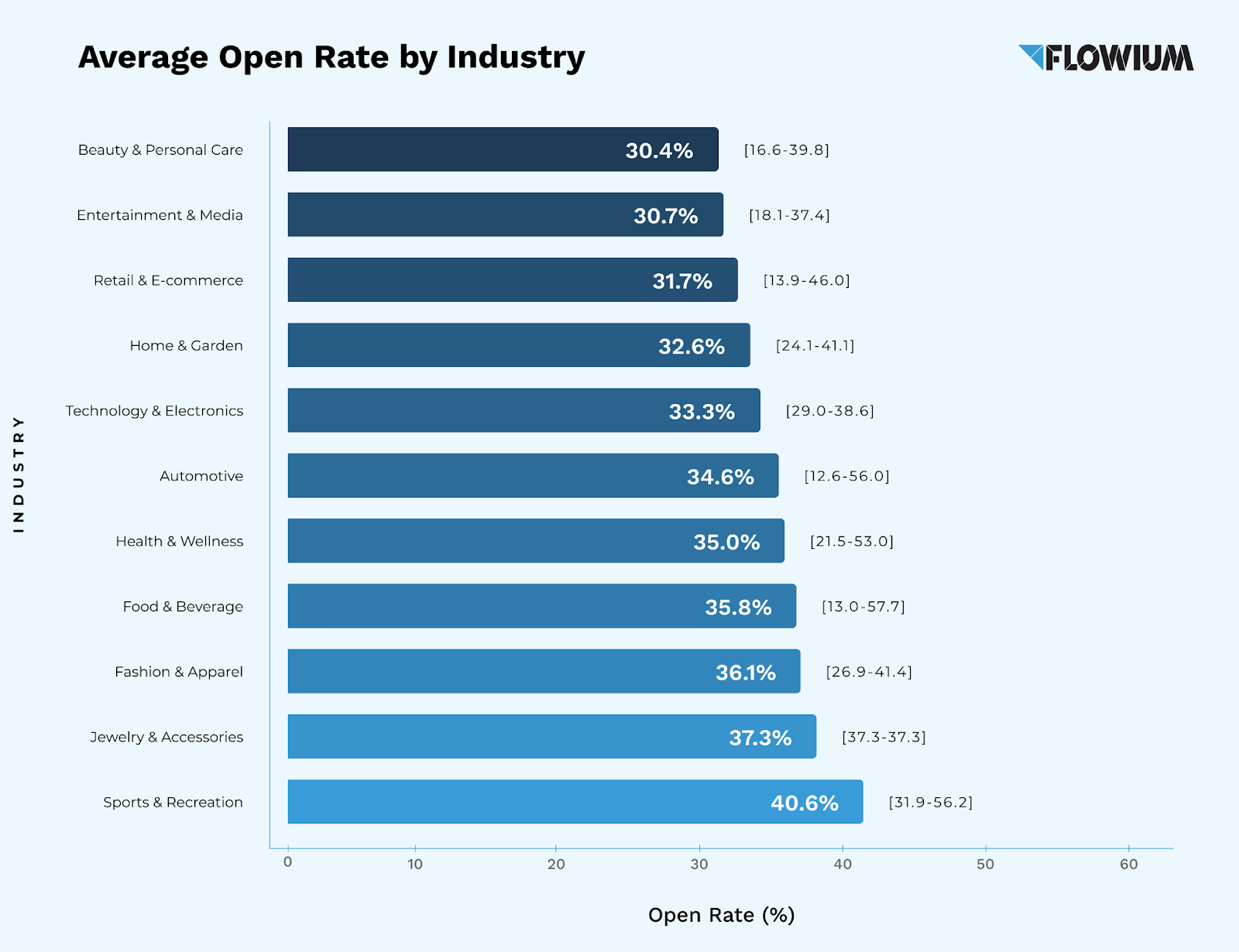
To give you more illustrative insight into the range of benchmarks of the same category, we created a chart showing average email open rates by industry.
As you can see, Sports & Recreation has the highest open rate (about 40.6%), followed by Jewelry & Accessories and Fashion & Apparel. In these industries, high purchase intent and time-sensitive messaging, along with compelling visuals and emotionally driven subject lines, play a significant role in capturing subscriber attention.
Food & Beverage, Health & Wellness, and Automotive also perform strongly, while Beauty & Personal Care and Entertainment & Media show the lowest average open rates, though all industries cluster around the 30-40% range. Still, the relatively narrow range suggests that with proper segmentation, personalization, and timing, brands in any industry can achieve competitive open rates.
What is a Good Open Rate Email Benchmark?
According to Klaviyo, the current benchmark for good email open rates across industries is between 37 and 38% for regular promotional emails. With good open rates of 48–50% and top performers surpassing 60%, automated emails (such as welcome or abandoned cart flows) usually fare better. Open rates above 35% are generally seen as great, while anything below the industry average indicates potential for improvement.
Takeaway:
- Average open rate across ecommerce: 37,93%
- Best open rates by industry: 40,6% in Sports & Recreation
- Good email open rates: 37-38% for regular campaigns; 60% for automated emails
Click Rate Email Marketing Benchmark
The percentage of delivered emails that obtain at least one click is known as your email click rate. Click rate indicates overall engagement and interest in your material throughout your whole audience, including those who open and those who don’t, in contrast to open rate, which indicates whether subscribers notice your emails.
Message relevancy, offer strength, content arrangement, call-to-action clarity, and audience segmentation are some of the characteristics that affect click rate. Click rate is a more conservative but trustworthy indicator of how successfully your campaigns generate action because it is based on the total number of emails delivered.
Average Across Industries
Depending on the business and type of campaign, average email click rates in e-commerce and associated industries often fall between 1.5% and 2.0%. Even slight increases in click rate can result in significant increases in traffic and income at scale, even though these percentages may appear modest. Click rate is, therefore, a crucial metric for assessing the overall efficacy of a campaign.
Industry Benchmarks for Email Marketing Click Rate
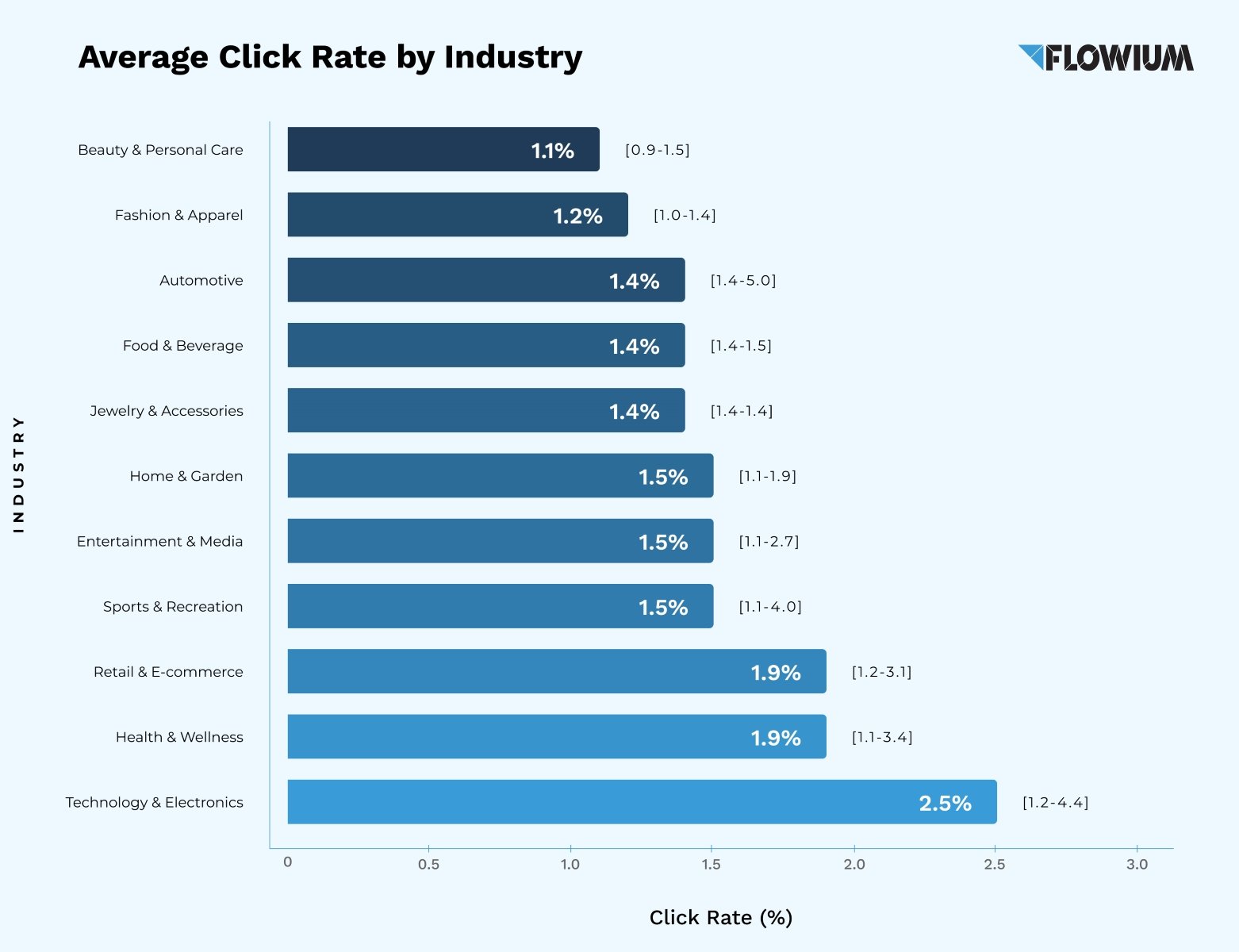
In the chart below, you can see average email click rates by industry, highlighting differences in how audiences engage with email content.
Technology & Electronics has the highest click rate (about 2.5%), followed by Health & Wellness and Retail & Ecommerce at around 1.9%. These industries often benefit from clear value propositions, educational content, and product-driven messaging that encourages users to explore further.
Most other industries cluster between 1.4% and 1.5%, while Beauty & Personal Care and Fashion & Apparel show the lowest average click rates. High competition and frequent promotional emails in these sectors can reduce engagement, making segmentation, personalization, and creative testing essential for improvement.
What Is a Good Click Rate for Email Marketing?
A good email click rate across industries typically falls between 1.5% and 2.0% for regular promotional campaigns. Click rates above 2% are considered strong and indicate that your messaging resonates with a broad portion of your audience.
Automated emails-such as welcome sequences, abandoned cart reminders, and post-purchase follow-ups- often achieve higher click rates, frequently reaching 3% or more, due to their relevance and timing.
Takeaway:
- Average email click rate across ecommerce: ~1.5-2.0%
- Best click rates by industry: ~2.5% in Technology & Electronics
- Good email click rates: 1.5-2.0% for regular campaigns; 3%+ for automated emails
Click-Through Rate
One of the most crucial measures for assessing the effectiveness of email marketing is click-through rate (CTR). It is a powerful indicator of how interesting and compelling your content is since it calculates the proportion of recipients who click on at least one link or call to action in an email.
A greater CTR indicates that your email’s design, content, and calls to action effectively draw readers in and encourage them to continue. Email format, audience targeting, personalization, offer clarity, and message relevancy are some of the variables that affect CTR.
Average CTR Across Industries
Depending on the business, demographic, and email type, email marketing initiatives in 2025 often aim for a click-through rate of 2% to 5%.
Newsletters, bulletins, and instructional materials are examples of general marketing emails that usually have a CTR of 2–5%. Due to their sales-driven content and clearer calls to action, promotional emails typically perform slightly lower, averaging 1-3%, which may impair engagement for some subscribers.
CTR Email Benchmarks by Industry
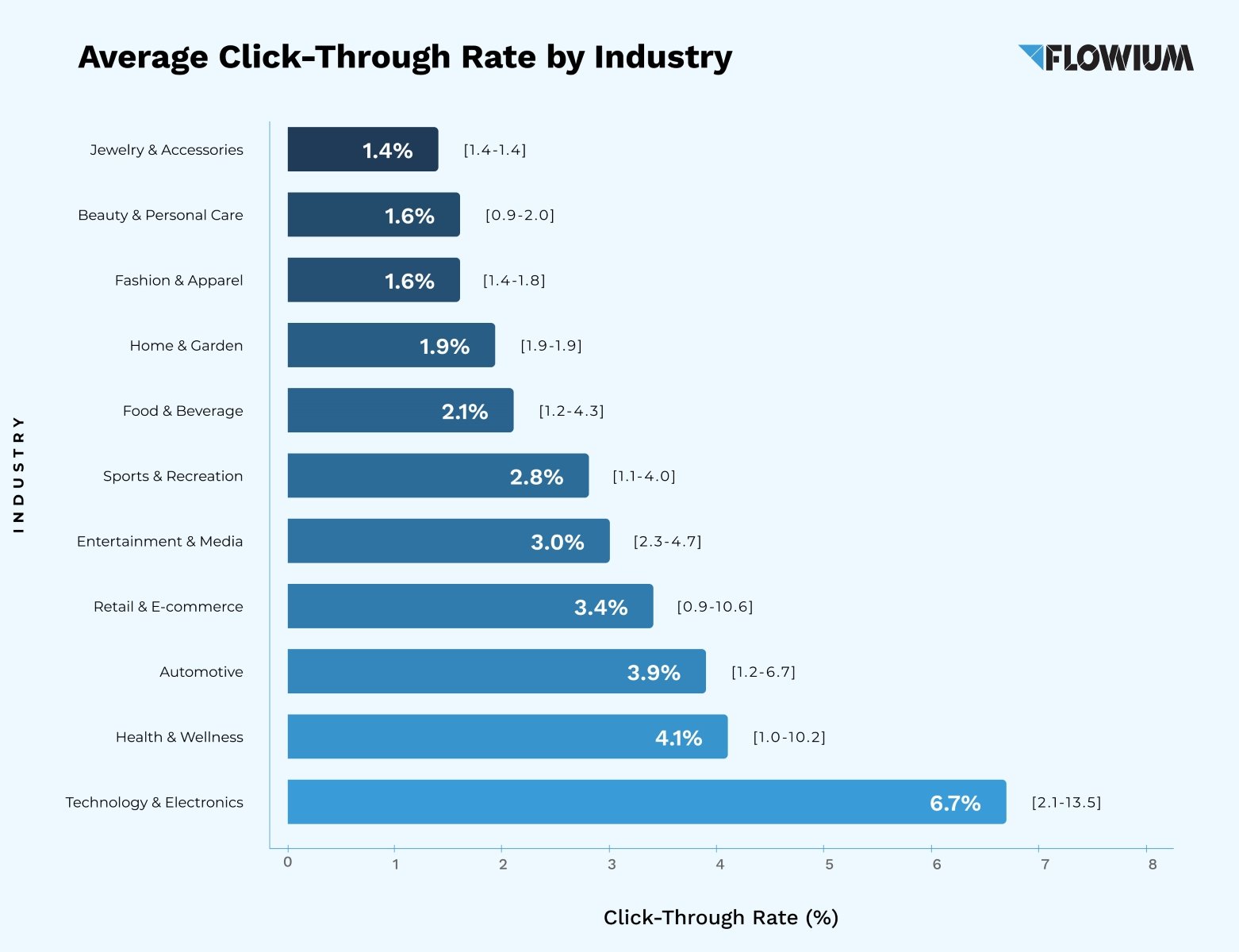
With an average CTR of almost 6.7%, Technology & Electronics leads by a significant margin, followed by Health & Wellness and Automotive.
Jewelry & Accessories, Beauty & Personal Care, and Fashion & Apparel have the lowest CTRs overall, whereas Retail & Ecommerce and Entertainment & Media perform moderately.
What Is a Good Click-Through Rate for Email?
CTRs over 5% are regarded as above average and typically signify extremely pertinent, precisely targeted messaging. Transactional emails often get even higher CTR (more than 5%) due to the informational nature of these messages.
Takeaway:
- Average CTR across industries: around 2.66%
- Good email CTR: 2-5%
- Above-average CTR: 5%+
- Best-performing industry: Technology & Electronics (6.7%)
Difference Between Click and Click-Through Rates
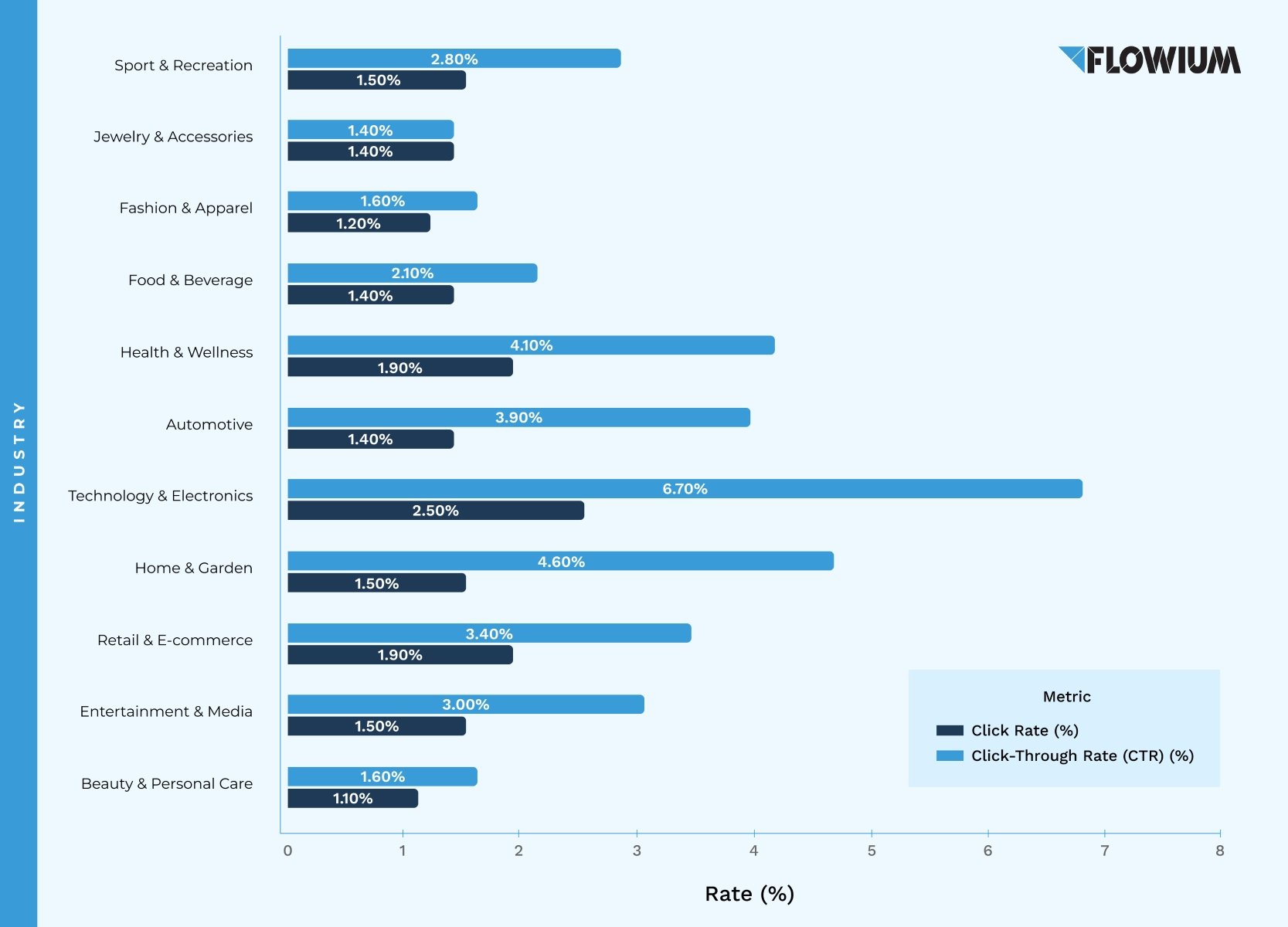
Click-through rate (CTR) is based on the ratio of all link clicks to all email opens, whereas click rate (CR) is the proportion of recipients who clicked at least one link in relation to the number of emails delivered. You can determine which aspects of your email campaigns are doing well and which ones require improvement by monitoring both metrics.
To show you how both of these metrics relate to each other, we prepared data on them across industries as well.
Conversion Rate
The percentage of consumers who finish a desired action after engaging with an email is known as the email conversion rate. It can be anything, from making a purchase, downloading a resource, registering for an event, or accomplishing another predetermined goal. It’s one of the most important email marketing metrics since it stands as the ultimate measure of campaign success, unlike the previous benchmarks we explored.
Average Conversion Rate Email Benchmark Across Industries
According to the Klaviyo analysis, the average email marketing conversion rate across all industries is 0.08%, with the top 10% attaining a conversion rate of 0.44%. Although this number might look disappointingly low when compared to open rates, these percentages actually can have a substantial impact on revenue.
Email Marketing Industry Benchmarks for Conversion Rates
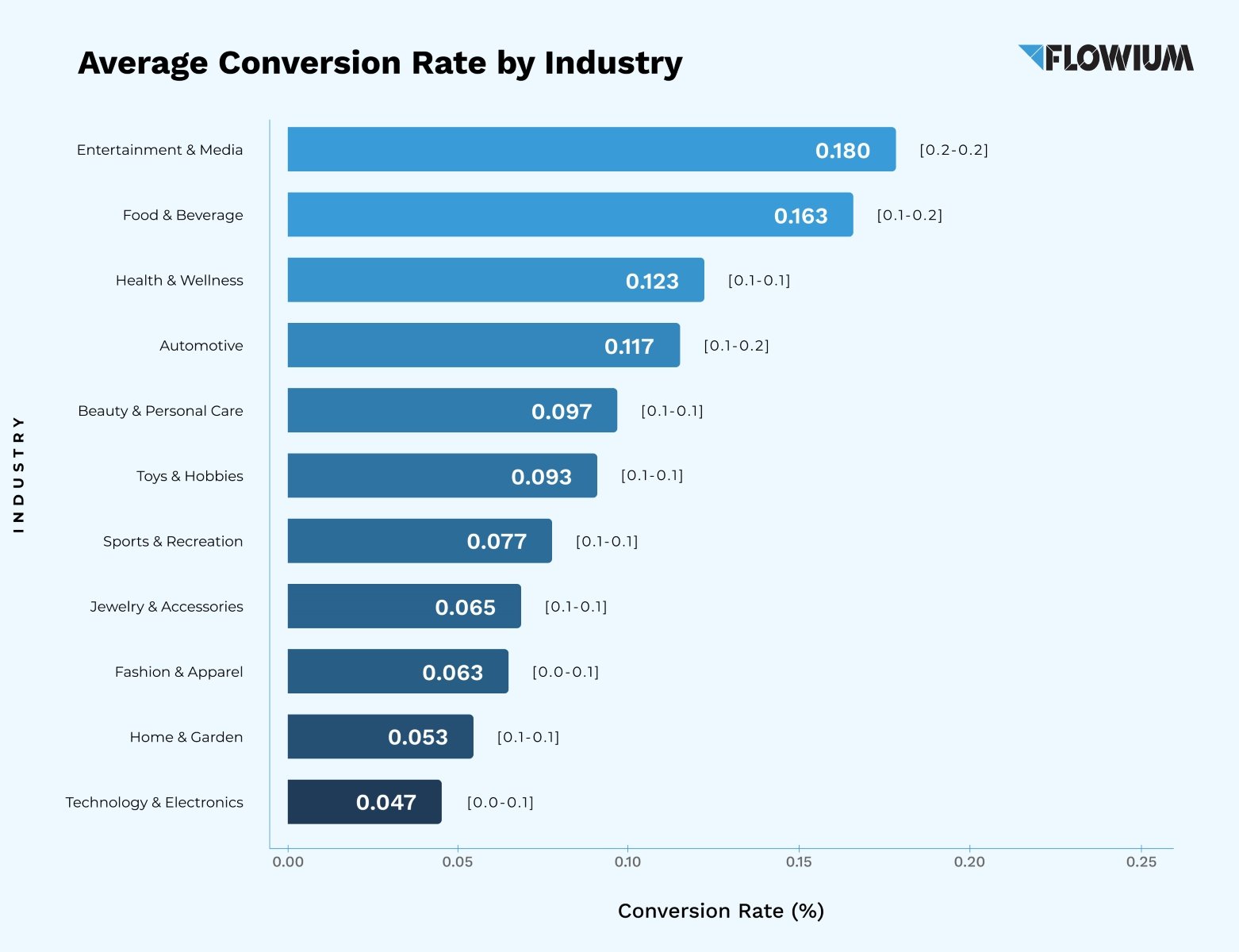
At an average of 0.16–0.18%, Entertainment & Media and Food & Beverage have the greatest conversion rates. These sectors frequently profit from impulsive purchases, time-limited promotions, and information that promotes prompt decision-making.
High customer intent and product-specific communications help Health & Wellness and Automotive perform well as well. The remaining industries have the lowest average conversion rates overall, with Beauty & Personal Care and Toys & Hobbies falling into the mid-performing area. Longer buying cycles, higher price points, or more comparison shopping can all lower quick conversions in these areas.
What Is a Good Email Conversion Rate?
Depending on the industry, email type, and business strategy, a good email conversion rate usually falls between∫. Excellent rates are those above 0.4%, which are typically attained by highly focused, automated programs.
Takeaway:
- Average conversion rates across industries: 0.08%
- Best performing industries: 0.16–0.18% in Entertainment & Media, Food & Beverage
- Good email conversion benchmark: 0.1—0.3%+
Bounce Rate
The percentage of emails that were not successfully delivered to recipients because of invalid email addresses, server problems, or the recipient’s mailbox being full is known as the “bounce rate” in email marketing.
There are two types of bounces: soft bounces and hard bounces.
Hard bounces occur when an email cannot be delivered due to an ambiguous reason. This could be because:
- The email address is fake;
- The email is misspelled;
- The domain doesn’t exist anymore.
Many professional email marketing services, like Klaviyo, automatically remove hard-bounced emails and suppress them from future sends. This helps maintain your deliverability rate and open rates by ensuring you’re only sending to valid contacts.
Soft bounces are different from hard bounces because they happen due to temporary issues. Some common reasons for a soft bounce include:
- The recipient’s inbox is full.
- The server is temporarily down.
Average Bounce Rate Email Benchmark
The majority of respectable email marketers in all sectors strive to maintain bounce rates well below 2%, with top-tier programs attaining rates closer to 0.5–1%. While campaign-specific circumstances may occasionally cause surges, consistently high bounce rates are a hint that acquisition strategies or list quality need to be improved.
Bounce Rate Email Marketing Benchmarks by Industry
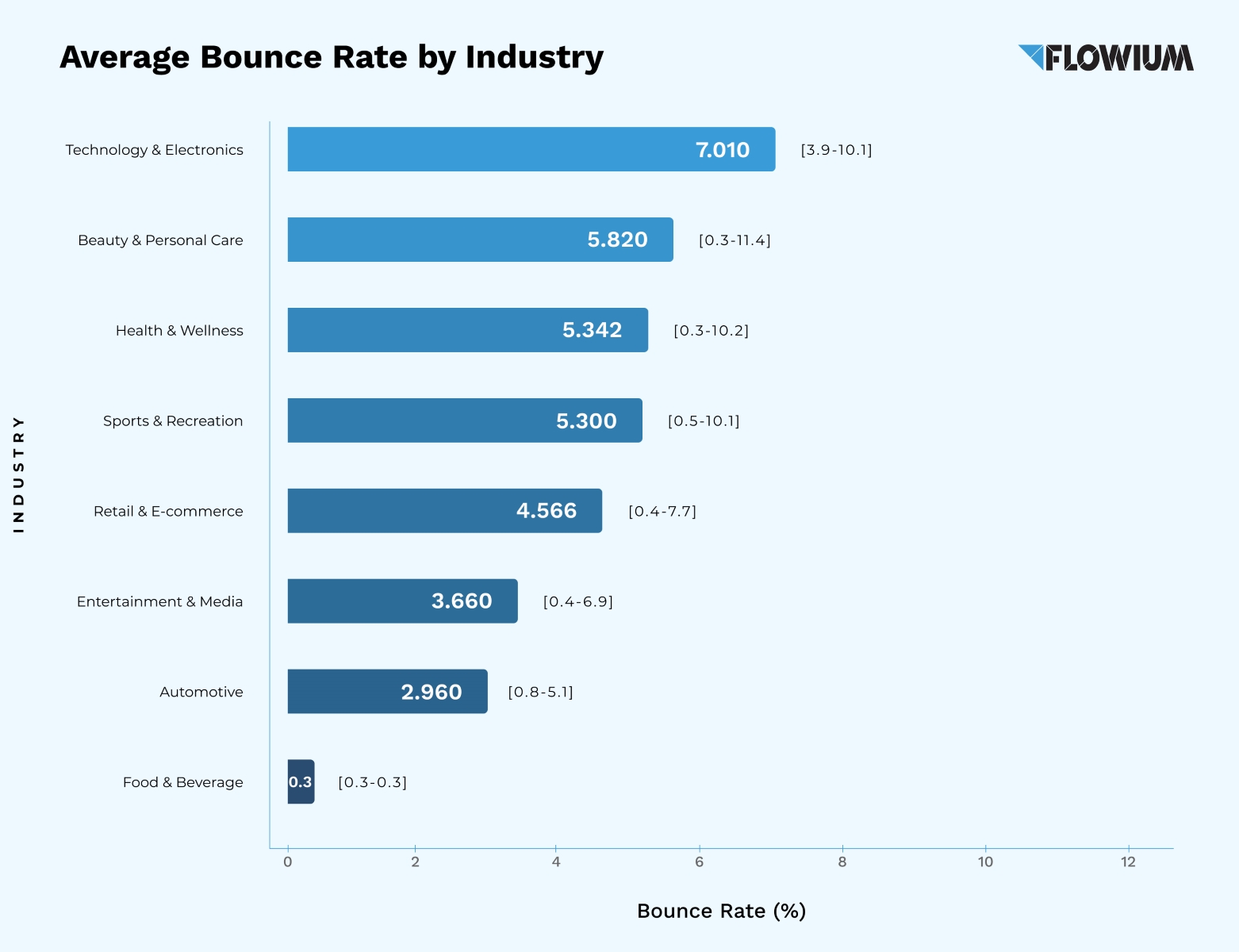
Technology & Electronics has the highest bounce rate (around 7%), followed by Beauty & Personal Care, Health & Wellness, and Sports & Recreation (between 5-6%).
The midrange includes retail and ecommerce as well as entertainment and media, indicating more reliable list management techniques. Food & Beverage has the lowest bounce rate at about 0.3%, showing very good list hygiene and subscriber engagement, while Automotive performs marginally better.
What Is a Goal Benchmark for Email Bounce Rate?
An email bounce rate of less than 2% is good, and less than 1% is outstanding. If bounce rates exceed this cutoff, we recommend verifying email addresses, working on your list cleaning, and enhancing opt-in techniques.
Takeaway:
- Average bounce rate: 2–5%
- Best performing industry: 0.3% for Food & Beverage
- Goal benchmark: less than 1%
Unsubscribe Rate Benchmark
A company’s unsubscribe rate is the proportion of email list members who opt out of receiving regular newsletters or other emails. It demonstrates how effectively your email strategy complies with audience expectations and is a crucial sign of subscriber happiness and content relevance.
An increasing unsubscribe rate may indicate problems with targeting, value proposition, email frequency, or content quality. Because of this, in order to keep a healthy and active subscriber base, unsubscribe rates should be regularly reviewed.
Average Unsubscribe Rate Across Industries
According to industry email marketing benchmarks, the average email unsubscribe rate is between 0.1% and 0.5%. Rates higher than 0.5% could indicate that you’re sending too many emails or that they don’t live up to user standards.
Industry Benchmarks for Email Marketing Unsubscribe Rates
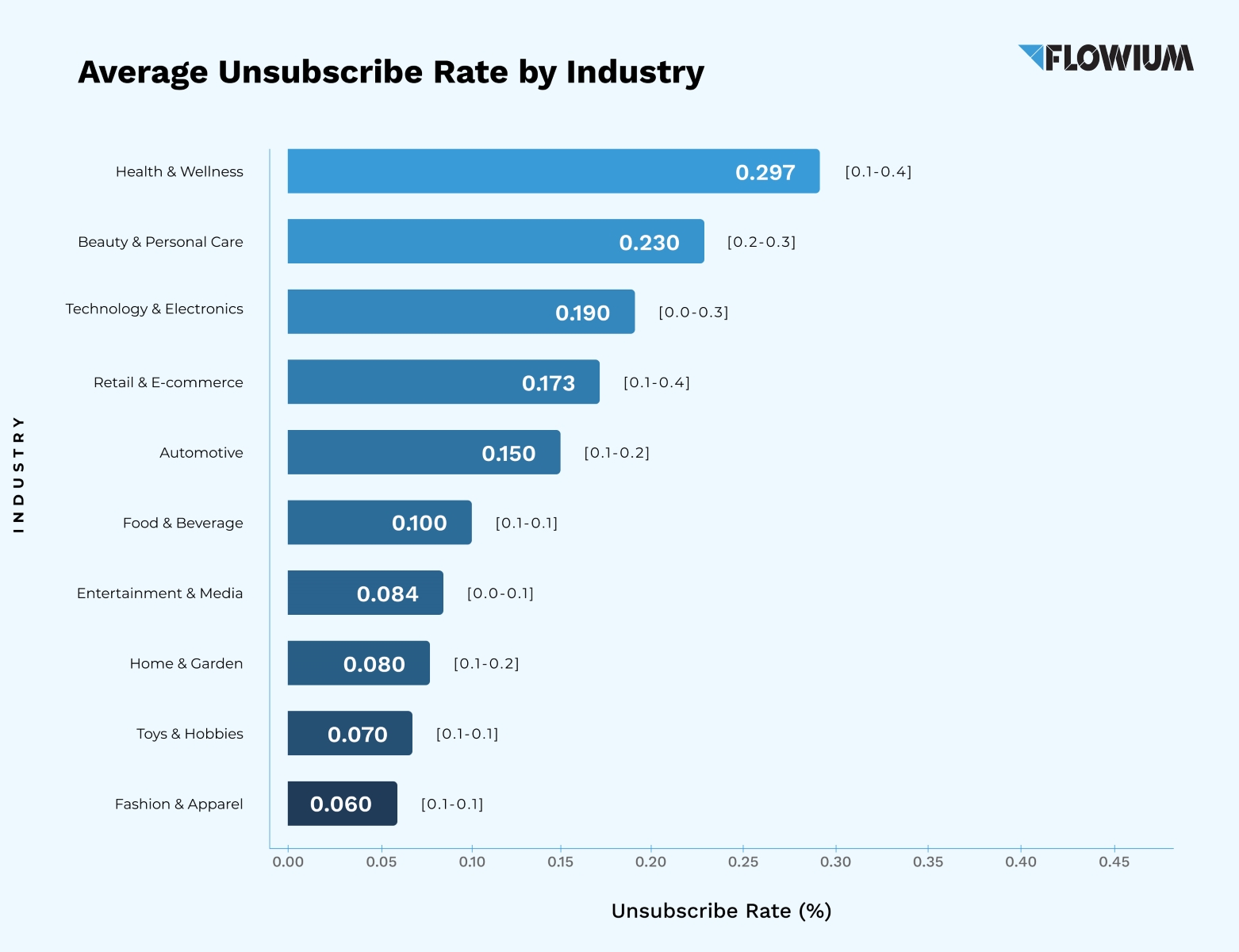
Health & Wellness has the highest unsubscribe rate (around 0.30%), followed by Technology & Electronics and Beauty & Personal Care. These sectors frequently send out promotional or instructional emails, which, if content relevance isn’t carefully maintained, may lead to an increase in unsubscribes.
Food & Beverage, Entertainment & Media, Home & Garden, Toys & Hobbies, and Fashion & Apparel report the lowest unsubscribe rates overall, typically below0.10%, while Retail & Ecommerce and Automotive are in the middle. In these sectors, lower rates are frequently the result of less aggressive email frequency, obvious value-driven content, or strong brand loyalty.
Good Unsubscribe Email Benchmark
A good unsubscribe rate for email marketing is typically below 0.3%, with anything under 0.2% considered strong. Rates consistently above this range may indicate that emails are being sent too frequently, lack personalization, or fail to deliver enough value.
Takeaway:
- Average unsubscribe rate: 0.1–0.5%
- Top performing industry: 0.06% in Fashion & Apparel
- Goal: less than 0.3%
How to Meet Email Marketing Benchmarks: Our Tips
To put it briefly, monitoring email marketing benchmarks will assist you in understanding the performance of your campaigns, especially in your industry and in particular geographical areas. You can design your email marketing more effectively if you know which days and times work best.
But never forget that every company is unique. Therefore, thoroughly examine your buyer personas and customers to learn about their patterns and adjust your email strategies accordingly. Additionally, use A/B testing to clear the air when necessary. You can always try different things until you discover what appeals to your target audience.
Optimize Your Email Marketing Benchmarks with Flowium
Reaching revenue targets and precisely measuring your marketing efforts are made easier by keeping an eye on top email marketing benchmarks and KPIs. It gives you information on how well your online store is performing and helps you make more successful strategic marketing choices.
Need assistance comprehending or enhancing your email marketing performance benchmarks? Contact Flowium right now! We’ll teach you how to measure email marketing success, help with identifying points for improvement, and set effective marketing strategies in place.
Frequently Asked Questions
What makes email marketing benchmarks crucial for marketers?
They assist marketers in determining what constitutes “good” performance, identifying areas for improvement, setting reasonable targets, and evaluating campaign performance against industry averages or major competitors.
How can companies enhance their email campaigns using benchmarks?
Benchmarks can help businesses discover weak areas, try various methods, enhance content and timing, and set realistic goals for future campaigns.