

Podcast Transcript
Vira: 0:41
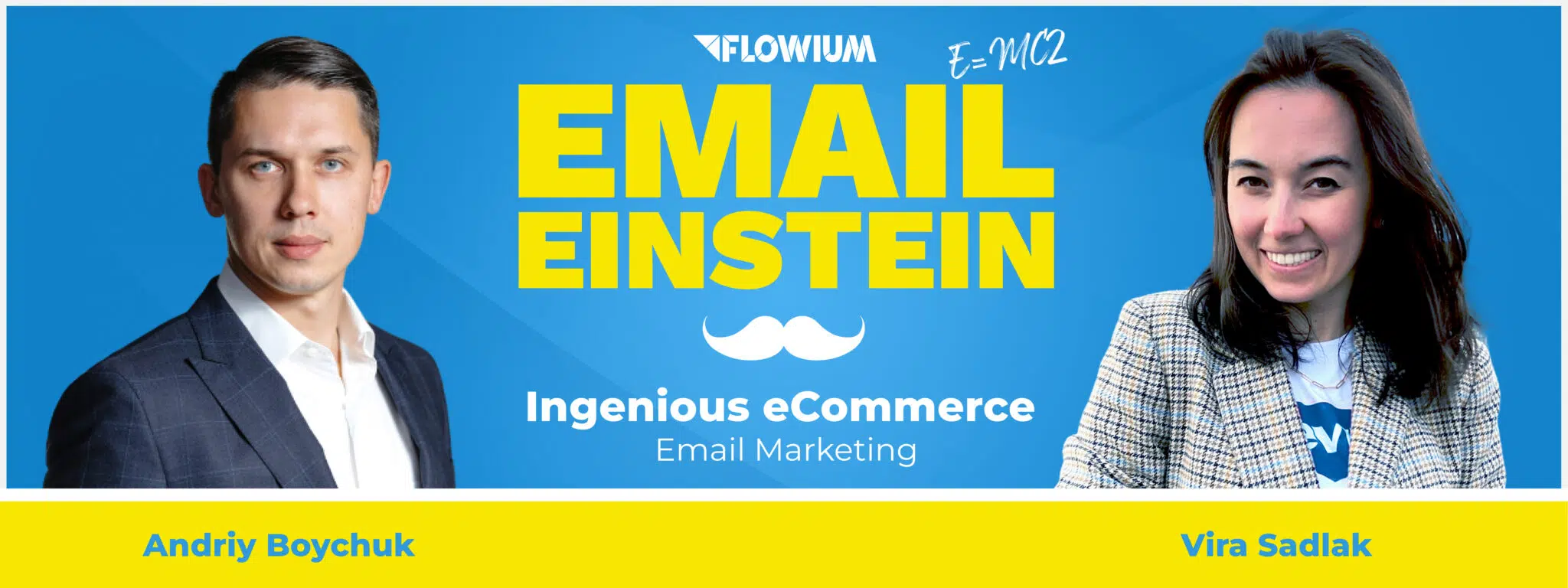
Hello everyone, welcome back to Email Einstein, the podcast by Flowium. We are your hosts, Vira Sadlak and ….
Andriy: 0:48
Andriy Boychuk.
Vira: 0:49
Hi, Andriy. Long time no see. We guys are very happy to have you back during this holiday season. And today we prepared something super fun and super quick for you. Andriy, how’s life?
Andriy: 1:00
Life is good. Busy, but good. A lot like time flies, but I think everybody has the same response. So I’m more curious about your life because something major happened in your life and in the best weekend of the year.
Vira: 1:18
Yeah, that’s crazy. I was just telling Andriy that me and my husband, whose name is Andriy too, just like super popular name in Ukraine, I guess. So it’s not confusing. No, just like to remove all of the confusions. We moved to London and not the London, Ontario, Canada, but like proper London. London, London, London, the capital of Great Britain. London, the best place on earth. London. You might not agree with me, Andriy, because I know you’re a hardcore New Yorker, but I mean, London is like so cool. But I was saying this, that same thing about Vancouver like 2 weeks ago. So I might be biased. Well, anyways, we moved countries, we moved continents, we changed different rainy places and all during the busiest season of the year for us e-commerce email marketers. So the week before Black Friday, Cyber Monday, on Saturday, we moved our lives from one country to another one. So far it’s been great, but so far I’ve only enjoyed my computer and viewings of some apartments that are really, really hard to get. So those are all of my life updates. Yeah.
Andriy: 2:20
Nice. Nice. And I wish you to find the apartment soon. Yes.
Vira: 2:25
Fingers crossed because I pretty much like invited half of our team already to London. Like all of my, all my family’s coming. I have people who bought the tickets. I like, kid you not, for New Year’s. I’m like, I better—
Andriy: 2:36
Actually, you inspire, you inspire me to visit London as well. Maybe next year.
Vira: 2:42
Yeah, you should. You should. Listen, such a cool place.
Andriy: 2:46
Today we have an extremely cool podcast. It would be extremely— I mean, it’s quick, but once I attended the Brian Tracy seminar and he said during the seminar I’ll be telling you a lot of different ideas and doesn’t mean that you have to implement all, it doesn’t mean I have all have to like stick, but I go through all of them. You either write it down or something stands out to you and implement that same logic goes here, we will go over 50 email mistakes, email marketing mistakes, something you might not make, but it’s still good for you to listen through kind of as a checklist. And if something stands out to you, you’re like, oh, I don’t know, maybe I’m making this mistake. I’m not sure. I need to ask my team. Just go back and check with your team so you’re not making this mistake.
Vira: 3:35
Cool. Andriy, you want to challenge? You want to do it in under 25 minutes? 50 mistakes in under 25 minutes. So we talk for less than a minute per mistake. It’s a challenge. I mean, I know for me it’s a challenge.
Andriy: 3:48
As long as we provide value, I don’t care. It can be like even 3 seconds, but we need to provide the value. So let’s go.
Vira: 3:58
Let’s do this. Let me set a timer. Ready, steady, go. Andriy, start with the first one.
Andriy: 4:05
Yeah, the first one, lack of clear goals. There’s many emails where people sending just to send and they don’t have a clear goal what people should do. Number 2, Vira.
Vira: 4:17
Sending emails without permission, aka spamming. Express consent is preferred in email in the US and it is required in all of the other countries. So don’t spam people without their permission. Number 3, Andriy.
Andriy: 4:31
Number 3, using like Purchasing, buying lists. It sounds extremely easy to buy a list, pay a little money, and start sending them. But it’s again, it’s spamming. It will hurt your deliverability and it, it will have negative return on investment.
Vira: 4:47
Number 4, not automating. Based on Klaviyo data, automated emails drive over 14 times higher revenue than non-automated campaigns. Think welcome flow, post-purchase flow, sunset flow, abandonment cart, add to cart. All of this good flows. You can automate this entire journey so you’re Your email makes money for you while you are not working on your emails.
Andriy: 5:09
Number 5, missing fundamental flows, meaning you need to have all touchpoints for the customer journey lifecycle, abandoned cart, welcome and win back and so forth.
Vira: 5:20
That’s a big one. Okay. Sending emails that are over 100 KB. Gmail automatically shortens all of the messages that have a size of more than 100 kilobytes. And it is not just like a visual problem because part of your email will be cut, but also it’s a problem for your tracking because Because very often a lot of ESPs, a lot of platforms, they put the tracking at the bottom of your email. So you won’t be able to track your email performance properly if your email is clipped. So make sure to stay under 100 kilobytes or even under 95.
Andriy: 5:52
Number 7, not having a pop-up on your website. Either it’s a welcome pop-up or exit intent pop-up. You must have the pop-ups. So to convert those web visitor into email subscribers.
Vira: 6:05
Number 8, not segmenting your email list. Ultra-relevant messages are the real moneymakers. There are some stats according to Campaign Monitor. 74% of online consumers get frustrated when content like offers or like educational content is not relevant to them. And according to DMA, marketers have found that segmented emails perform 760% better than non-segmented ones. So do segment.
Andriy: 6:30
Number 9, having double opt-in on. If you have deliverability issue, of course you need to have double opt-in. But this by default, all ESP email service providers like Klaviyo have double opt-in on. It means for somebody to opt in, they need to confirm via email and it will reduce your list growth. We strongly recommend to turn it off.
Vira: 6:54
Number 10, making it hard for your subscribers to unsubscribe. It has always been important to have this like unsubscribe link to make it easy for your subscriber to unsubscribe. But it is especially important with all of the new compliance changes that are coming in Q1 of 2024. Your marketing emails must include a method to unsubscribe, either like a link to unsubscribe from everything or like email preference page. You must include it. And starting 2024, you have to make it very visible and even at the top of the email.
Andriy: 7:27
Number 11, we are not sure how to show it. Not having DMARC set up for you. I’m— it’s too technical for me to explain. You must have it. Just remember. And we have previous episode with Bobby where we went through deep into details why it’s important, how to do it.
Vira: 7:46
Okay. Number 12, impersonating Gmail from headers. Not just Gmail, but like in general impersonating Gmail or From headers. It was cool 5 years ago. It’s not cool anymore. It is a requirement that the from header now matches your actual brand. So that is important for deliverability and just for the purposes of identifying you in the inbox.
Andriy: 8:08
Number 13 is not optimizing for mobile. Predictions indicate by 2025, 72.9% of users will be shopping through mobile. So you must optimize your email for mobile. And we strongly recommend and we practice in our company design mobile first and desktop second.
Vira: 8:30
That’s a big one. Number 14, using spam trigger words. Do not use spam trigger words. Here are the words that you must avoid in your email subject line and copy when you’re working on your email. So don’t use a lot of urgency words that pressure recipients, such as like urgent, before it’s too late, stuff like that. Shady or unethical or illegal names. Don’t use the dollar sign in your subject line. You can find those words. There are like certain like spam words that are not recommended for use. You can find them online. I’m not going to go over all of them, but be careful with being like too salesy in your copy and in your subject lines.
Andriy: 9:07
Number 15, sending the same sequence of the same emails to abandonment cart users. Either they purchase first time for you or 25th time from you. So it’s strongly recommended for you to segment who you’re sending to first time to non-buyers, buyer, first-time buyers, third-time buyers, somebody who has a low cart value, high cart value on specific products. So this is a big mistake in the industry right now.
Vira: 9:33
Cool. Number 16, not cleaning the subscribers list. This was always important, but it is especially important now with all of the new changes coming. Introducing a sunset flow actually is super helpful because this flow will allow you to automatically filter out the contacts once they reach that like unengaged status or those like contacts that are like bouncing or stuff like that. A lot of platforms will automatically suppress your like soft bounces or hard bounces, but it is always a good idea to have something in place, some procedures to make sure to always keep your list hygiene like top of your mind.
Andriy: 10:07
Number 17, as Vira just mentioned, list hygiene is extremely important, but the mistake number 16, continue sending to bounced emails. So there’s hard bounce, soft bounce. You can Google. It’s a lot of videos on our YouTube channel about this topic, but You need to make sure to create a special segment and exclude those people from your campaigns.
Vira: 10:29
Number 18, failing to track your campaigns. Emails you send should be trackable. They need to incorporate some sort of tracking so you can track revenue, open rates, click-through rates. You can like analyze them and stuff like that. Establish tracking system to continually improve your marketing measures to increase eventually conversion rates. Super important.
Andriy: 10:48
Number 19, not to have CTA or not to have clear CTA. We analyze a lot of emails where we see just cool content, but there’s no CTA. So you read, you’re like, cool, go to next. It’s bad, bad practice. Going back to mistake number 1, what is your goal with the email and the goal that user needs to— subscribers needs to engage with your email?
Vira: 11:13
Number 20, sending emails with broken links. There are like a lot of reasons why the links might be broken. Maybe you like misspelled the link, maybe you change some like collection name or you change like the product page page name or something like that. It’s very important to like continuously check the links before you send the campaigns or periodically check your flows as well.
Andriy: 11:34
Number 21, according to CAN-SPAM Act, you must include physical address. And this is where we see a lot of people do go wrong. They do not include their physical address and you must by CAN-SPAM Act 2003. If you don’t, you are breaking the law and there might be consequences.
Vira: 11:54
Number 22, not having an alt text. Alt text is very important, especially for people who use screen readers. So it’s considered a good practice, good basic practice to include alt text to all of the images and everything. Without that alt text, a screen reader will tell your subscribers there is an image there, but it won’t tell them what is in that image.
Andriy: 12:16
Number 3, not doing the split test, A/B testing. We see a lot of brands just sending emails without split testing, and it’s good to send versus not to send. But when you send it, you need to improve by like by doing split tests. You constantly will be improving and understanding what your audience want to receive from you.
Vira: 12:36
Number 24, not having a checkout abandonment flow. Not to confuse this with your traditional abandonment cart flow that, by the way, you absolutely must have. As the name implies, cart abandonment is e-commerce like flow when shoppers add items to their cart but leave before checking out. Checkout abandonment, on the other hand, occurs when a customer initiates the checkout process for the in-cart items but doesn’t complete it. So they happen at the different part of this customer journey, but they are equally important.
Andriy: 13:07
Not integrating with ecommerce apps. Each ecommerce store has a lot of apps, and we, after doing hundreds of audits for businesses, we see that they are not leveraging full potential of all their e-commerce apps, integrating them to Klaviyo and other email marketing service providers.
Vira: 13:27
Number 26, using a no-reply sender’s address discouraging engagement. When people reply to your emails, I don’t know if you know this or not, but it actually improves your deliverability. As you’re crafting your email marketing messages, consider giving subscribers some reason to respond. First of all, it builds the trust between the brand and the customer, but also it gives you brownie points for your sender’s reputation.
Andriy: 13:51
Number 27, not previewing your messages before you send it out. So we strongly recommend to send it to your inbox, check all links before you send to your audience.
Vira: 14:03
Number 28, another accessibility-related, not designing with color contrast and accessibility in mind. Color contrast accessibility in email design is all about ensuring email content is accessible to all users, even users with visual impairment. Good example is using, for example, example, like green letters on red background. This is like a very bad practice because first of all, colorblind people won’t be able to sometimes like distinguish between these 2 colors, but also they are not like contrasting enough for user to be easily be able to read it.
Andriy: 14:39
Number 29, using too many fonts in your email. Like good practice to have 2 fonts per email, but when you have more than 2, you typically make the email too complicated for humans’ brain to comprehend and they will just move to the another email.
Vira: 14:55
Number 30, not designing for dark mode. Did you guys know that 80 to 95% of subscribers, especially mobile subscribers, they prefer using dark mode on their mobile devices? That’s why it’s super important to be designing all of these emails with dark mode in mind. There are like certain design tricks that you can do, and we can definitely share the link on one of our blogs where we beautifully explain what needs to be done for this email to be dark mode optimized.
Andriy: 15:23
Number 31, not using fallback value for your email. So when you send hello blank where you want to put their first name, in some cases you don’t have your subscriber first name, so it looks weird. Hello space comma, and that weird space, this is where the mistake is happening. We have on our YouTube channel where Bobby explains how to set up that fallback value. And in case you don’t have a first name, you can say hello, hi there, or hello there, or something else.
Vira: 15:53
Since we started talking about the fallback stuff. Using fallback fonts that are not web safe is another mistake. A lot of computers and phones, they are like preloaded with like some standard fonts. That’s why there is like a list of phones that are recommended to use that are web safe. And basically they can guarantee that your email will look good on like different devices no matter the device your customer is using.
Andriy: 16:44
Number 33, neglecting preview text. If you do not include the preview text in your emails, the inbox provider Yahoo or Gmail will pull the first thing they see. Sometimes it’s text, sometimes it’s code. So you don’t want to send email with weird preview to your subscribers.
Vira: 17:04
Number 34, not testing discount codes before sending an email. This is pretty self-explanatory, but please make sure that your discount codes are like active when you’re sending emails. If you’re using dynamic codes, make sure that they are working properly. If you’re using static codes, make sure that you like change them sometimes so they don’t get leaked on like platforms like Honey and stuff like that. Very self-explanatory. Make sure to always be testing your discount codes because there is nothing more frustrating than sending an email with discount code that doesn’t work.
Andriy: 18:24
Using all caps letters for subject lines. It goes into category of spam words. Maybe you are not using the spam words, but converting the entire subject line to caps might fall under the filter of spammers. So you don’t want to do it for your emails.
Vira: 18:42
Number 36, typos. The dreaded typos. We’ve all made them, we’ve all saw them, we all find them. But there are like some certain Like apps that you can use that can help you with preventing typos in your emails, like Grammarly or even ChatGPT. They should be relatively safe when it comes to typos. But there are some words that these apps don’t catch, like you, you’re, and you’re, they are, they are, and they are, effect and effect. I know this all words sounds similar to you, but that’s because they are so similar. These typos happen very often. So keep your eye on those little things.
Andriy: 19:19
Number 37, going off brands. And this sounds like a small thing, but honestly, it’s an extremely big thing, like once somebody receives the emails. Recently, we were auditing the big massive brand and they went through different design changes and they have a bunch of different emails where I’m, as a receiver, I receive 3 or 4 emails from them and all had different style. So it’s a kind of bad reputation for, for, for your brand.
Vira: 19:49
The next one, number 38, not testing your emails across different email clients. Listen, your email, if you’re previewing your email in like Klaviyo or Mailchimp and it’s like beautifully designed and everything, it might look different on different design devices, on different email clients. That’s why it’s very important to use some sort of like software like Litmus or Email on Acid or stuff like that, just like to, to make sure that your email is rendering properly on different devices, different platforms, in different modes, including the dark mode.
Andriy: 20:18
Number 39, neglecting to use person’s first name when you send out email. Dale Carnegie in his book said that the sweetest sound to somebody’s ears is to hear their first name. So it’s extremely important. And we split tested hundreds of times when using the first person name versus not using, always perform much better when we use the first name. in the email.
Vira: 20:43
That’s a big one for sure. Number 40, sending emails that are at the wrong time or wrong day. Our data found that among different brands, and this is like the Klaviyo research that we went through, different brands using Klaviyo as their ESP, the highest number of emails were received on Fridays for some reason. That varied during warmer months in March and June and September when they saw more emails received on Thursday. But obviously there is no like magical day or time on when to send the email. So that’s definitely something that you’ll have to find out for your own brands and Thanks God, there’s like a lot of tools that help you, that can help you to do that. So do your testing and make sure to find that like perfect spot for your customers.
Andriy: 21:24
Number 41, using misleading subject line or sender’s name. You don’t want to mislead person because when they opening your email, the recipient expects something from it based on the sender’s name or the subject line. If you sell something for in the subject line for 50% off, and when they open email, it says 10% off, it’s misleading. It’s bad for you. They can mark you as a spammer or maybe unsubscribe from you because you lied to them.
Vira: 21:53
Number 42, neglecting plain text emails. Plain text emails are just as they sound. This is basically like an email that you would receive from your friend or something. They are the email equivalent to a letter written on a typewriter or something. No images, no fancy fonts, just like plain text, plain information with a few links and of course CTA. They are very good for engagement purposes. And while they may not be nearly as attractive as HTML-based emails or like this highly designed emails, they are great and they play significant role in well-rounded email marketing strategy. And they are actually really great for your deliverability as well because people do tend to engage better with those emails. But of course it comes down to your branding and to your email marketing goals. Definitely test them, but they can be game changers for your brand.
Andriy: 22:41
Number 43, personalization is crucial, but often we see some people go to the next level of crazy and they create millions of different segments and segments where they have only 50 or 25 people. Yes, it’s extreme personalization, but what’s the return on investment for that personalization? So we do not hyper-segment.
Vira: 23:06
Number 44, neglecting to provide exclusive offers to subscribers. Listen, you want to give some reason for your people to stay on your list. And perks of being— one of the perks of being on the list is providing exclusive discounts available exclusively to these people who trusted you and who gave you their email address. That’s why make sure to always, always, always provide exclusive offers and exclusive content to your subscribers, to your email subscribers, to strengthen that customer relationship.
Andriy: 23:36
Number 45, making emails too long. There’s a lot of issues. First of all, it’s clipping, but also keeping attention of your subscriber for them to finish your email. It’s bad, bad practice. So we strongly recommend to include call to action in few spots and make your email shorter, concise. See what that— where is trends going, like Reels, TikTok Shorts. Everybody wants something short, sweet, to the point.
Vira: 24:04
That’s a big one. Number 46, not collecting zero-party data. Asking your customer to consent or asking your customer to volunteer some data to you is a big thing, especially in the era of us like moving away from like the third-party data and stuff like that. Quizzes are a very effective way to help people to find the right product, for example, on your website. But at the same time, you as a brand are collecting very important information about your customer that can help you to serve them better. in the future to use this data for customization purposes, for segmentation purposes and stuff like that. So collect your zero-party data. It’s super important in the year 2023-24.
Andriy: 24:42
Number 47 is treating your loyal customers the same way as you treat all other subscribers and all other customers. It’s extremely important to have a segment or maybe a few segments of your loyal customers, your whales, somebody who spends money with you more often and bigger amounts. And talk with them differently.
Vira: 25:04
Number 48, having too long of a text without any, without breaking it up. Too much text is a problem because it doesn’t give your customer like the— it’s very hard for them to read it. That’s why we recommend to have like maximum 2 lines and then do some like break and then do like other smaller parts of the text. Do not have one long uninterrupted text because it’s difficult for your customer to read it and to understand it.
Andriy: 25:30
49, using marketing email for transactional purposes. We see a lot of order confirmation, shipping statuses, emails used as marketing emails. However, the true purpose of those emails are transactional. You need to convert those emails into transactional emails, which will have higher deliverability, and there’s no unsubscribe option from those emails because you want to update people with the status of their order.
Vira: 25:59
And number 50, we didn’t it in 15 minutes, but still, it’s a big one. The biggest one. We should have probably started from this one. Number 50 mistake is not doing email marketing. There were around 4.3 billion email users across the globe in the year 2022. And Statista predicts actually that this figure will increase to 4.6 billion users by the year 2025. And all of these users, or I’d say like probably like 90% of these users, they do have some sort of like email. They do subscribe to some sort of list. That’s why email is not dead. The status still proves that email is very much alive. It shows that the email use population is growing, and therefore it means more marketing opportunities for businesses. So do your email marketing, do it right, and you will be happy.
Andriy: 26:47
Just to put in perspective compared to, let’s say, Facebook users, I believe it’s close to 2 billion or 2+ billion. So almost half of email users and on in the email When you’re sending out email, you are able to control your messaging. You are able to control what your customer receives. On Facebook, on the other hand, unfortunately, it’s not possible unless you pay. But still, there’s a lot of restrictions.
Vira: 27:16
Yeah, that’s why it’s called the owned marketing and it’s huge. So it’s still very in, in the year 2024. What’s more, Statista also reported that there were approximately 306 billion emails sent daily in the year 2020. And now, or like by the year 2025, there will be 376 billion daily emails sent to your customers, which obviously means that email is thriving. But it also means that you’re going to have to do a better job with content segmenting, growing your list to make sure that your emails are staying at the top top of the mind or the top of the list of your subscribers. There you have it, 50 mistakes.
Andriy: 28:01
Yeah. And next week, next week we’ll have a podcast about the only 4 levers you can use to scale your e-commerce business. But in addition, but the episode after that, we’re planning to record about e-commerce as well as email marketing trends 2024. However, we need your help. We are interested to hear your opinion so we can make this episode more valuable to you and others. So please go to flowium.com/whatsapp and you will be invited to the private chat in WhatsApp where you can collaborate with us and we can discuss the topic together and have prediction together for 2024.
Vira: 28:48
Amazing. Thank you so much, guys. Thank you for listening and let’s connect on our WhatsApp channel. Thank you. Talk to you next week.
Andriy: 28:54
Bye.
Vira: 28:54
Bye.

Vira Sadlak
Podcast host, marketer, traveller and a life lover from Vancouver, Canada

Andriy Boychuk
Andriy is an Email Marketing Consultant and CEO of Flowium