

Podcast Transcript
Vira: 0:41
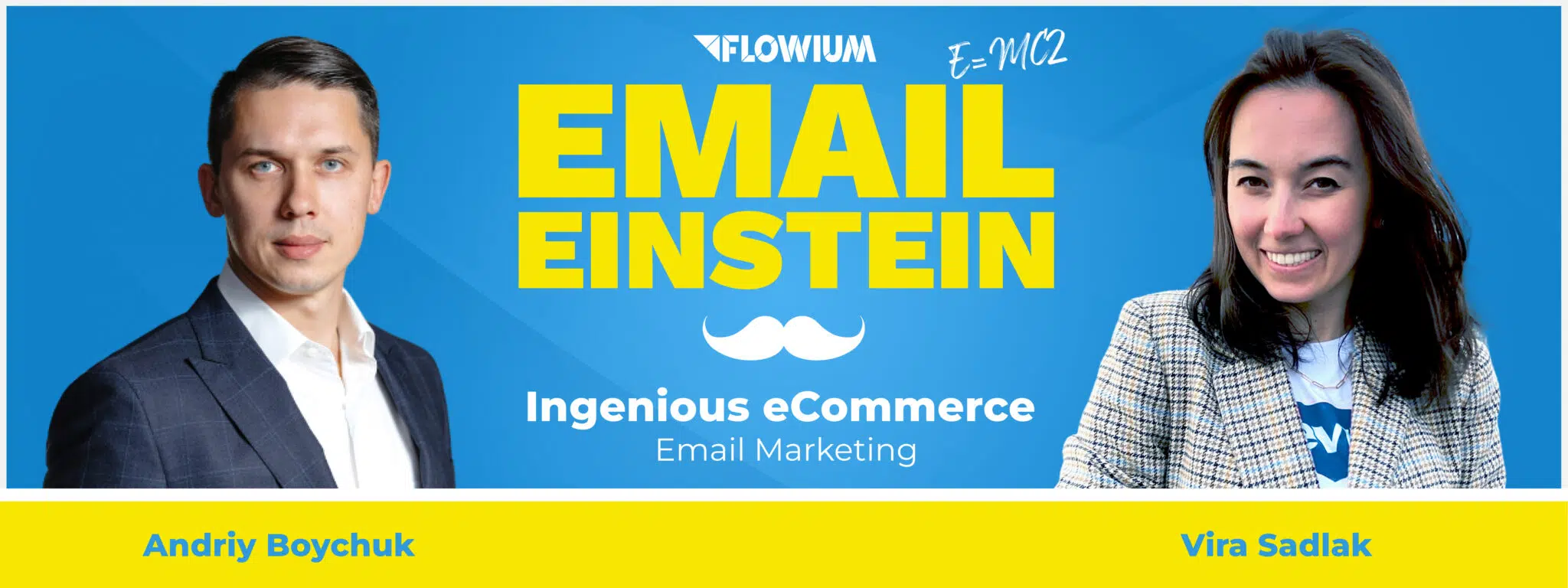
Hello, beautiful people of ecommerce, and welcome back to Email Einstein, the podcast by Flowium. I’m your host, Vira Sadlak, And today I’m joined by my new— that was a drum. Today I’m joined by my new co-host, Andriy Boychuk. Andriy, say hi.
Andriy: 1:00
Hi. Thank you, Vira, for having me and thank you for agreeing to make me a co-host. It took me what, how many episodes?
Vira: 1:07
Like 20? Gosh, I stopped counting after the 18th. I’m joking. But yeah, I’m so happy to have you here, honestly. It’s like doing the podcast on your own, it’s such a lonely journey, you know? having someone, some like actual person to share the ideas with, it’s like so much fun. So I’m like happy to have you here.
Andriy: 1:27
Same here. I mean, I love to hear your voice on every episode, but sometimes it’s like lonely. I mean, I feel bad that you’re just by yourself recording. So I’m like, I’m always offering help to team members in the company. I’m like, okay, hold on. Now it’s time to ask Vira if she needs help. So the episode is once the last episode is last 70. So after 170 episodes, I’m ready record to be a co-host of this podcast.
Vira: 1:55
That’s official now, Andriy. That’s official.
Andriy: 1:57
Listen, tell me a little bit more. What’s up with you? Like, did you move? Is it official or not yet?
Vira: 2:03
I haven’t even discussed it. I mean, technically we are. I’m not officially. I just like moved to my husband’s office for now. That’s like the only move that happened within the last few weeks. But yeah, you guys, for those of you listening, you know, I like currently live in Vancouver, Canada, and me and my husband decided to do this little I don’t know, like a fun change. We’re going to London, London, UK for a year. We’re giving ourselves a year and then we’ll see how it goes. But I love the city and that’s very exciting. And yeah, London. And when people from Canada are like, when I’m telling Canadians that I’m moving to London, they’re double-checking that if I’m going to London, Ontario or London, London, because we have our own London, like with all things London here. No, we’re going to UK. So that’s fun. That’s fine. It’s been a busy few weeks for us for sure. What’s new and exciting with you, Andriy?
Andriy: 2:57
Nothing, just busy Q4 and it’s, I just typically start at like around 10 a.m. and like do a few tasks and it’s already 5 p.m. or 6 p.m. And especially when I have those days on Tuesday or Mondays where it’s like filled up with meetings. I just recently made a post on LinkedIn, say like it’s 3:50 55 PM and I’m done with all my meetings, so I’m ready to start working.
Vira: 3:24
Yeah, you sent it to our Slack as well, I think, to our team Slack or something. It was fun. Yeah, you collected a lot of like understanding vibes from our team because I mean, we’re all in this together. So yeah.
Andriy: 3:38
Yeah, and I finally invested, and I finally, sorry, like I finally invested money in a good camera. So now like people can see all spots on my face if I shaved or didn’t shave.
Vira: 3:49
Not just hear you, but see you as well. Yeah. And see your, like, llama on the background too. I’m, like, obsessed with your—
Andriy: 3:55
I love that llama. This is our, one of our clients.
Vira: 3:58
Yeah.
Andriy: 3:58
She drew it and gifted to me. I, I love that llama.
Vira: 4:02
That’s exciting, guys. For those of you who are just, like, listening us, um, to us on your, like, phone or something, go and check out our YouTube. We are posting our beautiful faces there as well and some cool visual references as well. Andriy. I’m super excited about the topic of the day today, and I know you are too, because that’s something that we’ve been talking a lot with our team. Guys, I want just to hint you the topic that we will be discussing today. So what all of the following brands have in common? Apple, Canadian Goose, Chanel, Hermès, Louis Vuitton. I’m not sure if I’m pronouncing it correctly. MAC Cosmetics, and Peloton. Your wild guess, what all of these brands have in common? Well, too bad you can’t answer because you’re just listening to us.
Andriy: 4:54
No, actually, actually they can. They actually can. They can join, I mean, they can join our WhatsApp group dedicated for podcast listeners and they can engage with us. But they, of course, you cannot answer right now, but in general they can. Yeah.
Vira: 5:09
Well, Andriy, maybe you know what is like, what is like one thing that is common for all of these brands that I just listed?
Andriy: 5:15
I mean, first of all, those are amazing brands and they know it. And there’s a lot of perceived value in those brands. That’s why they don’t have any discounts for their products.
Vira: 5:31
Bingo. These are the brands. And I mean, they’re like so much more of them, but you won’t find them throwing a big discount party like every weekend or even for holidays like Black Friday, Cyber Monday, because Just like you said, Andrii, they have this high perceived value. They don’t want to devalue their— the value of their product in the eyes of their customers. That’s why they stick to strict no discounting strategy. And that’s actually the topic of our today’s podcast. We will be discussing all of these exciting things that you can do instead of, like, instead of giving this, like, discounts. But before we go there, Andrii, what’s your take on that? Discounts. You love them, you hate them. Everyone should use them. No one should do discounting. What’s your take on that?
Andriy: 6:22
As long as you, I mean, if you’re big like Apple, maybe it’s, it’s just, it’s a sensitive topic. But typically we work with brands who are like, like $100 million in revenue or smaller. And I, in my personal opinion, they should use discounts strategically. I’m not saying, I’m not saying to discount, send email with every email with a discount. There are some cool brands, but every email you open, they have some kind of discount, 20%, 30%, 50%. Those kind of discounting I personally do not like, and I do agree with many brand owners who said like, I do not want to use discount to devalue my brands. So if you send with every email, with any, every social media post, some kind of discount, that kind of discounting strategy devalues your brand. However, if you have a discount only to convert your first-time buyers or from second to third-time buyer and you strategically place in the customer journey, I think those discounts are extremely beneficial for small businesses.
Vira: 7:32
Yeah, I think it was like your example. We were talking with you or with someone from the team. You actually said that if Tesla did like a discount on their cars, people would still be buying the cars, right? So it won’t like devalue the product itself. But yeah, you do have to be very strategic with those discount codes. But like on the surface, offering discount codes is a good idea. And I know a lot of brands are doing that. A lot of brands have been doing that. And one fun fact that I found while researching this podcast, I didn’t realize that actually like the discount itself, like the whole economy is built on like helping customers find the lowest deals. And one thing I didn’t realize, you know, Andriy, this app called Honey, this is like a Chrome extension that helps you find like good deals. I had no idea that they were actually been acquired by PayPal for like $4 billion in 2019. Can you imagine like $4 billion? That’s actually one of the biggest acquisitions. I think it’s like top 10 app acquisitions in the history of humankind or something.
Andriy: 8:36
Wow.
Vira: 8:36
$4 billion, which tells you that, yeah, I mean, discounts, they are still here. They’re still too good. There are like a lot of bargain hunters. I’m like one of them, honestly. I have Honey. I have like all this kind of brands. extensions that I’m using.
Andriy: 8:49
Vira, are there any brands that, sorry for interrupting you, but are there any brands, let’s forget about the huge, like big brands, like massive, like Apple. Let’s talk about small brands. Is there any brands that doesn’t matter if they discount or don’t discount, you kind of loyal customer, like you will buy from them anyway?
Vira: 9:08
Yeah. Yeah.
Andriy: 9:09
Which one?
Vira: 9:09
And I, it’s, it’s kind of like I’m trained to receive the item that I want ASAP. So like, say, I don’t know, I wanted this like earrings from Oakenfort and amazing Canadian brands. And I know that they will go on sale in like 3 weeks, probably, because everything will go on sale. But I still went and bought them just because I want that convenience of receiving the product right away. You know what I mean? I’m not trained to wait for certain things. But if it’s like a bigger purchase, say, like last year, there was a certain set of kitchen utensils that I wanted to purchase. And it’s an expensive purchase, like over $1,000 or whatever. I’ve been waiting for that discount code. So I guess it depends. With cheaper brands, I’m less, I’m careless with my money and that’s bad because it adds up.
Andriy: 9:58
Does the food taste better with those $1,000 utensils or is it the same?
Vira: 10:03
100%. Yes. Everyone notices it. It’s not per se utensils, it’s pots and pans. It’s not even $1,000. I think it’s like $1,500 or something. I got them for like $1,100. $1,000, but I’m saying $1,000 because I feel bad. But yeah, they are cool. I’m gonna, I’m gonna give them to my granddaughter someday, probably. I better because I paid like a lot of money for them. So yeah.
Andriy: 10:32
Nice, nice, nice, nice.
Vira: 10:34
Yeah.
Andriy: 10:34
Yeah. How many? I believe we have what, like 15? No, we have 16 no discount strategies that you can use to promote your products, services. And actually at the end, And we will have one very fun bonus, so stick to the end. And also, if you are listening, we strongly recommend to go and rewatch part of this video because we will be showing exact examples, emails, and discussing what they did good or bad in that email.
Vira: 11:38
Right. So the first one is a very popular one, especially among the fashion brands, among the makeup brands, brands that have this like eye items with higher margins but lower price is the freebie with the purchase. Andriy, tell us more about this strategy.
Andriy: 11:58
Yeah, so basically, if you buy a product, typically they have some kind of threshold of how much you need to spend. And typically this is a little bit higher than average order value because the brand wants to increase the average order value. So they are willing to invest in that free product. And that free product needs to be in line with what you’re selling, that it’s beneficial for your customers. So before we go to the example that we have right now, I want to share my story. So I purchased a GoPro 9 back when they released it, and it was a big thing in GoPro world that you will get not only the camera, but also the case for the camera. And that case cost like in China, probably like, I don’t know, like $3 to manufacture. It was kind of a free gift included with the camera. So this is one of the examples. Yeah, but here we have an email from Riffle Paper Co. where they’re offering free gift with a purchase. And as I said before, it’s all that you need to place an order of $25 or more.
Vira: 13:18
And it’s a super cool strategy that I will be using with some of my clients as well. We’ve created, like for one of my clients, we’ve created this bundles of like multiple products. And if you’re getting this bundle, one product is like for free. So say you’re like purchasing the products for like eyelashes, this like extra eyelash serum that wasn’t a part of the bundle will be given to you as a freebie. And we’ve seen like a big, big success with this one, especially because we sort of like changed our language a bit for that email. And we say like, you can purchase this bundle for you, for your friends, or you can just split whatever is in the bundle and just like give it as a little Christmas stocking stuffer gifts and stuff like that. So freebies, I mean, everyone loves freebie. I love a good freebie. That’s like the reason why, why I spend more than I probably should spend. And I know that there are like a lot of cool Shopify apps like Rebuy, for example. They’ve been actually the guest on one of our podcasts where they have this like upsell technique that like at the top of the checkout page they have this this little bar that shows you how much money you need to spend to get a freebie. And that’s actually what we have with one of my clients. They are selling wellness drinks and basically we are encouraging them to spend more, to buy not one case of products but 2 cases of products to get the third one for free. You know what I mean? And it works beautifully. It works like magic. And that’s something that you can do as a part of your checkout experience or you can actually build it into your email marketing strategy. So yeah, I love that.
Andriy: 14:52
One more thing that I would like you to mention about the free gift. I would strongly recommend not to make that gift available for sale. So make it exclusive that if they buy, they will get that exclusive gift. So it would be more unique. And if they really want that gift, they need to make a purchase to get it.
Vira: 15:14
Yeah, that makes sense. I never thought about it this way. For us, it’s mostly like for the clients that I work with, they normally give out the products as a free gift if it’s it’s like the inventory that they need to move around. For example, it’s not like one of their best sellers, so they just like bundle it up with their best sellers and sort of like push it as a bundle, which is also a good strategy, I think, if you have the inventory that you need to move around. The second idea, I love it because that’s the strategy that I’ve been using with some of my clients, back in stock emails. They are amazing, honestly. In one of our previous podcasts, we discussed this strategy and I shared the conversion rates for this back in stock emails and like open rates and click-through rates and stuff like that. Andriy, tell us more about the strategy, why you think it’s a good idea to use it.
Andriy: 16:05
Sure. So it’s a high-intent campaign or automation because people were, are checking out, let’s say on our screen, we are checking out the email from Away, the brand that manufactures and sells the luggage. Let’s say I want this luggage a specific color. For example, my favorite is blue. So I want that dark blue case, suitcase, but it’s not available. But I care about this. So I sign up, say notify me when it’s back in stock. So I already go extra step to letting them know like, hey, brand, I do want that specific product.
Vira: 16:50
Right.
Andriy: 16:50
So first of all, they, it It gives you good signal to the brands how many bags additional product they need to manufacture. It’s one, and a second, they are able to remarket to me later when the thing is available. And again, they don’t need to discount. They just hey, it’s available. We’ll send you. We are sending email. You can buy it right now. That’s it. So zero email. But that scarcity that I would recommend maybe to add like, hey, it’s available, but again, it’s a limited stock. If it’s limited, don’t lie and see how it goes.
Vira: 17:31
That’s a big one. And I love that in like platforms like Klaviyo, it’s like a standard feature. All you need to do is like literally add like a teeny tiny snippet to your website and you’re going to have that field where someone can leave their email address and this will trigger the flow for them. One thing, and Andriy, maybe you know how to do that. I think to be able to pick sort of like the variation of the item, you need to have not a standard Klaviyo solution, but you need to have like some sort of like an app, right? To be able to pick like the size, the color and stuff like that. And yeah, one of the apps that we mentioned in the past, it was like, it’s literally called Back in Stock. And it helps you actually like even pre-plan your inventory to be fair, because you know that we need this green t-shirt, like 25 people wanted green t-shirt in size small. And that pretty much helps you to pre-plan your future inventory. And yes, this is the high-intent email. That’s why we always get huge, huge conversions from those emails and without the discount, just like you mentioned, Andrii. Okay. This one, you probably have more experience with this type of emails than I do because you specifically worked with one of the brands that used this strategy. Product drops or launches and limited edition products.
Andriy: 18:55
Yes.
Vira: 18:56
Tell me more about the strategy.
Andriy: 18:57
Sure. So I mean, the idea here, but you have to genuinely have the limited availability of the product. So you cannot have like 10,000 of specific SKUs and tell, oh, we’re dropping this product, it’s limited edition. So we work with the brand Ruzzles. They sell shirts and t-shirts. with prints of famous movies, TV series, and cartoons. They have licenses with Disney Studios, Warner Brothers, and typically they had drops 2 to 3 times per week, but each drop had between 250 to 500 units. So it was not a big, not big quantity and they had close to 1 million subscribers. So as you can imagine, some sales. Oh yeah. Some products were sold out in a matter of seconds, not even minutes. And it’s cool what we were using doing there. We were sending a teaser email day before announcing that the product is coming. Sometimes we were like hiding or blurring the product and the next day we were sending the email. And the interesting fact was for them we use Klaviyo, but doesn’t matter which ESP you’re using, the revenue was attributed to the teaser than to the launch email. And why? And I’ll explain you why. Because people put it in their like phone or something that that thing will be released on specific, specific time. So they were waiting on the website to buy that item. They didn’t even receive the launch email. They were just waiting at 4 o’clock to buy that specific product. That’s why revenue was attributed to the previous email. But this is amazing strategy if you have limited quantity, you have unique products. This is the perceived— this is not perceived value, it’s a scarcity. Like people want that thing and it’s limited and they want to be there. Like we used to work with Lost Crump and they did the same thing. Some people have 3 devices, phone, their computer, and tablet to buy a box of cookies which costs, what, $150?
Vira: 21:20
Yeah, I wasn’t able to buy it, honestly. I wasn’t like that determined and I like never could catch them, you know, like every time I went to the website it was like sold out. Even if I like say received an email and like went to the website an hour after I received an email, You have to be like very quick with those brands, and I love that for them, honestly.
Andriy: 21:41
Yeah. And in our example, we’re sharing with you the Magic Spoon email where they are releasing their product, but especially only for the fall season, I believe. No, from autumn.
Vira: 21:56
Yeah, yeah. Fall season, pretty much. Yeah. So it’s like a special thing that they are releasing that is like seasonally appropriate, I guess. It’s so much fun. I love those products. It’s like a pumpkin spice latte effect, right? Every time it drops, like every year it’s the same thing, but freaking on like the 3rd of September or whenever they launch it, we have huge lines in Starbucks just because it’s like people know that it’s going to be there for like a limited time.
Andriy: 22:26
Correct.
Vira: 22:27
So yeah, I mean—
Andriy: 22:28
This is a great example what you just shared. like trained people to associate with special, you know, season. And we are kind of trained to feel that smell, that look, pumpkin spice, cinnamon, Starbucks.
Vira: 22:45
Yeah, the marketers trained us well. I actually, I actually read in some book or something that when Colgate, I think when they first released their toothpaste, it didn’t taste like nothing. It didn’t taste like mint. It didn’t taste like nothing. It was just like the nothingness in your mouth. It did the same thing, but it just like didn’t taste, didn’t have that like minty feel. And they were struggling with creating the habit in people to brush their teeth because people didn’t have that like trigger, you know, they didn’t have this like minty fresh feeling that was like associated with the things that they’ve done. And that’s why once Colgate introduced that like smell and that taste of the toothpaste, their sales went up because people were craving that feeling. They were craving that freshness, that routine. And I think Starbucks is doing the same thing. Do I like pumpkin spice latte? Hell no. Were I in that line to get the pumpkin spice latte this year on September 3rd? Hell yes. I’m one of those people and I can appreciate good marketing.
Andriy: 23:52
So, yeah. It’s, um, I have a like childhood memory, like there’s a special dish in Ukrainian Christmas called kutia, and I was always asking my mom like, why can’t we have this dish on any other day? And she’s like, oh, we can’t, we can’t, it’s holiday specific. And I’m like, but we have all the ingredients, theoretically we can make it any other dinner. But yeah, I know.
Vira: 24:19
Yeah. Yeah. So it’s, it’s a marketing, it’s a Christmas Ukrainian marketing too, in a way. Yeah. And I love, and I know that like a lot of even like music brands, bands are doing that. Like a week ago, I went to this like concert of like one of the, one of the bands that my husband loves, Guns N’ Roses, for those of you listening. So we went to their concert and they had this like email list that you could subscribe to, which like big kudos to them. But they also are launching like t-shirts specific to the tour that you can like only purchase during that tour, during that like few months while they are touring. And then you can like flex the t-shirt on your like next concert, and everyone knows that you’ve been on like Guns N’ Roses concert in like 1994 in like Colorado or something, which is cool. I love this idea. And Spotify actually automated this process as well. If you are like a fan of like certain music, I like this example with Avicii. And it’s like an exclusive access kind of deal. So basically they had this email where they were saying to celebrate 10th anniversary of True, it’s like an album of Avicii. So they launched the specific t-shirt, but only 500 units are available for this offer until September 27th, 2023. So you can only purchase it while supply lasts. So yeah, I love this idea. I love this scarcity and I love when brands are actually doing the opt-in. to sign up for first access. It also gives that like high intent of purchasing vibe and you don’t need to discount your products in that case.
Andriy: 25:57
That exclusivity works very well for like all brands. If you’re of course not generic brand like CVS Pharmacy or Walgreens Pharmacy, but if you have some uniqueness to your brand and you have some kind of fan base or community, the exclusivity works perfectly.
Vira: 26:16
Yeah. One more strategy to use, and a lot of brands will be using this strategy during the holiday season, just like watch it. It’s double the loyalty points or different loyalty VIP program perks. Andriy, tell us more about it.
Andriy: 26:31
Sure. I mean, first of all, you need to have a loyalty program, which, or rewards program, so your customers can collect those points or whatever you call them to spend as a cash in your store. We’re strong believers in the loyalty programs because we see what kind of results it generates for brands. But the strategy here is to, instead of giving them 10% off, 50% off, whatever your discount is, you’re giving them some kind of incentive for their purchase, but in terms of your internal company money. So for example, if they spend $1, you will give them 2 points or 1 $1, 1 point, and then they can use those points toward the future purchases. One tip that I got from Hannah from Loyalty Lion, she’s partner manager and we just been together in Spain for workshop, like agency workshop thing, and she recommended not to give like 1-to-1. Because it’s— people can see how much money they already spent and they might feel bad that they spent so much money, you know?
Vira: 27:48
That’s, that’s cool. I never thought about it, actually.
Andriy: 27:51
Yeah. So it’s better to do like 1 to 15 points or 1 to 10 points or something that is like harder to figure it out.
Vira: 27:59
Like harder math. That’s interesting because like every time Starbucks is doing the double points day, I’m there. Like, I’m freaking there and I have an excellent coffee at home. Like the best. I spend like a lot of time searching for coffee. I found the one But every time Starbucks has like sent me this like double points day, go to Starbucks and get twice what you normally do, I’m like, get it, I’m going there.
Andriy: 28:23
Yeah. And there’s benefit for double points, triple or quadruple points. There’s 2 benefits. First benefit, if they are not loyalty member yet, they have to sign up. So it’s like given, it’s like they have to sign up. So first you are winning the new loyalty member. which will bring more revenue to your store, higher lifetime value, higher AOV. This is number one. But number two, they are more incentivized to buy today or during that specific promo period. As like Vira’s example, Starbucks does a good job with marketing to Vira.
Vira: 28:58
Yes.
Andriy: 28:58
With double points.
Vira: 29:00
That’s true. To be into coffee.
Andriy: 29:01
Do you still collect those points?
Vira: 29:03
Oh yeah, I’m like golden member. That’s embarrassing. Yeah. Back in the day, they actually had— I came later to this country, so I’ve never experienced this greatness, but they actually had the cards, like physical cards, the golden whatever cards that they were giving to their members. And they had real platinum cards, like physical platinum cards that only few people in the entire world had. That was like, you’re the top of the top.
Andriy: 29:30
That’s such a genius idea. Like, I don’t understand why brands don’t do that more. People do like touch something. They like physical things.
Vira: 29:41
Yeah. No, but you don’t, you don’t want to like carry those things with you all the time. No. I mean, right now everything is on, in, in the phones. So it’s like, that’s why more and more brands are opting in for like pop-ups or sorry, I mean, apps, right? Yeah, so actually I love this double points, um, thing. And one of the challenges that I have right now before like I’m leaving country for a year, I’m like trying to use all of my points for everything that I’ve collected just so they don’t go bad, you know. So I’m like, I’m going to McDonald’s every second day because I have a ton of points. I’m like going to Starbucks. I’m like shopping around with all of the points that I’ve collected. Okay, cool. Let’s talk about another strategy, uh, that a lot of brands will be using around the holiday Season, especially out-of-stock strategy. I feel like it’s very similar to the back in stock, but what’s the biggest difference, Andriy?
Andriy: 30:30
So out-of-stock is to build the perceived value of the product. And when they receive back in stock, they’re more likely and faster to react and to buy because out-of-stock is just notifying everybody like, hey, Hey, we had such an amazing product that it’s sold out and it’s not available and you are not able to buy it anymore. So kind of like building that, like, you know, like perceived value and advance scarcity. If they drop that product, they know, oh, it was out of stock. I need to buy like as soon as possible because other people may buy it.
Vira: 31:14
Yeah, I probably wouldn’t send it to everyone, honestly, this email. I would maybe only send it to people who have expressed some interest in this specific product or this specific collection. But that’s just me. Like, depending on your strategy, maybe you want to—
Andriy: 31:27
I agree.
Vira: 31:27
Know, like, everyone on your list to know how cool this product was. But be careful to not exhaust your list with, like, too many emails, right? That’s always, that’s always a problem. Okay, next strategy. I love, love, love this strategy, especially around the holidays. Bundling up your products or selling bundles. Andrii, why do you think this is a cool strategy for brands that are not doing the discount You’re kind of discounting, but you’re not like flashing, saying like, hey, it’s like 50% off.
Andriy: 31:54
You’re just saying like, hey, we have this cool bundle. And if they do the math, yes, it’s cheaper, but it’s not your main point. Your main point is like, hey, we’re putting those like things together and they’re like complementary and so forth. So there are a few benefits. Like, first of all, you can move more products, and second, you can increase the average order value.
Vira: 32:17
Right. And that’s a huge one. That’s a huge one. And people love a good deal, love a good, good, like, bargain. And especially if your brand is not doing the discounts, like regular discounts, this is your way of giving your customers the chance to save on the products, especially on the products that they love. And again, you can bundle up, like, different things. You can even bundle up your bestsellers with a product that is, like, a slow seller. sell, right? And you can still like move the inventory around. That’s a cool idea. The idea that I like even more, honestly, is the free swag or free sample. And I’m a big, big fan of those bundles. And I think Sephora, the cosmetic brand, you guys have it in the US. I’m pretty sure.
Andriy: 33:04
Do you mean like you said bundles, you mean samples?
Vira: 33:07
Because samples, yes. Sorry, I mean So the freebies and samples, and I think Sephora is doing an amazing job. First of all, they build this amazing ecosystem with like the surveys that they send you and collect information about you. You can like volunteer some of your information and collect points, and then that points can be used towards your future purchases. But also you can pay. A free sample with every purchase. You can pick a free sample of a product with every purchase. They give you like 6 options, and I love that they are only giving you 6 options and not like everything. And you can like manually pick what you like. And this product, they are actually this like freebies or samples, they are actually based on your preferences. So say if I’m like not into makeup, but I’m more into skincare, they would never recommend me a makeup because I volunteered my first customer data or zero-party data or whatever. I volunteered it to them. They are doing an amazing job. And talking about them, I have so much appreciation to them, but also at the same time, I spend way too much money with them, especially working from home that I don’t even need all of this amazing makeup products and stuff. I still spend way too much because they are so good with all of their marketing. Yeah.
Andriy: 34:30
Yeah. So free swag was a purchase. I love that idea. First of all, it’s free marketing for you, like a customer wearing your t-shirt or carrying the bag with your logo, with your information. And personally, I do love to wear brands that I care about, their shirts, their products. So either it’s Klaviyo or some other platform, like I’m talking about SaaS right now, But also I was listening to the book about Lululemon, The Black Pants Something.
Vira: 35:06
Yeah.
Andriy: 35:07
And he was describing how they came up with that bag where they put their mission on the bag. And I’m like, whoa, this is so cool. And I want— I mean, I never tried Lululemon. I’m not sure if I will be their customers, but honestly, I do want to have that bag. I don’t think they have have anymore, but they do.
Vira: 35:25
They still do have it. Yeah, that’s actually— I mean, they changed it for some time. And for those of you guys who don’t know, Lululemon is an athleisure brand. And every time you would purchase something from them, they had this branded Lululemon bag. It was reusable. So it’s not like one of those paper bags or plastic bags. It was reusable bag. And people were using it to go to the gym because at some point it was a symbol of status, right? Having the Lululemon. Not anymore, but at some point it was, and they put all of their values on the bag. So it looked cool, but it also communicated the message, like what this brand is about and what I am is about since I’m like the part of this crowd, right? Since I want to associate with this crowd. And they actually discontinued the bags for a bit, but they are back and I love that. And I have gazillion of them. I never like throw them away. So, Andriy, I can give you a few if you want. You will be one of those like cool guys in the gym, cool kids in the gym. Yeah, I love this idea. I love the free swag. And one of our clients actually, they sell the pet products and the pet supplements, and they were giving away the poop bags for, for like pups, but they were like branded with their branded logo and everything. And the cost of that product, like to manufacture it, it was probably like a dollar or something and where they order it from. But when we send the campaign, like giving that freebie of the product, with their brand on it, it was like one of the best performing campaigns of the year because everyone loves that product anyways, right? Everyone uses it.
Andriy: 37:05
I never thought about that, but you just remind me. So I was volunteering for one organization to help Ukraine, to support Ukraine. And there was a festival, Ukrainian festival here in New York City. And we were like, I was behind the fundraising money and we were kind of selling some goods like t-shirts, stuff like for Ukrainian. And some people came and like somebody give $1, $5, just kind of as a donation, nothing. And I’m like, hey, wait. And anybody who give any amount of money just because not to buy anything, and I say, hey, hold on, here’s a sticker, here’s a pin, as a kind of thank you to them.
Vira: 37:46
Mm-hmm.
Andriy: 37:47
Almost 80% of those people pull out the wallet and give more money. So it’s like, it shocked me. Like, I didn’t do it on purpose. I just want them to have something. And they feel kind of, I don’t know, like either obligated or, and they kind of gave more money.
Vira: 38:05
So that’s cool. That’s a, that’s a really cool example. See, you’re just like a natural marketeer. It’s like a built-in function in you now. That’s cool. The next strategy that we want to discuss is probably something that you’ve been using a lot, free shipping or complimentary shipping. It’s like a phenomenon. Every time I shop somewhere and I spend like a lot of money, but then I have to pay like $500 bucks for shipping, I’m like, forget it, I don’t need that. And I know that I’m not the only one. We discuss it with my friends all the time. That’s why the free shipping is still a big, big deal, especially you guys, if you’re planning something for December. December 14th is the International Free Shipping Day. A lot of brands will be doing that. So think about like introducing that on December 14th. And for a lot of brands, December 14th is like the last day in the US. I’m not talking about the other countries, but in the US, it’s like the last day to order For the brands to be able to deliver it in time for Christmas, so such a cool idea. We always are doing that. It’s sort of like a last call to order before Christmas. Free shipping works every time. Honestly, I have one client that always offers free shipping, like always. That’s a part of the deal. But every year on December 14th, when we offer, when we talk about the free shipping, our sales go up like every freaking time. So people still do like it. So definitely use it.
Andriy: 40:15
I would, I would be interested to split test free shipping for complimentary shipping because complimentary shipping has more value to me. I mean, this is the same idea, like you get this for free, like $0, but complimentary, it means like value. Free, it means like some kind of like discount. This is my few cents.
Vira: 40:37
That’s an interesting take. I never thought about it. Complimentary does sound more exclusive. Yeah.
Andriy: 40:44
And I believe more than 50%, the reason why people are abandoning their cart, the majority, the biggest percentage because of the shipping. So typically like more than 50% people abandoning their cart because of the cost of the shipping.
Vira: 41:00
Right. My client, one of my clients, they learned it and now they offer free worldwide shipping, which is like to me insane, but they kind of like figure out the the way to do it, like, in a smart way. And yeah, free worldwide shipping. I wish we could, like, tell their name so you guys could try their amazing products. But yeah, free shipping, cool idea. Definitely use it, especially on December 14th. Another one is interesting, and I know this is your example, Andriy. Free return. Tell me more about it.
Andriy: 41:33
So especially for those brands who sell shoes or clothes, like apparel, and you buy from them first time, or maybe you did not buy specific product. I’m not sure how about you, Vira, but for different brands, for some reason my shoe size is different.
Vira: 41:51
Yeah.
Andriy: 41:52
For Under Armour, it’s like 9.5, for Adidas is like 9, for Roses is like something different. And I’m like, do my like size change or it’s like brand? So it’s cool to have this free return. Again, no discount, maybe you charge for shipping, but you have a free return. I think Amazon does it right now with the wardrobe, Amazon wardrobe. You can even don’t pay until you keep it, something like that, like pay later or something.
Vira: 42:25
Oh, that’s cool.
Andriy: 42:26
They give you 14 days to try it. Yeah, you have 14 days to try it. And I think a few of our clients did the same. In the past, they ship you, you try it, and let’s say if you don’t return in 14 days, they charge your credit card then.
Vira: 42:41
Oh yeah, I think they’re like this kind of like not subscription boxes, but basically like every— I know there’s this service where every month you’re getting like the surprise items from the brand. They obviously know your preference, know your sizes and stuff like that. You get the surprise box from the brand on like the discounted price and then you can like return certain things and keep certain things and they will only charge you for the things that you will keep, which is, which is great. It’s just like they need to build in that into their business model, right? They need to think about the cost of return.
Andriy: 43:16
We do have it as this kind of subscription. It’s like Lit— I don’t know how to pronounce this— Literally. So it’s basically subscription It’s a box with 5 books which comes every month to us, to our house, for my daughter Carolina, 3 years old, and 7 years old, like Angelina. So they have separate boxes. And how it works, we pay like $12, but if we don’t return, and sometimes we forget to return, so that box becomes from $12 to almost $70. But each time they ship different kids’ books. By the way, you need to maybe contact them and put your books there.
Vira: 43:59
That’s a cool idea. I’ve never heard about this service. Literally, they call? I’m gonna Google them.
Andriy: 44:04
Yeah, like literally. Like, you know, like the cool brands putting LI, LY at the end.
Vira: 44:10
Yeah, like a weird spelling thing.
Andriy: 44:12
Yeah, like the other cool brands putting IUM at the end.
Vira: 44:16
Yeah, I know a few. I know a few like that.
Andriy: 44:21
Did you get my joke?
Vira: 44:22
Did you get my joke? Of course. Wink wink, Andriy. Flow ium. Flow ium.
Andriy: 44:28
So we will, now we will have like dad’s jokes on the podcast.
Vira: 44:31
Yes, please. Yes. I missed, I missed your dad jokes. No, I honestly do like the free return policy. I know a lot of brands are specifically offering this policy around the holidays time, but a lot of brands that, like, fashion brands that we worked with or, like, the brands that I follow, they, like, introduce this, like, apps on their website that help you to pick the size. It shows if the item is, like, true to the size based on the feedback from the customers they’ve collected and stuff like that. And that helps them to, like, minimize the returns because it still costs the brand to return an item. Okay. One more strategy that you Andriy added to the board is that percentage of sales go to charity. Why do you think it’s a good idea for brands that are not discounting?
Andriy: 45:22
Because it shows the cause you’re— so first of all, why people donate? People donate, I mean, because of the cause and how they feel after the donation. Some people feel fulfilled, some people believe that they’re making a greater world. So basically there’s 2 things happening. So first of all, they buy products for themselves. They already you feel good because they need that product for any reason. And second, they feel good, they feel even better because they do something great. So it’s a— yes, it’s a percentage, but it’s not discount. And I believe the company, the brand shows them from humanitarian perspective.
Vira: 46:07
Yeah.
Andriy: 46:08
It’s like, hey, we care about X, Y, and Z cause and we’ll give X percentage or X amount to specific brand.
Vira: 46:16
Yeah. I know a lot of like brands, Ukrainian brands specifically are doing that a lot these days, a lot of organizations and stuff like that. And when I have a choice between like 2 like similarly priced items, one even like more expensive, I feel better about like buying the more expensive one, but the one that would support a cause. And I know that like the Tuesday after like the Black Friday, Cyber Monday is actually the Giving Tuesday. Um, and a lot of brands will be like capitalizing on this holiday, donating to the cause that they support or to the cause that is like close to their brand. And, uh, yeah, that’s a, that’s a really cool strategy to try. Yeah.
Andriy: 46:58
True.
Vira: 47:00
Cool. Andriy, do you have anything to add to the, uh, charity side of things? I know you are active in this community.
Andriy: 47:08
There’s 2 things. Uh, first thing, there’s now there’s some apps available that you can add to the checkout so they can choose even to which charity you want— they want to donate. So basically you tell them that we’ll donate, let’s say, 5% or $1 or $20 to a charity of your choice. And in the checkout, there’s like between like, like 2 to 5 different charities.
Vira: 47:32
Mm-hmm.
Andriy: 47:33
And the person who— the buyer is choosing who they want to donate So, so this is option number one. And I just want to give a shout out to Viking Waffles. It’s, it’s protein waffles that we love in our family, like to, to consume more protein on a daily basis. And they did a collaboration with a nonprofit that I was volunteering for in the last year called Razom for Ukraine, and they donated 20% of sales.
Vira: 48:05
Wow.
Andriy: 48:06
Of sales. Which is—
Vira: 48:07
Shout out to you guys. Shout out to Viking Waffles for supporting an amazing cause. No, that’s a, that’s a really cool idea. I love that. I love that. Yeah. One more idea that I personally love, but it does require a bit of a, like a creative work from the brand, is the free resource with the purchase. And I know like a lot of makeup brands are using this strategy. Basically, the idea here is that instead of giving your customer like a discount code. You can provide some useful information about how to take care of this product that you just purchased, or maybe you provide some information on like how this product can be used and like what cases, or you— how you can like style this certain item. I remember back in the day we worked with this like yoga pants brand, and the email that became a hit for all of our customers was like the post-purchase email where once you purchase the certain leggings, and that was the post-purchase email for specific kind of yoga leggings or yoga pants. We showed them like 10 ways to style your leggings, and there was like an actual photo or actual photos of the owner of the company, and she created like 10 different outfits, and she showed how to style these leggings. It was so cool, so sweet, and we got a really good response from the community. And yeah, There are a ton of ways to do that. I know some brands are doing a Spotify list or something like the productive— how do they call it? Productivity journal. I think this is the 5 Minute Journal brand or whatever. They have the productivity playlists on Spotify that they send you the link to once you subscribe to their emails or the list of recommended resources for this specific topic. That’s a cool idea. It costs you nothing. I mean, it costs you your time and your creativity. creativity of your—
Andriy: 49:59
Yeah, you have to invest once, you have to invest once. We used to work like a long time ago with markers, they were selling markers, coloring markers to like for art and on the back end they had different courses which they will give, was giving away for free with certain amount of purchase. So basically they were also, I believe, selling those courses but if you purchase with them them like so many markers, you got that course for free.
Vira: 50:28
Oh, that’s a cool idea, especially if they had this product anyways. That’s actually something that I’m doing with, with my like book that we launched on Amazon. With Amazon, it’s like very challenging to get customers like email because Amazon wants to keep their customer on the, on the Amazon site, obviously. And obviously we want to build our email list. And what we’ve done for all of the books that we have, and it’s like children’s book, there is like a little QR code in like a few places now. At first, we only had it in one place, but now we’ve added the same code, like, in multiple locations that you can scan and you can get a freebie, like, a free coloring page based on the, based on the book. And you can also get a free poster that you can, like, print. It’s like a big size. You can print it. You can hang it on your child’s wall in their room. And it’s in, like, an inspirational poster with the main ideas from the book, like, in one post.
Andriy: 51:18
You know what would be more cooler? I’m not sure if even if it’s possible. You know those like dots, dots, uh, pictures that you have to connect dots and then you have a picture? And it would be cool to connect those. That works too. Yeah, with a, with a kid in your book, not to print out, not to download, but in the book you connect the dots, but to get the result you have to scan. And this is kind of the kid more invested, and if the kid more invested, the parent, trust me, will download that thing.
Vira: 51:48
That’s cool. That’s cool. Yeah, I think my husband, who’s a co-author of these books, he’s very good with capturing children’s attention in these books. And in every book, we have a little poop hidden somewhere in the book, and the children have to find it. And all of our kids who we talk to, they are going crazy for this little detail. It’s so silly, so stupid, but kids love it, and it’s their favorite part of the book. Anyways, kids are weird sometimes, but I love them. so much. They’re like so cool. But yeah, I mean, there are like different ways of providing the value without actually giving the discount codes. A few more strategies, very, very quick. Buy one, give one. It’s very self-explanatory. But basically the idea here is that you can buy one item and one item will be donated to like a certain organization on your behalf.
Andriy: 52:40
And I think TOMS, I think TOMS, the shoes, this is kind of— I think they either come up with a strategy or they repurpose, but they become the most popular with this strategy. If you’re not familiar, they produce like shoes and when you buy a pair, they will donate to Africa, I believe to Africa, kids in Africa, another pair of shoes.
Vira: 53:07
Yeah, that’s basically why their company started because the shoes itself, like a lot of brands are selling the identical shoes. Like the Skechers have them, like other brands have them. It’s like a very simple, simple shoe, but that’s how they became huge. But it was like back in, I don’t know, like 2012 or so, 2014 or something. But I still see like a lot of people wearing them. Andriy, what other strategies do you think we should cover?
Andriy: 53:34
I think you come up with a strategy, or at least I know that you Is this like Buy Nothing Day? Oh, hold on. Is this— there’s actual day like this? Buy Nothing Day?
Vira: 53:44
I don’t know about the Buy Nothing Day. I know that we like use the similar strategy with like a lot of my brands. Again, teasing the upcoming promotions, like saying like, don’t buy anything today, but like buy something on like this day. And we always got like big revenue. But now when you shared your like Roosevelt experience, example, I think what happened is basically like a lot of revenue was attributed to this campaign because people actually were waiting for that, for that like drop to happen or like the price drop to happen and they went and purchased it even without like opening the second email that they received or something.
Andriy: 54:20
Okay, here it’s like you need to be playful brand to do this. Like if you’re like a specialist, it will not work. But the idea here is like, hey, do not buy. And, you know, like where they have those red buttons and say, do not push. And people like, almost, I want to push it, you know, or like, don’t touch anything here. And like, can I touch something? This is the psychology thing. Don’t buy anything. Don’t buy nothing.
Vira: 54:49
And— Yeah, yeah. You don’t, you don’t tell me what to do, right? It’s kind of like, kind of like that thing. And I think maybe it was you who shared it in one of our Slack channels or Someone from, um, our colleagues, they emailed with like a little, uh, red do not push button, um, that like in the hero image that people were like clicking and it was like lifting the click-through rates up like crazy.
Andriy: 55:13
Oh yeah, it was, um, it was from MrBeast campaign. No, you have to click 500 times to get the discount.
Vira: 55:20
Oh, okay. Or, or like that. Yeah, this is how, this is how it works. No, I love these guys. They’re so creative. Okay, cool. Display limited quantity messaging. We kind of covered it, but yeah, there’s brands that have like a higher, that they have like a higher perceived value, you know, that they don’t like that Hermès don’t have like a gazillion of bags, that there’s like only a certain amount of bags that you can purchase and that’s why you have to act quick. So that’s pretty much—
Andriy: 55:50
I think the perceived value I mean, we discuss about the perceived value a lot, but let’s say if you sell, just hypothetically, if you sell, let’s say, iPad and you have an iPad with certain application already installed on it, there are perceived value of the second where the applications are installed has the value of that iPad is much higher.
Vira: 56:16
Right.
Andriy: 56:16
However, it’s like nothing changes, only the perceived value. Okay, what do we have for bonus?
Vira: 56:23
That’s a fun one. It’s actually your example, but I’m loving it. I’m like thinking how to convince my clients to do that. Andriy, share it. It’s like your example. Go with it.
Andriy: 56:35
So basically it’s a combination of a few strategies that we discussed, but this is the first time we both, me and Vira, heard about this. It’s from Chamberlain Coffee. Chamberlain Coffee. It’s random refund. We are randomly refunding 5 orders today up to $100 each. So basically it’s kind of giveaway, but not giveaway. So you purchase, you spend that money and you surprisingly get the refund back. I’m just interested to know how they communicate to the client because client might think, oh, they will not ship it to me or something, but this is cool strategy.
Vira: 57:14
That’s a cool idea and I’ve never seen it. And I like how you compared it with like a giveaway, but this is like not necessarily giveaway because you have to purchase to be able to participate, right? So that’s a, that’s a cool idea. I mean, I love it. I wish I could try it with some of my clients. Who knows, maybe I’ll convince them to give it a try. Yeah.
Andriy: 57:37
Try it with baby boomers brand.
Vira: 57:40
Oh, with baby boomers, they love a good, they love a good deal. Yeah. Maybe, maybe that’s actually one of my favorite clients to work with. It’s just like they are so, they are so predictable. You know what I mean? It’s like they love a good email, like the same time, same kind of like structure and everything. They like structure and I love them for that.
Andriy: 58:05
Yeah.
Vira: 58:06
Cool.
Andriy: 58:06
It was a whole episode.
Vira: 58:08
That was an intensive one. But you guys, it’s this, all of the strategies that are evergreen, no matter if you’re listening to this podcast, like before the holidays or like after the holidays, these are all of the really good evergreen strategies that you can implement to your no discount brand. Or even if you’re doing the discount codes, a lot of these strategies, they can be like combined and fit into that like ecosystem of yours. Yeah. Yeah. Awesome. Well, Andriy, how was it? How was your first episode as a co-host? Technically first.
Andriy: 58:39
I love it. I love it. I love because first of all, I learned something new. Second, I share something and I have time to spend with you to chat about email marketing and marketing in general. It’s nice to bounce the ideas from somebody.
Vira: 58:53
Yeah. Yeah. It was fun. Thank you so much, you guys, for listening. If you have any questions or any topics you want us to discuss here or any guests you have in mind, for the podcast, please let us know in that WhatsApp channel that we will share the link.
Andriy: 59:08
Or if you have any clients to refer, refer us.
Vira: 59:10
Oh yeah, absolutely. Absolutely. We love a good, we love a good referral. So yeah, definitely. Let’s, let’s stay connected there. It’s like fun to talk to you guys and we hope to have you back here next Tuesday. Thank you so much.
Andriy: 59:24
Thank you.
Vira: 59:25
Take care.

Vira Sadlak
Podcast host, marketer, traveller and a life lover from Vancouver, Canada