

Podcast Transcript
Vira: 0:41
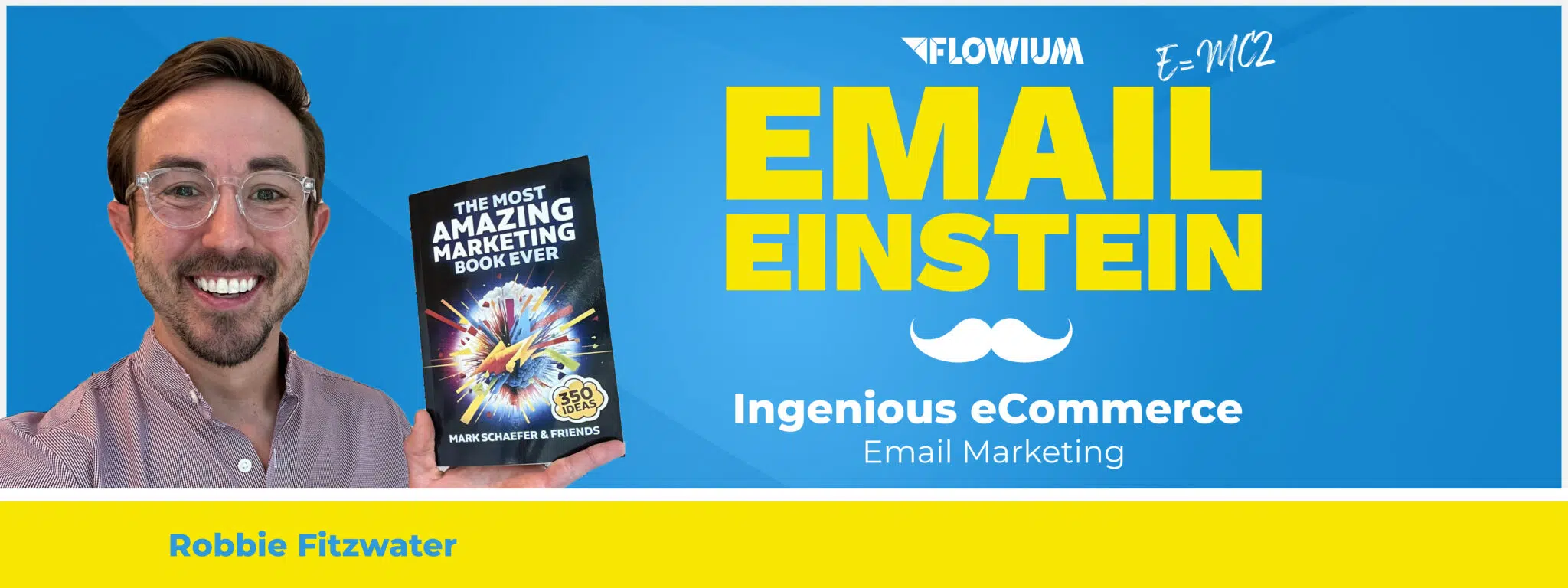
Hello, hello everyone, and welcome back to Email Einstein, the podcast by Flowium. I’m your host, Vira. Today I’m joined by the guest that many of you guys have met already, but we are happy to bring Robby Fitzwater back to talk about his new book that he co-wrote with other marketers. So for those of you who don’t know, Robby Fitzwater is a brilliant educator from Clemson University, and he’s the mastermind behind AMK TG Rhythms. That’s basically like an agency that he runs. He basically helps businesses, DTC businesses with their email marketing strategy, SMS strategy. He helps grow businesses through retention marketing in addition to converting more new customers. Robby, we’re super, super excited to have you back on this podcast. Say hi.
Robbie: 1:40
Hello, Vira. Excited to be back. Yeah, excited to talk shop on with you guys again. I think I mentioned this last time, I’ve been a fanboy for a while now and honored to be back. So yeah, this should be fun. I do have a question though. Am I one of the first repeat guests?
Vira: 1:58
No, you’re not. We do get quite a few of them, but you’re definitely one of our favorites. So not that we play favorites, but we’re glad to have you back.
Robbie: 2:08
That’s for sure. Okay. I’ll be riding off that being one of your favorites all day.
Vira: 2:14
Probably the guest that we’ve had the most on our podcast is Andriy Boychuk. But I mean, we might be biased. We love him. He’s kind of a shill of me. Right? Yeah. We had him on podcast quite a few number of times and he’s coming back to our podcast for those of you who are listening next week where we will be talking about AI in email marketing. So yeah, cool. But for those of you who, for those of our listeners who haven’t met you, let’s play this little blitz Q&A game, like this or that kind of game, just like to get to know you better. It’s very informal, it’s very casual. So just like answer with the first thing that comes to your mind.
Robbie: 2:54
Okay, I’m in.
Vira: 2:57
Let’s do this. Okay. Ebook or paper book?
Robbie: 3:00
Audible.
Vira: 3:02
Audible. Okay, well, I guess the next question is not— I guess the next question is not very relevant because my next question is reading or listening.
Robbie: 3:10
So I’m all Audible all the time. I struggle with physical books. They’re a little bit of a challenge for me, just getting the time. We have our son and another coming up, coming soon, and then plus teaching and running a business. Not a lot of, not a ton of time. So squeezing an Audible book in makes all the difference.
Vira: 3:33
What’s the last book you listened— what’s the last book you finished on Audible?
Robbie: 3:38
It sounds really weird. The Legend of Bagger Vance. It sounds really strange, but if anybody listens, if anybody out there has listened to The War of Art, the book by Steven Pressfield, it was one of Steven Pressfield’s first books. It’s really random, but it’s one of the best books I’ve ever read. I’m not kidding. It’s one of my favorite books, and I’ve reread it a few times now. So I relistened to it a few weeks ago just for fun.
Vira: 4:06
Cool. Okay, guys, all of the resources that Robby mentioned in this episode, or that he will mention in this episode, they will be in the description box as usual. So just scroll down if you want to listen to that book or read to that book. Scroll to the description box. Okay. Early bird or night owl?
Robbie: 4:27
Early bird all the way.
Vira: 4:30
Shopping online? Okay. Shopping online or shopping offline?
Robbie: 4:35
Shopping online.
Vira: 4:37
Sorting by price or by relevance?
Robbie: 4:41
Definitely by relevance.
Vira: 4:44
Email or SMS?
Robbie: 4:48
For me, my SMS inbox is constantly exploding more than I’d like it to. There’s some more red dots than I need. I’d say email.
Vira: 4:58
Cool. Yeah, I’m on the same page here. I mean, I’ve been very skeptical about SMS before it came out. Now I love it as a marketer. As a user though, I still prefer email. It just feels less intrusive. But I do appreciate good SMS marketing as well. So yeah, interesting. Okay, Robby. So tell us about your new book that you co-wrote with other marketers. So the book is called The Most Amazing Amazing Marketing Book Ever. More Than 350 Inspiring Ideas. So you co-wrote it with other marketing professionals. Tell us more about it. What sets it apart and what earned it the title of the most amazing marketing book ever?
Robbie: 5:48
So yeah, no pressure with the title. No pressure at all with the title.
Vira: 5:52
No title whatsoever. No.
Robbie: 5:53
Yeah. So we basically, what inspired this was one of my friends and mentors, Mark Schaefer, has been a consistent marketing author for a while now. But basically, he has a Discord channel that he’s had for about a little bit over a year. And inside this channel is a lot of really smart marketers. Some of them are authors, most of them are, again, VP-level, busy, high-level marketers that have been doing this stuff for a while. And we realized, hey, There’s a really great wealth of knowledge inside of this group. And a lot of this group has been interested and excited to try publishing for a while, just have never been able to kind of actually make that happen. So, after a while, everybody kept having this conversation that it’s like, hey, how can we write a book? How could you do this? And eventually ended up deciding, hey, why don’t we all take a narrow lane that basically everybody has some level of expertise in, and let’s write a book around it. So basically, the end result is 34 authors writing generally a chapter apiece, and that turned into a pretty impressive marketing book from an expert in that category. So anything from email marketing to like AI and marketing to every channel in between billboards, billboards, traditional, social, every social channel, and basically high-level view of 10 actionable recommendations for each of those categories from and like starting with marketing strategy, and so on and so forth. So it’s, it was a really fun process. I actually ended up writing 2 chapters, which is kind of intimidating, but learned a lot through the process and had a lot of fun. And basically, it’s a group of real rockstar marketers that are— I was honored to be a part of. So it was really neat. And I got to write a chapter on email marketing and then a chapter on the 4 Ps of marketing, which is like an old-school academic marketing concept.
Vira: 8:08
Right. No, I really like how you guys structured the book and that you do have a ton of actionable strategies or actionable advices that people can use in their business, which is awesome. So next question, since you wrote the chapter about email marketing and since you’re an email marketer yourself, you might be a little bit biased, but Robby, is email marketing dead? We get this question all the time still for some reason. So is it dead or is it not dead?
Robbie: 8:38
So this is one thing that I talk about in my chapter a lot. Email marketing has been around forever, but it’s like the cockroach of marketing channels. It like won’t die. Again, I think the first article that said email marketing was dead was published in 1989.
Vira: 8:55
Okay.
Robbie: 8:55
Which is before a lot of people on this call were born. So, or on this, listening to the podcast were probably born. So it’s been talked about as being dead for a while, but because it’s so ingrained in our lifestyle, Really, if you’re a professional in the real world, you have to use email. Like Slack and other channels are kind of taking a bite out of email in some cases, but it’s not going to go away. If you sign up for any service, your email is your unique identifier. You can’t sign up for Netflix without an email. Right. So basically email is that default kind of like layer that’s running in the background of our lives all the time. So reaching people through that channel makes a lot of sense. And I think the analogy I make in the book is, like, email is kind of like a cockroach. And a lot of people do approach it like a cockroach. They don’t really like it. But if you approach it in a way that’s gonna be, like, meaningful or valuable, and, like, maybe not so much a cockroach in your house, but, like, a kitchen utensil or, like, a houseplant, like, it’s gonna be a lot more effective and gonna bring a lot more joy.
Vira: 9:58
Right. But why do you think this is still the case? As you said, Email has been around for like 40-something years, yet a lot of businesses still struggle with getting it right, with doing email marketing right. Why do you think this is an issue? Why do you think this is the case? And what are some common mistakes you see businesses making in their email marketing efforts?
Robbie: 10:23
So this is one area where it— email doesn’t always get the credit and respect it deserves. Everybody does email as a person, so everybody thinks they have some level of expertise in it. And with every new shiny marketing channel, everybody gets excited about what’s new. Marketers are generally a group that’s really excited about what’s new and what’s possible. And email being typically a more established marketing channel, it’s been around for so long, nobody really thinks about it in the way they possibly could. And personally, like, I spent the majority of my career working as a director of social for a major university, and I didn’t take email seriously until I started working in the e-commerce space. And I was like, wow, I’m doing the same thing I was doing on social, but I’m not battling an algorithm, and I’m 3 steps closer to the cash register. And I’m absolutely blown away because this is so easy, and I’m having a lot of fun because I get to maximize the content I already have. and get to use it in really unique and different ways. So I was kind of mind-blown at that point. But the way that people like get excited about new channels, like again, TikTok or Threads, if they would spend a quarter of that time and attention on just getting— doing email well or caring about the end user, they’re gonna have a big benefit at the end of the day because they are gonna see a lot of really strong results for their business. And I also think some businesses in the ecommerce space can get really excited about the short-term gains and they burn out their lists and may not even necessarily realize they’re doing it. So once they start to position themselves as like an always-a-sale brand, it’s really hard to get to back out of that. And it’s not really a great place to be because that’s the only thing you can really do at that point and you’ve trained your audience to always expect a sale. And it can be kind of pigeonholing in the way that if you brought the same level of creativity they brought from other channels, they could do a lot of really great work. But it doesn’t always get the attention it deserves. I think the analogy I’ve used here, and again, I’m sorry, I speak in bad analogies and cryptic references, but like, it’s like the person—
Vira: 12:34
You got it.
Robbie: 12:35
Your parents wanted you to date in high school. They’re like, they’re stable, reliable, really smart, gonna grow up to be like a doctor. a doctor, an engineer, or professor, but they don’t ride a motorcycle or wear a leather jacket. They’re not as sexy as that shiny new marketing channel, so they may not get the attention it deserves.
Vira: 13:21
Right, right. I love that analogy. And I also love how you explain that aspect of owning your list, right? You’re being 3 steps closer to the cash box. That’s what you said.
Robbie: 13:31
The cash register.
Vira: 13:32
The cash register. Yeah, that’s a good one. That’s a good one. And yeah, it makes a difference, you guys. I mean, there are 4 billion daily email users. Think about it. 4 billion people are using email on a daily basis. That’s pretty much 50% of the world population. And if you consider that some portion of that population is kids and some are maybe older people or something, it’s like a big number. It’s pretty much like everyone you know is using email on a daily basis. And email marketing revenues actually, and this is an older study, it’s from 2021, but according to Statista, email marketing revenue is estimated to reach almost $11 billion by the end of 2023. So we still, we still see that like growing trend, right? Even though, just like you said, since 1989, people were talking about email marketing dying. Yeah, that’s, that’s really interesting. Robbie, the next question I have is the, is about the value that you can deliver in your email marketing channel. How can business improve the value and the engagement of your list and how to be more appealing to the recipients and how to, like, avoid that appearance of being, like, annoying, salesy, and aggressive in email marketing channel? What’s your thoughts on that?
Robbie: 15:05
So this is one area where I’m— yeah, this is— it’s really easy to get, like, again, like I said, pigeonholed into that, like, always-on-sale mentality.
Vira: 15:15
Mm-hmm.
Robbie: 15:16
But, like, likely, if you have a business, you— there’s likely a certain level of internal expertise inside that business. Your customers likely have problems they need help solving. If they’re engaging with your business in some capacity, what are those problems? And how can you help them solve them? And basically, even if it’s not something you directly touch, like, what’s a parallel lane that you can speak to? Like, if I, if I sell cycling apparel, how do I, like, help people maintain their bikes better? Or how do I help them pick the right pair of sunglasses for when they’re cycling? If I’m an expert in that, I can speak to that, that those problems. And when I can speak to those problems and I can help them solve them proactively, then my emails suddenly become, like, again, adding value beyond the transaction. And I suddenly, again, give myself a really great opportunity to deepen that relationship. And if I’m a cycling apparel brand, they’re going to need to buy more cycling apparel eventually. And if I’m top of mind and I, again, top of mind and I’m their preference, Then I win that because I’m maintaining that relationship over a long window of time. So it may not drive a transaction right away, but that lifetime value, again, we’re playing the long game here. And if I can maintain that relationship, I win that customer and they’re probably going to tell more people about it. And then if a business is investing in organic search and content that’s meant for organic search, like that’s a really easy way for them to again, us to use that through email to again drive value through that content early. And in a lot of cases, like, hey, it’s going to be 4 to 6 months before they can actually see revenue from that content when it ranks and starts to drive traffic. But if we can drive revenue initially with an email, like, that content is already revenue positive within a few weeks, and it suddenly makes that content flywheel that we’re working to build really effective and really, really helpful. And then we’re not battling for resources internally anymore. So it really kind of like helps the end user as a customer, but it also can help us as marketers like do a better job and, and not have to fight for resources all the time.
Vira: 17:34
Yeah. And how that strategy would be different for brand who say, say have like shorter customer like lifecycle, say they are selling, I don’t know, like the tea or like coffee or our favorite example of like socks versus how it would be different from something more expensive that people maybe buy once every like few years or like one time every 10 years. What’s your take on like different strategies for this, this type of brands?
Robbie: 18:06
So like we, we actually work with a good number of coffee, coffee brands and like that’s a really fun category because it is It is a place where it’s replenishable. Like the replenishable goods are really fun. And any email marketer who works with replenishable businesses knows they’re exciting because yeah, people have to purchase on a frequent basis.
Vira: 18:26
Right.
Robbie: 18:27
So you already add a little bit of repetition in there, but we’ve used that same strategy in like, hey, how do we take somebody from drinking again, like coffee out of the coffee machine, out of the drip like coffee machine in their house to like trying a pour-over or like understanding the difference between this coffee and this coffee. And the same for tea is like there’s a lot of ritual and a lot of excitement and a lot of discovery built into it. And if we can teach them how to learn more about it and how to get more into that, again, allow that to become a lifestyle of theirs, like that’s where we can really win. And that shorter conversion cycle, it really makes a lot of sense because Right. I can add a lot of value really early, and if I can give them something that’s going to help them make more informed decisions and be more discerning, they may just consume that category more often, which means we’re likely going to be part of that consumption decision. And yes, they may try other coffees too, but if, if we’re the ones helping to educate and inform them, again, we’re going to have that top-of-mind preference that’s, that’s going to last.
Vira: 19:35
Right. What about these brands with like longer cycle? Say, I don’t know, you’re purchasing like a fridge or something, and the company exclusively sells fridges, and like, you only purchase it, if you’re lucky, every like 5 years or something. Like, where, like, what can this type of companies do?
Robbie: 20:49
So, this is one where, like, in some ways, I do like, like, first off, like, I want to say, like, you need to go upstream. If you’re just selling one product, you’re not a you’re not a business, you’re a product company. What parallel products should they be introducing that complement that? Can you be selling the filters that go into that fridge? Can you be like working to have complementary products to that fridge? Could you partner with other, other brands that are internal within that internal, that like kitchen ecosystem that may be complementary to your fridge purchasers? There’s ways that they can probably get smart about that, or like How do you maintain— how do you keep your fridge from smelling horrible? Like, what are the common problems people have around a refrigerator? And then when, like, when to know when you need a new fridge. All of those problems that people generally have that are around that category, it can be kind of like extrapolated from what they’re doing. And even if that fridge is going to last a longer time, like, those people likely need more than just one kitchen appliance. And if they do purchase them, they likely purchase them on a cycle. So if they do last 5 years, they’re going to need a new dishwasher fairly soon, or they’re going to need a new oven. So how do we either leverage our audience to drive either conversions for another brand so we can actually monetize our list or our audience, or how do we introduce something like that on our own, which allows us to maximize, again, the lifetime value of those customers? So I feel like there’s a few different ways to approach it, but just trying to think about it creatively, like, I, I, that’s where, again, the creativity in email, and I know you guys do a lot of really, like, super gangster marketing, um, so it’s always kind of fun to see, but that level of creativity, if you can get, like, a certain, like, just go a little bit farther than you naturally would or most people do, you can really start to think of different ways that you can try things. Yeah. If it doesn’t work, it doesn’t work, but trying something like that, could be a good way for them to expand that, expand the revenue they’re going to make either from their list or from their product offering.
Vira: 22:58
Right. And we actually have a client like this. This is like one of my clients. And they’ve been guests on our podcast. The brand is called Shock Surplus. Basically, this brand, they sell car shocks, and you need to replace your shocks like every like 50,000 miles or something, or, or even like less often. So it’s not something that you buy constantly. Yet, if you’re like into off-roading or overlanding, you’re constantly looking into upgrading your experience. And what this brand is doing really well, I think they are kings of content. Honestly, what they do, they have different vehicles, they put different shocks or suspensions on different vehicles, and then they create the content around how that or this shock performs. Or they do this extensive overview. So they compare different brands and different models, different products. They create a ton of content around it. And this way we were able to overcome that issue of customer purchasing only once every 6 or every year or every 2 years or something, just because we kind of created that urge to constantly upgrade or to constantly try something new. And even people who don’t necessarily purchase, they still engage with our emails really well. So the open rate and click-through rate is through the roof for this brand just because they establish themselves as authority in that very niche space, this brand performs amazingly well. And you guys, if you want to listen to the episode about how Shark Surplus developed their content strategy and how they grow their email list through their content, we will link it in the description box as well. Amazing episode. Definitely listen to them. Go to their website. Look at what they are doing. I think they nailed this strategy of like doing the right content.
Robbie: 24:59
Yeah. And I think again, that episode was, was fantastic too, because you don’t necessarily think about that as like the, is something that you purchase on a frequent basis, but if you can create a behavior around it too, like they’re driving behavior by like this shock versus this shock. And if off-roading is somebody’s lifestyle, like there’s not as much content around that space, so it’s not as saturated as a lot of other areas. So, you give them an excuse to engage with the category they’re really excited about all the time. And there’s no Netflix for— there’s no Netflix specials for off-roading. Maybe there are, but there’s Netflix specials for everything. But that’s, again, a really smart move on their end. And again, like that geek factor, if you can constantly give them a reason to research or a reason to explore, like, that’s a lot of fun that they can have.
Vira: 25:46
Right. And in your book, you actually briefly touched on that. In your chapter that you wrote for the book, you briefly touched on encouraging business not to waste any content they create and use it strategically in their email marketing strategy. So tell us more about that. How can business repurpose the content from like other channels and make it a part of their email marketing ecosystem?
Robbie: 26:11
Yes, yes. Basically, we’ve always referred to it as using the whole buffalo. Like you want to maximize the value of the content you’re creating. Because It’s not going to just— it doesn’t have to live in one space. And when you can align that content with— it fits really well in the automation space. Like, if you can align, hey, how to clean and care for your bicycle in a post-purchase sequence after a month of time where they’ve received your bike or have an item that’s coming from your brand, like, that’s a really big win because you’re helping them like get more value out of it. So it fits that context really, really well. But also, when you share it as a campaign, that campaign, again, can perform at a super high level. But again, you can use one article in a campaign, in an automation, and like the likelihood of people, again, finding value in it the next year or 2, you can adjust that campaign slightly or just that article slightly. Add some fresh aspects to it and recycle it the next year and still find that same amount of value in it. And if it’s running for you as an automation in the background, it’s adding value all the time. So you’re able to kind of take what you would be using in other channels, or again, an article that you may publish and never really get a ton of traction to in a— as like, again, maybe one peak and then everything else flattens out, you’re able to give that like a certain level, certain baseline layer all the time with a few peaks intermittently.
Vira: 27:46
Right.
Robbie: 27:47
And basically, if you think about how to do this across other channels too, like people are probably producing great video content for social, or they may be doing some different things in different areas that they could probably, hey, that’s a video that we could transcribe, turn into a blog post, embed as a YouTube video, and then share out as a piece of content and it just gives you a reason to reach out to your audience and it’s thoughtful, it’s engaging, and hopefully you’re adding value beyond the transaction. So they’re ready to engage with it. They’re ready to, again, get excited when you send an email. And we’ve seen a lot more people in the last few years even subscribe to Substack accounts because people are finding so much more value in consistent good content they’re willing to pay for it every month. So I think that that’s an area where, yes, let’s take the content we have, let’s maximize the value of that content. And then also, again, like I mentioned earlier, justifies the marketing expense that we have to again get that created in the first place.
Vira: 28:52
Right. You briefly mentioned that social media content can be repurposed and used as a part of your email marketing strategy. Do you recommend including like links onto that social media content and the links being linked to the actual social media platform? Or do you recommend bringing all of the traffic to the website or to the store where the actual, like, conversion happens?
Robbie: 29:21
I definitely, your site, as much as possible, unless it’s impossible completely. Bring them to your site. If you send somebody to a social channel, it is a— like, they’re a very, very, very effective distraction machine. If you pull up a social channel, you may watch part of that video, but then you’re getting distracted by something else on YouTube. Embed the video in your— on your site. You’ve worked so hard to get that person onto your list, and then again, from your email to take an action. Don’t send them back into a social channel.
Vira: 29:57
Right.
Robbie: 29:57
Get them back to your website where they can take an action down the road. Even if it’s not taking action directly, you’re able to see, hey, this person’s engaging in my content. They’re, again, coming from one place to another. And that’s where your other lifecycle automations really come into play too, is like, hey, once they’re back on your site and they happen to go browse for a product, that’s a really easy opportunity to continue to bring them back in. So definitely, as much as you can, keep them in that ecosystem that you own more of than a distraction machine of a social channel.
Vira: 30:29
Right. Yeah, there is, I mean, there is a lot of debate about that. And the industry, I feel like, because some marketers, they do believe that you need to sometimes bring the traffic to social media as well. So you can like demonstrate to your customers that you have like other channels as well, where you can like reach them and say, if someone like unsubscribes from your email, you still have them like on social media, but I do agree with you on that, uh, on that note that you want to bring like as much traffic as you can to your actual website because like less interruption, more opportunity to like close that deal or like make the sale. And, uh, yeah, and you, you own that, uh, traffic. So that’s, that’s a difference.
Robbie: 31:14
Yeah. We always think about it like, I always try to think about it as like, what is the hierarchy of your audience? And like, you may have a social follower that— a social follower on Facebook is probably less valuable than a YouTube subscriber. A YouTube subscriber is probably less valuable than a podcast subscriber.
Vira: 31:31
Mm-hmm.
Robbie: 31:32
A podcast subscriber, like, may be of equal value to an email subscriber. But basically, at each layer that we go up, we have more control over that relationship. So again, you do— you may want them to follow you on another channel, But the more control we have over those relationships, the better position we’re gonna put ourselves in from a business standpoint. And then generally the more valuable they’re gonna be, cuz as soon as they’re subscribed, if they’re engaging on social and then subscribing to an email, the likelihood of them purchasing goes up and up and up. Yeah. And our opportunity increases. So the value of that prospect increases too. So yeah, I could go on a whole down, like a whole different rabbit hole there, but I think that there’s, there’s a lot of value to understanding, hey, we don’t want to give people back over to social too fast. If we’ve already done half the hard work of getting them onto our email list, let’s get them to purchase before we get them back over to our social channel.
Vira: 32:29
Right, right. No, I love this. I love this idea of like owning as much of your traffic as possible. Awesome. Another quick idea that you touched, touched in your article is that idea of out-humanizing the competition. Can you briefly explain what it is and how can business create this like more authentic connections with their customers through out-humanizing their competition?
Robbie: 33:02
So this is, again, I love this idea and this is like one that I always feel like resonates really well with email marketers. We’re never going to outscale the giants in our spaces. Like we’re never going to outscale Amazon. But we cannot human them. And what we’re always trying to like say in that is, hey, if somebody wants to make a purchase on Amazon, if I’m an e-commerce business, like Amazon makes a lot of sense because they get 30-day free returns, they have 2-day free shipping, and they probably already have an Amazon box coming to their house that week. Like most people do. So for an e-commerce business, I need for them to have an irrational relationship with my brand So they’re going to purchase from me and not go to a competitor or go to Amazon. So I want that better margin. I want that control over the relationship. And basically, if I can out-human them, I can differentiate myself. That’s going to, again, create a reason for them to make an irrational decision to purchase from me off my store as opposed to purchasing through Amazon. So for many reasons, like if we can, again, get deeper into the weeds with them, If we can give them content around a subject they’re passionate and excited about, if we can maintain that relationship and not burn them out, we can keep them coming back on a frequent basis. And when we do that, we kind of take ourselves from a commodity into a differentiated good.
Vira: 34:22
Mm-hmm.
Robbie: 34:23
And essentially, we give ourselves a reason for people to pay more or take more risk purchasing from our D2C site because they’re willing to, because they feel like they know the person on the other side. I think we have clients that we send a lot of like plain text emails. And when they call the store and say, hey, can I, can I talk to Michelle? Or when they call customer service and can I talk to this person? Can I talk to this person? Like, hey, Sarah emailed me. She had a really great idea about this. That’s a win for that brand because they feel like they know the person behind those emails. And again, we don’t wanna create like an inauthentic relationship, but when they feel like they know the person, that’s where That differentiation comes in, and that’s where those brands can really win because they’re not battling— you’re not battling other commodities in your space. You’re the differentiated value provider, and you don’t have to play the same game as everybody else. You can even charge more in some cases. So that’s where, again, if they can care more, give more, and then eventually see the results on their side. They’re gonna, everybody’s gonna win there. It’s a win for their customers and it’s a win for them.
Vira: 35:32
Yeah. The next question is kind of connected, but not really. Will we be able to out-humanize the AI? I mean, will AI play a significant role in reshaping the future of email marketing? And will it replace an actual, will it replace actual like email marketers and humans in email marketing? What’s your thoughts?
Robbie: 35:55
So I don’t, I, I, I, again, I’ve, I’ve thought about this a lot and like, again, in my MBA classes, like we have an AI policy and as soon as like ChatGPT got introduced last November and I had an open note final exam for, uh, with like open note, open response. And I’m like, how many students just use ChatGPT to just like create their entire finals, final, um, in my class in one week? It’s not gonna be us getting replaced by AI. It’s gonna be marketers getting— marketers using AI replacing marketers that don’t use AI. And I’m like, that’s something I really do believe in.
Vira: 36:30
Mm-hmm.
Robbie: 36:31
I think in embracing the— embracing those technologies, it allows for so much of that grunt work that people wouldn’t do on the other— on otherwise, that like the research, the heavy lifting, and like creating a, a bad first draft of something. It gives us the time and space to do more creative work, to elevate that creative work. So it’s gonna give good marketers a better shot at spending time focusing on what really differentiates them and makes them different and unique versus not being able to do that in the past. So I think it’s gonna be an opportunity for any marketer using it because it’s basically a, again, I always joke, it’s, it’s an intern that should be doing work for you that again, can, can help you. create a first draft of something, can help you push an idea farther in terms of like, hey, what are some different ways to look at this or different ways to frame this? There’s so many tool ways that you can use this tool in like ideation and iteration that is just gonna give everybody a better baseline to add value on top of that. The marketers that are gonna be the ones benefiting from it the most are gonna be the ones who are leveraging it effectively and then adding a human layer that the AI can’t. And that’s where it just, it raises the baseline and it’s gonna raise expectations for what marketing looks like, which means it’s gonna be more competitive in some ways. But it’s also gonna allow the people doing it really well to rise to the top continuously because there’s gonna be a bunch of white noise at the, like in the middle that is very average, very bland. And what’s really gonna set people apart is that human aspect that you, that an AI can’t make those same insights or give those same insights, give those same recommendations, or create that relationship in the same way.
Vira: 38:15
Right. Well, thank you so much, Robbie. I feel like that was a nice, nice ending to this conversation. If people want to learn more about your new book or about what you do, where should they go?
Robbie: 38:32
So for the new book, I’ll get— I’ll have you add a link in here. It’s available on Amazon right now. And then for us, it’s marketingmktgrhythm.com. It’s kind of hard to spell, truthfully. If I could change it a little bit, I probably would. But, but Marketing Rhythm and yeah, and or on LinkedIn is probably the social channel I spend the most time on. I’m kind of lame anymore.
Vira: 38:58
Awesome. Awesome. So we’ll link all of the, all of the resources that Robby mentioned in the description box. So go and check out the book, go and check out his company, his agency. Robby, thank you so much. It was such a pleasure having you back on this podcast.
Robbie: 39:13
Yeah, Vira, this was a treat. You’re a rock star. And yeah, like, you put so much thought and love and care into, like, this interview. Like, you read the book and you wanted to do this. Like, I appreciate the way you just approached this like a rock star. So thank you.
Vira: 39:27
Thank you so much. Thank you so much, Robbie. Well, we hope to have you back on our podcast one day again. Yeah. Okay.
Robbie: 39:34
I’ll be in the 3-time club.
Vira: 39:37
Yeah, thank you so much, Ravi. Guys, as always, if you like what we do, please leave us a review. Your reviews is what makes this podcast grow. And if you leave us a review and send us your screenshot, we’re going to send you a Flowium freebie surprise. So yeah, definitely do that. And thank you so much for listening. We hope to have you back here next Tuesday. Take care. Bye.

Vira Sadlak
Podcast host, marketer, traveller and a life lover from Vancouver, Canada