

Podcast Transcript
Vira: 0:41
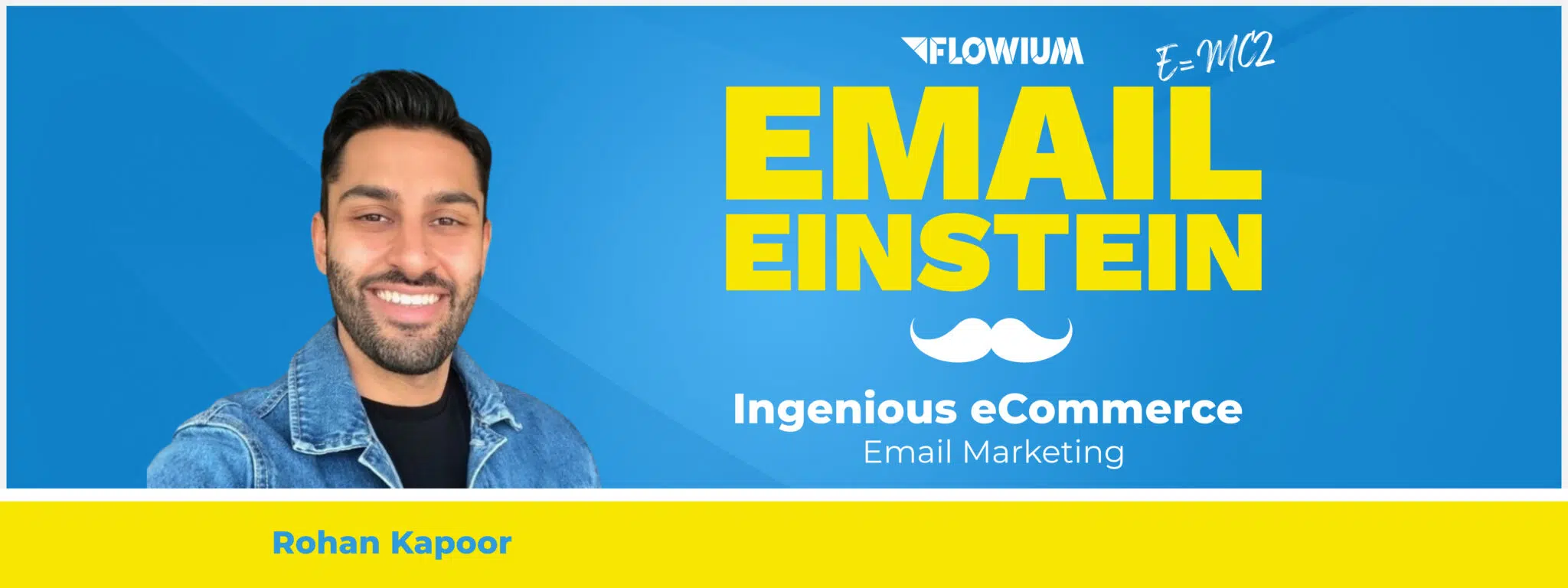
Hello, hello everyone, and welcome back to Email Einstein, the podcast by Flowium. I’m your host, Vira Sadlak. And today, guys, we’ll have part 2 of our 2 series episodes about all things customer service. And today I’m joined by a very special guest. Joining us today is Rohan Kapoor, the brain behind strategic partnerships at Gorgias. And for those of you guys who don’t know what Gorgias is, Gorgias is a fantastic customer support helpdesk software for e-commerce stores. We’ll talk about it in detail shortly, but basically today we’ll be talking about how you can turn that customer service channel into a profit center. Say hi, Rohan. We’re so happy to have you here on our podcast.
Rohan: 1:28
Yeah, no, thank you so much, Vira, for that incredible introduction. Like you mentioned, my name is Rohan. I manage strategic partnerships here at Gorgias. I’ve been at the company for over 3 years now, so I’ve definitely seen a lot of growth over my time, but I’m super excited to talk about Gorgias as a help desk and what we do and who we are, as well as to your point, mention how we can turn customer support into much more of a profit center and help brands generate revenue out of customer support.
Vira: 1:51
That’s exciting. That’s exciting. But before we go there, let’s play a little blitz Q&A game just like to get to know you better. Okay?
Rohan: 2:00
Sure. Sounds good.
Vira: 2:01
Let’s do this. Let’s do this. Okay. Live chat or email support?
Rohan: 2:06
I love live chat.
Vira: 2:08
Yes. Yes. I’m the live chat girl myself. Okay. Shopping with a list or impulse buying?
Rohan: 2:15
You have to have, I think like this is a little bit of a combo, but you have to have like a list in mind, but I’d never say no to some impulse buying. If you, You might see something you don’t know that you actually needed. So, you know, you need a little bit of impulse there.
Vira: 2:27
Okay. Online shopping or offline shopping?
Rohan: 2:31
Online shopping. I think like that’s the way of today. I think you can at least, at the very least, start online and browse for products. And if you feel like, you know, you need to try something on or go in store, then you can take that as step number 2.
Vira: 2:43
Okay. Express delivery or standard shipping?
Rohan: 2:47
Depends on the need. I mean, I generally go standard shipping. I think obviously there’s an option if you want pay more to go express or get something in a quicker period of time. So if you need something quicker, then you always have that option. But yeah, I generally go standard.
Vira: 3:00
I normally pay extra just to get the thing to me like right away. I don’t know. I think it’s like a North American thing. US and Canada trained me to get my, like my stuff right away. It’s like, it’s different here. Okay. Sorting by price or by relevance?
Rohan: 3:18
By relevance. I think like, especially if you’ve shopped with a brand before, if they do a really good job at identifying who is who you are as a customer, they’ll be able to suggest very personalized items for you based on relevance and what you’ve shopped for previously. So I always like the relevance piece. If you sort by price, you’re not always going to get the most relevant pieces that you’re looking for, right? Like, you’re going to get some recommendations that are probably not exactly what you’re shopping for. And so, you know, oftentimes it doesn’t make sense. Maybe price guidelines though, maybe a price range would be good to have. Okay.
Vira: 3:49
And the last one, AI in customer service, yay or nay?
Rohan: 3:54
Yeah. Yay. I think, you know, AI for me, and I know we’re going to get into this in the conversation, is super complementary to customer support and who we are as a help desk. And so I think there’s a lot to be done collaboratively with AI to really help merchants support the customers.
Vira: 4:09
Yeah. And we’ll definitely touch on that topic. I’m very excited to discuss it with you because it’s been like a big topic in the industry. But before we go there, tell us about Gorgias. What do you guys do, who you are, and what makes you different from similar apps on the market?
Rohan: 4:26
Absolutely. Yeah. Gorgias is a help desk designed for e-commerce brands. So what we do is we aggregate a bunch of different channels into one platform, one interface. So if you’re using email, chat, phone, SMS, social media, whichever channel really you’re using to communicate with your customers, we will aggregate that within the Gorgias interface. And we also integrate with the platform that you’re using. So if you’re using Shopify, BigCommerce, or Magento 2, we can integrate with those 3 platforms to bring in order information from your customers, no matter which channel that they come from. So if they email you, if they come through social media, if they come through SMS, immediately you’re pulling up that order information for that particular customer so that you don’t have to go back and forth between Shopify to find different pieces of information or copy and paste different pieces of information. But you have those pieces of information about that customer at your disposal so you can help that customer as efficiently as possible. We also build in a lot of automation and machine learning. So generally speaking, we’re able to automate, you know, depending on the customer, it could be anywhere from 25% to 60% of the responses, sometimes even more based on what customers are asking. So those very common and repetitive questions that a lot of merchants get, like, where’s my order? What’s my shipping status? When is it going to arrive? You know, you paid for express shipping like we talked about earlier. So it shows that customers are really, really itching to know when their order is going to arrive. Those questions, oftentimes merchants are having their CX agents spend way too much time manually responding to those inquiries when things like that could be automated by setting rules and macros in the backend of your help desk. And we also utilize machine learning to understand what it is exactly that customers are asking about so that CX agents can help them as efficiently as possible. And we also, you know, bring in social media to the platform. So Facebook and Instagram ad comments, DMs, Facebook Messenger. You know, we really want to allow merchants to open up as many different channels as possible for customers to get in touch with them, to ask questions or to inquire about something. And ultimately what we help do is, is what we’ve touched on a couple times already, is we help turn customer support from a fixed cost into a revenue generator. So we help brands generate revenue out of customer support through meaningful interactions with their customers through all of those different channels that I mentioned.
Vira: 6:39
And that’s really interesting that you mentioned that because I know a lot of brands that I’ve worked with or a lot of brands that I see across the industry, they don’t think about customer support in terms of return on investment, right? For them, it’s only marketing and sales. What do you need to know about the return on investment of customer service to help you maximize the value of brands’ customer service? I know it’s a loaded question, but— What are your thoughts on that?
Rohan: 7:07
Definitely. I think the number one thing is not to look at it as, or, you know, setting up your help desk or customer support function as a fixed cost, because it’s not a fixed cost. You know, this is a small investment that you have to put up upfront, but at the end of the day, your interactions with customers mean everything, right? Whether that’s your existing customers that you have in your community or net new customers that you’re looking to acquire through all of the different channels that you give an outlet to. you have an opportunity to engage with that customer and to convert that customer into a shopper. And so customer support really is a platform to generate revenue. It’s a sales channel. CX agents are actually sales representatives that are responsible for interacting with customers and helping them pick a product to add to their cart or add even more products to their cart. And so while, yes, you know, a help desk may cost something upfront, just like anything will, this is actually an opportunity for you to improve conversions, to bring down first response time, to bring down resolution time, And to ultimately drive sales of products that you’re selling on your website.
Vira: 8:07
Yeah. And for me, probably like the biggest advantage of tools like this and of a good customer service is that actually good customer service, it improves customer retention at the end of the day, right? And it’s especially important. I read this study that over the last few years, new cost of customer acquisition grew by like 60% on average. in recent years because of all of the like changes, the cookies, and because of all of the competition, I guess, as well. And all of this like tools becoming more and more advanced. So for me, the big thing of a good customer service is actually like improving that customer retention. And of course, in addition to helping you retain the customers you already have, good customer service can also improve your overall, I don’t know, the image in the eyes of the customers, right? And the maximizing revenue while minimizing the spend is also an important aspect for me. But you briefly touched on like CX companies or like CX aspect of businesses. It’s often discussed but not implemented. Why do you think this is an issue and how can brands make CX more like actionable?
Rohan: 9:25
Absolutely. Yeah, you made a lot of good points around retention. I want to say 2 cents quickly on that as well too. I think there’s a lot to be said around your community and the brand loyalty with those customers in that community, right? If you can establish some brand loyalty and a message that actually resonates with net new shoppers, those are going to turn into returning shoppers and those returning shoppers are going to tell net new shoppers for you and bring more people to the community. So there’s also the advantage of retaining, but also working with your community in that respect to make sure that you’re driving net new sales to your website.
Vira: 9:57
Right.
Rohan: 9:57
To touch on, to touch on your point around your question, you know, customer support’s often talked about, maybe sometimes not implemented. I think, you know, there, there needs to be a deep dive into the efficiency of your help desk setup. I think a lot of times, you know, for example, one of the things that we talk about quite frequently at Gorgias is that we are a help desk that’s built and designed for e-commerce, right? We are consistently on the ground servicing e-commerce merchants so that when we roll out new product developments or advancements or anything related to our platform, it’s because ecommerce merchants are asking for it and want it. And I think one of the first questions that you as a merchant have to ask yourself, you know, if maybe customer support is talked about, but you’re not implementing the right things, is do I have a help desk in place that is built for ecommerce that can work with Shopify or the platform that I’m using, or that can work with other apps that I’m utilizing in my ecosystem like Klaviyo or Yotpo or Recharge or Loop Returns? And is this ecosystem really delivering the efficiency that we want it to deliver, right? Am I able to automate a certain number of tickets that I interact with my clients with? Am I able to help my customers help themselves so that we don’t have to spend a lot of time interacting with those customers manually? And can I work on bringing down first response time, resolution time, improve conversion in order to drive sales out of customer support? And those are questions that merchants need to be asking themselves to say, hey, is this a fixed cost that I have in place right now, or is this a revenue generator for my company? And if the answer is, you know, point number one, then maybe there’s an evaluation that needs to take place on the help desk side of things.
Vira: 11:32
Right. Yeah, it’s interesting that you mentioned this, like, aspect of turning customer service into profitable, almost like a sales channel. Let’s talk in details about that. So, like, how can you increase sales at different stages of sales cycle? Let’s talk about that, like, very first interaction that customer have with your brand. Maybe you can share some actionable strategies for that, like, pre-sales customer conversation stage?
Rohan: 12:03
Yeah, absolutely. I think one of the things that we’re talking about quite frequently in that, in that kind of pre-sale, you know, conversation phase from merchants to customers is helping customers help themselves. And this is something at Gorgias that we call self-service and self-service with automation. So basically providing answers to customers on things they have questions on so that CX agents on the merchant side of things don’t have to spend a lot of their manual hours on interacting with customers on answers that they could theoretically find themselves. So self-service basically allows customers to go to the merchant’s website and find answers on, you know, maybe they want to initiate a return, maybe they want to retroactively apply a discount code, maybe they want to report an issue, maybe they want to track an order, or maybe they want to find answers to very specific questions that they have. And so In those scenarios, you know, merchants can set up quick response flows that to answer pre-sales frequently asked questions like, hey, do you have these colors for these products? Or where do you ship? Do you ship internationally to my country that I’m living in? Or how do I find the right products for me personally based on my needs and my wants? A lot of these questions that are frequently asked questions can be produced back to the customer in a self-service quick response format. So that merchants are not having to deal with these questions manually, but then they can focus their efforts, their manual human efforts, on other interactions with customers that actually are gonna drive maybe some more conversions, like sales through SMS or maybe social media or other channels that they might come through. And so it really opens up the time and opportunity for CX agents to focus on things that require their attention versus putting things in place that maybe you know, customers can find their own answers for.
Vira: 13:47
Right, right. And, and I’ve noticed with like a lot of brands that we were working with or that we are working with, that sometimes that like lack of pre-sales education about the product, it can actually backfire at you because your return rates are going to be through the roof if you’re lacking that like educational aspect at the pre-sales customer conversation stage. And something that are a lot of our clients are doing amazingly well is that they actually like proactively educate their customers on the products, on like what product to buy. Say I have this like amazing client that I work with that sells like shocks for different types of cars. They have like a lot of quizzes on their website, a lot of like tools to help customer to find the exact product that they are looking for. And especially this is I mean, I guess this is like important for all of the brands, but especially for those like higher price brands, when the customer spending more, they kind of expect like a better, almost like a white glove service, right? So I like that aspect of proactively educating your customers a lot.
Rohan: 14:57
Absolutely. Education is a big piece of it, right? And, you know, return rates sometimes spike through the roof, just, you know, based on what you’re saying, because I bought the wrong product and I didn’t know which product I should have bought. And so Those quick response flows to frequently asked questions, the ability to self-help from a customer standpoint and get answers to questions that you might have upfront so that you buy the right product is pivotal for merchants to put in place in order to convert those shoppers and make sure that those shoppers come back for more and don’t necessarily have to return those items. So education is huge for brands that are looking to connect with new customers and then retain their existing ones as well.
Vira: 15:31
Right. What are some good strategies for managing returns? This is a big one, especially for, say, people who are in like a fashion industry or like a skincare industry. What are some like actionable tips that you can share with our audience on that?
Rohan: 16:39
Yeah, no, absolutely. And I have a really good example actually of one of our customers, Kulani Keenys. They grew quite a bit, you know, from early on to where they are now. And a lot of their processes on the return side were very manual. They were time-consuming. You know, they had representatives internally, their CX agents basically marking emails as unread so that they could remind themselves to come back to that unread email to initiate that return or make sure that the customer, you know, had sufficient help there to initiate that return. And so it was a very manual, time-consuming process that they were going through. And, you know, the solution that Kalani Keen has put in place was to integrate Gorgias with Loop Returns, which is a really, really strong partner of ours. Generally speaking, I love talking about our ecosystem of apps, right? There’s so much optionality out there. Gorgias integrates with over 100 of the most commonly used apps in the D2C space. Loop Returns is one of our strongest integrations and one that we talk about quite frequently. So, you know, with the Gorgias and Loop integration, what Kalani Keenis was able to do is allow customers to easily ask questions during the return process with the live chat widget. So make it super easy to get in touch throughout that returns process. There’s not an unread email that has to come back to you at the end of the day. The customer service team on the merchant side can attach visual product links, to responses to recommend products without having to manually copy and paste raw URLs. So for example, if a customer is looking to initiate a return, maybe the customer support representative has an opportunity to turn that return into an exchange so that, you know, the brand is still generating revenue from that interaction. And the customer service team through this interaction can see all customer store data like purchase history, exchange item stocks, past orders.
Vira: 18:23
Mm-hmm.
Rohan: 18:24
And that really just allows them to provide this really personalized response without switching tabs, you know, back and forth between returns platform Loop, their help desk in Gorgias, you know, their platform Shopify.
Vira: 18:35
Yeah, it’s a game changer.
Rohan: 18:36
And Kulani Keeney, you know, with being able to integrate with Loop and really produce an efficient process with Gorgias and the returns process, 75% decrease in resolution time, $400,000 in refunds saved, and $80,000 generated in exchange revenue. So working with, you know, customers that were coming through to be able to prevent that return and actually turn it into an exchange. So, there’s a, there’s a positive in terms of the dollars generated there as well too.
Vira: 19:04
Right. And I, and I think this is especially important for companies like Lanikinis because they are like an international business, right? They have like customers all over the world. So, that like price of product return, it’s quite, quite high. It’s funny that you mentioned that they were using their like literally inbox to sort out all of their customer requests because that’s what I’m doing with my brand that I launched like not so while ago. That’s literally what I’m doing, the inbox, like Gmail Suite inbox, and I’m just like replying to everything manually. On that note, at what point should you start thinking about like software like yours? Like when does it make sense to start thinking about it?
Rohan: 19:47
Absolutely. I think even, you know, at the stage you just described with your new business, congratulations, by the way. It’s, it’s, I know, You know, starting a new business takes a lot of time and a lot of effort. So congrats on that. And I think even when you’re an early-stage business, we do have a solution for early-stage startups all the way through to enterprise. So the really good thing about Gorgias is that our ICP is really broad when it comes to that. We’ve got early-stage merchants that are just kind of starting out their e-commerce journey all the way through to enterprise-level merchants like Steve Madden and Princess Polly and Dollar Shave Club. And so we’ve got features in place that can support these different brands of different sizes. We have different plans that are starting as low as $10 a month to really just put something in place to help you consolidate your communications, manage your email inbox like you were talking about, bring in different channels that you might be using to communicate with customers. And it really allows early-stage e-commerce merchants to get familiar with the platform and understand how to utilize a help desk with the ecosystem that we just talked about as well too. And then as you grow and as you start to have more interactions with customers, start to use more channels, Of course, we have plans that move all the way up the chain to be able to support your needs. And one of the really unique and distinct things about Gorgias is that we charge our customers based on ticket volume. So how many tickets they do on a monthly basis through all of their different channels. We don’t charge by number of people that want to use the platform or users. So that’s a difference in our makeup. And, you know, most other help desks out there are going to charge based on how many users want to use the platform. We make it really cost efficient from that standpoint to manage your tickets within Gorgias and start as early as you’d like and work all the way through up to enterprise.
Vira: 21:54
That’s cool. That’s cool. On that note, like a lot of our customers, a lot of our listeners, I guess, as well, they are using both like email and SMS. Can email and SMS be integrated into Gorgias ecosystem?
Rohan: 22:09
Absolutely. Yeah. No, email and SMS are definitely 2 of our most talked about Integrations for sure. So we’ve got a number of different partners in the space for email, for SMS, depending on what the brand is using at that given time. However, I know, you know, Flowium, you guys are super strong in the Klaviyo relationship. Klaviyo is one of our most commonly downloaded integrations across the portfolio. So we’ve got email, we’ve got SMS, we’ve got more. And it really allows, you know, leveraging the Gorgias and the Klaviyo integration really allows merchants to Save time, work more efficiently. So you can provide customer support via Klaviyo SMS conversations, minimize back and forth between both systems. You can utilize Shopify variables in your Klaviyo SMS responses. You can respond to messages more quickly. So inbound messages in Klaviyo automatically lead to ticket creations within Gorgias. You know, that allows support agents to provide a solution very directly, increase customer satisfaction. So fast and helpful support. leaving customers raving about your brand, talking about your brand, and the sufficient support that they receive via that integration. And you can even target campaigns based on customer support interactions. So, you know, the Klaviyo and the Gorgias integration is something that I talk about pretty frequently because we do have that email component and we have that SMS component, and it just makes sense. It just makes sense. And so it’s a very strong integration, most commonly used across our portfolio, and a really, really strong partnership of ours.
Vira: 23:35
Right. So basically what you’re saying, you can have this real-life, I guess, conversation, real-time conversation in Klaviyo SMS, right?
Rohan: 23:43
Absolutely. Yeah. So at Klaviyo, SMS tickets create in Gorgias. You can respond to those SMS tickets directly from within Gorgias. And the cool thing is you can pull in Shopify variables on that customer from their order information into those Klaviyo SMS responses and fire that response back to them. So there’s a lot of functionality right in this one interface. A lot of things, more generally speaking, that I’ve talked about today is that you need to have a help desk in place that keeps everything together, right? You don’t want to have to go back and forth between Klaviyo or back and forth between Facebook or Instagram or back and forth between Shopify.
Vira: 24:16
Right.
Rohan: 24:17
You can’t have too many tabs open or you’re going to make mistakes and it’s going to take time. And that’s what increases the cost of customer support. But if you put pieces in place, like having a help desk in place that integrates with all these different apps in the ecosystem, Then you’re gonna save time and you’re gonna generate sales. So that kind of ties to a common theme I’ve been mentioning throughout.
Vira: 24:35
That’s so cool. I’ll need to pick your brain after the call for one of my clients who are using Gorgeous and Klaviyo SMS, ’cause there’s like a lot of opportunities there.
Rohan: 24:44
Absolutely.
Vira: 24:44
Okay, cool. Rohan, what about the customers who’ve like purchased from you once, but you want to turn this like one-time buyers into repeat customers? can you do that with like a good customer service?
Rohan: 24:59
Yeah. Well, I think like number one is you have to, you have to really just resonate with the customer or you have to have the customer resonate with your brand rather, I should say. Right. And so you have to create this experience that, you know, while automation is super important, you have to find that right balance of automation and personalization. And I think when you do that and communicate with the customer in a way that they know that they can identify with your brand, so you’re addressing them by first name, you’re highlighting specific features about them, like their order number and their tracking information and their shipping address, you know who they are as a customer. That is what is going to help them in resonating with your brand. Another thing that is very, very important that I’ve mentioned a couple times in this conversation is first response time and resolution time. Oftentimes brands are leaving a long time to get back to customers and an even longer time to get an answer back to customers. And so My advice there would be to get back to customers in a relatively short period of time. Even if you don’t have the answer to their question right away and you need to look into it as a CX agent, tell them that you’re looking into it. Tell them that you’re on their issue, you’re looking into their problem, and you’ll get back to them with a response as soon as possible. Bringing down first response time and resolution time are incredible indicators of how well you’re able to convert that shopper into a buyer. And that whole experience of just like keeping the shopper in the know will help them to develop a loyalty to your brand. If you keep that customer waiting for too long for an answer, then chances are they’re just going to go to brand number 2 and shop for a very similar product because there is so much competition out there. So you need to be sure to put the personalization aspects in peace— in place, rather, and also get back to your customers in a reasonable period of time. And if you can do those 2 things really, really well, then you’re going to develop new customers and then retain those customers.
Vira: 26:44
Yeah, yeah, that’s a good one. I love that aspect of like being using this like tools as a, almost like as a proactive sales tool. That’s cool. Okay. So there is this big conversation in the industry. We briefly touched on it already. Helpdesk apps definitely have revolutionized the entire e-commerce customer service, but with the rise of AI, there like so much controversy in the industry. Do you see the future where AI might replace traditional help desk solutions and traditional, like, representatives altogether? Or do you think it’s going to be something like in between, like a mix of different things?
Rohan: 27:29
Yeah, I know it’s a question that’s definitely out there for sure. I think how I see it is I see, you know, your traditional help desk environment, very, very complementary to things that are happening with AI right now. There’s a lot that can be done together in order for merchants to be able to deliver this optimized, like super efficient customer experience. And there are elements of AI that merchants can put in place to really help their teams if they haven’t already from their traditional help desk setup, be more efficient in their interactions with customers to generate more sales. And so I see this more as an opportunity than anything to augment certain aspects of your business with AI. to allow your team to open up time, energy, and interactions to generate sales out of customer support to spike up that number even more, right? We wanna enable customer support agents, which is why we have automation put in place, which is why we have machine learning put in place. And AI is really kind of an extension of machine learning or another piece that they can put in place to be able to efficiently drive conversions. And so I see them more complementary than anything. And we’re even working on our own AI capabilities internally as well too. to make things easier for merchants and their teams. So that, you know, should show obviously what we think of AI and how we think about it collaboratively to the help desk environment and what we have in place.
Vira: 28:49
Interesting. Interesting. Yeah, I heard this phrase that AI will not replace a traditional help desk solution or traditional, I guess, customer service representatives, but it will replace customer service representatives who don’t use AI. And I agree with that. I like that you’ve also like mentioned that aspect of it being very like complementary to what we already have. Yeah, no, that’s for sure. Okay, so to wrap up this quick episode, if you could give like one customer service advice to brands who are like rethinking their entire CX strategy, what would it be?
Rohan: 29:27
You know, I think the overarching theme is use a help desk or put a help desk in place that is built for e-commerce. You want to have a solution that is gonna work with you as a brand, your platform, and the broader ecosystem. So the group of apps that you choose to use as a business.
Vira: 29:42
Mm-hmm.
Rohan: 29:43
But I would just say that it’s important to, you know, continue to look for ways to make things more efficient and to optimize your help desk environment. So are you using automation? Are you leveraging machine learning to the best of your ability? Are you putting things like self-service in place to allow customers to help themselves, right? The whole reason that we’re able to help merchants and brands turn customer support into a revenue-generating area of the business is because they put different pieces in place in order to help their CX agents become a lot more efficient in their interactions with customers. And so look at customer support as a sales channel, look at your CX agents as sales representatives, and put the pieces in place accordingly to make those things happen. And I think if you’re able to sufficiently put those pieces in place, then you’re gonna have a very good time on the customer support side of the business and generate some good revenue out of the function.
Vira: 30:35
Thank you so much, Rohan. If people want to learn more about what you guys are doing or about your tool, where should they go?
Rohan: 30:42
Absolutely. Yeah, no, if you’d like to learn more about Gorgias and what we’re doing, the partners that we work with, you can reach out to me directly. So my name is Rohan Kapoor. My email is rohan@gorgias.com. So that’s R-O-H-A-N M-G-O-R-G-I-A-S.com. I’m happy to help out with any questions that you might have. You know, we’re working with plenty of brands from early stage all the way through to enterprise, over 12,500 brands at this point. And I’m happy to have a conversation if you’re looking to make some improvements on the CX side of things.
Vira: 31:11
Thank you so much. It was so much fun having you on this, on our episode. You guys, if you are interested in getting some more like advice on how to establish a solid email marketing strategy for your ecommerce store, definitely visit flowium.com. Or if you have any questions, just go to flowium.com/contact. And also all of the links that we mentioned in this episode, all of the case studies, all of the resources that we mentioned here, they will be linked in the description box. So scroll down, go to description box and check out all of the links. Rohan, thank you so much for coming to this episode. It was fun having you. Learned a lot of new stuff, some stuff that I want to try after this episode. So thank you so much.
Rohan: 31:55
Thank you so much, Vira, and the Flowium team for having me. This was super fun.
Vira: 31:58
Cool. Okay, guys, we hope to have you here next Tuesday, guys. And as always, if you like what we do, please leave us a review. And if you leave us a review and send us a screenshot of your review, we’re going to send you some really nice Flowium branded merch. So thank you for listening. Take care. Bye.

Vira Sadlak
Podcast host, marketer, traveller and a life lover from Vancouver, Canada