

Podcast Transcript
Vira: 0:16
Email can actually be a very good retention tool if you know when and how to use it. And that’s exactly what we will be talking about today.
Alissa: 0:48
Hey everybody. Welcome, welcome. Vira and Alissa here, Email Einstein. We are back in action for another week of exciting stuff and we’re really excited about today. Before we get started, Vira and Alissa here. As always, we’re two email marketers at an email marketing agency called Flowium. We are super passionate about email marketing and because we love what we do, we want to share our insights with you. Flowium is one of the fastest growing email marketing agencies in the world. We specialize in providing a premium, full service e commerce email marketing experience for all of our clients. Our service is tailored specifically for your business and is designed to help increase your online retail revenue. We deliver the right message to the right person at the right moment. That’s what we’re all about here at Flowium. And Vira, what are we talking about today?
Vira: 1:52
Retention, you guys, we are talking about all things retention. I just like went straight to it. So according to a study by GetResponse, there is a 32% chance your first time customers will buy from you again. 32%, not bad. But that’s not all. Second time customers are actually 53%. 53% more likely to place a third order. And by the time they’ve placed their third order, there is an 83% chance that they will come back to your store again. That stats are like crazy to me, but it’s just like a good reminder of how important the customer nurturing and customer retention is and whether it’s for acquisition or retention. You know, we are email fans and we do think that email is a great tool for both acquisition and retention. Yet a lot of businesses will approach their customer email retention strategy blindly and as a result they don’t necessarily always get the results they want. Right? But the reality is email can actually be a very good retention Tool if you know when and how to use it. And that’s exactly what we will be talking about today with our guests. And Alissa, please introduce our very special guest.
Alissa: 3:04
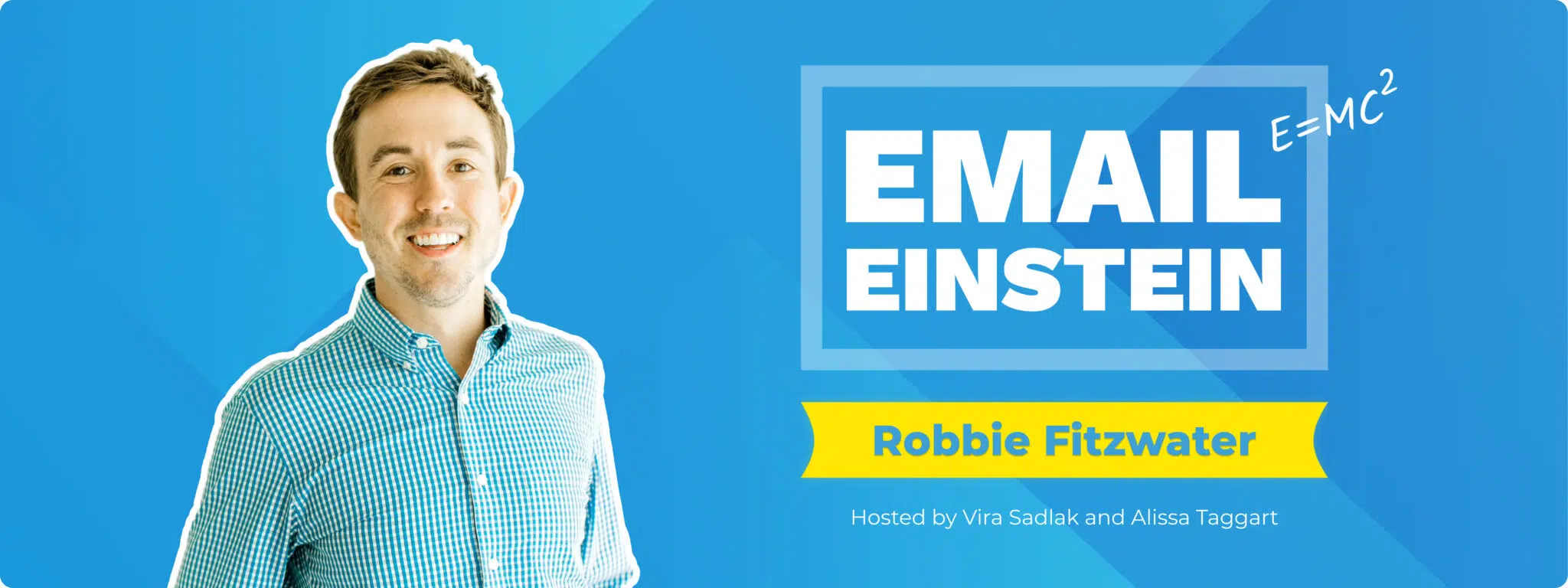
I am. I’ve literally been waiting and looking forward to this guest. So, guys, we have Robbie Fitzwater on with us today. Robbie is, like the coolest dude ever. We met him at unspam. Are you noticing a trend here? Like, all the cool people that we meet are on unspam. But I met him at unspam, which is the really good emails conference back in January in Greenville, South Carolina. And it was really funny because I was there with Andriy, the founder of flowiam. And this guy walks up to Andriy and he’s like, are you Andriy? Like, the Andriy? And Andriy’s face was like, oh, no, what did I do? And Robbie was like, no. Like, my team listens to your podcast email, Einstein. So my ears perk up and I’m like, wait, I’m on the podcast. What’s going on? And we had a really great time connecting with Robbie at the conferen. So he is actually the founder of a marketing agency specifically focusing in retention. So also working in email called Marketing Rhythm. Robbie, do you guys call it Marketing Rhythm or do you call it mktg? Rhythm. Marketing Rhythm. Right.
Robbie: 4:07
Call it Marketing Rhythm.
Vira: 4:08
Okay.
Robbie: 4:09
And just in hindsight, it’s. I could have picked something that was easier to spell.
Alissa: 4:13
No, but this is great.
Robbie: 4:14
Telling somebody your URL, telling somebody what your website is, it’s like, oh, yeah, it’s mktg. And everybody struggles with the word rhythm too, so naming could have been better. But I teach, so wanted to, like, bring this, like, academic component into it too, because we. We always kind of pride ourselves, like, we want our. Our. The groups we work with to grow as marketers too. So that’s kind of how that name came to be and connected with you guys at UNSPAM and was just. Was an absolute treat. Like, heard Andriy talking in the back and I was like, wait, I know that voice. I know that voice. He tries to offer me socks every week. And I was like, oh, yeah, that’s Andriy. And. And I loved it because again, we’re able to connect with you guys and just, yeah, love the conversations, love the interaction. And yeah, really enjoyed the UNSPAM experience just to connect with so many great groups in the email space. And like I mentioned, have followed what you guys do. And I’ve listened to your podcast for a while now. Again, I’ve been so impressed by the level of quality of content and also the level of actionable insights. So, yeah, really have been looking forward to this myself. And hopefully I’m not bit too much of a fanboy right now. And I don’t. I mean, I’m worrying about freezing this entire time. I’ve been. I’ve been paranoid about that. So hopefully I can keep together.
Alissa: 5:31
Don’t even worry. And so if you go, I mean, we’ll. We’ll add links and everything, but if you guys go to Marketing Rhythms website as well, it’s so funny, like when you go to the about section, so there’s all this info about Robbie and his team and stuff. And at the bottom, like, it’s so. It’s so humble. It’s so funny because we found this out about Robbie at the conference and we were like, are you kidding me? So at the bottom it just says, I also teach digital marketing and social media as part of the Clemson MBA program as a side gig. Which is like, oh, like you’re an MBA professor. Are you joking? So he’s like, super smart guy. He also did a retention talk at unspam and that’s why we were like, okay, we need to get Robbie on here ASAP so that he can share the same information with you guys because there’s so much insight that he knows from a theoretical but also from a practical perspective. So, Robbie, thank you so much because we know you’re super busy for taking the time out to be here. We appreciate all the love that you and your team have for our podcast. We’re so, so honored and excited to have you here. So, yeah, thanks.
Robbie: 6:27
It’s very mutual. And yeah, I’ve been looking forward to it for a while. And yeah, like, getting to contribute to see marketers grow. It’s like one of my favorite things. So looking forward to. Looking forward to making it happen.
Alissa: 6:38
Let’s do it.
Vira: 6:38
Let’s do it. Awesome. Awesome. Let’s do this. But before we go to all of the serious, juicy questions, let’s do a quick blitz Q and A. Just like to get to know your better. Okay, cool. Robbie, so email or sms?
Robbie: 6:51
Email right now. Like, SMS is exciting. Like, we can make. You can make somebody’s wrist vibrate, but on the consistent basis. Like, the email side of things is just. Yeah, I think a stronger open door. Again, that’s to be decided in the future. But right now, email.
Alissa: 7:05
Yep.
Vira: 7:05
Cool, we’re on the same page here.
Alissa: 7:07
Yep.
Vira: 7:07
Favorite city in the US Beside the one you live in.
Robbie: 7:11
Oh, not now. This is now that you really have me enjoyed a lot of places. The last place I visited that really enjoyed it and kind of blew me away. I recently just got back from Austin, Texas. I really enjoyed it. Enjoy Austin, Texas or Portland. So I’m gonna hedge.
Alissa: 7:27
Awesome. I’ve heard Austin is amazing.
Vira: 7:29
Nice. Favorite childhood TV show. That’s a random one, but we love random questions.
Robbie: 7:34
You’re really giving me the hard ones now.
Alissa: 7:36
We’re giving you hard ones.
Vira: 7:37
These are the hard ones.
Robbie: 7:39
Oh, my gosh. I can’t do any of them. These are great. The Rocco’s Modern life was kind of interesting. That’s one of the ones that, like, that one, like, sticks out as, like one. One of those shows that, like one of those early 90s Nickelodeon shows. It was probably a little bit racy for its time, but kind of burned in the back of every one’s mind brain.
Vira: 8:02
I loved it. I loved it growing up.
Alissa: 8:04
Okay, if you had to pick a song that played every time you entered and exited a room, what would it be?
Robbie: 8:09
Midnight Train to Georgia.
Alissa: 8:11
Oh, nice, nice, nice. That’s awesome. Awesome. Okay.
Robbie: 8:14
That was my go to karaoke song and song for everything. It’s just great.
Alissa: 8:18
We have to have Marketing Rhythm and Flowium. I’m like, the two teams get together and we’ll have a karaoke night one day.
Robbie: 8:24
Oh, that would be. That would be epic. That would.
Alissa: 8:26
That would be next level. That would be serious.
Robbie: 8:27
It’s a shame we didn’t do that while you guys were in Greenville. Yes, we have. We have plans for the future. We have plans.
Alissa: 8:35
Do you ever post inspirational quotes on social media?
Robbie: 8:38
I don’t post inspirational quotes. I post a lot of content. I’m kind of boring now. I post on LinkedIn more than I use any other platform. But mostly stuff that I think of and I try to try to share some good insights and maybe they’re inspirational. If they are, that’s a double win. But I don’t get into as many inspirational quotes.
Alissa: 8:57
That’s when you know you’ve made it, right. When you’re posting more on LinkedIn than you do anything else, that’s when you’re like, oh, I am officially an adulting professional now. Like, that’s official.
Robbie: 9:08
Yeah, I can’t. I again, can’t keep up with Twitter and Instagram again. Just gets me. And my dancing isn’t up to speech yet.
Alissa: 9:19
Okay, last one, last one. Socks or mattress?
Robbie: 9:22
Socks. I’m a sock fan. I think you guys can. I can share. You share a photo with you guys at Vina and Becca on my team, we, they made some of the best socks ever for like holiday gifts for, for clients. And they have my face right on them. They’re kind of pretty wild.
Vira: 9:39
Nice.
Robbie: 9:40
But they’re. Yeah. Socks have a warm place in my heart.
Alissa: 9:43
Stop. We need a pair of those. We absolutely need a pair here. We need Flowium socks and we need Robbie socks. That’s, that’s where we’re at right now.
Robbie: 9:52
- Whatever makes you happy.
Vira: 9:57
Exactly. Exactly. Awesome. Well, Robbie, let’s get into the juicy part of the podcast. So let’s talk some post acquisition email marketing. Why do you think or do you actually think it’s often undervalued and why? Let’s just like briefly discuss acquisition versus retention and like the post acquisition email marketing.
Robbie: 10:21
Okay, so, so I, yeah, and I could go down a rabbit hole here. So I’m going to try and keep it at a high level. So I spent a lot of time before I moved into like focusing on the retention side of things. I was a director of marketing at a large E commerce organization and I started to recognize, hey, this is like one area where business, a lot of E commerce, other e commerce organizations do it well. Talking with my peers and talking to others in the industry where you’ you’re acquiring customers, you’re growing your business and you’re focusing so much on roas that you don’t really necessarily focus on many other areas of your marketing and you become really, really, really dependent on one or two channels to drive a lot of your traffic and a lot of your business. Because, hey, if I can acquire traffic through Google or Facebook or Instagram, I have a really strong top of the funnel strategy where I can consistently bring new customers in. But that kind of leaves a lot of businesses really vulnerable. It’s like having a, if I’m sitting on a stool, I don’t want my stool to only or two legs. I want to have a few legs to my stool because I’m going to be a lot more stable and I can handle situations when they pop up. So being really dependent on one or two channels, especially on the acquisition side, is really challenging for businesses and can be honestly really dangerous because any volatility, any instability, you don’t have as many other options to go with. So in terms of the acquisition side, most groups focus on again, the paid acquisition to bring people into the top of the funnel. If you’re again working to get those customers in again. SEO also works really effectively on the, on the acquisition side. But you want to be able to understand how to how to increase the revenue that customer is going to bring in after the fact, I guess. Also I always kind of talk about Alissa, you heard me say this and I probably beat that horse. But like email and like the retention side of things is kind of like the person your parents wanted you to date in high school. It’s kind of smart, it’s straightforward. It’s going to be a doctor, a lawyer or an engineer one day. It’s not sexy and it’s not exciting. The same way that the acquisition side of things is like acquisitions. Got a leather jacket, drives a motorcycle. Acquisition is sexy. Like it’s fast, it’s exciting. You can see your roas every day. The retention side of things takes a little bit more time to build and grow, but is a really, really effective way to grow a business. And where I think a lot of businesses fall flat is, hey, there’s three ways to geometrically grow a business. You can increase the number of customers, you can increase your average order value, or you can increase your lifetime value. If you double any one of those three, you double the value of the business. And like I’m always like, which, which of those three do you think most marketers focus on the most?
Vira: 13:00
Probably the acquisition one.
Alissa: 13:01
The sexiness. Well, and that’s the thing is like you have these clients, I mean we have clients internally as well who spend thousands and thousands and thousands of dollars even on a monthly basis on acquisition. And it’s what you said is exactly right. Like retention is more of the long game and acquisition is more of the short term play of like wow, look at all these people who are shopping. Clients more often than not focus on like the pre purchase flow for example, because they’re like, well we offer a homepage pop up incentive of 10% off, you know, your first purchase and look how well our post purchase flow is or our pre purchase flow is doing or a welcome flow. And then they look at like the win back and they’re like, yeah, not it’s not great but like they don’t really care about the win back because the win back is happening two, three, four months down the line when in reality that win back, I mean in my opinion, and this is a question that we’ll ask you next, Robbie, in my opinion that win back is going to be a lot more lucrative for you in the long run versus that pre purchase flow where most people are just trying to get a quick discount so you can acquire a million different people whether or not they stay as a totally different story. I think yeah, yeah.
Robbie: 14:03
Are you building, are you building a business or are you building a vending machine? And like you can build, anybody can build.
Vira: 14:07
That’s a good one.
Alissa: 14:09
I need to write that down.
Robbie: 14:10
The way you can again build a sustainable like again growing business is again focusing on that retention side. And typically when you can really work to maximize that lifetime value or keep people purchasing over and over, you can again drive more revenue in each mentioned criminal purchase as you’re educating, informing them, oh this product complements this product and really getting strategic to move that average order value up along with that lifetime value. So you’re generating more and more consistent purchases and you’re having a more educated, more engaged purchaser, which is kind of everybody should be everyone’s goal. And if you’re doing that well and you’re using different strategies to keep people coming back and keep people engaged with the business, you’re probably having some fun doing it. And the groups that I think are always the best on the retention side are the groups that know their customers the best are the groups that are really living, living the lifestyle of that like they know their customer because they are that customer. And those are the ones that really have some of the most fun in building communities and building audiences and keeping them coming back and back for more.
Vira: 15:16
Yeah, I agree totally. And Alissa, going back to that example with pre purchase versus win back flow, one interesting thing that I’ve noticed with my win back flows is just like we discussed earlier, those flows they have one of the highest dollar generated per customer. So the average order value, the obviously the historical order value and everything for that flows, it’s much, much higher. So yeah, definitely don’t ignore a good win back strategy there here.
Alissa: 15:46
The business or vending machine that like made my mind explode. I’m like whoa, yes, so true. So go. I mean focusing in on the email side of things, right? Cause we love email. What do you think are some customer retention emails that every business should have? So obviously we just in win back, right? And I mean that’s an obvious one. But are there any others, Robbie, that you think are really like more helpful than others in terms of retaining customers or maintaining the loyalty that a customer would have to your brand?
Robbie: 16:12
So my theory on this is your retention job, your, the work you’re doing in retention starts in the welcome series and starts in that first as you’re building a, building a relationship. And like the work we do and the clients we typically serve, we use a lot of content marketing to kind of supplement the work we’re doing. And so so we’re sharing value added content along the course of that customer journey. So we can make sure that we’re serving them at different stages with different information. And we’re really trying to target and segment the information they’re going to get based on their use cases they’re, they’re purchasing around. So like we want to understand how someone’s going to be using it, what they’re looking for in that purchase, what the outcome they want to see at the end of the day is. And then when we can understand who they are, what they want, what they need, we can serve them, we can make recommendations for our product catalog that’s going to be relevant to them. We can serve up value added content that helps them make a decision. We can help again keep them engaged through content in that, in the welcome series but also in the post purchase sequence when we’re sharing content around how, how like this is again your order’s on its way, but here’s how you can get the most out of it. So like for like an example, like a coffee business that we work with, like we have content coming like starting like basically the day after they’re like we’re, we’re sharing content basically the day after their purchase, like asking them how they grind their beans so they can make sure that they know different course, different levels of grind level to improve their experience or how do they brew their coffee so we can share our brew guides to make sure that they’re going to be able to enjoy that product as much as possible. And then during the course that time we’re, we’re communicating and educating them around all the other great resources we have. Because our goal there is we want to make a good purchaser and turn a good purchaser into a great purchaser. And if we can really keep them engaged, like attention is the attention is one of the hardest commodities to come by, but it’s even harder to maintain. So you’ve got to really work to earn and maintain that attention over time. And if you’re doing that by building a relationship, you’re going to be a lot more successful in the process of again building an audience and keeping that audience coming back and purchasing. Yeah, I guess I always feel like I was kind of like came into E commerce a little bit later in my career. I spent the majority of my career working in social media as like director of social for Clemson University. And again, so much of the work I was doing was like, hey, how do we build an audience? How do we maintain that audience? And when I got into the E commerce space, I was like, oh my gosh, I’m doing the same thing I was doing in social space. I’m just again doing it without battling an algorithm. So I own that audience and I’m also three steps closer to the cash register. So it seemed like it was cheating. So it was really kind of exciting. But adding value through the customer journey is one I think one of the most underutilized ways to making sure that you’re going to be onboarding that customer smoothly and then turning them into a great customer over time. So the more expertise you have internally that you can share with that customer, the more value you’re going to add through that process.
Vira: 19:19
So true. And many brands don’t look at the post purchase sequence as the customer sort of like a nurturing. A lot of brands that we worked with like before we started working with them, they just had like two post purchase emails and that’s it. And we here in Flowium, we believe in that like customer nurturing especially in that time between the purchase and between the time that they actually received their order. We don’t want them to have any like post purchase remorse. Is that how it’s called? Yeah, buyer’s remorse or like buyer’s remorse? Yeah. And we want them to provide as much love, care and value as we can. And we even like grouped it into like three big categories that we are trying to deliver in our emails. So we try to make our emails either educational, inspirational or just like fun. So that’s pretty much what we are trying to do with our emails. And yeah, I definitely, I definitely agree with you that post purchase sequence is in fact a very undervalued flow and content as well.
Alissa: 20:24
I have to agree with that because that’s something that we try to push a lot of the time with different brands and stuff and there’s always this kind of like no, I don’t want to just email them for the sake of emailing them and it’s, it’s not.
Robbie: 20:36
Yeah, the value added content gives you an at bat and basically we’re giving ourselves an excuse to like I always think about like hey what if, what if every email we sent like costs more, was more expensive? Like what if every email we sent cost like 5 cents? Like would we send as many emails? No, but we’d probably be a lot more intentional about every email we did send. So like how if we took that same approach to it and really respected the per the persons inbox, we really need to make sure that we’re Delivering value every time. So it kind of takes us through a thought experiment of really making sure that it’s going to be valuable, it’s going to be engaging. And one of the best parts about that content is, hey, like we know that we’re again using that content through campaigns, but if you’re using it in campaigns, you can, I always call it like using the whole buffalo, like let’s automate it afterwards. Like we know it’s a high performing campaign. Let’s automate that content in a place that it’s going to be relevant and make sense sense in that customer journey and then recycle the content probably the next year if it’s super contextual to like this, how to make like cold brew coffee, like that’s all. There’s lots of different ways to use it. And especially if a group is working with a SEO partner, that’s where there’s some real opportunities. Because again, an SEO is going to be looking at who’s driving traffic, what’s going to drive traffic at the top of the funnel, what are the common questions that that categories purchases are finding they’re having trouble with. And then you can work to kind of onboard them in a really smooth way so you know that you’re addressing the questions they may have. So it expedites that purchase process on the front end, but also helps them enjoy the experience afterwards. And then I always kind of joke around like marketing channels like SEO plus email is like a one plus one equals three relationship where it just both pretty much compliment and supplement each other so well that it’s a really great, a great way to kind of build that marketing flywheel.
Alissa: 22:20
And I guess the other. I feel like we always bring email back to like, like analogies with like relationships and stuff. But like as everyone’s talking, I’m like, oh, this is kind of like when like there’s like a guy for examp who like likes the girl and he literally is everywhere she is constantly pursuing her, like going after her, texting her all the time, all of this, all of that, whatever it is like doing everything he can to get the girl. And then once he gets the girl, he disappears. Like he ghosts her like, oh, I got the girl, like I’m done, right? And I feel like a lot of brands act like that towards customers. So before the potential customer makes their first purchase, I mean they are constantly reaching out. Ads everywhere reaching out to you. How can we make your experience amazing? Because sometimes customer will even reach out to you if they go that far. Constantly emailing you. And then as soon as you make the purchase, they disappear. They don’t care about you anymore. They’re not sending you any content. They’re not continuing to engage you with the brand because they think, we got a purchase out of you, we’re done. And that’s a really bad, bad, bad way to go about things. Because now that the person has shown interest cause they purchased with you, that’s when you really want to drive home the content, drive the connection, drive the engagement with that customer. Because you have them basically. And now the potential for them to become really lo is huge. So, yeah, it’s interesting. It’s very interesting that people want to do it the other way around. It’s the acquisition thing, right? It’s what you said. It’s a lot sexier in a leather jacket than it is with a lab coat or a law.
Robbie: 23:45
Yeah.
Alissa: 23:46
Or a law degree.
Robbie: 23:47
It’s like later on down the road, again, you’re going to thank yourself for it. But early on, early on, it’s not, it’s not like the sexy, sexy part. Yeah, I was like, talk about like building out your email ecosystems, like investing your 401k. Again, not fun to do when you’re 20, but like when you’re 65, you’re going to be so happy you did it. And it doesn’t take till you’re 60, 65, but building that in a thoughtful, methodical process really, really helps. And plus, after they purchase, like, you know what they purchased, you know what they may want afterwards. And like, you have so much more great data that you can leverage after that. And that’s where you can consistently improve upon.
Vira: 24:22
Right. But retention strategies, they must be like different for different types of brands. So for example, for the company who’s the selling, like met mattress versus company who’s selling socks. Our favorite example ever, how their strategy will be different. Like what would be the biggest difference and how to approach those mattress companies. You know what I mean?
Robbie: 24:46
So from that perspective, like, and I don’t want to get too nerdy in business from that perspective, are they a mattress company or are they a sleep company? And do they need parallel products or do they need products in line with what that purchase is purchaser needs? So like even looking at some of the current mattress businesses like Casper, like, I forget I should like tough and needle a few of those other mattress companies, like, they’re sleep companies. They want to have an extension of like, okay, purple also has pillows. Purple also has items that will help supplement the sleep process. Those are Ways that they can extend the lifetime value of that customer because that mattress ideally is going to be like a once every 10 year purchase. So other ways that you can introduce products that are complementary and supplementary to that ex offering because you want to tee yourself up for success from the business perspective and you want to give yourself the room to give, hey, once we have that first purchase, how do we extend that lifetime value? So some of it’s like a business strategy component but also like being strategic and the growth of the business along with the growth of the communication and email I always think is kind of important. But if you are kind of like a one trick pony and one purchase thinking about that in terms of like how do we grow this in terms of like our product offering or our business offering. But also like wouldn’t necessarily be like how do we again cross sell with, if we partner with other brands, how could we cross sell there? Or how could we refer others over so we can kind of walk them through, get others who may be in line with that same purchaser to purchase the same product for like again getting their friends on board, getting them again excited about a product. And people buy, people buy products because they get recommendations from people. And really that social proof goes a long way. So really developing that relationship in a really strong way. The customer value doesn’t end just because they don’t purchase twice. The customer value extends when they can refer somebody else in and help leverage your retention channels for an acquisition channel too.
Alissa: 27:12
Yeah, I love it, I love it, I love it. Okay, so loss of third party data, which it’s, I mean that’s another rabbit hole, right? So owning the relationship that you have with customers, particularly right through email, it’s super, super, super important. So do you think will be affected and what do you think makes a good customer retention email strategy in 2022 and how will that be different when we’re losing third party data? There’s a lot, there’s a lot in like multiple questions.
Robbie: 27:44
So okay, so for third party data this is like an area again like I’ll, I’ll bring in like the social, social media marketers. Hat like we’ve worked in like started working in social media marketing and like basically 2008, like we started um, we started using it when I was in school. I helped manage a running shoe store in Fayetteville, Arkansas. Woo pig. So we go Arkansas making a shameless plug for Arkansas. But I realized, hey, we’re doing something good here. We’re growing the business and like we would put stuff on we would like, share something on Facebook and like, we would have some fun with it sharing content on Facebook, but we recognize like, hey, we’re selling through like entire shipments of clothing before touching the, the sales room, the sale floor, and because people are commenting and engaging on our content there. But after like, around, like 2011 or so, like Facebook started to change its algorithm where we suddenly lost a little bit of audience and we lost, basically we realized, like, we’re not building our house on owned land, we’re building our house on rented land. And that’s kind of the world I lived in for so long. Basically from like 2000, like entire time I spent my career in social. Where again, you’re building, you’re building an audience and that audience is kind of getting taken, getting taken away from you because that platform has to Monet and they need to keep driving engagement. So again, we work really hard to continue to do that, but it makes you keep evolving as a marketer. And again, I kind of hate Facebook for so many reasons. And I was always like, I hate Facebook, but I kind of love Facebook because they’ve made me a lot better marketer. And I think the loss of third party data, this is going to force a lot of groups to be better marketers. Like, we, we may not have as many resources on the acquisition side, so we’re really going to have to focus on developing relationships and on the retention side. So basically like, each of those customers may cost a little bit more, which means I’m going to have to drive a little bit more value in the long term out of those customers. I’m going to have to get really smart about my acquisition strategy. I may need to make sure that I’m focusing on bringing in the right customers, just like everything. So am I working to get the right customers in the front, in the door, and then am I working to make basically retain those customers afterwards? So from the perspective of how do I do this better from the email side, how am I working to collect data and leverage that data during the course, that customer journey? So basically I always think about, like, how am I asking for data? Like, again, do you have to have some kind of transaction there where you’re, you’re, you’re giving them some value to get some value, but also over the course, that customer journey, how do I, how do I build the credibility and social proof that they’re willing to share that data when later on in that customer journey, how do I earn the right to ask for that data and being able to like, take them Farther and farther down that customer journey really helps me because I can ask for like I have one client in the equestrian space. Like we asked for their horse’s name, we have their horse’s name, we asked for a horse’s birthday. Like we’re not going to ask that out of the gate but like how do we build a relationship where we can have some reciprocity there and the more actionable data and insights we can leverage later on those give us great opportunities to communicate and celebrate with our customers. And those are ways that that loss of first part, that third party data is going to make it more challenging on the front end but it’s also going to make us all ideally better marketers. And so for those e commerce entrepreneurs out there, those e commerce marketers, it’s going to make them work a little bit harder and possibly be a lot, a little more intentional about what customers are bringing on the acquisition side but also how they’re really working to make take those customers through a journey that drives as much incremental revenue from each of them as possible.
Vira: 31:09
I totally agree. There is this like joke in marketing in marketing field. Like what do marketers and season street monsters have in common? They all love cookies. And like we do love cookies but we actually want to make our email as intentional as possible. And I think sometimes cookies actually hurt both in real life and in marketing.
Alissa: 31:30
So we were, we rely a lot on cookies. We do like with, with some of our flows. That’s what we base them on.
Robbie: 31:37
Yeah, yeah.
Vira: 31:38
But with like email is a bit different because right now, at least right now I don’t know what’s going to be in the future. But Google says it’s only planning to phase out the third party cookies on its browser. So it means that you can still like track basic data about your website sites and visitors and stuff. It’s just you will not be able to rely on like third, third party cookies and.
Robbie: 31:57
You can’t get that data. We’re not gonna be able to get as much data from other parties. But if we’re, if we’re collecting it on our own site, on the individual sites like it may and that’s where like it’s understanding how, how that’s gonna work to like what, what actions are people taking on your site? How can you align that with what behaviors you wanna see on the other side too? So like how do you, how do we see those actions? And like I know you guys are really like do some really impressive stuff on like the again popovers and how do we send different popovers on different pages based on the intention of that person? And really, I mean like so much of this work comes down to just empathy and just like, how well can you put yourselves in the shoes of your customers and view things through their perspective? And if you can take that lens, like, it really opens up doors for a lot of creativity, a lot of fun and hopefully a lot of like profitability for the business. Because you’re making that process fun, you’re making engaging and you’re aligning it with what they need, need at each step.
Vira: 32:49
Yeah, right. They say that when you can’t use email to win their business, use it to win their hearts. And I feel like we’re gonna win so many hearts when we’ll start delivering like more relevant, more targeted messages when we own that like data on each and every customer. Yeah, I think, I think this change, even though it’s scary, it will make email marketers a bit more intentional, hopefully. Yeah.
Robbie: 33:15
Honestly, I always think like, like how does it’s going to give email marketers a bigger seat at the table, truthfully, like it’s going to make email suddenly going to get a little bit sexier. That, that leather jacket’s gonna have some holes in it. It’s like the motorcycle tires are flat. Like, yeah, email’s not, it doesn’t always get the attention it deserves there. But I think that’s something that’ll put it a little bit more into the forefront of like, this is gonna be important. This is how we need to focus and like seeing that kind of happening in so many businesses right now. Like everybody’s looking at the subscription, subscription, subscription based business models like in revenue, but you get that consistency in revenue from like those repeat purchases. Like Spotify makes like$15 a month, 10 or $15 a month, month over month over month over month. And like that adds up over time. It doesn’t stop like one large purchase from Spotify, you make those purchases month over month over month. And that’s where I think more attention is being placed. I think like a lot of SaaS businesses have kind of like helped some people reframe the way that they look at that retention side too.
Alissa: 34:14
Yeah, yeah, no, for sure. So another aspect of retention marketing that we internally, we try to kind of not push this on our clients, but we talk a lot about. So I know we’d love to hear kind of your take on it. But using customer centric loyalty program or some kind of loyalty program and using that to really connect with customers, what would you Say, I mean, what’s your kind of view on that?
Robbie: 34:37
So like the loyalty program like we talked about earlier, like for so many ways, it gives us an at bat. Like we get a, we get to celebrate our customers, we get to reward our customers. Customers. And then afterwards it gives us a chance to follow up to make sure, hey, you earn these points. Make sure you get these points. And some businesses, this is an area where I think some businesses are doing some cool things too with taking their building in some ways, again, they’re building a loyalty program. So they get points, they get rewards. But also I think the businesses are doing this really well. They’re building exclusivity around their business in terms of, hey, once you’re part of this loyalty program, you get exclusive access who are like, you’re a vip, let’s treat you like a vip. I follow a lot of like, I think some of the big, the most innovative brands in marketing right now are in the women’s cosmetic space. So like, like a glossier or a, like, like I love glossier. I’m not a, again, not wearing it myself. I mean maybe on the weekends, but there are like, I’m always like, hey, I’m asking my wife, hey, can you send me that, that email you got from Glossier? Hey, like I just want to see
Vira: 35:42
it like this experience.
Robbie: 35:43
Like, but like they have a private sock channel for all of their super fans where they can communicate with them and engage with them and ask questions. Wow, it’s really cool because like you have your, you have your super fans, you’re building a community.
Vira: 35:57
And that community are like ambassadors pretty much.
Robbie: 36:01
Yeah, like they’re your ambassadors and like they’re your marketing researchers too. Like, hey, how would you, how would you describe this product? Like, if this product were a celebrity, who would it be? Like they’re asking questions that are giving them a lot of valuable insights into the business. But they’re your super fans and like treat them like super fans. And that’s where I think some of those, some loyalty programs and that community based program, like it takes a while to kind of build that into the system. But I think that’s one of the biggest invest biggest opportunities for marketers today is like, how do we get people excited? How do we get people to feel like they’re part of something through the work we’re doing and through again, kind of that, that experience for get we’re providing and, and it goes outside of like what would again be naturally like traditional marketing, but it goes into like, how do we how do we add value to their lives in a way that like, they’re, they’re. They’re looking for some kind of connection and some kind of meaning.
Alissa: 36:52
Slack Channel is like, next level. I never even thought of that.
Vira: 36:56
I’ve never heard about it.
Alissa: 36:57
That’s amazing.
Vira: 36:58
I heard about, like the Facebook, like closed Facebook community. A lot of our clients are doing them, but Slack Channel, this is like a next level. Yeah. You do have access to all this, like, amazing data that you can collect firsthand from, from the people who are your super fans. That’s an amazing idea. I love it, Robbie.
Alissa: 37:15
I need that.
Robbie: 37:15
That one does. One I love, like, I know groups that do like the Facebook, the private Facebook channel. Like that. That’s in another awesome place to do it. I’m always a little bit skeptical. Again, like, you’re building your house on rented land. Even groups on Facebook are always a little bit worried. It gives me a little bit of pause. But the time investment, it’s going to be, again, a lot of, A lot of work on the front end. But if you can build that community that, like I always joke, like, content. Content builds community and community typically will drive commerce. So like, if you can be like, kind of like Starbucks wanted to create that third place where people can gather and connect. And like, if your business can do that in a digital space and bringing people together around common interests and common passions, that’s the businesses that are going to really continue to thrive moving forward.
Alissa: 37:59
I love it.
Vira: 37:59
It nice.
Alissa: 38:00
I love it. Oh, my gosh, the Slack Channel, like, my mind is blown.
Robbie: 38:05
If you guys, if you, if either of you can get into it, I don’t know, I may be. I may get some funny looks if I’m trying to, like, get into the Slack Channel. But it’s again, have the work being done in the. Again, the cosmetic space, like, the lifetime values are so high and again, the margins are really high too. But like, once groups are in there, like, they’re. That’s where some of the really innovative things are happening because it is a dog fight for so many of those customers. And the level of competition is just raising the bar. And it’s really kind of fun to see that being a place where a lot of innovation and marketing is happening right now. So I always look at that as like, that’s one of those, like, North Star examples of like, groups that are doing it really well.
Vira: 38:44
Right. What about the groups who are doing it not really well? What are some common customer retention mistakes you’ve seen in the, in the industry? What are the mistakes to avoid?
Robbie: 38:54
Going back to like the, like the hard sell, hard sell before that conversion again starting, so starting too aggressive, too hard and like, again trying to like, like trying to go in for a kiss like an 8th grade boy, like just way too early. You haven’t, you haven’t, you haven’t gotten to that place yet. Dude, slow down. Again. Everything comes back to a, to a relationship analogy, but basically like that little bit too hard sell, but also continuing that afterwards too. I think once businesses get into the place where they’re, they’re selling, they’re selling, they’re selling, it turns a business from like again, communicating to a used car lot really fast. Like where every day is a sale, every day is a promotion, and it really burns their customers out really fast. Because if everything is a sale, then you’re, if you’re, if every day is a sale, then you’re not having a sale ever. Because you’re always the same consistent rate.
Vira: 39:46
Yep.
Robbie: 39:47
So you have to build a little bit of tension in there if you’re going to have a promotion. And like, definitely, like you need to look at like, what does my promotional calendar look like? How do I be intentional with it? But like, you’ve got to build up that tension before you can, you’ve got to blow up a balloon before you can pop it. And you’ve got to build that tension over time. And as you’re adding value consistently communicating, you’re hopefully building anticipation ahead of time too. And then once you do have a promotion, you can kind of pop that balloon and then you can give your VIPs access to it early maybe, but consistency and just like beating the drum of promotions is I think one area where you can really turn people off, burn people out, and they’re not. You kind of commoditize your product in so many ways because you’re not building a relationship, you’re not building, building an experience or a relationship on anything other than price. If price is the only thing you’re doing, you’re not really kind of like doing it. Well, I always kind of talk with groups like, you’re never going to out Amazon Amazon, but you can probably out human them. And that’s where we really want to focus on really growing the business and being more human, caring more and giving them a reason to come back and purchase for me, as opposed to make that second purchase on Amazon or, or look for the price every time. And the groups that are really kind of commoditizing their products are the ones that are not Are, like, just going too heavy on the sales side.
Alissa: 41:05
Where do you get these one liners, Robbie? Is that, like, a requirement to become a professor? An MBA professor? Because they’re, like, unreal.
Robbie: 41:12
If you spend a day here, like, Gina on my team is, like, around. Like, I can see her eyes rolling right now. For years, I’ve come up with a lot of bad marketing analogies, and, like, that’s how I communicate. So, yeah, I could go for days like oatmeal chocolate chip cookies or, like, using the whole buffalo. And, yeah, I could go for.
Alissa: 41:30
Oh, my gosh. No, they’re amazing. They’re. I’m like, I can’t write them down fast enough. Like, you can’t out Amazon Amazon, but you can out human Amazon. That’s like. Like these, like, golden nuggets. I need to. I need to listen to this podcast. We’re going to use them.
Vira: 41:44
We’re going to use those lines.
Alissa: 41:45
Yeah, yeah, yeah. No, the one that I wrote down 100% is the. Are you building a. A business or a vending machine? That’s like. That is. If you don’t remember anything from this podcast episode after listening to it, you have to remember that line, are you building a business or a vending machine? And that’s, like, your question that you have to ask yourself every day when you wake up in the morning, am I building a business or a vending machine? And then go from there. It will help you make your decisions. Robbie, thank you so much for your time today. Honestly, like, this has been so insightful, and there are just so many, like, key principles that I think deep down we all know because they sound like common sense, but then you hear it in real life and. And you’re like, oh, yeah, like, I need to be a lot smarter about this. So thank you so much. There’s a. It’s a very. It’s very obvious why you have your own agency with lots of clients, but also why you’re an MBA professor. So thank you, thank you, thank you.
Robbie: 42:35
Hey. Hey, you again. I, like, again, I. My. One of my goals is. Is empowering the next generation of great marketers. And, like, again, I respect it when I see it too. So, like, again, shout out to you guys for. For doing a great job and, like, making this podcast great. I’m. It’s an honor to be part of it and good on you guys for. For building this community here.
Alissa: 42:52
So thank you. Thank you very much. Um, so Robbie will add a link to your agency site on the podcast, like, description and everything. So you Guys can check out Marketing Rhythm if you want to know more about what Robbie and his team are doing. But is there anywhere else that people can find you, like, whether it’s on LinkedIn or anything else?
Robbie: 43:11
LinkedIn. LinkedIn is probably the easiest way. Again, I feel so lame. I wish I could be more active on Twitter, Twitter or Instagram, but again, TikTok, you know. Yeah. I mean, maybe my dancing will step up in the coming days, but LinkedIn’s probably the best place to reach out and connect, and that’s where I probably share the majority of the content I’m sharing. Trying to be active there just to. Yeah. Continue to stay relevant. That’s. It’s a battle we’re all facing.
Alissa: 43:40
Yeah, right. Relevance.
Robbie: 43:41
It’s.
Alissa: 43:41
That’s the only thing that anyone cares about these days, which is rightly so. Rightly so. Okay, well, awesome. We’ll make sure we include Robbie’s link to his L. So then that way you can continue to get these gold nuggets that we got today on our episode.
Robbie: 43:54
Sorry, sorry. Yeah, I didn’t even make myself accountable. We’re sharing more content through marketingrhythm.com on our blog too, so you’ll probably find more content there. And even some of our team is sharing content there too, so hopefully some good insights. And I truly have, like, an awesome team of people to help me work on those. So give a shout out to them for bringing those to life, because those are. That’s not an easy. You guys know, as a content creation process, it’s not easy. It takes a village and, like, it’s amazing having great, great team of people in place to do that.
Alissa: 44:25
Yeah, the team makes everything. They really do. Awesome. Thank you again, Robbie. Guys, thank you all for listening, as always. Don’t forget to subscribe and share this podcast with your friends. And if you like what we do, make sure that you leave us a review. And once you leave us a review, make sure you visit us at flowium.com/socks when you go to that link, you’ll be able to fill out a Typeform questionnaire where it’ll ask you for your name, your address, not because we want to stalk you, but because we want to share your Flowium of socks with you and send them your way. So make sure that you also include a screenshot of your review and then we’ll get those socks out to you. And yeah, as always, come back next week.
Vira: 45:03
And next week we actually will be talking about how should you optimize your emails for dark mode, which is like a Big, big topic in the industry right now. So definitely come back next Tuesday. We hope to convince our, one of our lead designers to join us. So finger crossed. She’ll have time for us. Yeah, she’d be.
Alissa: 45:26
Marcy, if you’re listening to this, you’re going to be on our episode next week.
Vira: 45:30
Yeah, you don’t know it yet.
Robbie: 45:31
No pressure, no pressure.
Vira: 45:32
No pressure whatsoever. And yeah, we hope to see you guys here next Tuesday. And Robbie, thanks again for coming. You were literally taking notes. Typing. Yeah. If you heard the typing in the back, please don’t be offended. We were like, literally taking the notes seriously.
Robbie: 45:51
Hey, this is fun. This is where, this is where everybody grows. And again, like, it’s, it’s not easy to do. Like, you guys share great content all the time. We learn from you too. So, like, takes a village here.
Alissa: 46:01
Yeah, it really does. Thanks again, Robbie, and thank you all for listening. We’ll see you guys next week.
Vira: 46:07
See you soon. Bye.

Vira Sadlak
Podcast host, marketer, traveller and a life lover from Vancouver, Canada

Alissa Taggart
Alissa is an email marketer that is passionate about relevance!