

Podcast Transcript
Vira: 0:41
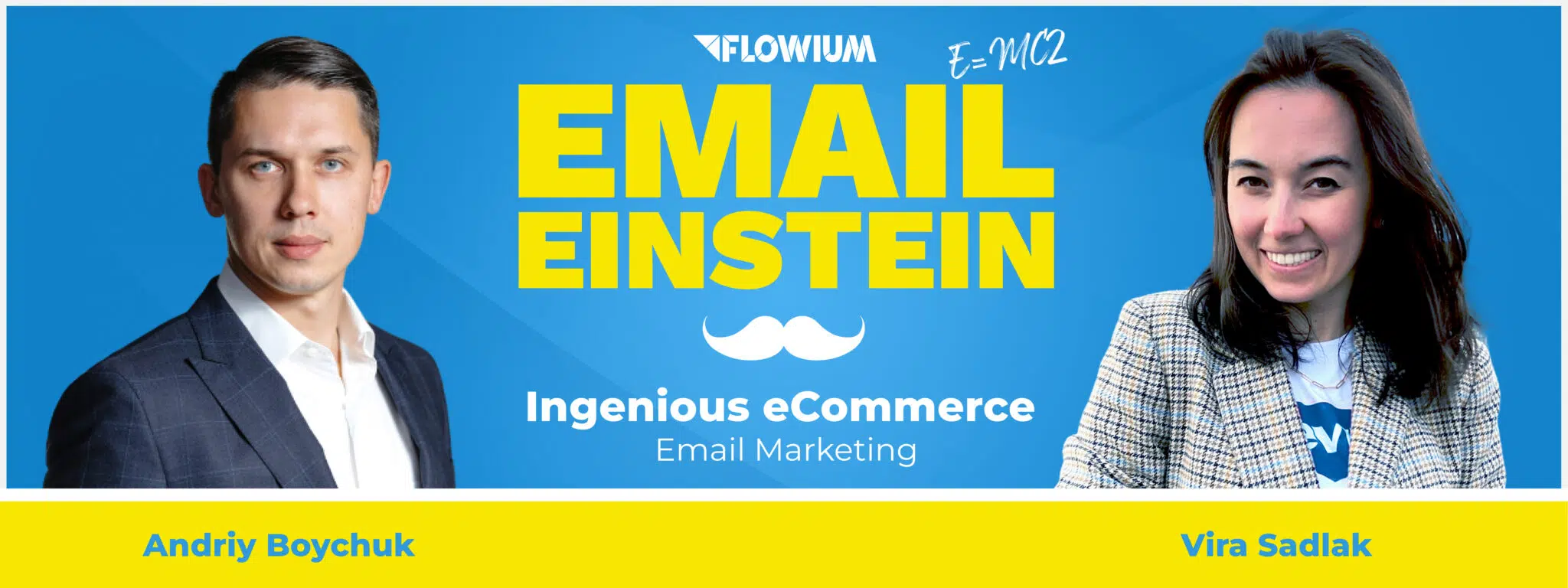
Hello everyone, and welcome back to Email Einstein, the podcast by Flowium. We are your hosts, Vira Sadlak and… And we’re happy to welcome you back to episode number 179, where we will be discussing the only 4 levers to grow and scale your e-commerce business. Andriy, it has been a trend recently to be giving some sort of like lists to our customers, right?
Andriy: 1:09
Maybe this is how my brain works as well. And since I’ve become a co-host of the show, probably I’m influencing the episode structure. By the way, I will not ask Vira how she is doing because we just recorded another episode and we know she just moved to London. So if you did not listen to the previous podcast, I strongly recommend disregard the 50 email mistake, but just check that episode to find out how Vira— yeah, how Vira moved to London.
Vira: 1:41
Yeah, I last, last week it was on Saturday and I was like entire day online because it was like a Black Friday Cyber Monday weekend. And I remember checking an email on the carousel in that like Christmas market, you know, just like to make sure that we’re good with everything. And like, it was like literally, no, I mean, everything went so smoothly this year. I didn’t want to jinx it, but we like literally didn’t have like one little like hiccup this year for my clients, which makes me like so happy because like, this is obviously the stakes are big.
Andriy: 2:12
I have to make a confession. A confession? How’s that?
Vira: 2:17
Confession. Yeah.
Andriy: 2:17
There’s one thing that I hate about our company at BofLomi and it’s like, It’s terrible to say, but I need to be, like, to be honest here and transparent.
Vira: 2:26
Yeah, I’m clean, Andriy. I’m clean. Exclusive content, you guys.
Andriy: 2:33
In our contract, we have that we, I mean, it’s flexible work hours, blah, blah, blah. You can take time off, just give us a heads up and so forth. But there’s a stipulation that you must be present in the week of Black Friday, Cyber Monday. And work on the weekends, and if it requires work on the weekends. And unfortunately, we cannot avoid this because we need to support, provide the best service ever for our clients. But unfortunately, I personally don’t like it. I hate it actually, like that stipulation. But since Black Friday happened on Friday and Cyber Monday on Monday, there’s no way to avoid it. We cannot be as a full team off on those during that period of time. But so, Vira, I just want to apologize for that.
Vira: 3:25
I don’t care about that. I’m from Canada. We had our Thanksgiving like a month ago, Andriy. Like, seriously.
Andriy: 3:31
Oh, okay.
Vira: 3:32
Okay.
Andriy: 3:32
So, yeah, but other people.
Vira: 3:33
Here’s the solution for you. Yeah.
Andriy: 3:35
Yeah. Go ahead.
Vira: 3:36
The solution for you, just like hire more Canadians because we celebrate our Thanksgiving at the beginning of—
Andriy: 3:41
But it’s not, it’s not about the holiday. It’s not about the holiday, but like to work, to force some people to work on Saturday, Sunday. This is the thing for me.
Vira: 3:51
I see. Well, anyways, thank you so much to our team who have been like absolute rock stars through this Black Friday, Cyber Monday season. Yeah. Every year I feel like it’s getting like easier and easier for us. Right. So the stakes are high for Black Friday, Cyber Monday weekend, but so much work is done like pre-Black Friday, Cyber Monday that the weekend itself normally goes super smoothly. But anyways, you guys, Going back to our topic, 4 levers to grow and scale ecommerce business. We’ve been in ecommerce for a while. I’ve been in ecommerce for like 8 years. You probably like more, Andriy. And over this period, we have studied like many ways of like increasing or like growing the businesses. And I think it was like your idea actually, or like your list of the items or the techniques that can be used to grow the business. You, nicely summarize them to 4 main things. What are they? What are these levers?
Andriy: 4:46
Sure. And before I list them, it’s not kind of my idea. I think it’s a, it’s a standard for, for e-commerce business.
Vira: 4:55
Right.
Andriy: 4:55
And actually for all businesses. But it’s so simple. Sometimes we either overcomplicate, we like think that we need like a million other things, different KPIs, different metrics. If you keep track only about those 4 metrics, trust me, you will see how your business either growing or declining. So, and by the way, how we call it, other people might have different name, you might have different name, but think about the concept. Concept is the same. So number one is lead generation, like list growth, how you are getting the new customer base, how you are growing the customer base. Second is the CRO, Conversion rate optimization, how you are converting those either web visitors into customers or some other action you want to, like, you want them to take. So how you are improving your CRO. Number 4, number 3 is AOV, average order value. How are you increasing the average order value? And number 4, increasing lifetime value of the customer. So those are 4 things. There are 4 levers you can pull to scale and increase your business. You can focus on them, on 4 of them, and do it in like altogether, or you can pick one and focus one by one.
Vira: 6:20
Right, yeah, I know you said it’s not your idea, but when I was like Googling this, like different, the only 4 levers you need to grow the ecommerce business, the lists were like super, super different. Like honestly, the people were offering like different strategies there, but basically it all comes down to like visitors times conversion rate times average order value times repeat customers rate. So this is like the only way to grow your business, basically. So let’s start from the basics, I guess, the lead gen/list growth. Why is this the key?
Andriy: 6:52
Before I give you the answer, I want to share a story. I mean, I read, I was subscribed to one of e-commerce, something like a newsletter, and they give an example of30millionstore.Let’ssayyouraverage30 million per year revenue store. So they spend, for example, for email marketing, their budget is approximately10,000amonth.Sothisistheirbudgetforagencyorinternalteam,they’respending10,000 a month. However, for media buying, their revenue, so10,000foremailmarketing,formediabuying,it’squarterofthemillion,so250,000. Hmm. So it shows you how much business care about attracting new customers, attracting new visitors, attracting new subscribers. All businesses spend, like no matter where in the world you ask any business owner, what do you need to grow your business? And probably in 95%, everybody will say, I need more customers. Yeah. Sometimes there might be more pressing issues like, oh, I have HR issues or I have chain supply issues. But at the end of the bottom line, everybody’s looking for more customers. Yes, you can continue selling to returning customers, but it’s not expendable. It’s not something you can scale. Lead gen, it would be the fuel to the business growth all the time.
Vira: 8:23
Yeah, I like your example because it puts everything like into perspective when you like assign real numbers to it, you know. But at the same time, I feel like it’s like the trap that many companies fall into assuming that more traffic like means only like growth. In reality, sales and traffic, they almost like never grow at the same rate, if you know what I mean. And that’s where the CRO, conversion rate optimization comes into place. This is like a super big topic too, because basically in reality, again, sales and traffic, they don’t grow at the same pace. And at some point you need to take a really good look and like critically analyze your website, critically analyze your entire customer journey, the product, and just like taking a super close look at your website. and the whole buying process your customer going through. And we are talking like digging deep and like analyzing stuff like how many times people click, where they come from, how they navigate your website. And like, I specifically talk about like email and website here, but basically CRO, it’s like it throws the guesswork out of that equation. And basically the numbers are showing, telling you, hey, like this needs fixing, this item needs fixing. It’s like navigating a trusty guide that helps you make smart moves based on like real facts. And that’s what I like about the CRO. Yeah.
Andriy: 9:50
And nowadays it’s so easier to improve your conversion rate optimization. When we talk about conversion, you need to understand people use conversion for different things. Somebody, once they say about conversion, they’re talking from web visitor to customer. Somebody says from web visitor to email subscribers. In our case, I mean, we talk in general, but now I want to focus, let’s say, web visitor to email subscriber. Because it’s easier to convert them from email subscriber to a customer because we are customizing the journey via emails. So nowadays with different email service providers like Klaviyo, SendLane, ActiveCampaign, it’s extremely easy to test and split test the pop-ups, forms embedded for flyout forms. So you can do it almost on like monthly basis, on weekly basis. If it’s not performing, you can update it. The good conversion rate from web visitor to email subscribers is around 4.5%. However, we recently created the course, not sure if it would be live on YouTube. It’s 100% free course, but it’s called retention.com Mastery where we use one of our partner retention.com and we had Adam, CEO of retention.com, and we recorded how to use it and how to increase that 4.5% from web visitor to email subscriber to 15, 20, and even more conversion rate for email subscribers. So strongly recommend for you to check it out. It’s 100% free. It’s on YouTube. Just check it out. And also we have a case study, some case studies for our clients.
Vira: 11:32
No. Yeah, I’m sure it’s going to be, it’s going to be really insightful, this course. And I mean, we like internally we are using like different methods of like collecting the data for optimization. One that I particularly like and it is specifically for the customer journey side of things. We do this like user testing experience where we basically, when we first start working with the client, we just go through the entire purchasing process of the product. We record our screens, we provide feedback so the client can see where people click, where they like scroll. Is their entire process intuitive? Is it easy to navigate? Is it hard to see through the eyes of— Because it’s like very often it’s like very hard for you as a business owner to see it as a, as a user because you’ve been working with that website for so long, right? A/B tests are great. Just like Andriy mentioned, there’s like a ton of technology or like ton of possibilities of doing like A/B testing in Klaviyo and I’m sure in like Mailchimp and other platforms as well. The heat maps are huge. The heat maps for the websites and for the emails as well. But for the websites, the heat maps specifically show you where people click, scroll, how they evaluate your site, like helping you as a business to understand visitors’ engagement. And this knowledge helps you to better align your future actions with the website. And of course, like Google Analytics for basic data. This includes like any data from Google Analytics so you can better understand how much traffic you’re getting, where this traffic is coming from, how people are acting with your website and stuff like that. So you’re not just counting visitors, but you’re also figuring out what really matters. To your visitor. So yeah. Cool. Okay, Andriy, AOV. Why? Oh yeah, go ahead.
Andriy: 14:15
Yeah, I mean, sorry I interrupted Vira and I’m like, I hate when I do this to people, but I need to be more patient and listen more. AOVs. So the fact is 80%, sometimes more, sometimes less, but around 80% of all of your customers will be one-time customers. So they will never purchase from you second time. It’s a big issue in the retail e-commerce space. However, so what we can do here is to increase average order value. So it means the first-time buyer, if they buy with you one time, if you work on improving your average order value, they will spend more with you. And there’s a lot of different strategies we can discuss about, but it’s not the purpose of this episode. However, we have a podcast episode that we already recorded and featured. It’s 12 strategies how to improve your average order value where we went with Vira in depth into those strategies. So check those strategies. And I don’t want to like talk much about on this episode about that, but it’s extremely important and it’s extremely important lever to pull if you want to scale your business.
Vira: 15:31
Right. And obviously the next one is kind of big too. The biggest one I think is the customer lifetime value. And what I didn’t realize, well, first of all, it is one of the most important metrics that you can use as a business to determine the health of your business. But you can also use that data or that metric to make better decisions in terms of pricing your products, pricing your services, in terms of understanding customer behavior and stuff like that. What is customer lifetime value? This is basically the measurement that estimates how much money you will earn from each customer over the entire period of them being a customer. What I didn’t understand about this before I started getting deeper into of the metrics, it is important to understand that CLV, the customer lifetime value, does not represent the total amount of money a person has spent with you. It’s rather than like estimate or like prediction of what they might spend in the future over their lifetime as a customer. But customer lifetime is obviously very important. The bigger the customer lifetime value, the higher your revenue as a business is. It also affects your bottom line of your acquisition costs. But also if you like understand this metric really well, it can help you to increase your customers’ loyalty and retention and end up with happier customers at the end of the day.
Andriy: 17:00
Yeah.
Vira: 17:00
And do you have anything to add?
Andriy: 17:01
Sure. I mean, in general, we’re planning to record a special, like dedicated episode talking about lifetime value, about strategies, how to increase it. We’re helping our clients increasing lifetime value for years. By the way, one shout out I want to do, it’s, we are not partners with them yet, but it’s in the process. There’s a tool called FundYou. It was recently purchased by Postscript, the SMS provider. So this, what this tool does, and I think it’s genius because this is especially for those not discount brands. So what does it do is instead of giving you discount, they are giving you store credit and you might think like, It’s the same thing, like $20 or 10% off or 10% store credit is the same thing. No, but it’s not because store credit will require them to go back to your brand and buy from your brand versus competitors. Even when you give them 10% off and they might be done for you forever. But when you get the store credits, it’s like kind of you chain the customer to your brand.
Vira: 18:13
Yeah, it’s just like a psychology, right? So this store credit— Can I like collect them? Say I like—
Andriy: 18:18
Yes, yes, yes.
Vira: 18:20
So at the end I can get like 100% off the product if I like collect enough store credits or whatever, right?
Andriy: 18:28
I don’t have all the details, but it sounds right to me. So it’s perfect to customers like you. I know you love like Starbucks loyalty program. You love the McDonald’s loyalty program.
Vira: 18:40
I love loyalty programs.
Andriy: 18:41
Yeah, it’s not loyalty. loyalty program, but it’s similar, but it’s giving you store credit, which is, I personally believe, it’s amazing. We have not tested yet, but we should, and we’ll probably report in the future the results of our tests.
Vira: 18:58
There is a similar app to this one, and I’m pretty sure we’re not partners with them either, but it’s more based on like referrals through social media. It’s called Social Snowball. I’m not sure if you’ve heard about them or not, but basically there are like 2 ways of like making this rewards, you can either get an actual cash. This is how like brands are getting the ambassadors for themselves or like, and cash, like an actual cash, not just like the store cash, but the real cash. Or you can get a store credit and there are like different customer journeys that, that you can use. Actually, one of my clients is using that thing. So I’m just like starting to learn about this app, but it sounds pretty cool. So yeah. Cool. So here you have it, guys, the only 4 levers that you need to grow your business. And I’m sure we will talk about each and every one of them like in depth moving forward. But just like to summarize everything, lead gen, CRO, conversion rate optimization, AOV, increasing your average order value and improving your lifetime value of your customers, improving your LTV. Here you have it. Awesome. Short and sweet. Well,
Andriy: 20:08
and just make sure, make sure to go to our YouTube channel and check out that retention.com master course. It was created for you. It was created to help you to add your value. Like it’s 100% free and check it out as well as go to flowium.com/whatsapp and join our podcast community chat where we discussing the next next topics. You can suggest your own topic. You can provide the feedback. You can say that my dad’s jokes are bad and I will stop doing them, or maybe I I will not. So but still you can provide any kind of feedback, but just be polite to Vira.
Vira: 20:47
We need to do, we need to do the voting there, you know, more dad jokes or less dad jokes. I’m going to be in more group probably because I do appreciate a good dad joke.
Andriy: 20:56
That’s the bad thing about WhatsApp communities. The poll is not available yet.
Vira: 21:02
What a bummer.
Andriy: 21:03
Yeah, we’ll figure a way.
Vira: 21:05
We’ll figure a way. Yeah. A way to do that. Awesome. Well, thank you so much, you guys. Definitely come back next week because next week we will be talking about all of the exciting upcoming trends in e-commerce world for the year 2024. And if you have some e-commerce trends that you specifically want us to like feature in this episode, please drop them into that WhatsApp channel as well. Thank you so much and enjoy the rest of your week. Take care.

Vira Sadlak
Podcast host, marketer, traveller and a life lover from Vancouver, Canada

Andriy Boychuk
Andriy is an Email Marketing Consultant and CEO of Flowium