

Podcast Transcript
Vira: 0:41
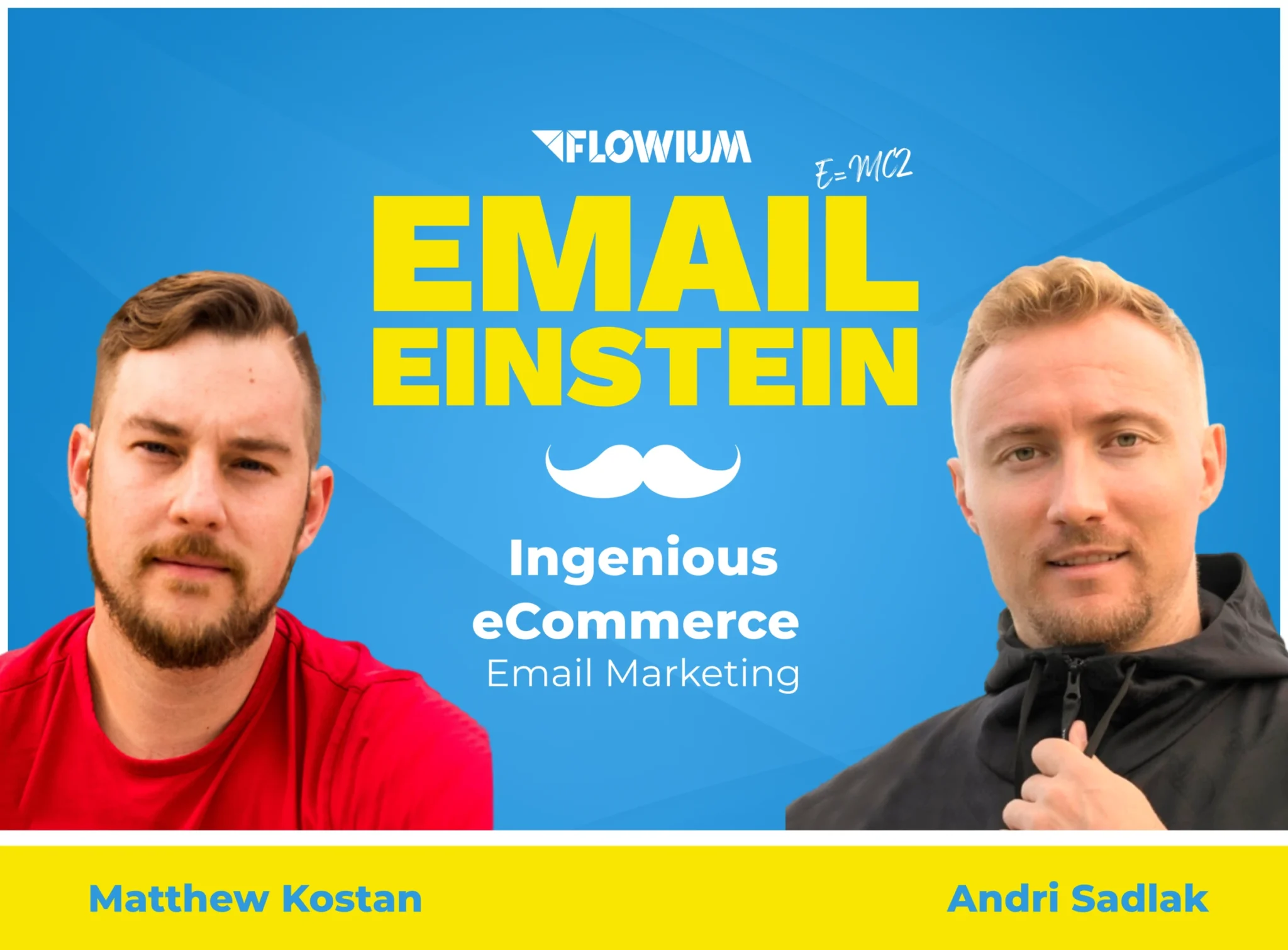
Hello, hello everyone, and welcome back to Email Einstein. I’m your host, Vira Sadlak, and this is the podcast by the agency called Flowium. Here at Flowium, we are very passionate about email marketing. Obviously, that’s what we do. And because we love what we do, we want to share our ecommerce and email marketing insights with you. Delivering the right message to the right person at the right moment. That’s what we are here about. And today we’re kind of talking in depth about that delivering message to the right person at the right moment thing. Quick intro, guys. As an ecommerce retailer, you probably know that there are no small decisions in ecommerce. And you have to dig into the analytics and be very granular with all of the details to get some information you need to make a data-driven decision. And here’s actually the fun statistic that I read, and I didn’t realize it was true. The challenge in the industry right now is too much data and not enough insights. And according to a report by Forrester called Data Literacy Matters, 90% of global data and analytics decision makers, they actually focus on prioritizing data insights in business decisions making. The interesting thing is that the same report indicates that 90% of organizations, they actually struggle with understanding the data and improving and getting that insights and improving their sort of business processes or business stuff based on those insights. So today we will be talking with 2 amazing people from the product called ProductPinion, Matt and Andri. And we will be talking about utilizing the right combination of data solution when merchants can basically generate insights to allow them make correct data-driven decisions and create customer experience that actually help their business grow. That’s a long intro, definitely. Matt and Andri, say hi.
Matt: 2:34
How’s it going?
Andri: 2:35
Hi, thanks for having us.
Vira: 2:36
I’m excited to have you here, guys.
Andri: 2:39
Absolutely.
Vira: 2:39
I know you both really well, so that’s going to be an interesting podcast. By the way, guys, for those of you who are listening and who noticed Andri’s last name, it’s Sadlak. And no, he’s not my sibling. That’s actually my husband and his business partner who started this amazing tool called ProductPinion. And we will talk about it in a bit. Okay. No more talking on my end. Say hi guys. How are you doing? We’re so excited to have you here.
Matt: 3:09
Good. Good. Yeah, no, right on. And I love what you said in the intro there, like people and businesses in general are suffering from too much data and not enough insight and like actionable insight to do stuff. So Yeah, I’m hoping to chat about that today and, you know, even go over some of the insights that we’ve seen that, you know, can help move the needle.
Vira: 3:29
Totally, totally.
Andri: 3:30
Yeah, 100%. For me, data, data that we are focusing on is basically collecting people’s opinions, actual focus groups’ thoughts on your business. And that’s actually the data that matters the most.
Vira: 3:44
Definitely, definitely. We’ll definitely talk about it. Before we go there, before we go to all of the serious juicy questions, let’s do a quick this or that game. Like Q&A, just like to get to know you better.
Andri: 3:56
Okay, let’s do this.
Vira: 3:57
Cool. Matt. Matt, shopping online or shopping offline?
Matt: 4:01
Oh, online, 10,000%. What is offline shopping?
Vira: 4:07
I mean, for me it’s Costco and we just talk about it. We’re both avid Costco fans.
Matt: 4:13
Groceries at Costco. But yeah, 99% online.
Vira: 4:16
As my friend says, I’m at that age where I purchase my grocery and my clothing at the same place. Like, that’s me, this girl. Cool. Okay. Andri, sorting by price or by rating?
Andri: 4:29
Price first, then by rating.
Vira: 4:31
Okay.
Matt: 4:32
But do you sort from highest to lowest or lowest to highest?
Andri: 4:35
Lowest to highest. And then I try to find the best deal.
Vira: 4:38
It’s like it’s Ukrainian in him. We’re always trying to find the best deals.
Matt: 4:42
I have a joke with my sister that she sorts it high to low.
Vira: 4:47
That’s an interesting approach. That’s a very interesting approach. I’ve never done it. Maybe I should try it as well. Cool. Okay, Matt, physical books or e-readers?
Matt: 4:58
So e-readers, but I like, I appreciate a physical book.
Vira: 5:01
Same, same. Okay, Andri, Amazon or Shopify?
Andri: 5:06
Amazon for me only because I know it better. Long term, you need Shopify though.
Vira: 5:11
Only because Amazon bought us a house.
Andri: 5:13
Pretty much.
Vira: 5:14
I’m joking. But yeah, we’ll talk about it in depth about like Amazon side of business, of your business and like Shopify side of your business in this podcast, definitely. Matt, I’m curious to hear the next answer. Instagram or Twitter?
Matt: 5:29
You know what? I’m not a big social media guy, but it’s— ooh, this is a tough one. So I think I prefer Instagram, but I have more followers on Twitter. Okay.
Vira: 5:40
Interesting. Okay, Andri, ChatGPT, yay or nay?
Andri: 5:45
Yay. Definitely an improvement, but basically to any business if you can utilize it well.
Vira: 5:52
Okay, awesome. Matt, if you had one song playing every time you entered the room, what would it be?
Matt: 5:58
Okay, so Fall Out Boy. What’s the name? I can’t remember. So someone played the song as an intro just before I came onto a podcast. It’s like, You’ll Remember Me. I think that’s the name of the song. For centuries. Fall Out Boy Century. That’s the song.
Vira: 6:16
Okay, cool. Next time you’re going to be on this podcast, I’m going to play that song for you.
Andri: 6:20
Sweet.
Matt: 6:20
Or we could edit it in post. Cool.
Vira: 6:24
Yeah, sure. Definitely. Definitely. Okay, guys, let’s go back to the basics. ProductPinion. Explain what it is, what you guys do, and is ProductPinion some sort of like a split testing tool, or is it like a data gathering platform? What is ProductPinion?
Matt: 6:41
Yeah, so basically ProductPinion came to be just as a need as an ecommerce seller myself. So I’ve done Kickstarters in the past. I love getting people’s opinions. I love being able to kind of create something with the advice of a community, because then your chances of success are that much higher. So in a nutshell, Product Pinion is a full market research platform to get your creative ideas in front of people and figure out what’s going to sell, avoid those mistakes, and increase your chances of success. And not just data for the sake of data. Like we talked earlier in the intro, you’re getting actionable advice of knowing like, Which decision to make, because the faster you can make decisions and the faster you can make the better decisions or correct decisions, the faster you’ll grow the business.
Vira: 7:29
Cool. So in other words, how do you guys do that?
Andri: 7:33
Yeah, exactly. That’s how we do it. So it’s shopper interviews. So focus groups kind of interviews and a split testing tool all in one.
Vira: 7:42
So basically, in a way, it’s like a polling software that enables you to get the access to the audience that you like don’t even necessarily have access to, per se?
Matt: 7:55
Yeah, so we have over 20,000 shoppers and basically you can ask them quick questions to get quantitative feedback, but then you can also like almost interview them and get screencast recordings of them looking at your Shopify website, asking them 3 questions, and then they’ll be thinking out loud and you’ll actually get to hear them, you know, as they speak out loud answering your questions, as they go over your Shopify site and tell you, What’s wrong, what could be improved, or any questions you can think of.
Andri: 8:25
Mind you, they are paid to be brutally honest, and you can watch them shop as they are brutally honest about your Shopify site.
Vira: 8:32
That’s interesting. So who are these people? Like, why do they take part in this, like, experiments and stuff? Like, who are these people, and how can I be sure that this audience that you guys provide will match the audience that my brand serves?
Matt: 8:49
Yeah, so I mean, the people are like everyone and anyone. So having such a big diverse group of people, we have a wide range of demographics. They enjoy— I mean, I don’t know about you, but I mean, I love giving my opinion. If someone asks me what I think, hey, it’s a chance to talk, I’m gonna talk. I want to give you my 2 cents, my 3 cents, that sort of thing. On the platform itself, we have some things built in. So for example, Yeah, if you just so happen to get not the greatest responses, you know, we can remove people from the platform. If people give great responses, they get a bonus. And as Andri mentioned too, yeah, like they’re paid to do this. So they have a, you know, they have the reason why they want to do that too. But most importantly, like people love giving their opinions and they like helping out.
Vira: 9:39
Cool. So how does the process look like? Walk me through the process so our listeners can understand. what this tool like actually does and what benefits it can bring them. For example, I’m the Shopify store owner and I want to test, I don’t know, like 2 variations of the product to launch or like 2 different copies on my product listing. What do I do next?
Matt: 10:07
Yeah, so there’s a few, a few ways to tackle it. So with product opinion, there’s 2 main types of tests. So one is the qualitative where you’re kind of like interviewing shoppers, And the next one is where you’re testing options. So if it’s your Shopify store and say you want to figure out like, are there anything better or extra you can do to increase conversions? You can set up a test where you give your Shopify URL and you ask 3 questions. One I really like is, you know, do you trust the brand? Why or why not? And they’ll record a video as they go to your Shopify site or any URL that you like. And they’ll speak out loud and be like, oh no, I don’t really trust it because of, you know, ABC, that sort of thing. Another thing you can do is also put in, say, a competitor’s website. So something we did recently, we used the Chubbies website as just as an example. And we wanted to figure out, you know, why is it that Chubbies is amazing, right? It’s a shorts clothing company for those that don’t know. I mean, they do more than shorts, but that’s how they started. And, you know, one of the big things that people commented on or spoke about was they love how they know exactly what the company stands for right on that homepage.
Vira: 11:19
Mm-hmm.
Matt: 11:19
So they have this section that says, we believe, we believe, you know, short shorts is a redundancy, and all that fun stuff. And it gives them a very, like, understanding of the brand. And if it’s something that, more importantly, they’re not, I mean, you can buy shorts anywhere, but, you know, with Chubbies, you’re buying into the brand promise and having that brand promise front and center is one of the takeaways that, you know, after looking at how people shop on Shopify, that’s something I would do for my store too.
Vira: 11:48
Interesting.
Andri: 11:48
Yeah, that’s a good example, ’cause I feel like a lot of brands miss that point of aligning their visitors with the mission of the brand. And what exactly people care about is something you can definitely split test. And the easiest way is not to show, hey, do you prefer if our mission statement says A versus B, But you’d rather want to see them look at the website and speak out loud what they think, answer your questions, and kind of free flow, just like you would interview someone over coffee.
Vira: 12:21
Yeah. Yeah. One thing that was always sort of like interesting to me regarding the tools like Product Pinion is that when you’re running like a traditional A/B test or split test, say, on Klaviyo, or on Amazon, shoppers are not necessarily aware that their behavior is being monitored. But in this case, people do realize that you are expecting some sort of like feedback from them. And they basically know that they are being monitored. Do you think this may affect their decision?
Matt: 12:59
Yeah, I mean, so, and keep in mind testing on Klaviyo, you should do it 100%. Like even with productpinion. The idea behind ProductPinion is you’re almost qualifying your test options before they go to Klaviyo because you wanna make sure what you’re split testing, what you’re A/B testing is worth the test because testing can take a lot of time, energy, and money. So ProductPinion is able to do that. So it’s a— you’re right, like it’s a different mechanism of asking for feedback and maybe it’s a different Yeah, it’s a different methodology, but I think it goes hand in hand. And regardless if they know they’re being tested or not, the end result is using both tools, you’re gonna get a better inclination of what’s gonna be more successful.
Andri: 13:46
Yeah, in other words, it’s a fast tempo testing. If you want to make a decision, educated decision really fast within sometimes minutes, sometimes hours, depending on the demographic you choose, then Product Pain is the way to go. Say you have 2 options you want to split test with Klaviyo. Instead of you having one good one and one bad one, You’d rather have one good one and one and even better, and you’re not sure which one’s better, but you know they’re both good because you split tested multiple of these options before with product opinion. And now we can have higher chance of success with the two that you selected for the split test with Klaviyo.
Vira: 14:20
Yeah, yeah, that’s interesting. And also, like for those of you guys, I know a lot of you listeners, they you guys use Klaviyo as your prime platform for email marketing, and you know that there are like two types of sort of like testing. There is like A/B test, and there is split. Test. And with A/B tests, you’re kind of testing more like design features or the copy features or offer, and you get immediate results. But when I say immediate results, it’s still like 5 days because the attribution window for any email is like 5 days. When you’re testing customer journeys, so like this time delay or that time delay or 2 emails versus 3 emails, that process can take up to months or a few months even if you’re a small account. So what I like about tools like ProductPinion is that it kind of gives you access to the audience even when you don’t necessarily have it yet, or even if you are just like targeting something else.
Andri: 15:21
Or when you expand, sometimes you can expand into an audience that you don’t have yet. Say you’re selling shorts to men, but maybe you want to launch a bikini line and all of your email list is men buying shorts, right? So you can easily access an audience of women of certain age, certain income, certain interests. Say they like certain exercises and we have those kind of interests and behaviors, lifestyle kind of breakdown in the audiences and ask their opinion. And when they tell you, say a few hundred people tell you, oh, I prefer A versus B and C, or they speak out loud, record their screen in the user experience testing, they explain what matters to them, It makes it easier for you to build that product or optimize that product page or whatever it is you’re working on for that new audience that you haven’t served before.
Vira: 16:12
And that like screen recording thing, I’ve used this type of tools before in the past, but I’ve never seen the video recording thing. Is that like a feature that is unique to ProductPinion? Like, is that what makes you guys different? Like, what is this feature first of all? And why does it matter?
Matt: 16:29
Yeah, so the screen recording thing is kind of— so it gives you more context. So it’s not necessarily unique to product opinions. So a lot of software developers will use user testing to see how people actually interact with the software. So if they get stuck and that sort of thing.
Vira: 16:43
Mm-hmm.
Matt: 16:43
But what’s really nice seeing the screen is, you know, I mean, you could also be testing— I mean, the beauty of Shopify is that you could have any theme under the sun, but— and most themes follow certain patterns and that sort of thing, but you can actually uncover actual like roadblocks in certain themes too, or anything confusing with it. So having the screen there gives you a better understanding of what they’re seeing, but then also gives you that context around, yeah, like how to make it better. So more like actionable insights with it.
Vira: 17:14
That’s so cool.
Andri: 17:15
Yeah, I have a good example for that too. We had one of the clients test their eye cleanser product, and only after watching a few videos of people commenting on the options they see online, we realized that a lot of people choose a vegan option, something that has vegan in title, which again, eye cleanser is not food. It’s not even clothing that can include animal products. It’s eye cleanser, right? But products with vegan in the title were getting more conversion and stuff like that. You can’t research by researching keywords or looking at sales data, whether like more people click on this because of this. You can only get this information from hearing people speak out loud. Hey, I like that. it’s vegan and cruelty-free or whatever it is. I would choose this option first of all. And if everything else lines up, I’m buying this because I care.
Vira: 18:08
That’s a really cool example. I love it. I love it. Let’s talk more about like the Shopify side of business. Majority of our listeners are Shopify plus Klaviyo combo people. So what are the components of high-converting Shopify, first of all? And what are the main things you should be testing on, say, your like Shopify product pages on your Shopify store? And then we can definitely talk about Klaviyo as well.
Matt: 19:25
Yeah, totally. So, I mean, number one, I mean, even though it’s, you know, obviously Shopify website and there’s lots of things you could test there, I still think your subject lines for any Shopify store, for your email subject lines are your number one. If my bet is most revenue is driven by the emails you send out, so it’s like the 80/20 rule. I would spend like 80% of my effort working on what’s gonna produce the most results. So, and I would say like 20% of, you know, working in email probably produces 80% of your sales, right? So, and in terms of subject lines, what you can do, say for example, with Product Pinion is actually, so we talked about the video kind of qualitative testing thing, but you can also do the A/B kind of quick feedback on different creative ideas. So you could actually put in, you know, a few subject line ideas send it off to like 100 people and get fast feedback on which subject line option is the better one. Once you have that knowledge, you can then plug it into Klaviyo and then actually run the proper split test there where you’re, you know, you’re sending a sub-portion to another audience, or so you’re sending a portion of it to an audience and then figuring out which one, you know, converts better or gets the most open rates and that sort of thing. So I think number one actually is still your email subject line for testing.
Vira: 21:21
Okay, cool. And since we started talking about the audiences, so I know I can work with an audience that I sort of like don’t have, but you can provide that audience for me to get that data. But what if I already have my Klaviyo sort of like list? What if I have my audience and I want to ask them like, what do you guys like? Do you like A or B? B, do you want this product or that product? Do you prefer this sort of like image or that image? What product do you want us to launch next? What happens then?
Matt: 21:55
Totally. Yeah. So this is like a really cool feature and it’s fairly unique as well where you can actually ask your own audience for the options as well. So if you’re looking to create or launch a new variation, a new product, you can send these polls using Klaviyo because it’s just a link. And not only will you be getting, you know, customers’ feedback, which is worth its weight in gold, we also have a feature where after they complete the survey, you can send them to a page with an offer or a discount. So now your polls are now making you money, which is incredible. Plus you’re building that relationship with your audience. People love to be feeling a part of something. And if you’re not using your audience to help build your products, your brand, and not— and if you’re not involving them in the choices you make, you’re really doing yourself a disservice because that’s building that loyalty and that’s building up the feeling of them being a part of your journey, a part of the business journey, and no competitor could ever take that away. So I would 100% recommend, even if you’re not using Product Pinion, like definitely involve your audience for creation and being a part of the whole the whole journey for sure.
Andri: 23:08
Yeah. To add to that from my own experience, so the first business that I built, the brand that I sold recently, was in the home decor travel-related space. Basically, one of the product lines was scratch-off maps. So these maps where you scratch off where you’ve been, and I have continuously been improving the world map and fully designed the national parks map for the USA with my community. And the fact that I was asking their opinions, and in my case that was a Facebook community, Facebook group, and I would message them, I would ask specific people certain things based on what I know about them, kind of build that relationship over time, led to me launching that product successfully. And not only the product was designed super well with all the features, all the design elements that matter to my customers, and later I could see that my competition was just copying straight up the design because it was so good, but also people were so involved in designing it with me that they became fans. It became part of them. They would speak about that product to their friends. They would go and buy it, and I don’t even need to ask them to leave a review because they’re co-creators of that, right? So it matters a lot emotionally for the community building perspective. But what’s cool technically when you do something like that with ProductPinion, which makes it way easier than messaging everybody in your Facebook group, hey, I need your opinion, is in the results of that test, you can sort it by the audience of ProductPinion. So the generic Amazon customers, online shoppers versus the audience you have. So if you send an email list with that link to that poll and they vote, you can see whether your audience opinion is different from the target audience you preselected from our audience.
Vira: 24:49
Okay. So you can sort of like tell, tell them apart. You can say like, these are like my people that I brought from like Klaviyo or whatever, the list that I’ve uploaded. And these are the audience that I got through ProductPinion. Okay, I see.
Andri: 25:03
Exactly.
Vira: 25:04
So like another like sort of like a benefit that I personally liked, and I watched you guys do this pulse like multiple times, but it’s the ability to sort of like compare your product, your PDP, your product page, or your business to a competitor or category leader. It’s like really easy to see it on Amazon, but is that something something you can do on Shopify? Can you actually like match your product directly against the product of your competitors to sort of like hear the honest feedback along with voting to discover what you’re doing well and what can be improved?
Matt: 25:44
For example, I mean, with Shopify, obviously, everyone’s site is almost standalone. But you can do something like, so for example, if someone’s searching for a particular category of product, and they might be searching through different Shopify stores, say on Google Shopping. So if they’re Googling a product, they show a bunch of different products there. You could test that because it’s as simple as putting in any URL. So if you wanted to see a comparison between other Shopify sites, you could do it that way. You could also instruct the people to, hey, like go to this webpage and then go to this one, let me know what you think, that sort of thing. And you could also, for example, grab like a competitor’s, say, main image of their best-selling product, have yours as well, and then do one of those A/B tests to see, yeah, like which one is a preference. And keep in mind too, what we didn’t mention is not only do people select an option, they’ll also tell you why too. They’ll write out a couple sentences on why they chose what they chose. So you’re also getting some qualitative feedback that way as well.
Andri: 26:56
Yeah, the why is very important to understand.
Vira: 26:58
And they’re not just like writing it, they can also like record the video too, I think, with their actual feedback, right? Because that’s what we’ve done for our brand that me and Andriy launched recently. Like back in the day, we had this, we sent the traffic to Amazon asking them like, what stands out? Like what sort of like packaging do you like the most? Why you pick that packaging and not that packaging? And people were actually giving us really good insights that we didn’t even think about because we worked with that brand for so long. It’s like our baby. We’ve been dealing with it for like months, almost a year now. And we can’t necessarily see the things just because we are so working so closely with it.
Matt: 27:44
Yeah, it’s something called the curse of knowledge. So no matter if you’re like, you know, you have your own products or you’re even just reselling products on your own Shopify store, It’s your baby, and you see it so often that you develop these blinders of being able to see it critically. So what’s so important with a tool like product opinion, or I mean any you know getting any kind of third-party feedback, is that fresh pair of eyes. Like you know what’s going on? How can I make things things better? Because yeah, unfortunately, as a brand owner, you it’s it’s two things. It’s one you just you don’t see it anymore. Things kind of just. go out the window. But then also, it is your baby, it’s your creation, so you’re less likely to be as critical about it.
Andri: 28:31
Yeah, I would summarize this with this famous saying, you don’t know what you don’t know. So, it’s always great to hear somebody else’s opinion and ideally your preferred customer’s opinion. And I think the example you brought up here is a very good one, even for those who never consider selling on Amazon, but you’re thinking of launching a product, and it is available on Amazon and you’re gonna launch it on your Shopify site, I would still create that user experience campaign to collect that qualitative feedback from people watching, not watching, but searching through Amazon results for that particular product and telling you which ones they would click on and why and what matters to them. And then I would have them click on a few and explain whether they’d buy it or not and why not. And that way you can design a product that would be competitive even on Amazon. Because realistically, people just look for certain things in certain products. And if you select the right demographic that matches with your ideal customer, whatever they tell you they’re looking at available options on the marketplace will apply to ideal product design or product offering on your own website.
Vira: 29:40
Cool. What are the, what are the common mistakes that you guys are seeing across the industry when people are running a productpinion poll?
Matt: 29:50
Yeah, so one of the bigger ones is there’s a thing called statistical significance where basically it’s a measure of how likely was this result due to chance, or if you repeated it, how likely is it an actual winner. So basically, if you say like, you know, it’s a 90% statistical significance, it means that there’s only a 10% chance that this result was due to luck, and 90%, if you repeated it, you’d get the same result. So, I think a lot of people, I mean, not everyone is into stats, right? So, people don’t necessarily understand that that’s the case, that you have to have enough people actually doing the poll to make sure that the results aren’t just by luck. As a general rule of thumb, what we like to say too is like, if you’re in science, you know, you want 99% like accuracy, right?
Vira: 30:43
Yeah.
Matt: 30:43
But we’re in marketing. So, marketing, you can get away with, you know, 85%, Looks like it’s the better option, you can go for it. So something to keep in mind. And with the polls, yeah, people don’t sometimes don’t put enough, ask enough people. And as a general rule of thumb, we say like at least 50 people per choice. So if you have 2 choices, that’s 100 people.
Vira: 31:07
Okay.
Matt: 31:08
And it just obviously goes up from there. But what we did recently too, as a feature, you can always add extra people even after your poll is complete. So if you find yourself in that position, you can always fix it by adding more people to that poll too.
Vira: 31:24
Right, right. And I kind of like that for anyone who doesn’t yet get a ton of traffic to their ecommerce website, or they don’t have like a ton of emails, they still can get like results in like minutes or hours, even without having that audience yet. That’s, that’s kind of cool. Yeah.
Matt: 31:41
I was gonna say too, like, again, love Klaviyo’s split testing tools, and you should do it. But if you’re blindly or A/B testing without knowing that those are the right things to be testing, you’re missing out. So for example, if you have an email list of 1,000, the only way to know which A/B, say subject line gets the most opens is by sending the bad version to like 20%, like 200 people are gonna get the bad version. Yeah, don’t do that. Like André said before, you know, send— the better option versus the best option and give yourself that leg up before you even get into the testing with Klaviyo.
Vira: 32:22
Yeah. Yeah. And I mean, traditional split tests, they just like you said, Matt, they are great and you should 100% use them and split test and A/B test. It’s just sometimes they can take days or weeks to complete in Klaviyo. So it’s good to know what should be A/B tested Before you actually start A/B testing the 2 versions. So—
Andri: 32:49
Yeah, basically reducing the risk of wrecking the relationship with your email list and maximizing the chances of pleasing both audiences that you send different options to.
Vira: 33:01
That’s true. That’s true.
Matt: 33:02
And for most polls, like, I actually just did one about an hour ago before we hopped on here. And within minutes, right, within like, within like 3 to 4 minutes, there was enough people that did the poll that gave us a statistically significant result. So it’s kind of cool that you can basically unearth any— you basically get an answer to any question in minutes.
Vira: 33:27
Mm-hmm.
Matt: 33:27
So when you have that power as a, as a, I mean, never even mind, you know, ecommerce, or just as a, as a business owner, That’s the kind of power that is fun to have. It can get you some pretty cool results.
Vira: 33:42
Yeah, definitely. And there’s also no risk of losing sales if the new variant, say, performs worse than the original, right? Because that unfortunately happened to us before when you sort of like you have something in mind and you create this amazing version of the email, you spend like days creating that like new version and it surprise, surprise performs worse than the original ones, which is always heartbreaking. breaking, but I mean, it is the nature of the beast. Yeah. Cool. Well, guys, thank you so much. Thank you so much for answering all of those questions. If people want to learn more about your tool or about what you do, where should they go?
Matt: 34:22
Yeah, so productpinion.com. Feel free to sign up for a— for— we have a free trial, so you’ll get some credits to play with. And if you book a call with us, you can do that after you’ve signed up for the free trial. We can guarantee that we’ll, you know, we’ll help you with your first test and we’ll get you a winner. Like if you’re testing on something that you’re currently using and you want something that will perform better, we’ll work with you to get you a winner, make sure that you’re happy and make sure that you’re on the right track.
Andri: 34:54
Yeah, and we’re on all social media as well. It’s easy to find me and Matt online. I’m happy to answer questions anytime whenever available. And just as a summary, if you’ve never split tested outside of Klaviyo, outside of Shopify, we can pretty much guarantee you that you’re gonna make more money once you start, especially in the beginning. First few tests can make a big difference.
Vira: 35:18
Yeah, thank you so much, you guys. All of the links that we mentioned in this episode, all of the links that Matt or Andriy mentioned, they will be linked in the description box. So just like scroll there, Go to their website, play with that tool. It’s pretty impressive. I used it a lot of times. I’m not affiliated with them or anything. I just love what you guys do. No, not at all. And I’m like married to this guy, but whatever. But no, honestly, I do like what you do and I think this tool is very powerful, especially when you combine it with Klaviyo’s native A/B testing and split testing technology. Which is so cool. Okay. Awesome.
Matt: 36:02
Thank you for having us.
Andri: 36:03
Appreciate it so much. Thank you.
Vira: 36:05
Thank you for coming. It was really fun talking to you guys. We hope to have you back here one day again.
Andri: 36:10
Likewise.
Matt: 36:10
Sounds good.
Andri: 36:11
Thank you.
Vira: 36:12
Thank you. Take care. Bye.

Vira Sadlak
Podcast host, marketer, traveller and a life lover from Vancouver, Canada